
NIL
Bill Connelly's book looks at college football's future


-

Bill Connelly
Editor’s note: On Sept. 2, ESPN writer Bill Connelly’s book “Forward Progress: The Definitive Guide to the Future of College Football” will be released. This edited excerpt looks at whether the sport needs central leadership like professional leagues.
In 1920, professional baseball was in crisis. The Black Sox scandal, in which eight members of the Chicago White Sox — star outfielder “Shoeless Joe” Jackson; co-aces Eddie Cicotte and Lefty Williams; four other starters (first baseman Chick Gandil, shortstop Swede Risberg, third baseman Buck Weaver, and outfielder Happy Felsch); and a key backup infielder (Fred McMullin) — were indicted and accused of throwing the 1919 World Series, had, along with allegations of other fixed games, shaken the sport to its core. Baseball had been governed by a National Commission consisting of three parties with extreme self-interest: National League president John Heydler, American League president Ban Johnson, and Garry Herrmann, president of the Cincinnati Reds team that had beaten the White Sox in the World Series. Its leadership proved lacking in this moment, and its questionable independence severely damaged perceptions. Herrmann resigned from the commission in 1920, and the commissioners couldn’t agree on a new third member.
In early October 1920, days before the start of that season’s World Series between the Brooklyn Robins and Cleveland Indians, leaders of the Chicago Cubs, Chicago White Sox, New York Giants, and Pittsburgh Pirates proposed a tribunal of, in the words of the New York Times, “three of America’s biggest men, with absolute power over both major and minor leagues.” A letter sent to every major and minor baseball club said, “If baseball is to continue to exist as our national game (and it will) it must be with the recognition on the part of club owners and players that the game itself belongs to the American people, and not to either owners or players.”
The letter stated that “the present deplorable condition in baseball has been brought about by the lack of complete supervisory control of professional baseball,” that “the only cure for such condition is by having at the head of baseball men in no wise connected with baseball who are so prominent and representative among the American people that not a breath of suspicion could be ever reflected.” It concluded, “The practical operation of this agreement would be the selection of three men of such unquestionable reputation and standing in fields other than baseball that the mere knowledge of their control of baseball, in itself, would insure that the public interests would first be served, and that, therefore, as a natural sequence, all existing evils would disappear.” This tribunal would have the power to punish players, strip owners of their franchises, “establish a proper relationship between minor leagues and major leagues,” you name it.
This proposal, first discussed by Cubs shareholder A.D. Lasker, became known as the Lasker Plan. Perhaps unsurprisingly, a number of clubs — particularly, those in the American League still loyal to the strong-willed Johnson — initially balked at the idea, to the point where the National League considered beginning an entirely new league with a few insurrectionist AL clubs, including the New York Yankees and Boston Red Sox. But all necessary parties eventually came to the table, and figures as grand as former president William Howard Taft, General John J. Pershing and former treasury secretary William G. McAdoo were under discussion for the tribunal.
The search pretty quickly began to revolve around a single figure: Judge Kenesaw Mountain Landis. A known baseball fan and an occasional showman on the bench, the 54-year-old Landis was known primarily for his antitrust judgment against Standard Oil, issuing the corporation a $29.2 million fine in 1907, equivalent to almost $1 billion today. (The U.S. Court of Appeals would eventually strike down the verdict.) He was regarded as tough but thoughtful, a grand figure but a supporter of the everyman. He would go on to serve as the sport’s first commissioner, a one-man tribunal, until his death in 1944.
The 1919 “Black Sox” scandal brought a commissioner and change to baseball. Bettman/Getty ImagesLandis proved ruthless and uncompromising when he felt he needed to be. Despite all of the indicted “Black Sox” being acquitted in a criminal trial, Landis still banned them from baseball for life, stating, “Regardless of the verdict of juries, no player that throws a ball game; no player that undertakes or promises to throw a ball game; no player that sits in a conference with a bunch of crooked players and gamblers where the ways and means of throwing ball games are planned and discussed and does not promptly tell his club about it, will ever play professional baseball.” For better or worse, he stuck to that decision through the years despite both legal and emotional appeals.Landis wasn’t a ruthless traditionalist, however. The All-Star Game was created under his watch in the early 1930s and proved to be a big hit, and while he didn’t seem to approve of the development of farm systems, in which minor league clubs developed affiliations with major league clubs to develop and promote their talent through the ranks, he also didn’t stop it, choosing only to step in on a case-by-case basis. He was far from infallible — you can certainly find inconsistency in some of his decisions, and Lord knows baseball didn’t exactly speed toward integration under his watch. (Jackie Robinson’s major league debut came two and a half years after Landis’ death. He might not have stopped that from happening had he still been in charge, but he certainly wasn’t pushing owners to become more progressive in this regard.) But he provided as steady a hand as possible, and both the trust in and popularity of baseball grew under his watch.Absolute power? A dictatorial hand over the sport you’ve loved since childhood? Man, sign me up. That sounds amazing. Sure, I’ve never issued a billion-dollar fine to anyone, and my strongest bona fides regarding my general incorruptibility probably stem from the time I went on “The Paul Finebaum Show” and proclaimed that Cincinnati should have ranked higher than the SEC’s Texas A&M in the 2020 College Football Playoff rankings. But that qualifies as speaking truth to power, right?
In 2017, while at SB Nation, I indeed decided to run for college football commissioner. Granted, there was no such election and no such position, but it felt like a good use of time all the same. “College football needs someone to make long-term decisions,” I wrote. “College football needs someone who can reflect the interest of programs at every level: Alabama, Alabama-Birmingham, North Alabama, and all.”
There was an explosion of commish talk in 2016, thanks to a number of issues like College Football Playoff selections, conference schedules (mainly that some conferences play eight conference games and others play nine), and high school satellite camps, an issue that was all the rage for a few months and then vanished from consciousness altogether, to the point where I don’t even feel the need to define it here. “There needs to be somebody that looks out for what’s best for the game,” Alabama‘s Nick Saban said at the time, “not what’s best for the Big Ten or what’s best for the SEC or what’s best for Jim Harbaugh, but what’s best for the game of college football — the integrity of the game, the coaches, the players, and the people that play it. That’s bigger than all of this.” (Harbaugh was at the center of the satellite camp issue that I’m still not going to explain further.) But even with Saban’s high-visibility comments, nothing came of it. Nothing ever comes of it.
Through the decades the only thing everyone has seemingly agreed on in this sport is the need for a commissioner figure.
“Charley Trippi, one of the all-time greats in college and professional football … said college football today needs a national commissioner to direct the game on a national basis. Trippi … charged that the National Collegiate Athletic Association is ‘controlled by the Big Ten.’ He said he felt no conference in the nation should have any kind of monopoly in the game.” — Macon News, 1958
“You don’t think we need a commissioner and a set of rules to make things even? We’re the only sport in America that doesn’t have the same set of rules for everybody that plays … Everybody goes to their own neighborhood and makes their own little rules.” — Florida State head coach Jimbo Fisher, 2016
“I think there’s a perception with the public that perhaps college football doesn’t have its act together because there are so many different entities pulling in different directions.” — former Baylor head coach Grant Teaff, 1994
“… If you’re biased by a specific conference or if you’re impacted by making all your decisions based on revenue and earnings, then we’re never going to get to a good place.” — Penn State head coach James Franklin, 2024
“What this business needs is a commissioner who has the best interest of the game in mind. There needs to be somebody who creates a structure in which people just don’t cannibalize each other. … The NCAA president doesn’t have any legal authority to do much, in his defense, because they’ve given away that authority over the course of the last 60 years.” — West Virginia athletic director Oliver Luck, 2011
“I think we need to have a … commissioner. I think football should be separate from the other sports. Just because our school is leaving to go to the Big Ten in football … our softball team should be playing Arizona in softball. Our basketball team should be playing Arizona in basketball. … And they’ll say, well, how do you do that? Well, Notre Dame’s independent in football, and they’re in a conference in everything else. I think we should all be independent in football. You can have a 64-team conference that’s in the Power 5, and you can have a 64-team conference that’s in the Group of 5, and we separate, and we play each other. You can have the West Coast teams, and every year we play seven games against the West Coast teams and then we play the East — we play Syracuse, Boston College, Pitt, West Virginia, Virginia — and then the next year you play against the South while you still play your seven teams. You play a seven-game schedule, you play four against another conference opponent, division opponent, and you can always play against one Mountain West team every year so we can still keep those rivalries going. … But I think if you went together collectively, as a group, and said there’s 132 teams and we all share the same TV contract, so that the Mountain West doesn’t have one and the Sun Belt doesn’t have another and the SEC another, that we all go together, that’s a lot of games, and there’s a lot of people in the TV world that would go through it. … But I think if we still do the same and take all that money … that money now needs to be shared with the student-athletes, and there needs to be revenue sharing, and the players should get paid, and you get rid of [NIL], and the schools should be paying the players because the players are what the product is. And the fact that they don’t get paid is really the biggest travesty. Not that I’ve thought about it.” — UCLA head coach Chip Kelly, 2023
Kelly’s spiel, spoken at a pace faster than his fastest old Oregon offense at a press conference before UCLA’s LA Bowl appearance, made waves. In a way, he was basically calling for a College Football Association of sorts, an all-of-FBS league that could negotiate a huge television contract to be divvied out in a fair manner. In a perfect world, maybe that’s what would exist. But as with any other “In a perfect world …” construct, the real world prevailed instead.
The waves continued after Kelly’s comments. In January 2024, Nick Saban retired in part because he was frustrated with all the different demands of the NIL era. In February, Saban told ESPN’s Chris Low, “If my voice can bring about some meaningful change, I want to help any way I can, because I love the players, and I love college football. What we have now is not college football — not college football as we know it. You hear somebody use the word ‘student-athlete.’ That doesn’t exist.” A company man until the end, Saban suggested that either SEC commissioner Greg Sankey or Alabama athletic director Greg Byrne might make a good commissioner for the sport. (“They would be more qualified than I am. They’re in it every day and know all the issues.”) In December 2024, Penn State head coach James Franklin expressed frustration with the state of the college football calendar and the fact that his backup quarterback, Beau Pribula, felt he needed to hop into the transfer portal before the Nittany Lions’ College Football Playoff journey began to make sure he had a solid home for the winter semester. His solution? “Let’s get a commissioner of college football that is waking up every single morning and going to bed every single night making decisions that’s in the best interest of college football. I think Nick Saban would be the obvious choice if we made that decision.”
Did anything come of that? Of course not. But that just means I’m still a candidate, right?
Back in 2017, my campaign platform consisted of nine pillars intended to maximize both the athlete’s experience and the fan’s enjoyment of the sport:
-
A student-athlete bill of rights to ensure proper health care options, guaranteed undergraduate scholarships, and freer transfer rules.
-
A modernized definition of amateurism that allowed players to profit off of their name, image, and likeness.
-
The return of the EA Sports video game. (Hey, you have to throw some red meat to the base, right?)
-
A fairer recruiting landscape that allowed players easier releases from their letters of intent if a coach left and explored changes to signing periods and regulations surrounding official visits and other recruiting rules.
-
A system of promotion and relegation that incorporates actual merit into the sport’s power structure. (This one’s always on my mind.)
-
An expanded playoff.
-
Ditching unequal conference divisions in favor of a system of permanent rivalries and a larger rotation of opponents.
-
Increasing creativity and flexibility in nonconference scheduling. (One idea: a “BracketBuster Saturday” in November in which everyone in FBS gets paired off based on in-season results.)
-
Changes in clock rules that stemmed the recent increases in average game times, which had reached nearly three and a half hours per game.
It’s been about eight years since I put that list together, and damned if I haven’t gotten a lot of what I wanted: We’ve seen either partial or complete success for items No. 1, 2, 3, 4, 6, 7, and 9. That’s a hell of a success rate, especially considering how hard it is to actually institute change in this sport at times. But it feels like a lot of the forces I was responding to at the time — mainly, massive disorganization within the sport and an ever-increasing imbalance between haves and have-nots — have only gotten worse since 2017. Why? BECAUSE WE STILL HAVE NO COMMISSIONER! Any change that could have produced progressive outcomes only made the imbalance worse because when no one’s in charge, that really means that the most powerful and self-interested figures in the sport are in charge. And their only goal is to reinforce the power structure.
Bill Connelly’s book “Forward Progress: The Definitive Guide to the Future of College Football” will be released Sept. 2. Triumph Books”I can’t tell you how many times I heard [former Big Ten commissioner] Jim Delany say two things,” former Mountain West commissioner Craig Thompson said. “One: ‘You didn’t bring the Rose Bowl, or the Orange Bowl, or the Sugar Bowl, or the Fiesta Bowl, so [you get] whatever we decide you are worthy of.’ He also used to say, ‘The world cares more about 6-6 Michigan than 12-0 Utah, and until you realize and understand that and accept that …’ and I got it. But we always seemed to find a way to work together for the good of the cause, the good of the overall enterprise. Great, you started the Rose Bowl, but was it all bad that TCU beat Wisconsin in the Rose Bowl [in 2011]? That Utah beat Alabama in the Sugar Bowl [in 2009]? Did the enterprise come crumbling down? No. We’re trying to look at the good of the cause and what’s best for the second most popular sport out there, and what I always had in the back of my mind trying to protect was how we could make sure that people give a damn about college football.”
For somewhere between 10 and 30 years, Delany was the sport’s most powerful figure. He kick-started multiple runs of conference realignment, and the Big Ten’s creation of the Big Ten Network turned out to be a game-changer. But college football’s most powerful figure was also doing everything he could to keep other conferences’ ambitions in check, to almost limit the sport’s potential growth in other areas of the country.
“When people talk about wanting a commissioner, what they’re really asking for is someone whose job it is to look out for the betterment of the sport as a whole,” said NBC Sports’ Nicole Auerbach. “I know it sounds really pollyannaish and idealistic, but you don’t have someone whose job it is to look out for the greater good. So you have competing interests. You have an NCAA president who has certain motivations and goals — and major college football is not even under their purview. And then you have all these different commissioners, and it makes a lot of sense that we ended up in a position where conferences started hiring outside of college sports. They hired businesspeople, they hired media executives, and then those people believe that their goal is to advance the interest only of their conference because that’s how those jobs work.”
“Lately, it seems like we’ve morphed into, ‘I’ve gotta feed the beast,'” said Thompson. “‘I’ve got 18 schools, 16 schools …’ In 2023, there were five autonomous conferences with an average membership of 13 schools each. Now we’ve got four autonomous conferences with an average membership of 17. We’ve gone to that consolidation, and a commissioner is paid to protect his 14, 16, 18 school interests. But, man, it just doesn’t seem like we care as much about how we just keep this thing going, how we keep 80,000 people, 50,000 people, hell, even 30,000 people coming to games.”
Now, professional sports have proven rather definitively that you can be disorganized and inequality-friendly with a commissioner atop the organizational chart. Just look at the last 35 years for most of Europe’s biggest soccer leagues or large swaths of Major League Baseball’s history — baseball had all the inequality a fan of capitalism could possibly crave, especially in the 1990s. And, hey, having an occasional tyrant like David Stern in charge didn’t stop the NBA from basically being ruled by three teams for decades — from 1980 to 2002, the Los Angeles Lakers, Boston Celtics, and Chicago Bulls won 17 of 23 titles. Even in the NFL, all the parity measures in the world couldn’t stop the teams that employed either Tom Brady (New England, then Tampa Bay) or Patrick Mahomes (Kansas City) from winning 10 of 24 Super Bowls from 2001 to 2024.
It’s also not hard to see how a dictatorial figure like the Landis-style commissioner I dream of becoming could get corrupted. (I wouldn’t, of course — you can trust me — but others might.)
You can obviously manage things quite poorly with a commissioner in charge. But the only thing worse might be not having one. Professional organizations have commissioners, and at its highest level college football is now a professional organization of sorts. But a quote from Notre Dame president Father John J. Cavanaugh from the late 1940s still rings impressively true: “The type of reformers I refer to are those who play with the question for public consumption, who seem to say that an indefinable something has to be done in a way nobody knows how, at a time nobody knows when, in places nobody knows where, to accomplish nobody knows what. I wonder if there are not grounds to suspect that the reformers … protest too much, that their zeal may be an excuse for their own negligence in reforming themselves.”
Of course, there’s no place for a commissioner in college football’s structure. There’s no National College Football Office for him or her to occupy. England has spent the last few years working toward an “independent football regulator” (IFR) to oversee soccer as a whole in the country — in a lot of the same ways we’re talking about here — and it might create an intriguing model to follow. Or it might prove to totally lack independence from either partisan government or financial influence. We’ll see.
The creation of the College Football Playoff as an entity might have produced an opportunity for a leadership structure of sorts — imagine a situation in which schools must opt in to CFP membership (which features a set of rules and protocols you must follow) to compete for the CFP title — but it doesn’t appear we’re anywhere close to that at the moment. Among other things, expanding the CFP’s governance potential would again require a vote from Sankey and Petitti to strip themselves of power. “It could come through the CFP,” Auerbach said. “They already have a governance structure. In theory, they could build that out and add all of the bureaucratic pieces they would need to truly govern the sport. But you would need the people who are powerful now to be willing to give up some of that power for the collective good of the sport — you would need to have a willingness from the SEC and Big Ten commissioners, or those schools in their leagues, to give up power to have a collective, centralized, powerful figure. … It’s just hard to imagine that that would happen.”
“I think any governance system probably has to shift power away from the presidents,” said Extra Points’ Matt Brown, “… That could be a centralized commissioner. That could be a different board.” Right now, however, it’s nothing. And without anyone atop the pyramid, any change that could be good for the sport just exacerbates the haves-versus-have-nots divide that already exists.
Writing about the possibility of interleague play in Major League Baseball in the early 1970s, Roger Angell wrote, “The plan is startling and perhaps imperfect, but it is surely worth hopeful scrutiny at the top levels of baseball. I am convinced, however, that traditionalists need have no fear that it will be adopted. Any amalgamation would require all the owners to subdue their differences, to delegate real authority, to accept change, and to admit that they share an equal responsibility for everything that happens to their game. And that, to judge by their past record and by their performance in the strike, is exactly what they will never do.” He was right and wrong: it did come into existence, but it took 25 years to do so. We’ve been talking about a college football commissioner for far longer than that, and there doesn’t yet appear to be much of an appetite for subduing differences or delegating real authority. And it’s hard to imagine that changing without some sort of Black Sox-level emergency.
Then again, we can only envision what we know to envision. “Our imagination is bound by our experiences,” The Athletic’s Ralph Russo said. “And that’s making it hard to see where all this could possibly go. I feel like there’s a conclusion here that nothing in our collective experience could have brought us to. There’s just something, some other event, that is going to influence college football, probably an outside event. I say that because the history of college football is riddled with outside events totally influencing the power structure. It’s demographic movement — where the population goes within the United States. It’s wars. It’s segregation and desegregation. All of these things. So is the next thing something that completely disrupts the university system? Is it something that disrupts the U.S. government?”
At best, a commissioner figure could for the first time give the sport a vision to follow and a steadying hand for guidance. At worst, he or she would reinforce the divides and inequality that have already been established, furrowing his or her brow and talking about how great and deep college football is and how hard it is to satisfy everyone before simply giving the SEC and Big Ten whatever they want.
Regardless, I’m keeping my hat in the ring. CONNELLY 2025 (or 2036, or 2048, whatever it ends up being).

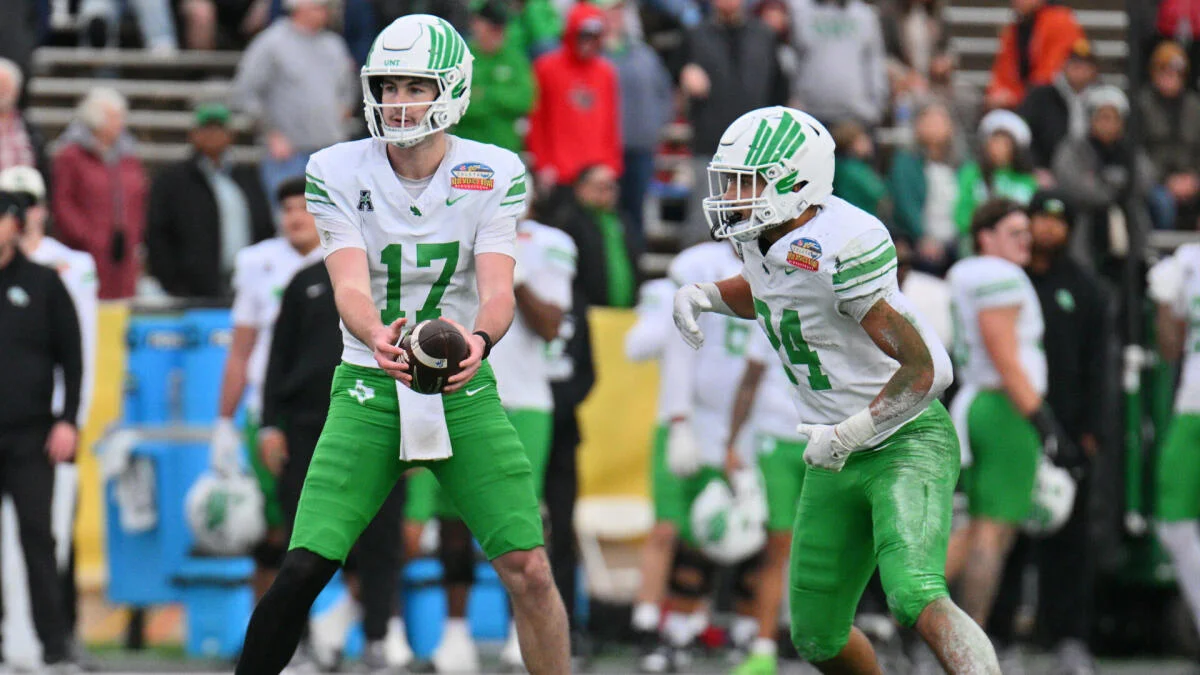
When Oklahoma State hired coach Eric Morris, attention quickly turned to the spoils of the roster he left behind at North Texas.
Quarterback Drew Mestemaker was the crown jewel, the No. 3 overall player in Cooper Petagna’s 247Sports transfer rankings after leading the nation in passing yards. Running back Caleb Hawkins was close behind, the No. 15 recruit and No. 1 running back transfer after leading the nation in rushing touchdowns. Wide receiver Wyatt Young came in at No. 43 after ranking No. 7 nationally in receiving yards.
In the first 48 hours of the transfer portal, Morris and his staff managed to lock all three players in. And now, the triumvirate is the perfect foundation to build the future of Oklahoma State.
College football transfer portal: Indiana, Oklahoma State among teams off to hottest starts in 2026 cycle
Cody Nagel
Mestemaker is one of the great stories in college football, a former walk-on who never started a varsity game in high school. In his second season, he threw for 4,379 yards and 34 touchdowns, the latter of which trails only Heisman winner Fernando Mendoza. Other major programs had interest in Mestemaker, but Morris closed the deal. Young was his favorite target, even posting a 295-yard game against Rice.
While 247Sports rated Hawkins as a high-end three-star recruit, the rest of the industry was far less optimistic. His only other reported offers were Emporia State and Central Oklahoma. However, Hawkins rushed for 1,434 yards and 25 touchdowns as a true freshman, one of the nation’s best seasons for a running back.
Immediately, the trio becomes the best set of “triplets” at Oklahoma State since the legendary 2017 combination of Mason Rudolph, Justice Hill and James Washington. And more importantly, the additions announce nationally that Morris and highly-touted general manager Raj Murti are ready to compete on the national stage.
“Having the relationships with the new coaches helped land all three guys, but they also had to pay them what they’re worth and pay serious money for the first time,” GoPokes’ McClain Baxley told CBS Sports. “Until this week, the highest reported player was running back Ollie Gordon in 2024 and that was less than $1 million. Oklahoma State has stepped up by making scoring points a priority and given other prospects in the portal something to think about.”
The Cowboys are coming off arguably the worst season in program history, a 1-11 disaster that lacked a single FBS win. Oklahoma State ranked last in nearly every category in the Big 12 as the final year of the Mike Gundy era ended with a thud.
Gundy was reluctant to embrace the new world of college football, often dismissing NIL and the transfer portal. It seemed to bottom out with a stunning 3-9 season in 2024, after which Gundy claimed he “bought” his first roster for 2025 with 65 new additions, plus nine new assistant coaches. Between bad identification and bad development, the Cowboys rated as one of the worst power conference programs of the past several years.
As of publication, Oklahoma State has 15 total commitments to hold the No. 2 transfer class in the nation. Eleven commitments are directly from North Texas. James Madison running back Ayo Adeyi also ironically started his career with the Mean Green and reunited with Morris in Stillwater.
The strategy echoes that of Indiana coach Curt Cignetti, who brought 13 highly-touted transfers from James Madison in 2024. Now, many of them are All-Americans and the leader of the national title favorite. Like James Madison, North Texas finished 11-1 in Morris’s final season.
The transition to the major college level could come with complications. The Mean Green struggled against Tulane and South Florida, the two most talented teams they played in The American. North Texas is bringing several starting linemen, but it’s unclear how they’ll translate. Gundy’s disastrous finish leaves almost no existing foundation on the roster, especially in the trenches.
However, the triplets give Oklahoma State something to build around. The Cowboys are spending big money and competing with the best. With Morris’s history of creating the best offenses in college football, Boone Pickens Stadium should be rocking once more.
Yahoo Sports Daily hosts Caroline Fenton and Jason Fitz are joined by College Football Enquirer host Steven Godfrey to discuss how to fix the college football transfer portal window. Watch the full episode of Yahoo Sports Daily on YouTube or YahooSports.TV.
Advertisement
Video Transcript
My problem is the fact that the transfer portal opened on January 2nd when we We’re still in the middle of the playoffs.
So there areyes, That is athat is a problem.
So, if you’re the star of college football It is a major problem, yeah.
How do you fix that?
Yeah.
Well, you move it to April, but then we’d start Talking about this thing like it was a professional sport and people don’t want to do That.
Um, no.
We should get it, even though it is out of the way of the playoffs.
We should… What?
Now, whatever do you mean?
Are you implying that it’s a billion-dollar industry that people have made money off of for years, but all of a sudden, when the kids started getting paid, Everything was going to hell in a handbasket?
Advertisement
Except the television ratings are up and Interest has never been higher, so back of the line, nerds.
No, I’m sick of the idea of pearl-clutching over this.
Ah.
I think that it does need revision, and it does need a certain amount of… Again, I feel like I say this in some way, shape or form every time I’m on the show.
We talk about a problem in college sports.
We have no central governance, okay?
We have no one who is in charge of college.
Football, who’s looking out for just college football?
Everything is, like, feudal and it’s these little confederacies of conferences and they They can’t agree on much.
Advertisement
And so the portal is the latest example.
Now, before you feel bad for your local coach who is talking about how tough things are.
On him and his staff right now, the coaches voted for this date.
Okay?
The coaches wanted to have the portal here, And they didn’t want two portals.
So before you’re like, Oh, man.
It’s just so, it’s so tough on my coach right Now, think about just the distractions on and off.
No, no, no.
They wanted this.
What’s funny is some of these staffs aren’t even complete yet.
Next week, I’m going to Charlotte for AFCA, which is the college coaches convention where a A lot of these hires are still taking place, and it’s not, Like, the big ones.
Advertisement
It’s, “Do I have a linebackers coach?”
“Is this guy gonna go…” You know, “Is this assistant gonna go to this team?”
And so At the same time, you’re out there trying to make aggressive offers and also… By the way, it’s two-sided.
You are recruiting players who are in the portal, or might get in the portal, but then you’re also recruiting your players to not get In the portal.
So, is this an ideal system?
No, not at all.
I just don’t care if the kids are getting paid.
And the kids can move around.
That’s fine with me.
I mean, you look at the very top of this graphic right here.
You’re seeing two kids offensively who helped define North Texas’ season.
Advertisement
Especially Mesta Maker, who’s considered to be one of the best quarterbacks in this class.
They’re following their coach.
That should be okay.
Right?
That should be allowed.
And by the way, don’t think for a second that when Eric Morris was interviewing to be Hired at Oklahoma State… Trust me.
He very casually mentioned, “Hey, I might have a really good quarterback that we can go pick up in the portal.”
So it’s, like, kind of a package deal, Which is, like, a whole other dirty thing that we could talk about sometime.
Jan. 5, 2026, 2:46 p.m. CT
As the college football season draws to a close, players’ decisions about their futures are set to significantly shape the landscape of the sport.
Some players have already made their intentions clear, announcing their plans to enter the transfer portal. Several Oklahoma players, including running back Jovantae Barnes, linebacker Kobie McKinzie and quarterback Michael Hawkins Jr.
Starting to seem like the smaller schools are becoming farm systems for the schools with elite NIL funding. Much like Major League Baseball were we see small market teams pillaged by the likes of the Mets, Dodgers, Yankees, Red Sox, Blue Jays, Cubs. Has this what College football has become in the age of NIL and the transfer portal? How is it going to be stopped? Feels like we are going to see anyone not getting playing time go to a mid level school develop and off to the elite. I’m afraid college football is becoming MLB, about 6 to 8 of the same teams with a legit shot year in and out.
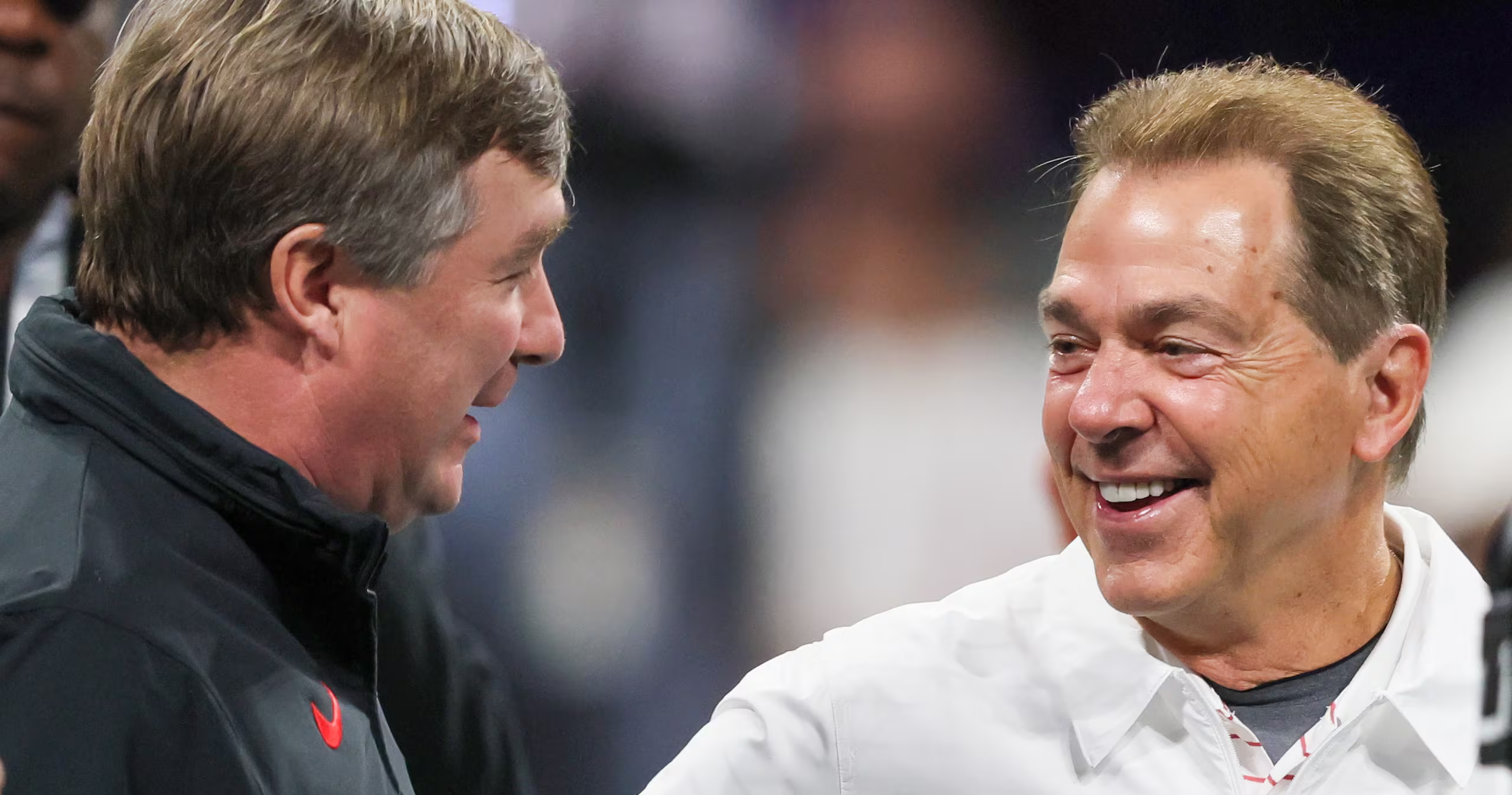
ATHENS — College football calls the current period of player transactions the “transfer portal,” but Nick Saban refers to it as “chaos.”
More than 4,000 college football players, including more than 120 starters, per Saban, have entered their name into the portal alerting their own and other programs of their intention/willingness to change schools.
“We created a system that only allows you to gain advantage if you want to leave,” Georgia coach Kirby Smart said during the lead up to the Bulldogs’ CFP quarterfinal in the Sugar Bowl last week in New Orleans.
“You’ve created a system that inherently rewards what defies a team concept, and in a team sport, it just makes no sense.”
But it does make dollars for some players who make themselves available to the highest bidder, via collegiate sports’ version of free agency.
There was some optimism last June when the House vs. NCAA case was settled that collegiate athletes could find some order with a then-$20.5 million “cap” put in place for schools to pay out to student-athletes.
Roster sizes were to be reduced, but there would be no scholarship limits and an exception was in place for student-athletes to secure their own NIL deals outside of the school’s cap, provided it met the standards as determined by a clearinghouse.
“This new framework that enables schools to provide direct financial benefits to student-athletes and establishes clear and specific rules to regulate third-party NIL agreements marks a huge step forward for college sports,” NCAA president Charlie Baker penned in a letter in response to the case settlement.
It seems like so long ago, and now, here we are after a season that saw 11 Power 4 coaches fired before the end of this season, including five from the SEC — and a sixth change when Lane Kiffin left Ole Miss before the start of the College Football Playoff to accept the LSU head coaching job.
Saban, citing the unprecedented scenario currently playing out at Ole Miss, said it’s a matter of the football “calendar” of events, which includes the early signing date (Dec. 3-5) and the transfer portal window date (Jan. 2-16).
“Ole Miss has six (assistant) coaches going to LSU, trying to take guys to LSU from their (current Ole Miss) team,” Saban said on College GameDay. “But they’ve got to play a game.
“Is that chaos, or is that chaos? So this whole college football calendar needs to change, that would be my New Year’s resolution.”
To Saban’s point, Ole Miss did beat Georgia 39-34 in the Sugar Bowl to advance to play Miami in the College Football Playoff Fiesta Bowl semifinal at 7:30 p.m. on Thursday in Glendale, Arizona.
In the meantime, Kiffin is working to rebuild the LSU roster with transfer players who, no doubt, will be wanting to meet and talk with the Rebels’ offensive coaches who plan to join the LSU staff once Ole Miss is eliminated from the CFP.
Clearly, it’s not an optimal situation for the student-athletes, even as some of the current Ole Miss players are considering transferring elsewhere.
There’s no alternative, however, with the playoff schedule and transfer portal overlapping.
Indiana, the CFP No. 1 seed that will face Oregon at 7:30 p.m. on Friday in the Chick-fil-A Peach Bowl semifinal, has already received a commitment from TCU quarterback Josh Hoover among five other transfer portal additions, per reports.
“The NCAA doesn’t seem to be in control of the way things are happening right now, and I think if we’re going to change things in college football, we’ve got to get Congress to have some kind of antitrust legislation because the NCAA can’t enforce their own rules,” Saban said. “So even if they tried to change this, somebody might sue, and they might not be able to do it, that’s how we got where we are now.”
Former Auburn basketball coach Bruce Pearl proposed on TNT programming that collegiate eligibility needs to be capped at five years, with no appeals.
Further, Pearl echoed Saban on the matter of congressional oversight, which could lead to players signing enforceable contracts of two or three years to eliminate the year-to-year free agency turnover.
Saban, a seven-time championship coach at Alabama and LSU, suggests the transfer portal date be moved back to May, in line with the academic calendar, and that offseason football training be moved from the spring semester to the summer semester.
“You can get your team together and work over the summer, just like an NFL team does — they don’t have their team together until after the (NFL) draft and after free agency, in May,” Saban said. “So do the same thing in college football and you wouldn’t have these issues with coaches changing jobs, because everybody could finish the season with their team, which is what’s best for the players.”
Smart, who led the charge at SEC spring meetings for the January portal date, admits the situation is overly complicated.
“I wish I could solve it, everybody will tell you there’s an answer,” Smart said. “I can tell you that the answer isn’t currently where we stand. I can promise you that.”

Ole Miss quarterback Trinidad Chambliss agreed to a new deal with the school for the 2026 season, contingent on his eligibility waiver being granted, On3’s Pete Nakos reported. School officials are hoping for a resolution to end up in their favor, giving Chambliss a sixth year of college football next season.
Chambliss has been spectacular for the Rebels this season, and their most recent win was no exception. In the victory over Georgia in the College Football Playoff quarterfinals, Chambliss completed 30-of-his-46 pass attempts for 362 yards and two touchdowns, without throwing an interception.
In total, Chambliss has completed 66.4% of his pass attempts for 3,660 yards and 21 TDs this season, while only throwing three interceptions. Though Chambliss spent four seasons at Ferris State, he only played in two of them.
He redshirted in 2021 after seeing no action. He didn’t make any appearances in the 2022 campaign, either. Chambliss is seeking a medical redshirt for that season, claiming he battled respiratory issues, which ultimately led to the removal of his tonsils.
“I deserve it,” Chambliss said Dec. 30 at Sugar Bowl media day. “I’ve only played three seasons of college football. I feel like I deserve to play four. I redshirted in 2021. That was my freshman redshirt. Then I medically redshirted in 2022. Played in 2023, 2024 and this is 2025.
“… “I have records from an ear, nose and throat doctor that I was getting treated for the issue that I had in 2022. … I was in communication with Ferris (State), doctors, all of that.”
For now, Trinidad Chambliss can only continue to focus on the current season. On Jan. 8, Ole Miss will square off against 10-seed Miami in the CFP semifinals. The game will air live on ESPN. The winner will advance to the national championship.
Grant Grubbs contributed to this report

ASUS Republic of Gamers Presents Next-Gen Gaming Innovations, Commemorates 20 Years of Gaming Excellence at CES 2026

The Indiana model arrives at Oklahoma State, where new ‘triplets’ could star

Daren Lucas Named President of the Motorsports Hall of Fame of America (MSHFA)
District 10 high school basketball midseason freshman of the year fan vote

Yamaha Motor Corp, USA, Promotes Dean Burnett to Senior Vice President and President of Motorsports Division

Mayor Michelle Wu Inauguration Address Monday, January 5, 2026

Manchester City’s Josko Gvardiol to undergo surgery after tibial fracture

How to fix the college football transfer portal

Summit Racing Equipment | Error 410: Resource Gone

Duke to Host 2026 National Girls and Women in Sports Day Youth Clinic

Daren Lucas Named President of the Motorsports Hall of Fame of America – Speedway Digest

Brittnay Estes – Assistant Coach/Recruiting Coordinator – Women’s Volleyball Coaches

Ranking Non-Super-Team Drivers | SVG, Zilisch Lose Sponsor? | Bristol Hockey Rumor
NCAA college football transfer portal. When does 2026 portal close?

This Week in Wake Forest Women’s Athletics – Presented by Truist (Jan. 5-11)

SoundGear Named Entitlement Sponsor of Spears CARS Tour Southwest Opener

Donny Schatz finds new home for 2026, inks full-time deal with CJB Motorsports – InForum

David Blitzer, Harris Blitzer Sports & Entertainment

DeSantis Talks College Football, Calls for Reforms to NIL and Transfer Portal · The Floridian
Elliot and Thuotte Highlight Men’s Indoor Track and Field Season Opener

#11 Volleyball Practices, Then Meets Media Prior to #2 Kentucky Match

Rick Ware Racing switching to Chevrolet for 2026

Colleges ponying up in support of football coaches, programs
West Fargo volleyball coach Kelsey Titus resigns after four seasons – InForum

Nascar legal saga ends as 23XI, Front Row secure settlement

Maine wraps up Fall Semester with a win in Black Bear Invitational

Stempien to seek opening for Branch County Circuit Court Judge | WTVB | 1590 AM · 95.5 FM

Ross Brawn to receive Autosport Gold Medal Award at 2026 Autosport Awards, Honouring a Lifetime Shaping Modern F1

Sunoco to sponsor No. 8 Ganassi Honda IndyCar in multi-year deal

Women’s track and field athletes win three events at Utica Holiday Classic





-
 Motorsports3 weeks ago
Ross Brawn to receive Autosport Gold Medal Award at 2026 Autosport Awards, Honouring a Lifetime Shaping Modern F1
-

 Rec Sports2 weeks ago
Princeton Area Community Foundation awards more than $1.3 million to 40 local nonprofits ⋆ Princeton, NJ local news %
-
 NIL3 weeks ago
Kentucky AD explains NIL, JMI partnership and cap rules
-

 Sports3 weeks ago
Beach Volleyball Unveils 2026 Spring Schedule – University of South Carolina Athletics
-

 Sports2 weeks ago
Badgers news: Wisconsin lands 2nd commitment from transfer portal
-
 NIL3 weeks ago
College football program loses 25 players to transfer portal
-

 Sports2 weeks ago
Is women’s volleyball the SEC’s next big sport? How Kentucky, Texas A&M broke through
-
 Rec Sports3 weeks ago
Refugee-Focused Youth Sport Initiatives : Moving for Change
-
 Rec Sports2 weeks ago
Youth Sports Business in 2025: The Year the Industry Grew Up
-
Rec Sports2 weeks ago
Inside the NWSL’s first combine: Can the league create a more robust pathway for American talent development?