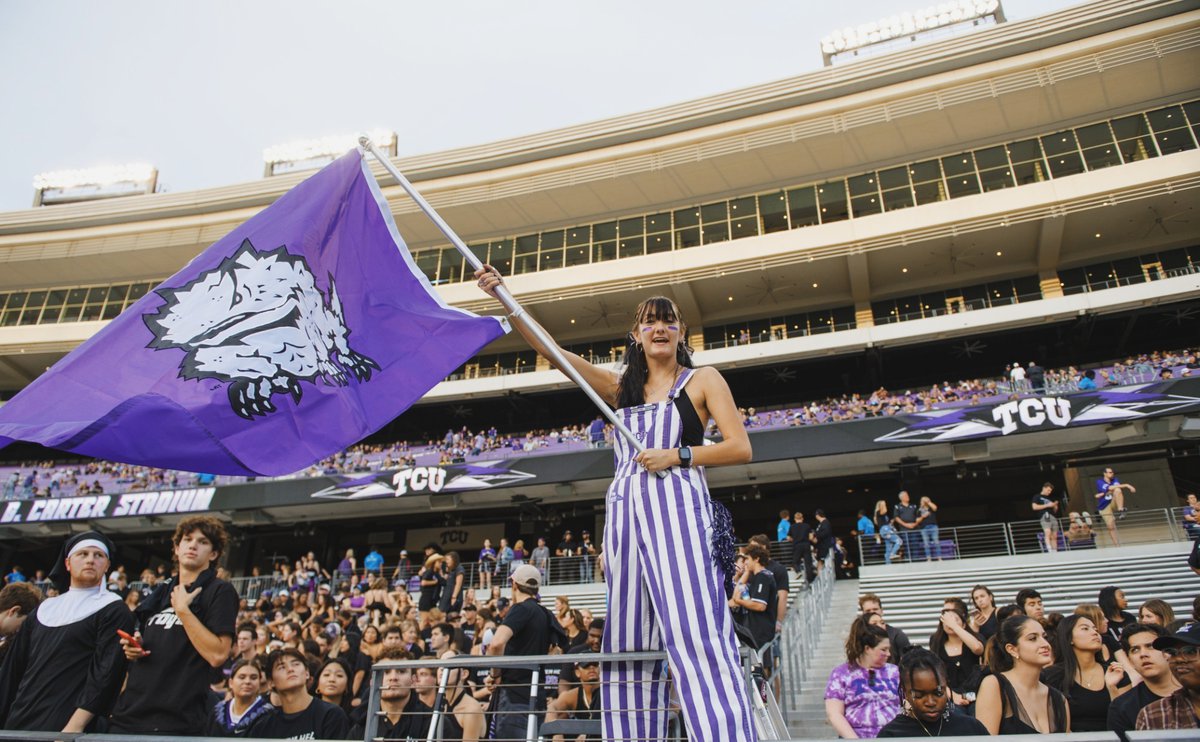
TCU’s just-passed 8-4 regular season had many in the purple people masses as angry as a tourist who just paid $40 to park, and for many others as disappointed as when Junior brought home an F in civics.
Many have expressed themselves in much the same way of our old friend, the frontier prospector Gabby Johnson of “Blazing Saddles” fame: No sidewindin’, bushwackin’, hornswagglin’ cracker croaker is gonna rouin me bishen cutter!
TCU Athletic Director Mike Buddie gets it.
“I think there were 11 teams in our league this year whose fan bases wanted their coaches fired,” Buddie said on Friday morning at the FIFA World Cup Draw party at Billy Bob’s Texas, the world’s largest honky tonk. “That’s the culture that we live in. You can win [against a] ranked opponent, [next week against] ranked opponent, [a third straight win against a] ranked opponent, and then lose — they want you gone.
“It’s a new day and age.”
Like the mood of Paris in 1793 — cheers in the morning, pitchforks and the guillotine by dusk.
TCU finished in the middle of a congested Big 12 at 5-4. To put some perspective on its season, Texas finished 9-3. Of course, many UT fans think the Longhorns should win every game, too. No. 25 Missouri, like TCU, finished 8-4. So, too, did Tennessee and Iowa, two teams receiving votes in the AP poll. In the end, after 12 regular-season games, only two teams finished undefeated — Ohio State and Indiana. One of those teams will lose this weekend; they play each other.
North Carolina — guided by renowned football genius Bill Belichick — stumbled to 4–8, taking a season-opening black eye from TCU.
Just last year, Ohio State fans wanted coach Ryan Day on the nearest interstate out of town after the Buckeyes took the worst kind of a second loss of the season — to Michigan. That was on Nov. 30. By the end of January, they wanted to elect him governor after winning the national championship.
The Horned Frogs will learn their postseason bowl destination on Sunday.
Dykes has gone 35-17 over four seasons at TCU, including 13-2 and a berth in the College Football Playoff championship game in his first season. That campaign included a victory over No. 2 Michigan in the Fiesta Bowl CFP semifinals.
TCU slipped to 5-7 in 2023 but went 9-4 last year and could do the same in 2025 with one last victory.
“We need to be better,” Buddie said. “We’re committed to getting better. I’m excited because nobody realizes that more than Sonny Dykes.
“He’s committed to addressing some needs that I think we have and more than ever before, what I do and how we strategically fundraise and approach people financially has a direct impact on your football program. I think Texas Tech showed us all that if you can build the most talented roster and develop them, really good things happen.”
Texas Tech, which is playing in the Big 12 Championship Game on Saturday against BYU, spent, according to reports and speculation, as much as $28 million on its football roster this season. The Red Raiders are No. 4 in the most recent CFP rankings.
Spending that kind of money is the result of a completely transformed landscape in college football. Colleges can now spend as much as $20.5 million on payroll for athletes in its various programs. That mostly impacts football and men’s basketball — those sports that generate the most revenue, the “revenue sports.”
Before that, each Division I school had an adjacent collective designed to allow athletes to cash in on their name, image, and likeness. That quickly evolved — devolved? — into merely paying athletes by writing checks out of the collective’s pool. Now completely legal after a U.S. Supreme Court case permitting athletes to receive compensation beyond traditional scholarships. The collectives simply became the mechanism to funnel those payments.
Most, if not all, of the collectives have now been merged with universities’ traditional athletics fundraising arm. NIL endorsement deals are now supposed to be just exactly that — an athlete endorsing a product, for example. I’m not exactly sure how all that sorts out.
“The landscape has changed, but we still have a ton of advantages in facilities and where we’re located and historical success,” said Buddie, who added that TCU also is “thoughtful and strategic in how we employ people.”
“We’re not in the business of paying $50 million buyouts for people to go away. And when you believe you’ve got the right person who’s already proven that he can win in the College Football Playoff, it’s incumbent on me to provide him every resource that he needs to be successful.”