
Sports
Cade Horton's Spin is Like a Magnet, But His Movement Covers the Whole Compass



Cubs Video
The moment when Cade Horton‘s potential first jumped up a level came last year with Triple-A Iowa, when he first began to find the changeup he now sports in the majors. Even by his own reckoning, though, the pivotal moment for him came when he found that he could trust that pitch against big-league bats, last month in Miami.
“I thought it was in a good place in Triple A, and then got here, and it was really the Miami start where I got a good feel for it,” Horton said earlier this month, during the Cubs’ trip to Minnesota. “From there, it’s just kind of taken off, to where I’m able to repeat that pitch. It’s been huge for me.”
Since then, that pitch has been a staple in Horton’s arsenal to lefties, and it hasn’t stopped dominating opposing batters. On the contrary: an eye-popping 59.6% of swings at the pitch have come up empty. The changeup was virtually non-existent when the Cubs drafted Horton in the first round of the 2022 MLB Draft, but now, it’s a vital weapon. Did that change how he has to think about himself as a pitcher, and how he operates?
“Not necessarily. I think it’s more, I just use the changeup more to lefties,” he said. Indeed, 112 of the 116 he’s thrown in the majors have been to left-handed batters; he’s not (yet) the type of hurler who will go to the changeup right-on-right. “So that’s been the big key, is being able to have that pitch that runs away from them. That opens up fastballs in and fastballs away. The slider’s more for righties, and that’s why I’ve been working on the sinker and trying to set up the pitch away from them.”
In other words, Horton prefers to use his fledgling sinker to attack righties inside, setting up the slider. The changeup, coming from his high three-quarters slot and with his natural tendency to supinate (the direction of forearm movement that better facilitates breaking balls, rather than arm-side movement), has more run than tumble, which makes it the type of change that’s harder to throw with conviction to same-handed batters.

As Horton alluded to, his slider (Statcast, as shown above, labels most of those as sweepers, but the ones labeled sweeper and slider are both what Horton calls his slider) is the go-to pitch against righties. However, he’s not kidding around when it comes to making the sinker a meaningful part of his arsenal to them. In two starts this month, the sinker has emerged as a key third pitch to righties, with his fastball becoming less predominant.

He’s had to do that, of course, because his fastball isn’t a traditional four-seamer at all. It’s much closer to being a power cutter—and indeed, some classification systems call it one. Horton didn’t set out to create this type of heater, but now that he has one, he understands the value of steering the sinker in on righties to set up both the fastball and the slider away.
“I think it just naturally happened,” Horton said of his change in fastball shape, which happened after the Cubs selected and signed him but isn’t the product of conscious pitch design. “Just getting around the ball more and creating that cut action—which I don’t think is a bad thing. I think it plays against lefties, and then it runs off the barrel to righties.”
The fascinating thing is that, now that he has the changeup (and his curveball, which stands in for the slider against lefties), he offers three different looks to hitters of each type—but they all come from one basic spin axis. Horton’s changeup, sinker and slider each rely on considerable seam-shifted wake. They start on similar spin-based movement paths as his four-seamer and curve, but are deflected based on the orientation of the seams and the action of the air on the ball.

The chart above shows, on the left, initial spin direction, meaning what the pitcher actually imparts on the ball. Bars at the top of the clock graphic indicate the frequency of pitches thrown with backspin, which will “rise” (drop less than gravity would normally dictate) en route to the plate. Bars at the bottom show the frequency of pitches with topspin, like a true overhand curveball. Bars on the nine o’clock side show the frequency of pitches whose spin would push them toward the first-base side of the plate, away from a righty batter; bars on the three o’clock side show the frequency of those with spin pushing them toward a righty batter.
On the right, instead of spin direction, we see the actual movement direction of pitches. The difference between the two is explained by seam effects. Notice how, on the left, Horton’s pitches cluster mostly around the 12:30 and 7:30 parts of the clock. That means that it’s relatively hard for hitters to distinguish even between, say, his four-seamer and his slider, because they enjoy “spin mirroring”—the ball is spinning along very close to the same axis, so even though the directions of spin on the two offerings are opposites, it’s hard to see the difference. A change in spin axis can make a visual difference for a batter, but telling which direction a ball is spinning along a similar axis is very hard.
Compounding that difficulty, though, is that Horton also has pitches that diverge from each other in ways spin can’t explain. Thus, even for a lefty batter (who rarely sees the slider and only needs to worry about the curve), there are mutliple layers of trouble. He could be throwing the fastball or the curve, and spin mirroring would make it hard to tell which. He could also be throwing the changeup, and because it has a similar spin axis to the fastball (and a near-identical arm angle; Horton has worked hard to match release points on those two offerings) and the two pitches veer opposite directions due to release angle and seam effects, they end up in very different spots. That’s how you miss bats with your changeup almost 60% of the time, without elite movement on the pitch.
The slider is an especially nasty version of the same problem, because for a righty, it’s like dealing with the curveball problem and the changeup problem for lefties, rolled into one pitch. It’s shielded by spin mirroring, especially now that he has the sinker working, but it also has the seam-effect sweep that mirrors the changeup’s run. Unlike the changeup or the fastball shape, the slider has been like this since Horton was an amateur.
“It’s kind of always been that way,” he said. “I don’t think too much about metrics. I think more about executing a pitch. I know where my slider works, and it’s down and away, so it’s just about executing to that spot.”
That’s really what it comes down to, for him. He’s only gotten hurt in the majors when he’s made mistakes over the heart of the plate. With that blooming movement spread from such a tricky set of spin orientations, he’s one of the game’s more deceptive hurlers, and he also happens to throw 96-98 with life on the fastball.
“It’s just all about executing: Where are my misses? The hits I’m giving up, where are the fastballs?” he said. To him, the next step is simply to eliminate those, and to continue honing his feel for putting batters away with the heater. “Just execution. Two-strike execution is big, maybe getting to the top of the zone, making quality pitches.”
Over time, if he can sharpen his command a bit, Horton could jump another level and become an ace by learning to use all of his pitches to both left- and right-handed batters in certain situations. For now, though, if he can avoid the worst of the missed locations he’s had over his first two and a half months in the majors, he can be a solid mid-rotation starter on a playoff-bound Cubs team. For a rookie, that’s plenty.



Lancaster, PA (December 6, 2025) – The DeSales University men’s track & field team opened the 2025-26 indoor T&F season competing at the Diplomat Open at Franklin & Marshall College on Friday.
The Bulldogs posted 10 MAC qualfying times/marks in the meet.
Among the qualifying times were junior Bryce Guthier taking second in the 400-meters with a time of 52.08. It is the fifth fastest time in indoor history. Senior Davis Trump also qualified in the 5K with a time of 16:20.32.
In the field events, DSU posted eight qualfying marks. Junior Weston Simak qualified for the MAC Championships in both the long jump (6.52m) and triple jump (13.72m). His triple jump mark was the second best in team history. First-year Luke Heimann also qualfied in the triple jump (11.86m).
Junior Jonathan Castronovo took home first place in the long jump with a mark of 6.58m, the second best long jump in team history.
First-year John Amoretti qualified in the shot put (12.33m), seniors Jonathan Eudja and Giovanni Wellington qualified in the weight throw with marks of 14.85m and 14.23m. First-year Ryan Rodriguez also quallified in the weight throw (11.89m).
The Bulldogs won’t return to action till the New Year at the Blue and Grey Invitational on Jan. 17th.

RESULTS
ITHACA, N.Y. –
The Ithaca College women’s track & field team opened its 2025-26 season over the weekend as the Bombers made the short trip across town to compete in the Greg Page Relays hosted by Cornell University on December 5-6.
Lola Gitlin posted a time of 10:25.57 in the 3000-meter run to finish third overall.
Rachel Larson was a fourth place finisher with a time of 8.58 seconds in the 60-meter hurdles. That time is currently No. 1 in Division III after the opening weekend of the season.
Aynisha McQuillar took fifth in the 200-meter dash in a time of 26.61 seconds. McQuillar also ran in the 60-meter dash and posted the 11th fastest time in DIII during the prelim with a performance of 7.78 seconds.
Lyla Powers was fifth in the 500-meter dash with a time of 1:21.75.
Lily Seyfert claimed fifth in the shot put with a heave of 12.78 meters, which is currently ninth in the nation.
Bree Boyle and Erin Eastwood each cleared 3.54 meters in the pole vault, which is tied for 11th on the Division III performance list.
Alexis Brown turned in a leap of 11.02 meters in the triple jump for the 17th best mark in the country.
Ithaca is off for the remainder of 2025 and will return to Cornell on January 10 for the Southern Tier Invitational.

RESULTS
ITHACA, N.Y. –
The Ithaca College men’s track & field team opened its 2025-26 season over the weekend as the Bombers made the short trip across town to compete in the Greg Page Relays hosted by Cornell University on December 5-6.
Anik Vossschulte claimed third in the 200-meter dash in a time of 23.32 seconds, while Jacob Antilety was seventh at 23.71 seconds.
Matt Lokshin posted a time of 8.65 seconds in the 60-meter hurdles to place third in the event. Aidan Irwin took fourth in the high jump with a mark of 1.70 meters.
Quinten Lewis posted a mark of 13.73 meters in the triple jump to place fourth and Sebastien-Oliver Lacrete was sixth at 12.68 meters, while Evan Cherry secured fifth in the long jump with a leap of 6.84 meters.
IC’s 4×400-meter relay team of Damian Simmonds, Griffin Lupes, Noah McKibben and George Nilson placed sixth in 3:34.49.
Luke Ellor finished sixth in the shot put with a mark of 14.40 meters.
Three Bombers finished within the top eight in the 500-meter dash as Brad Kellogg was sixth in 1:09.73, Peter Tysiak followed in seventh with 1:10.74 and Matthew DeJulio was next at 1:11.59.
Kaiden Chandler and Luke Ferrer posted times of 4:41.29 and 4:53.44 in the mile to finish in seventh and eighth.
Raf Campanile was seventh in the pole vault with a clearance of 4.25 meters.
Ithaca is off for the remainder of 2025 and will return to Cornell on January 10 for the Southern Tier Invitational.

UTICA, N.Y. – The Hamilton College Continentals competed against 13 teams at the non-team scoring 2025 Utica University Track & Field Holiday Classic inside the Todd & Jenn Hutton Sports and Recreation Center on Saturday, Dec. 6.
The meet was the first of the 2025-26 season for the Hamilton women, who will be back at Utica for the Pioneers’ Winter Opener on Friday, Jan. 16 after taking a break for finals and the winter holiday.
The Continentals qualified for the 2026 All-Atlantic Region Track & Field Conference Indoor Championships in four different events and finished first in three events.
Emily Pogozelski ’26 won the 3,000-meter run by over 20 seconds with a regional-qualifying time of 10:27.93. Mackenzie Loudon ’29, who was competing in her first collegiate meet, took first place and qualified for regionals in the triple jump.
Loudon was also part of Hamilton’s winning 4×200-meter relay with Tatiana McCray ’28, Ava Chiappinelli ’29 and Marley Meyers ’28. Their performance was more than five seconds faster than the regional-qualifying time.
McCray ran a regional-qualifying 7.96 seconds and finished in second place in the 60-meter dash final. Chiappinelli also qualified for regionals in her first collegiate meet and finished right behind McCray with a time of 7.99 seconds.
TOP PERFORMANCES
300-Meter Dash (17 Runners)
4. Marley Meyers ’28, 43.08
7. Hannah Turner ’26, 43.91
60-Meter Dash (35 Runners)
2. Tatiana McCray ’28, 7.96 (PR, AARTFC)
3. Ava Chiappinelli ’29, 7.99 (AARTFC)
600-Meter Dash (16 Runners)
5. Aisha Kandji ’29, 1:47.31
4×200 Meter Relay (9 Teams)
1. McCray ’28, Mackenzie Loudon ’29, Chiappinelli ’29, Meyers ’28 (1:46.42, AARTFC)
3000-Meter Run (19 Runners)
1. Emily Pogozelski ’26, 10:27.93 (PR, AARTFC)
Triple Jump (15 Athletes)
1. Loudon, 11.29 meters (37 feet, 0.5 inches; AARTFC)
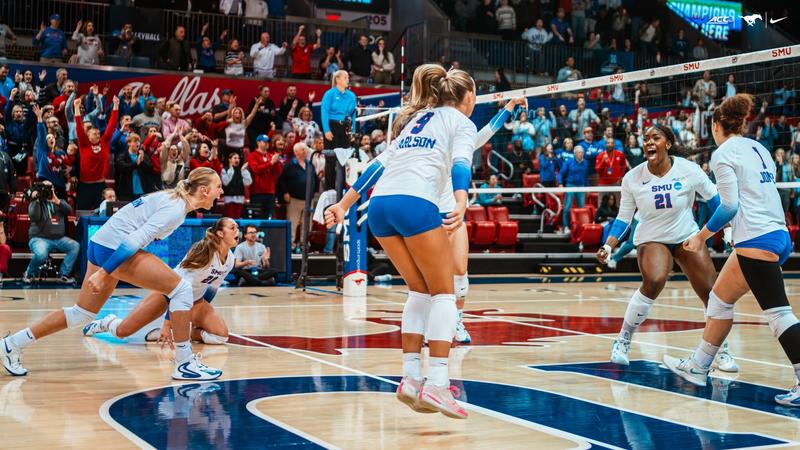
DALLAS (SMU) – For the first time in program history, SMU volleyball is headed to the Sweet Sixteen after sweeping Florida (16-12) in the Round of 32 on Saturday with set scores of 25-11, 25-21, 26-24.
With the win, SMU won its 27th match of the season, tying the program record for single-season wins. It also gave coach Sam Erger her 100th victory at SMU and in her Division I head coaching career.
Averi Carlson dished out 38 assists, the most in a three-setter for the senior setter this season. Carlson led the Mustangs to a .370 hitting percentage in the win. Kennedi Rogers went for 14 kills, hitting .440, with four digs and three blocks. Malaya Jones closely trailed Rogers with 13 kills, eight digs and seven blocks, tying her career high.
SMU out-blocked the Gators 15-4, spearheaded by a career-high nine blocks from freshman Maggie Croft. The Mustangs’ blocking efforts helped hold the Gators to a .156 hitting percentage for the match.
MATCH NOTES
- With 13 kills against Florida, Jones (503) is now the second player in SMU Volleyball history to reach 500 kills in a season. She joins Rachel Giubilato, who notched 568 kills in 2006.
- Averi Carlson (1,341) moved to third in the rally scoring era and sixth all-time for single-season assists at SMU.
- Jones reached the double-digit kill mark for the 26th time this season and for the ninth straight match.
- Rogers recorded double-digit kills for the sixth time this season.
- It marked Schilling’s 22nd time in double-figures this season and her fifth straight.
- With six blocks against the Gators, Anyanwu draws within 14 of breaking the program record for most blocks in a season. (188 by Janelle Giordano in 2015)
- SMU had double-digit blocks (15) for the 17th time this season and for the second straight match.
- SMU has won 20 of its last 21 matches and its 12th straight.
- The Mustangs end the 2025 season with 15 wins at Moody Coliseum, tying the program record for most in a season.
- The win marks the Mustangs’ 15th sweep, 11th at home this season.
HOW IT HAPPENED:
SMU controlled the first set from start to finish in all phases of the game. SMU hit .483 with no errors on 29 swings in the first, while holding Florida to a .000 hitting percentage. Rogers put in five kills to lead the Mustangs, who got point production from six different players to help propel them to a 25-11 set one victory. SMU commanded the net with a 5-0 advantage in blocks.
Down four (16-12) in the second frame, SMU responded with five straight points on a run that included two aces from Madison Scheer. After trading points, SMU went on a 4-0 run to pull away in the frame. The Mustangs went on to win the frame 25-21.
Tied 20-20 entering the red zone of the third set, SMU got the first two points on an ace from Carlson and a block from the freshman tandem of Rogers and Croft. Despite a 3-1 run by Florida that put the Gators at set point first, the Mustangs responded with three straight to close the match, ending the frame with their sixth block of the set to win 26-24.
SMU LEADERS:
SMU Kills Leader: Kennedi Rogers (14)
SMU Assists Leader: Averi Carlson (38)
SMU Digs Leader: Jordyn Schilling (11)
SMU Blocks Leader: Maggie Croft (9)
SMU Ace Leader: Madison Scheer (2)
SMU Points Leader: Malaya Jones (17.5)
Up Next: SMU will get a rematch with No. 3 seed Purdue in the NCAA Regional Semifinal on Thursday evening in Pittsburgh, Pa.

Dom Amore: What’s in a number? UConn women raise the perfect ’10’ to the rafters at Gampel Pavilion

The Omaha World-Herald’s Nebraska All-Class volleyball teams

Iowa and Vanderbilt head to Tampa for ReliaQuest Bowl

Snowball Derby 2025 postponed to Monday

Mill Creek Activity Center to increase gymnastics space to help meet demand

New Mexico and Minnesota Selected to Play in 2025 Rate Bowl on December 26 at 2:30 p.m.

UGA suing former Bulldog, Missouri DE for transfer damages

IU football is No. 1 seed in College Football Playoff, headed to the Rose Bowl – The Daily Hoosier

Men’s T&F Opens Season at Diplomat Open

Max Verstappen’s wife has child with F1 driver he replaced – Motorsport – Sports

Miami Selected to College Football Playoff – University of Miami Athletics

Women’s Track & Field Turns in Multiple High Marks to Begin Season at Cornell

Brad Keselowski glad Michael Annett ‘no longer suffering’ after death – Motorsport – Sports

Men’s Track & Field Opens Indoor Season at Cornell Greg Page Relays

Verstappen expected to win race, Norris title

First Tee Winter Registration is open

Fargo girl, 13, dies after collapsing during school basketball game – Grand Forks Herald

CPG Brands Like Allegra Are Betting on F1 for the First Time

Volleyball Recaps – November 18

F1 Las Vegas: Verstappen win, Norris and Piastri DQ tighten 2025 title fight

Two Pro Volleyball Leagues Serve Up Plans for Minnesota Teams

Utah State Announces 2025-26 Indoor Track & Field Schedule

Sycamores unveil 2026 track and field schedule

Redemption Means First Pro Stock World Championship for Dallas Glenn

Bowl Projections: ESPN predicts 12-team College Football Playoff bracket, full bowl slate after Week 14

Texas volleyball vs Kentucky game score: Live SEC tournament updates

Indiana’s rapid ascent and its impact across college football

How this startup (and a KC sports icon) turned young players into card-carrying legends overnight

Pohlman admits ‘there might be some spats’ as he pushes to get Kyle Busch winning again

Robert “Bobby” Lewis Hardin, 56

 Why a rising mid-major power with an NCAA Tournament team opted out of revenue-sharing — and advertised it
 NBA Legend Michael Jordan to Join NBC Sports as Special Contributor
 Falcons mailbag
 Portal Update – Basketball and Gymnastics Take Hits
 has always dreamed in Mercurial. Now his initials are on the boots.
The new Kyl…
has always dreamed in Mercurial. Now his initials are on the boots.
The new Kyl…
-
 Rec Sports2 weeks ago
First Tee Winter Registration is open
-
 Rec Sports2 weeks ago
Fargo girl, 13, dies after collapsing during school basketball game – Grand Forks Herald
-
 Motorsports2 weeks ago
CPG Brands Like Allegra Are Betting on F1 for the First Time
-
 Sports3 weeks ago
Volleyball Recaps – November 18
-
 Motorsports2 weeks ago
F1 Las Vegas: Verstappen win, Norris and Piastri DQ tighten 2025 title fight
-
 Sports2 weeks ago
Two Pro Volleyball Leagues Serve Up Plans for Minnesota Teams
-
 Sports2 weeks ago
Utah State Announces 2025-26 Indoor Track & Field Schedule
-
 Sports2 weeks ago
Sycamores unveil 2026 track and field schedule
-
 Motorsports1 week ago
Redemption Means First Pro Stock World Championship for Dallas Glenn
-
 NIL1 week ago
Bowl Projections: ESPN predicts 12-team College Football Playoff bracket, full bowl slate after Week 14