

Kentucky’s reward for torching its side of the bracket? A date with the program it’s never beaten.
Sports
Can the fastest NFL players beat the NCAA track stars? Here’s what the numbers say

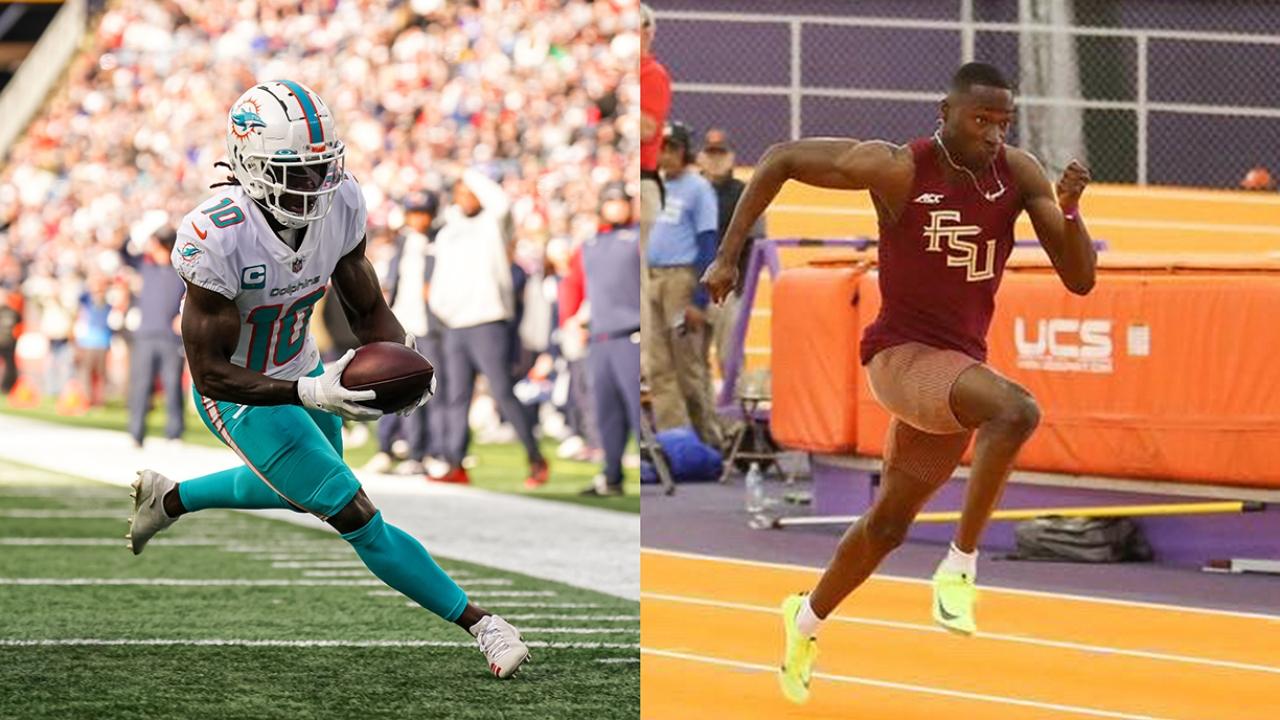
Are football players faster than track and field athletes? It’s a question that’s been in the spotlight recently, with the likes of Tyreek Hill (NFL’s Miami Dolphins) challenging Usain Bolt (arguably the greatest Olympian sprinter ever) and more. However, before we get to the all-time greats, we should figure out if NFL players can even beat the best sprinters in the NCAA.
I compiled data from the NFL and the top collegiate sprinters to finally get an answer to the oft-asked question. Here’s what the numbers say.
Fastest 2022 regular season NFL speeds
Every year, the NFL uses Next Gen Stats to track the fastest players each game. Below you’ll find the fastest players that carried the ball from the 2022 regular season.
| RANK | SPEED (MPH) | PLAYER | POSITION | TEAM | NFL WEEK |
|---|---|---|---|---|---|
| 1 | 22.11 | Parris Campbell | WR | Indianapolis Colts | 18 |
| 2 | 22.09 | Kenneth Walker | RB | Seattle Seahawks | 7 |
| 3 | 21.87 | Breece Hall | RB | New York Jets | 7 |
| 4 | 21.72 | DeSean Jackson | WR | Baltimore Ravens | 12 |
| 5 | 21.72 | Christian Watson | WR | Green Bay Packers | 13 |
| 6 | 21.68 | Jaylen Waddle | WR | Miami Dolphins | 16 |
| 7 | 21.68 | Dalvin Cook | RB | Minnesota Vikings | 10 |
| 8 | 21.62 | Travis Etienne | RB | Jacksonville Jaguars | 17 |
| 9 | 21.6 | Devin Duvernay | WR | Baltimore Ravens | 2 |
| 10 | 21.58 | Tariq Woolen | DB | Seattle Seahawks | 4 |
In total, 36 NFL players ran faster than 21 mph during the 2022 regular season, but only Parris Campbell and Kenneth Walker surpassed the 22 mph threshold. Campbell’s 22.11 mph speed ranks as the fifth-fastest top speed by a ball-carrier during an NFL season since 2016.
👀: Here are the DI track and field teams with most NCAA championships
| RANK | SPEED (MPH) | PLAYER | Year | TEAM |
|---|---|---|---|---|
| 1 | 23.34 | Tyreek Hill | 2016 | Kansas City Chiefs |
| 2 | 23.09 | Raheem Mostert | 2020 | San Francisco 49ers |
| 3 | 22.3 | Matt Breida | 2019 | San Francisco 49ers |
| 4 | 22.13 | Jonathan Taylor | 2021 | Indianapolis Colts |
| 5 | 22.11 | Parris Campbell | 2022 | Indianapolis Colts |
| 6 | 22.09 | Matt Brieda | 2018 | San Francisco 49ers |
| 7 | 22.05 | Leonard Fournette | 2017 | Jacksonville Jaguars |
So, how do these speeds relate to the top track and field athletes? Let’s find out.
DESTINATIONS: The greatest venues in outdoor track and field, according to you
Fastest NCAA track athletes in 2023
While mph data for NCAA track and field races isn’t always readily available, there’s luckily data from NCAA sprinters who participated in the 2022 World Athletics Championships. We’ll be using that data for this article.
Top male sprinters
The 100 meters is the premier male sprinting event, with track athletes running the shortest distance during an outdoor meet. To compare the 100 meters to football, it equates to just over 109 yards, roughly the front of one end zone to the back of another end zone.
It’s rare that a football player will ever run 100 meters in a straight line continuously in a game like a sprinter would in a race, but a football player still needs to hit his peak speeds to escape from opposing players in the same way a sprinter needs to hit his peak speeds to win a race.
That said, here are the fastest 100 meter sprinters that returned to collegiate track and field in 2023.
| SPEED (MPH) | PLAYER | School | Time (Round) |
|---|---|---|---|
| 26.2 | Favour Ashe | Auburn | 10.00 (Heats) |
| 25.6 | Ismael Kone | Florida State | 10.17 (Heats) |
| 24.3 | Shaun Gill | Texas A&M-Kingsville (DII) | 10.76 (Prelims) |
All three of the collegiate 100 meter sprinters ran faster than all NFL players since 2016. Yet, none of the collegiate sprinters above made the 100 meter final at World Championships, meaning there were even faster sprinters in track and field in 2022.
NCAA T&F: Here’s how the outdoor track and field championships work
What about the equipment?
A common cry in debates between football and track speed is that football players where equipment that can slow them down. Per Sports Illustrated, football equipment like shoulder pads, helmets and more can weigh more than 10 pounds. While there’s no hard data on how much football equipment slows down a player, one can assume that it likely knocks off tenths of a second from top speeds.
40-yard dash
That said, we have seen football players run their top speeds in non-game like settings via the NFL Combine’s 40-yard dash. Take a look a some of the speeds from 2022’s NFL Combine.
| Speed (MPH) | 40 Time | Athlete | School | Position | |
|---|---|---|---|---|---|
| 25.1 | 4.23 | Kalon Barnes | Baylor | CB | |
| 24.8 | 4.26 | Tariq Woolen | UTSA | CB | |
| 24.6 | 4.31 | Velus Jones | Tennessee | WR | |
| 24.5 | 4.34 | Bo Melton | Rutgers | WR | |
| 24.1 | 4.33 | Danny Gray | SMU | WR |
Speeds taken from Reel Analytics.
.@BUFootball CB Kalon Barnes (@KaayBarnes_) exceeded 25 mph during his record-setting 40-yard dash at the #NFLCombine pic.twitter.com/cY4GdDru4g
— Reel Analytics (@RAanalytics) March 7, 2022
Kalon Barnes ran the second-fastest 40-yard dash time in NFL history, only one-hundreth of a second behind the NFL record of 4.22 seconds. Tariq Woolen ran the fifth-fastest time in NFL history.
However, none of the top-speeds from the 2022 NFL Combine ran without football equipment surpass the top two recorded speeds from the NCAA athletes listed above at World Championships.
While the 40-yard dash is a decent indicator of speed, it’s not the end all be all as shown by analytics experts. There’s no correlation between 40-yard dash speed and in-game speed, with players with slow 40 times running just as fast — with equipment on — as players with fast 40 times.
Data suggests no correlation between the 40-yard dash & play speed (MPH) for many reasons. For example, both Jordan Howard & Ted Ginn have reached a max speed of 22 mph although Howard ran a 4.59 & Ginn a 4.28 40-yard dash. Don’t over-emphasize the 40. #NFLCombine2022 pic.twitter.com/BeciA7lw76
— Cory Yates (@CoryRAanalytics) March 4, 2022
Moreover, the NFL record of 4.22 seconds in the 40-yard dash pales in comparison to what track athletes have ran in the 40-yard dash. Take former NCAA Champion Christian Coleman for example. He ran a 4.12 second 40-yard dash back in 2017, blowing the NFL Combine record out of the water. Coleman even beat NFL legend Bo Jackson’s rumored 4.13 second 40-yard dash time.
In 2024, Iowa sprinter Kalen Walker took running the 40-yard dash as a track athlete to the next level, running the dash at halftime of the Hawkeye’s game against Northwestern. Walker didn’t match Coleman’s time, but still finished 4.15 seconds, with the wind of an outdoor environment.
That was fun … 👀💨@kalenwalker131 x #Hawkeyes pic.twitter.com/JNwPyxelIu
— Iowa Track & Field/Cross Country (@IowaXC_TF) October 26, 2024
Coleman and Walker’s 40-yard dash performances shows that even in similar conditions, without equipment, track speed is faster.
The DK Metcalf race
While Christian Coleman tested out NFL conditions with his run in the 40-yard dash, NFL wide receiver DK Metcalf did the opposite, running a 100 meter race on the track.
Metcalf ran the 100 meters at the Golden Games in an attempt to qualify for the U.S. Olympic trials. In his first 100 meter race with only a few months of training, Metcalf ran a 10.37-second time to finish 15th out of 17 competitors in the preliminary round.
Great start for @Seahawks wide receiver DK Metcalf.
He ended up finishing his 100m heat in 9th with a time of 10.36.@usatf // #JourneyToGold pic.twitter.com/OSPrrMZFVe
— NBC Olympics & Paralympics (@NBCOlympics) May 9, 2021
Metcalf’s speed paled in comparison to track and field sprinters in a race that didn’t include some of the America’s best 100 meter runners. Yet, when it comes to the NFL, Metcalf is one of the fastest in the league with a 4.33 in the 40-yard dash and a top speed of 22.64 mph 2020.
DK Metcalf would’ve caught Daniel Jones
DK Metcalf’s speed 22.64 mph matches Tyreek Hill last year 💨
pic.twitter.com/GumVZMhBHR— John Clark (@JClarkNBCS) October 26, 2020
Metcalf’s top speed in the NFL is one of the fastest since the NFL has tracked the data. However, when Metcalf transferred his football speed to the track — without equipment — his speed didn’t keep up.
Tyreek Hill vs. Noah Lyles
For the longest time, NFL wide receiver Tyreek Hill — one of the fastest players we’ve seen in the NFL during the 2020s — and Olympic and World Champion Noah Lyles taunted each other over who would win in a race. The two were supposed to line it up on the track in the Summer of 2025 before the big plans fell through.
However, Hill still showed off what he could do on the track. Hill ran his first 100 meters since 2013 at the Last Chance Sprint Series. Hill finishing in 10.15 seconds at the age of 31 — much faster than Metcalf’s 10.37.
To put that in perspective, Hill’s previous 100 meter PR was 10.19 from 2012 at 18 years old, and he hadn’t ran an outdoor track race since a +5.0 9.98 100 meters while in JUCO in 2013.
When on a tour of Oklahoma State university in 2024, I personally asked Head Coach Dave Smith — Hill’s coach when he finished fifth in the 2014 NCAA indoor 200 meter finals — what he thought of Hill’s speed and his challenging professional track athletes. To summarize Smith’s sentiments, he explained that if Tyreek Hill chose to focus on track instead of football, he had the talent to compete at the highest level against the top sprinters of today.
Smith’s point is validated after Hill ran 10.1 in a season-opener. That’s no small feat and is on-par with some of the Olympic-level sprinters to start their seasons. 2024 Olympic 100m Bronze medalist Fred Kerley opened 2025 with a 10.23. The fifth-place 100m finisher Marcell Jacobs opened with a 10.30. The sixth-place 100m finisher and Olympic 200m champion Letsile Tebogo opened with a 10.55.
No matter how you look at it, Hill’s 10.15 performance was impressive.
Tyreek Hill runs a decent 10.15s to win his 100m at the Last Chance Sprint Series!
His first official 100m since 2014 and a new Personal Best (PB) for him.
🎥 athlete.x || IG pic.twitter.com/Yy9K4BxBfO
— Track & Field Gazette (@TrackGazette) June 13, 2025
Went for a lil jog today ☺️ pic.twitter.com/hGNxufzamX
— Ty Hill (@cheetah) June 14, 2025
The dual-sport athletes
NFL x track speed
For all the comparisons between NFL and track speed, there’s one person who blurred the lines in 2022, Devon Allen. Allen, an NCAA champion and Olympian, was a finalist in the 110 hurdles at the 2022 World Championships and also is a member of the Philadelphia Eagles roster, even scoring a touchdown during the preseason.
OLYMPIC SPEED. @DevonAllen13 flies into the end zone!
📺: #PHIvsCLE on @NFLNetwork (check local listings)
📱: Stream on NFL+ https://t.co/GH49hZ3d4L pic.twitter.com/pkTHZbyrHF— NFL (@NFL) August 21, 2022
Reid Sinnett & Devon Allen (55-yd TD)
Completion Probability: 28.8%🔹 Air Distance: 59.6 yds
🔹 Target Separation: 4.9 yds
🔹 Allen Top Speed: 20.93 mphSinnett’s pass traveled 59.6 yards in the air, the longest completed pass so far this preseason.#PHIvsCLE | #FlyEaglesFly pic.twitter.com/gj4Dfj64u0
— Next Gen Stats (@NextGenStats) August 21, 2022
Devon Allen hit a top speed of 20.93 mph on his 55-yard touchdown in the preseason. While Allen’s top speed ranks below some of the top speeds in the NFL this year and the top collegians in track and field at the World Championships, Allen is an Olympian hurdler, running the third-fastest 110 hurdles time ever (12.84 seconds) at Worlds. With out football pads and routes and without hurdles, Allen’s top speed is likely much higher.
💨: Wind and scoring in track and field, explained
NCAA football x track speed
Texas A&M’s Devon Achane is a soon-to-be NFL player with legit track speed. How do we know this about the 2023 NFL draft prospect? Because he actually ran track in college.
Achane qualified for the 2022 DI outdoor championships in sprint events. Achane finished in the semifinals during the outdoor championships with a 10.48-second 100 meter time. On the gridiron, Achane was clocked at 22.2 mph in 2021 on a kick return for a touchdown.
.@AggieFootball RB Devon Achane hit a max speed of 22.2 mph on his 96-yard KOR for a TD in the #Aggies’ win over #Bama on Saturday. #myRAmaxspeed pic.twitter.com/sHVqs3wtCq
— Reel Analytics (@RAanalytics) October 11, 2021
Achane’s speed on that kick return is faster than any NFL player’s top speed during the 2022 regular season. He’s one of the select few players than when someone says “he has track speed” legitimately does.
FOOTBALL TRANSITION: Arkansas’ Rojé Stona’s attempted transition to NFL
Elsewhere, Kentucky has a football-track standout of its own — and he’s only a freshman. Jordan Anthony plays wide receiver for the Wildcats and runs sprints. Prior to enrolling, he won the U.S. U-20 200 meter title with a personal-best 20.34-second finish.
Anthony kicked off his 2023 indoor season with less than a week of track practice between the transition of football and track season by breaking the Kentucky freshman record in the 60 meters in 6.57 seconds. That performance comes after Anthony redshirted on the gridiron, playing in just two games.
Anthony is another dual-sport athlete with true “track speed”.
Anthony continued to prove he has track speed with his 2025 NCAA DI 100 meter win while running for Arkansas (he also had a stop at Texas A&M before transferring to the Razorbacks). The victory came after Anthony won the 2025 NCAA DI 60 meters and after he ran the No. 2 all-conditions 100 meter race in NCAA history, finishing in 10.75 seconds (+2.1). Anthony’s success on the track led to him signing an NIL deal with adidas and turning pro in track in June of 2025, foregoing the rest of his football career.

Arkansas’ Jordan Anthony runs 9.75! Watch every men’s 100m quarterfinals from 2025 NCAA outdoor track and field championships
📸 @Jordan_anthony6 wins the Rod McCravey Memorial with a #UKTF Freshman Record time of 6.57. Fellow Wildcat @lang_jackson9 finished in 3rd, stopping the clock at 6.77.
📺: https://t.co/40G9geRPKD pic.twitter.com/zgs82nWHIt
— UK Track & Field (@KentuckyTrack) January 14, 2023
In July 2024, track speed again made the news thanks to South Carolina’s Nyck Harbor. Harbor drew recognition around the country for his 99 speed and 99 acceleration rating in EA College Football 25.
Meet Nyck Harbor, the Most OP Player in EA CFB 25
At 6’5 242:
-99 Speed
-99 Acceleration
-98 Jumping
-79 Strength (strongest WR in the game)Runs a 10.11 100M & 20.20 200M 🤯
Cheat Codehttps://t.co/nUKSivocbE pic.twitter.com/4TXDTf7ay2
— Hayes Fawcett (@Hayesfawcett3) July 14, 2024
Harbor’s speed caught many by surprise, but not track and field fans. Harbor finished 16th in the 100 meters and 10th in the 200 meters in the 2024 Division I track and field championships.
Just absolutely GLIDING! @Nyck1k with a new wind-legal PR time of 20.47 and he will represent the Gamecocks in the 200m finals on Saturday 🤙 pic.twitter.com/FWm1m8az70
— Gamecock Track & XC (@GamecockTrack) May 9, 2024
MORE: Complete history of The Bowerman award
So who’s faster?
From the data, it’s clear than the top-end speed of NCAA track and field athletes is faster than the top-end speed of NFL players. While there are other external factors like distance run, equipment weight, directions run and more, the top-end speed data is plain to see.
Could things change if the fastest NFL players raced track and field’s best? Maybe, but until that happens the win goes to the trackletes.
For reference when NFL Players say they’re faster than track athletes:
The top NFL MPH the last 6 years
‘21 Jonathan Taylor: 22.13
‘20 Raheem Mostert: 23.09
‘19 Matt Breida: 22.3
‘18 Breida: 22.09
‘17 Leonard Fournette: 22.05
‘16 Tyreek Hill: 23.24Track speed is different! https://t.co/PKbiX22FQG
— Stan Becton (@stan_becton) July 17, 2022
Continue Reading
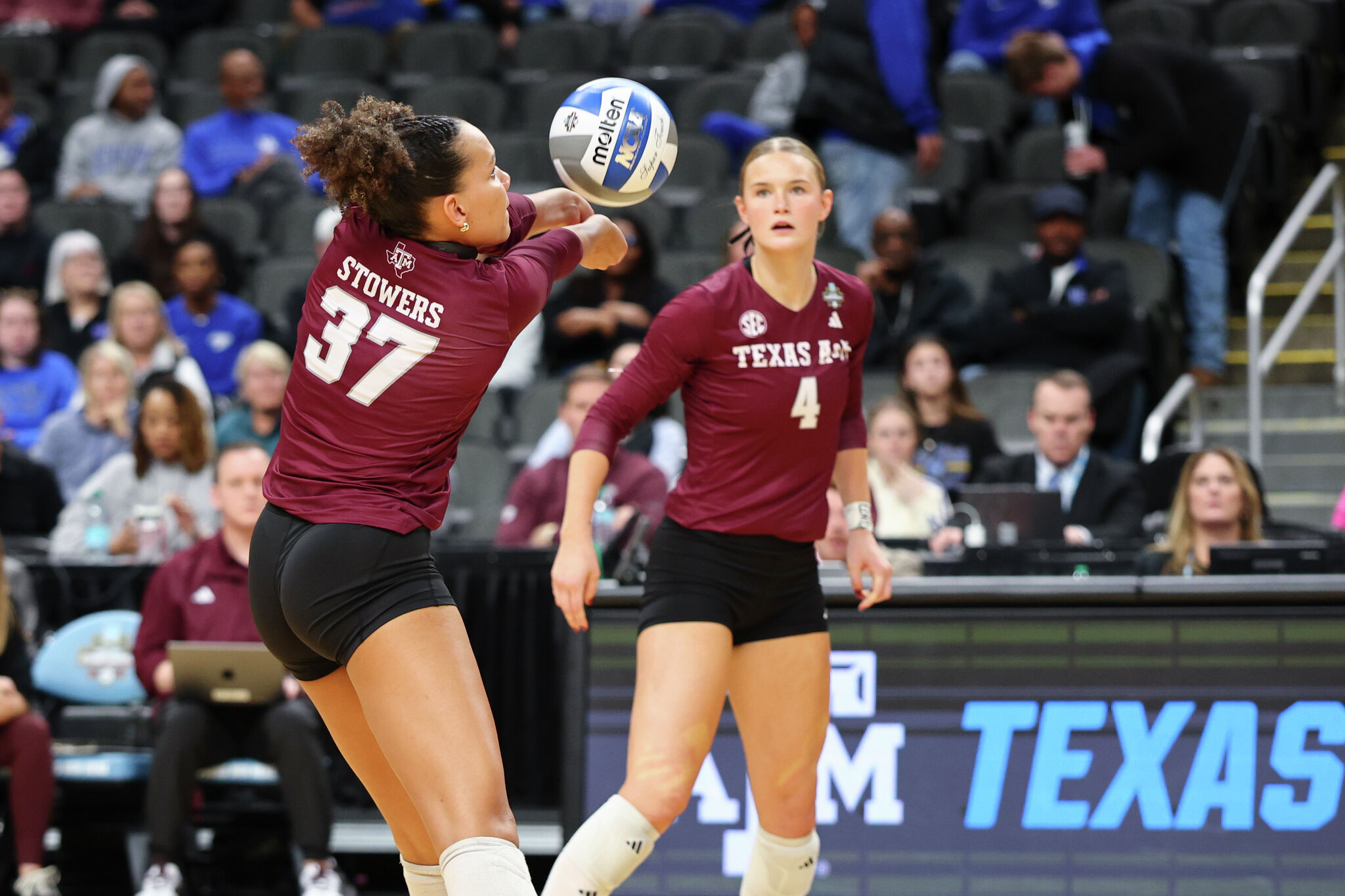
KANSAS CITY, Mo. — In the moments before Texas A&M’s match against Pitt in the NCAA women’s volleyball semifinals, coach Jamie Morrison had simple message.
“We are here,” he told his team. “We are here.”
The meaning was for A&M to stay true to its identity.
The Aggies did with three-set sweep over Pitt and will play for their first national title at 2:30 p.m. on Sunday against either Kentucky or Wisconsin, which played later Thursday in the other semifinal.
A&M’s identity — “we are the grittiest,” senior Logan Lednicky said after last week’s regional win over Nebraska — has power hitters in Lednicky and Kyndal Stowers up front, the middle blocking of Ifenna Coas-Okpalla and the “quarterbacking” of Maddie Waak.
Texas A&M won the first set, 29-27, on its fifth match point on a kill by Stowers, who had nine in the first set with no errors.
A&M appeared to have won earlier on a kill by Lednicky at 25-23 but the ball was ruled out, reversing the score to 24-24. Pitt would have its own set point later but didn’t convert.
In the second set, the Aggies fell behind 15-11 after an 8-0 run by Pitt but answered. Cos-Okpalla blocked a shot by Olivia Babcock to set up set point at 24-21 and A&M got the win when Babcock’s next attempt at a kill went long.
In what turned out to be the deciding third set, A&M took its first lead at 11-10 on a strong serve by Waak. The Aggies finished it off at 25-20.
“We just played good volleyball and had fun,” Morrison said. “It’s pretty simple. They have a lot of grit and anytime another team makes a run, they answer. A lot of belief in that group.”
A&M’s sweep was the first in an NCAA semifinal since Nebraska’s win over Pitt in 2023. Pitt was making its fifth consecutive appearance in the Final Four but has yet to win a title.
Reid Laymance reported from Houston.
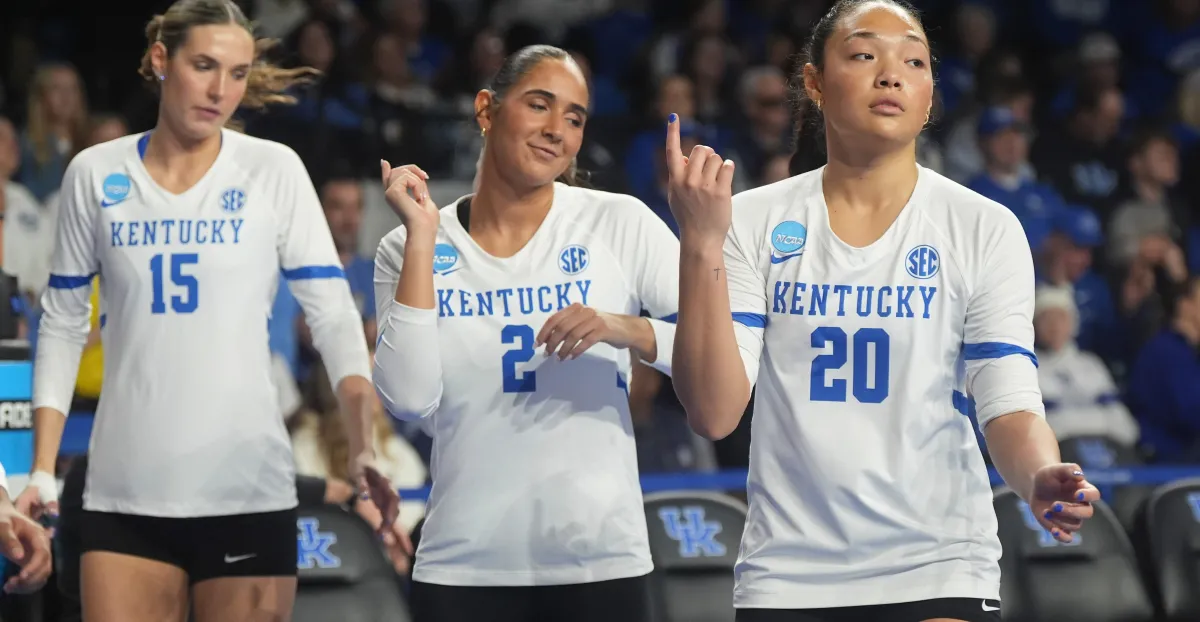
Wisconsin comes into the Final Four at 28–4, fresh off a brutal run through Eastern Illinois, North Carolina, No. 2 Stanford, and No. 1 Texas. Meanwhile, Kentucky sits at 29–2 after sweeping Wofford, Cal Poly, and No. 3 Creighton and outlasting UCLA in four. This isn’t a Cinderella story on either side; this is blue-blood versus rising powerhouse.
On paper, it looks like strength-on-strength almost everywhere you look.
Why Kentucky–Wisconsin is a heavyweight clash of efficiency, blocking, and star power
Kentucky’s offense is built around a vicious one-two punch on the pins. Brooklyn DeLeye is averaging 4.69 kills per set on .289 hitting with 521 kills, while Eva Hudson is right behind her at 4.54 kills per set on .317. That’s 1,000+ kills of high-volume, high-efficiency scoring from the outside and opposite positions. The Cats are hitting .295 as a team with nearly 15 kills per set—elite numbers for this level.
Wisconsin counters with its own superstar in Mimi Colyer, who’s putting up 5.39 kills per set on .340 hitting with 566 total kills. She’s the kind of terminal scorer who can take over a set all by herself. Around her, Carter Booth and Alicia Andrew give the Badgers a massive, efficient middle presence, both are hitting .454 with more than two blocks per match, while Andrew sits at .371 with steady production at the net.
Both teams defend at an absurd level. Kentucky holds opponents to .180 hitting and just over 12 kills per set, with 2.47 blocks per set and 1,653 digs on the season. Wisconsin is just as nasty: opponents are hitting only .184 with 1.79 blocks per set against them and fewer than 12 kills per set.
Translation: this match is probably going to be won at the pins and in transition, not by easy side-outs.
Serving and first contact might be the swing factor. Kentucky has 137 aces and 225 errors on the year, while Wisconsin has 158 aces and 304 errors—both aggressive from the line but willing to live with some risk to knock the other out of the system. The question becomes: who handles that pressure better in serve receive? The Cats have just 79 reception errors across 111 sets; Wisconsin has 85 in 106. Both are tough to rattle, but Kentucky’s backcourt has been incredibly steady during this tournament run.
Setter play will be under the microscope, too. Kassie O’Brien is the engine for Kentucky, averaging 11.02 assists per set and helping spread the ball between DeLeye, Hudson, Lizzie Carr in the middle, and Asia Thigpen on the right. Wisconsin uses Charlie Fuerbringer as its primary distributor, and she’s been excellent at keeping middles engaged while still feeding Colyer in big spots.
From a narrative standpoint, it’s simple: Wisconsin has dominated the head-to-head, winning both prior meetings and dropping just one set total. Kentucky has never gotten over that hump. This time, the Wildcats come in as the higher seed and arguably the more balanced team, while Wisconsin carries the “we’ve been here” aura.
If Kentucky’s passers hold up and DeLeye/Hudson can win enough rallies against a big Badger block, the Cats finally have the firepower to flip the script. If Colyer goes nuclear and Booth controls the middle, Wisconsin’s size and experience could send Kentucky home again.
Either way, it has all the ingredients of a classic: superstar pins, elite setters, massive blocks, and a trip to the national title match hanging in the balance.
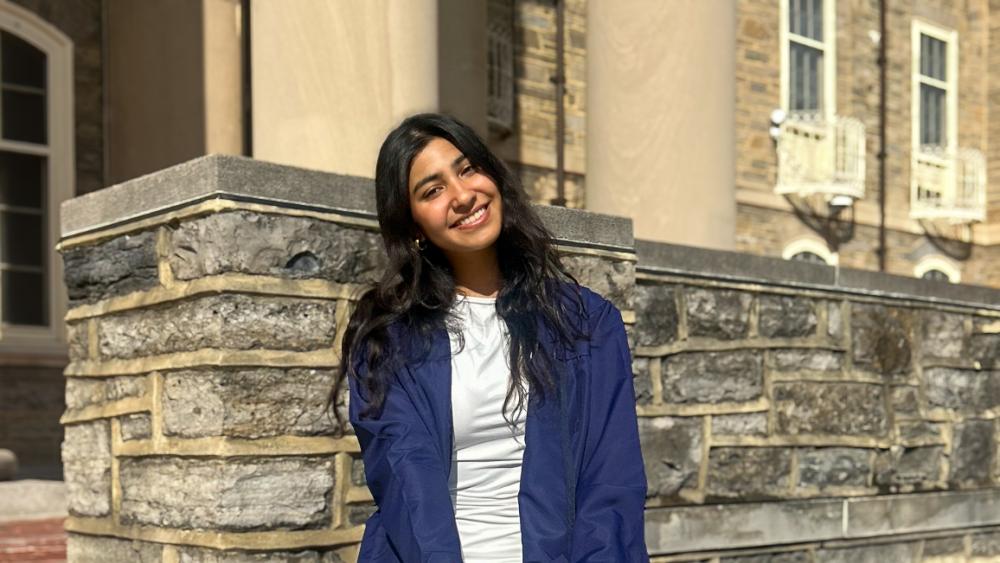
“Penn State is the No. 1 school for Division I Fencing. As a national-level athlete, being recruited to one of the best NCAA teams in the country felt like a dream come true,” Maniar said. “When I arrived as a new student, I realized that many of my teammates didn’t understand my capabilities or how I trained, and it often left me feeling isolated, misunderstood and behind. But it also forced me to confront discomfort head-on, dig deep into my resilience and prove to myself, not anyone else, what I was truly capable of.”
Maniar said her experiences in fencing changed her approach to challenges, teaching her to focus on what she can control and persist with strong, disciplined determination.
She brought the same drive to her studies, leading her to become a Schreyer Scholar. She’s maintained a high grade-point average, crediting it in large part to “the structure, rigor and support the program provided,” she said.
While her honors-level courses were challenging at first, Maniar said she can now see how her analytical skills, interpretations and confidence in handling difficult materials have grown due to her involvement in the program. She said she’s grateful for the professors who guided her intellectually, emotionally and professionally throughout her journey.
“I feel incredibly lucky to have had professors who genuinely cared about me as an individual,” Maniar said. “That’s what makes the College of the Liberal Arts so special, whether it’s a 15-person honors seminar or a 200-person lecture, my professors took the time to listen, guide and support me when I reached out to them.”
Those professors include Associate Teaching Professor of Communication Arts and Sciences John Minbiole, whose honors courses, CAS137H: Rhetoric and Civic Life I and CAS138T: Rhetoric and Civic Life II, left such an impact on Maniar, she said, that she became one of his teaching assistants.
“His teaching style was empathetic yet structured and helped me build confidence in public speaking,” Maniar said. “The safe and encouraging environment he created gave me the skills to speak in front of large audiences, something I know will help me immensely in my career.”
Assistant Professor of English and African Studies Samuel Kolawole and academic adviser Julianna Chaszar were two other influences on Maniar’s college experience, she added.
Kolawole and Maniar initially met at a book reading and later in writing classes. Maniar said Kolawole noticed her enthusiasm, encouraged her to write more and allowed her to gain real-world experience with publishers as a social media content manager for his book releases. In this role, she attended events with Kolawole, including one where he won the prestigious Whiting Award in New York, an experience she describes as unforgettable.

Texas A&M volleyball is going where no previous Aggies team has gone before.

The Aggies pulled two straight upsets against No. 2 seed Louisville and No. 1 overall seed Nebraska to reach their first Final Four in program history. But they are facing a Pittsburgh squad that has appeared in every national semifinals since 2021.
Article continues below this ad
Led by nine seniors, the Aggies have called themselves the “grittiest team” in the tournament, allowing them to come back and win matches against TCU and Louisville.
“We know how to get down and dirty, and grind when it when it matters most,” outside hitter Logan Lednicky said after the team erased a 1-0 deficit agains TCU.
RELATED: How beating Nebraska helps Aggies volleyball in Final Four
If A&M wins, they will face the winner of the other semifinal: Kentucky vs Wisconsin.
Article continues below this ad

Texas A&M players celebrate winning the NCAA Division I volleyball playoff game against TCU at Reed Arena on Saturday, Dec. 6, 2025 in College Station, Texas.


Here are live updates of Texas A&M’s national semifinal against Pittsburgh:

Ifenna Cos-Okpalla and Logan Lednicky combine for the block on Nebraska’s Harper Murray during the Elite Eight on Dec. 14, 2025 in Lincoln, Neb.


2025 NCAA Tournament, Final Four
Panthers start on a 2-0 run after Pittsburgh makes a few changes on offense. Stowers swings hard cross court to put the Aggies on the board. Waak serves an error. Cos-Okpalla slams down a ball in the middle of the court in a one-on-one. Pitt delivers two free balls to A&M and Lednicky ties the match at three. Stowers serves an error, but Lednicky gets it back by going line. Pitt’s passing improved on Cos-Okpalla’s serve to break the tie. Perkins ties the match with a swing.
Article continues below this ad
Pitt sends a kill from the middle to the back row. Hellmuth tools the block and splits two defenders to send A&M into the redzone with an offspeed shot. Fitch serves an error. Hellmuth’s shot goes wide. Waak sneaks a throwdown in the wide open court. Bayless’ kill sneaks into the back corner to put the Panthers in the redzone. Lednicky’s kill does wide and the error ties the set at 21. Stowers’ kill retakes the lead. A tight set from Pitt leads to an attack error. Babcock is blocked to give A&M set point. Babcock goes wide for a kill but misses high hands.
A gritty point continues Pitt’s 6-0 run. The Panthers are serving out of system balls and the Aggies are having trouble adjusting. Cos-Okpalla stops the Panthers’ 8-0 run. Lednicky fins the back corner to close the gap. Lednicky’s kill is blocked but Pitt hit the antena and Stowers serves an ace to continue the Aggies’ scoring run. Pitt goes to Babcock to break the tie. Cos-Okpalla throws down to tie the set again. Lednicky powers it in front of the net for the Aggies to retake the lead. Perkins swings through the Panthers block, forcing Pitt to call a timeout.
Article continues below this ad
Kelley’s kill couldn’t be dug up and Pitt follows it up with a service error. A&M serves an error. A tight serve from Waak couldn’t connect with Cos-Okpalla’s arm and Waak is called for an error. Babcock goes cross court for the kill and tie. A&M is called for a net violation and the Aggies take the lead.
Lednicky serves a floater that drops over the night and Perkins roofs the Panthers. Hellmuth takes a corner kill. Pitt challenges a Panthers swing was touched but while there was no A&M touch, the call was ruled in. But Pitt serves an error making momentum short lived. Cos-Okpalla blocks gives A&M a four point lead. Pitt calls a timeout.
Article continues below this ad
Stowers is met with a Babcock block at the net. But the lead is short lived when it sails out of bounds. A dig from a Babcock kill sails out, but A&M challenges the ball was in because it tagged the line. The call will stand due to inconclusive video evidence and A&M loses the challenge. But Stowers gets the kill to tie the match. Babcock gives Pitt the lead but Lednicky ties it again. Babcock is leading the Panthers with 11 kills. Perkins hammers the ball into the middle to retake the lead.
Stowers ties the match for the 17th time. Thomas serves an ace for a fifth set point and Stowers hits high hands to take set one.
Article continues below this ad
Babcock adjusts and blocks Lednicky. But Waak sends the ball to Lednicky again who had a different blocker to get set point. Babcock forces a second set point. Lednicky’s shot takes a sharp angle to win the set but Pitt challenges if the ball was in and the call is reversed, forcing a 24-24 tie. Hellmuth tools the block for the third set point. Fitch’s serve forces Pitt out of system but Hellmuth’s power tip is blocked and ties the match at 25. Aggies go to Lednicky for the fourth set point but Hellmuth’s serve sails out. Babcock’s swing gives Pitt its first set point. A&M calls a timeout.
Stowers’ swing breaks the tie. Lednicky goes for the high hands on Babcock to catch the Pitt block off balance. Pitt calls another timeout and the Aggies are hitting .519 with Stowers leading the way with seven kills and zero errors.
Article continues below this ad
Stowers ties it at 18. Pitt takes the lead but A&M challenges that the Panthers were in the net and the call is reversed. Pitt ties it with a quick point. Cos-Okpalla swings to put A&M in the redzone and Stowers goes high for a kill that finds Panther hands. Waak serves an error to put Pitt in the redzone. A tight pass gives Kelley the kill and the tie for Pitt.
Pitt goes on a 3-0 to tie the match. Service from Mosher is coming in deep and hot, forcing the Aggies to play a little out of system. Bayless taps it over for the kill but A&M’s block is coming alive. Cos-Okpalla’s serve goes long to get Pitt within one. Babcock ties the match with a kill after a block touch is deflected. Hellmuth threads the needle of the Pitt block and Babcock goes line. Pitt takes the lead after getting a touch on a long kill. Hellmuth ties it at 17
Article continues below this ad
A&M wins a point after a rally full of Cos-Okpalla blocks. Pitt takes an early time out after A&M has its largest lead of the night. So far, three Aggies (Stowers, Cos-Okpalla and Lednicky) are hitting above .500.
A 2-0 Aggies run ends with two straight points from Bayless. A&M goes for tips early and Pitt uses them to set up easy kills. A swing from Stowers ties the match at three. Lednicky goes for the kill against Babcock and wins the one-on-one; Cos-Okpalla gets the point on a one-on-one in the middle. Lednicky is finding confidence going down the line early and a serve from the senior give the Aggies an ace. Pittsburgh delivers an early service error.
Article continues below this ad
Article continues below this ad
Article continues below this ad
Article continues below this ad
Article continues below this ad
Where:T-Mobile Center in Kansas City, Mo.


Captains: Maddi Cuchran, Allison Jacobs, Serena Nyambio
Record: 22-11, 11-9 Big Ten Conference (Ninth Place)
NCAA Tournament: Second Round
The University of Michigan volleyball team finished with its best record since 2018 in head coach Erin Virtue‘s third season at the helm of the Wolverines. Rounding out the season with 22 wins, this marked the 15th time in program history the team has won more than 20 games. U-M finished the season with an NCAA Tournament berth, the first time since 2021 and the first time under Virtue.


Team Highlights
• Michigan compiled a 22-11 overall record and an 11-9 Big Ten Conference mark to finish ninth in the league. The Wolverines were picked to finish 10th in the preseason poll and managed to take sets off five of the eight teams ahead of them, including two wins.
• Eleven of U-M’s 27 opponents earned NCAA Tournament berths, with nine coming from the Big Ten to match a conference record. The Wolverines finished 45th in the RPI, 57 places higher than 2024 and went 20-4 in quads 2-4.
• Michigan started the season 6-0 before dropping a five-set match to Virginia; then finished non-conference play with four consecutive wins to give the Wolverines a 10-1 non-conference record. U-M faced five ranked teams in the first eight games of conference play, but finished the Big Ten season 9-3 to earn an NCAA tournament berth for the first time since 2021.
• The Wolverines got a statement win, defeating then-No. 10-ranked Minnesota — which finished 14th in the RPI and 17th in the AVCA poll. After dropping the first set, U-M went on to dominate the next three sets winning 25-12, 25-14, 25-12 led by a 20-kill performance from Allison Jacobs. U-M finished the match hitting .383 and held Minnesota to a .093 hitting percentage with the help of nine blocks and 53 digs.
• Another highlight came via a five-set win against reigning national champion and No. 19-ranked Penn State. The Nittany Lions controlled the first set with the Wolverines always following close behind before eventually falling 25-21. After falling behind early 11-6 in the second set, U-M battled back to win 25-21. An overall close third set ended in a 28-26 Penn State victory. After a close fourth and fifth set, Michigan won the battle. Four Wolverines tallied double-digit kills, led by 18 each from Jacobs and Ella Demetrician, while Cymarah Gordon added 13 and Serena Nyambio recorded 10.
• Michigan earned its 21st NCAA Tournament appearance, and first since 2021, heading to the Pittsburgh regional where the Wolverines faced off against No.8-seeded Xavier in the first round. U-M won in straight sets (25-19, 25-15, 25-23) for its first NCAA Tournament win since 2019. The Maize and Blue was led by 19 kills from Jacobs and four aces from Maddi Cuchran. The Wolverines then faced off against No.1-seeded Pittsburgh, dropping the first two sets by just two points but fell in three sets.
• The Wolverines retained the state pride flag for the second year in a row. U-M and Michigan State split the series with each program sweeping at home, but U-M held the Spartans to one fewer point over the matches. In the Wolverine win, Cuchran recorded her 1,000th career dig.
• U-M swept Ohio State in both matches this season for the first time since 2019. In Columbus, Michigan hit .471 against the Buckeyes and held OSU to .067, including a -.036 hitting percentage in a 25-9 set-two win. Across the two matches, Jacobs totaled 27 kills and Demetrician added 24 kills, with both recording double-digit kills in both matches.
• Michigan hosted a record 12 games at Crisler Center during the 2025 season. They went 9-3 in those matches, with notable wins over Minnesota, Penn State, and rivals Ohio State and Michigan State, while hosting a record 12,707 fans in a match against Nebraska.
• The Nebraska match marked the first time in program history that Michigan sold out Crisler, and it was just the fourth women’s sports event sell out Crisler. The Wolverines had the highest average attendance in program history, with a 50 percent increase in average attendance compared to 2024. U-M finished the season ranking 17th in the NCAA in total attendance and was 21st in average attendance.
Individual Highlights
• Earning All-Big Ten first-team status and being one of nine unanimous selections, Jacobs had a phenomenal final collegiate season. She tallied 473 kills in 33 matches, including a career-high 26 kills in a double-double performance against Iowa, one of seven double-double matches this season. Jacobs set a new career high in aces with 34, tied for the team lead, and totaled 227 digs (third) and was fifth on the team with 63 total blocks. She finished the season with the 10th-most kills in a single season in program history.
• Making the All-Big Ten second team, Nyambio had a strong senior season. Nyambio became the first U-M player since 2003 with 100 blocks or more in a Big Ten season, recording 104, to tie the program record. She finished the season ranking fourth in the Big Ten and 27th in the nation with a .394 hitting percentage over 449 total attempts, recording 220 kills. Nyambio also led the team with 151 total blocks, good for third in the Big Ten and 22nd in the nation. She finished her career seventh in total blocks, seventh in block assists and 12th in solo blocks.
• Sophomore Jenna Hanes led the Wolverines with a .450 hitting percentage with 185 kills and 23 errors over 360 total attempts. Hanes had the highest hitting percentage in program history since the rally-scoring era began in 2001, with a minimum of 300 attacks. She never had more than two errors in a match and was errorless in 15 matches. Hanes also contributed defensively with 118 total blocks, good for second on the team and 14th in the Big Ten this season.
• Junior Morgan Burke led the Wolverines as their starting setter, playing in all 121 sets and starting all 33 matches, totaling 791 assists this season. Burke recorded 20 assists or more in 20 matches this season, including a career-high 56 against Rutgers. She sits eighth all-time in career assists at Michigan with 2,447. Burke was also second on the team in digs with 241 and tied for the team lead with 34 aces.
• Cuchran led the team with 408 digs, finishing her career with 1,083 — the 13th-best total in program history. She tallied double-digit digs in 24 matches this season, including her first two career double-doubles in back-to-back matches, recording 10 assists against Washington and Oregon. Cuchran added a career-high 27 aces, including four in the NCAA Tournament win over Xavier, to become just the fourth Wolverine with four aces or more in an NCAA Tournament match.
• Demetrician was second on the team in kills with 284 on 700 total attempts, for a .214 hitting percentage. She registered seven double-doubles, including an 18-kill, 11-dig performance against Penn State. Demetrician had 190 total digs this season, good for fourth on the team, and added 20 aces and 41 blocks.
• Lydia Johnson finished the season with a career-best 183 kills and 52 errors on 440 total attempts to give her a .298 hitting percentage. Johnson was also third on the team in total blocks (65). Her strongest match of the season came in the upset win over Minnesota with 14 kills on 22 swings along with three block assists.
• After an injury in last year’s preseason, Gordon contributed in her redshirt freshman season. She had 129 kills on the season and added 56 total blocks, with her season high in kills (13) coming against No. 19 Penn State. Gordon started the final 14 matches, during which U-M went 10-4.
Honors and Awards

Morgan
Burke

Maddi
Cuchran

Ella
Demetrician

Jenna
Hanes

Allison
Jacobs

Serena
Nyambio
American Volleyball Coaches Association
All-America (Honorable Mention): Allison Jacobs
All-North Region (First Team): Allison Jacobs, Serena Nyambio
Big Ten Conference
All-Big Ten (First Team): Allison Jacobs
All-Big Ten (Second Team): Serena Nyambio
Sportsmanship Award: Sydney Schnichels
College Sport Communicators
Academic All-America (Third Team): Allison Jacobs
Academic All-Region: Morgan Burke, Allison Jacobs, Lydia Johnson, Serena Nyambio
Academic All-Big Ten
Morgan Burke, Jr., Movement Science
Maddi Cuchran, Gr., Management
Ella Demetrician, So., LSA undeclared
Camille Edwards, R-Fr., Sport Management
Carly Greskovics, Jr., Sport Management
Jenna Hanes, So., Business Administration
Allison Jacobs, Gr., Management
Lydia Johnson, Jr., Movement Science
Trixie McMillin, So., Engineering
Serena Nyambio, Sr., Biology, Health, & Society
Amalia Simmons, Sr., Biopsychology, Cognition, & Neuroscience
Ellie White, So., LSA undeclared

Sports16 minutes ago
Aggies sweep Pitt to reach NCAA title game

Rec Sports26 minutes ago
Visit Eau Claire and Sonnentag Center host 2026 Flag Football tournament

Sports32 minutes ago
Previewing Kentucky Volleyball vs. Wisconsin Badgers in the Final Four

Rec Sports34 minutes ago
Midweek Matinee A Celebration for Community’s Kids

Technology36 minutes ago
Sultan Almasoud on the Top Trends in Technology and Esports in Saudi Arabia – Tech & Sourcing @ Morgan Lewis

NIL38 minutes ago
Joel Klatt can’t stand NIL re-signing announcements

Rec Sports43 minutes ago
More Than 550 Boys Volleyball Teams Gather in Los Angeles for SoCal Cup ‘Winter Formal’ Event and College Combine

Sports1 hour ago
From student-athlete to entrepreneur, Liberal Arts graduate charts next chapter

Technology1 hour ago
What to expect from Gaming Malta at ICE Barcelona

NIL2 hours ago
Texas Tech Linked to $2.4 Million College Football Transfer Quarterback

Sports2 hours ago
Live updates as Aggies take 2-0 lead

Sports2 hours ago
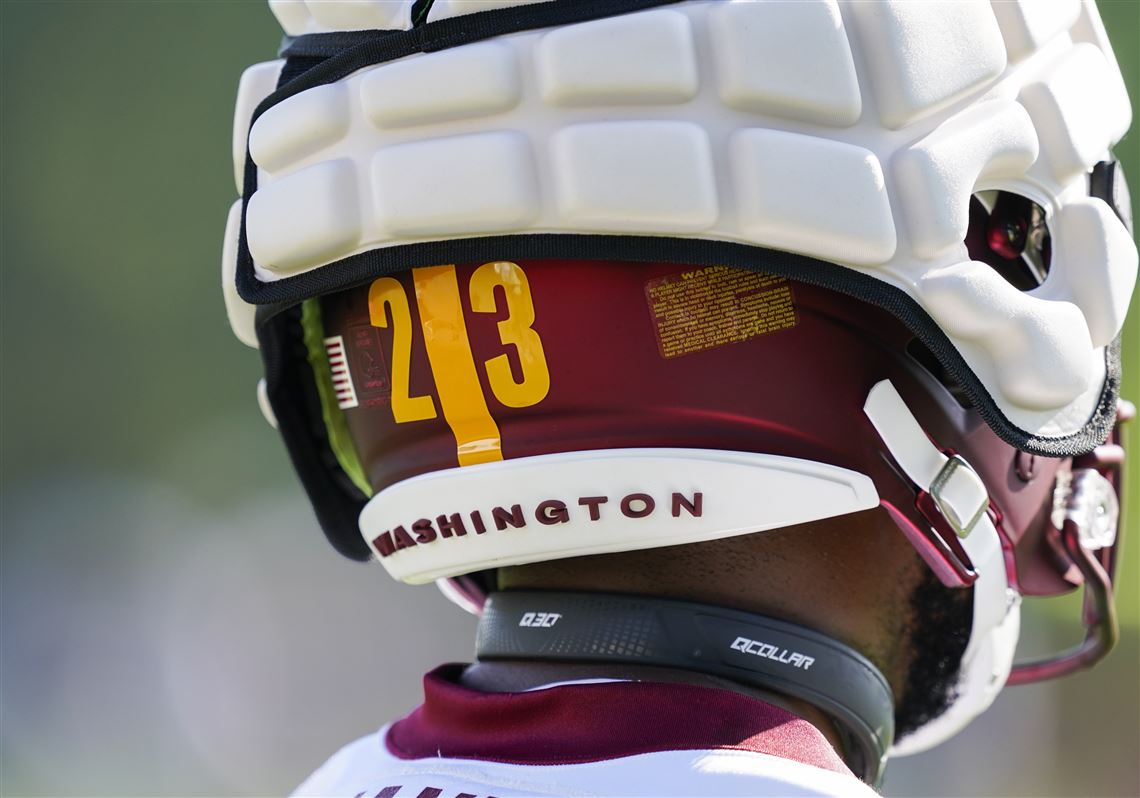
Q-Collar to make NCAA volleyball appearance in Final Four Pitt-A&M match

Rec Sports2 hours ago
Trump administration moves to cut off transgender care for children
Rec Sports2 hours ago
LEIFRAS Co., Ltd. Reports Financial Results for the Nine Months Ended September 30, 2025

Sports2 hours ago
Season Review: 2025 Michigan Volleyball

Rec Sports4 weeks ago
First Tee Winter Registration is open

Rec Sports3 weeks ago
Fargo girl, 13, dies after collapsing during school basketball game – Grand Forks Herald

Motorsports3 weeks ago
CPG Brands Like Allegra Are Betting on F1 for the First Time

Motorsports4 weeks ago
F1 Las Vegas: Verstappen win, Norris and Piastri DQ tighten 2025 title fight

Sports4 weeks ago
Volleyball Recaps – November 18

Sports3 weeks ago
Sycamores unveil 2026 track and field schedule

Sports3 weeks ago
Two Pro Volleyball Leagues Serve Up Plans for Minnesota Teams

Sports3 weeks ago
Utah State Announces 2025-26 Indoor Track & Field Schedule

Motorsports3 weeks ago
Redemption Means First Pro Stock World Championship for Dallas Glenn

Motorsports1 week ago
SoundGear Named Entitlement Sponsor of Spears CARS Tour Southwest Opener

Motorsports3 weeks ago
Jo Shimoda Undergoes Back Surgery

Sports3 weeks ago
Texas volleyball vs Kentucky game score: Live SEC tournament updates

NIL3 weeks ago
Bowl Projections: ESPN predicts 12-team College Football Playoff bracket, full bowl slate after Week 14

Rec Sports3 weeks ago
How this startup (and a KC sports icon) turned young players into card-carrying legends overnight

Rec Sports3 weeks ago
Robert “Bobby” Lewis Hardin, 56





-
 Motorsports1 week ago
SoundGear Named Entitlement Sponsor of Spears CARS Tour Southwest Opener
-
 Motorsports3 weeks ago
Jo Shimoda Undergoes Back Surgery
-
 NIL3 weeks ago
Bowl Projections: ESPN predicts 12-team College Football Playoff bracket, full bowl slate after Week 14
-
 Rec Sports3 weeks ago
How this startup (and a KC sports icon) turned young players into card-carrying legends overnight
-
 Rec Sports3 weeks ago
Robert “Bobby” Lewis Hardin, 56
-
Sports3 weeks ago
Wisconsin volleyball sweeps Minnesota with ease in ranked rivalry win
-

 Motorsports1 week ago
Donny Schatz finds new home for 2026, inks full-time deal with CJB Motorsports – InForum
-

 Motorsports3 weeks ago
Increased Purses, 19 Different Tracks Highlight 2026 Great Lakes Super Sprints Schedule – Speedway Digest
-

 Rec Sports2 weeks ago
How Donald Trump became FIFA’s ‘soccer president’ long before World Cup draw
-

 Motorsports3 weeks ago
Michael Jordan’s fight against NASCAR heads to court, could shake up motorsports