Connect with us
https://yoursportsnation.com/wp-content/uploads/2025/07/call-to-1.png

NIL

How 2024-25 CFP Would’ve Looked Under Proposed Expansion Formats

Published

on


The College Football Playoff will almost certainly expand again in 2026, going from a 12-team format to a 14- or 16-team format. While we don’t know which of these it’ll be, it’s always fun to think about what things could look like.

In the most recent episode of “The Joel Klatt Show: Big Noon Conversations,” Big Ten commissioner Tony Petitti broke down how discussions over the CFP expansion are going, as he holds a key role. He also shared that he’s seeking more meaningful games in the CFP expansion and believes that a 16-team format could help accomplish that. 

“Bigger is better,” Petitti said. “I think 12 is not enough teams given the size of the teams that are competing. You look at professional leagues, they [have] somewhere between 40% and 50% of their teams qualifying for the postseason. We’re way below that, even at 16. I think we want to be really careful.”

As Petitti potentially seeks a 16-team CFP, the determination of which 16 (or 14) teams would qualify is still up for debate. Automatic qualifiers would likely be involved in some form or fashion. 

So, let’s see how the proposed formats for the CFP expansion could have impacted last year’s field, with the consideration that the CFP has already gone to a straight seeding model after last year.

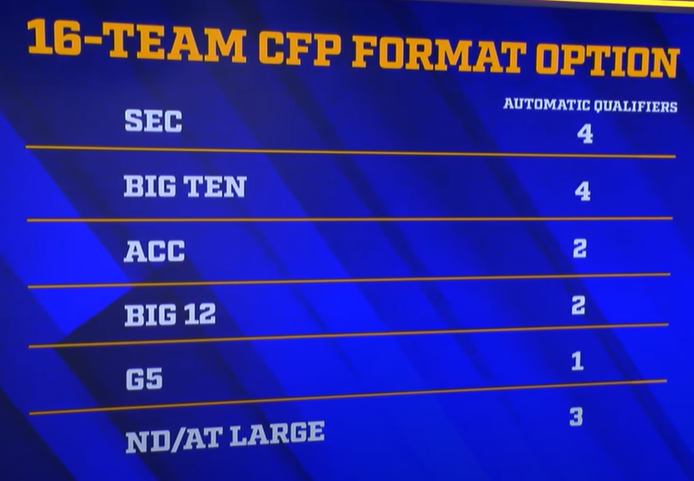
4+4+2+2+1+3 format

In this format of the 16-team model, the Big Ten and the SEC would’ve received four automatic bids to the CFP, while the ACC and Big 12 each would’ve received two. There also would’ve been an automatic spot for the highest-ranked Group of 5 conference champion and three at-large bids. With the idea of a conference championship weekend being thrown out there as an extension to the CFP expansion, we used the standings for the four major conferences to help determine which teams would have received those automatic qualifying spots.

In the Big Ten, both Oregon and Penn State would’ve received an automatic bid, as they had the two best conference records in the regular season. The other two games in the Big Ten during conference championship weekend would have been Illinois (No. 6 in the Big Ten standings) at Indiana (No. 3 in the Big Ten standings) and Iowa (No. 5 in the Big Ten standings) at Ohio State (No. 4 in the Big Ten standings). The winner of those two games would’ve received the two automatic bids. In this practice, let’s presume that Indiana and Ohio State win their respective games.

In the SEC, both Georgia and Texas would’ve received an automatic bid, as they had the two best conference records in the regular season. The other two games in the SEC would’ve been South Carolina (No. 6 in the SEC standings) at Tennessee (No. 3 in the SEC standings) and LSU (No. 5 in the SEC standings) at Alabama (No. 4 in the SEC standings). Just like the Big Ten, the winners of those games would’ve received the conference’s two other automatic bids. So, let’s presume the favorites of those games win, meaning Tennessee and Alabama advance.

As for the ACC and the Big 12, it isn’t exactly known what their conference championship weekends would look like. The ACC recently mentioned an idea where it could have its regular-season conference champion get a bye that week, meaning the second- and third-place teams in the regular-season standings play for the conference’s other automatic berth.
For the sake of this exercise, let’s send the two teams who finished No. 1 and No. 2 in the regular season standings for the ACC and Big 12 to the CFP. That would mean SMU and Clemson would advance out of the ACC, while Arizona State and Iowa State would’ve advanced out of the Big 12. Boise State was the highest-ranked Group of 5 conference champion, receiving the No. 9 ranking in the final CFP poll. That was an easy one to figure out.

As for the three at-large spots, that’s where things might get a little tricky. Notre Dame was ranked fifth in the final CFP poll, meaning it would’ve likely occupied one of these at-large bids. If we went by the rankings, Miami (Fla.) and Ole Miss would’ve received the final two at-large spots. However, neither of those teams would’ve played in conference championship weekend during this exercise, leading to some potential murkiness with assembling the field. For now, let’s send Miami and Ole Miss to the CFP.

Here’s how that 16-team field would’ve looked under that format, using the final CFP rankings: 

  1. Oregon
  2. Georgia
  3. Texas
  4. Penn State
  5. Notre Dame
  6. Ohio State
  7. Tennessee
  8. Indiana
  9. Boise State
  10. SMU
  11. Alabama
  12. Arizona State
  13. Miami (Fla.)
  14. Ole Miss
  15. Clemson
  16. Iowa State 

First two teams out: South Carolina, BYU

One of the ideas being thrown out there for the 16-team CFP is for the top two seeds to get a double bye and a play-in round between the No. 13-16 seeds. That would mean Miami would host Iowa State, which was the Pop-Tarts Bowl matchup this past season, and Ole Miss would host Clemson. As for second-round matchups, Ohio State would’ve hosted Alabama and Notre Dame would’ve hosted Arizona State. Oregon also would’ve avoided Ohio State in the quarterfinals thanks to the straight seeding. 

5+11 format

This is probably the easiest of the five formats to understand. In this format, the five highest-ranked conference winners plus the 11 highest-ranked at-large teams would’ve received a berth into the 2024 CFP.

Here’s how that would’ve looked like:

  1. Oregon
  2. Georgia
  3. Texas
  4. Penn State
  5. Notre Dame
  6. Ohio State
  7. Tennessee
  8. Indiana
  9. Boise State
  10. SMU
  11. Alabama
  12. Arizona State
  13. Miami (Fla.)
  14. Ole Miss
  15. South Carolina
  16. Clemson

First two teams out: BYU, Iowa State

In the possible scenario that there’s a “play-in weekend,” we would’ve seen two conference matchups taking place. Miami would’ve hosted Clemson after the Tigers won the ACC Championship Game, while Ole Miss would’ve hosted South Carolina. This format would’ve really only changed the last two seeds from the previous format, with South Carolina taking Iowa State’s spot in the field. That would’ve left the Big 12 with just one team in the tournament. 

4+4+2.5+2.5+1+2 format

This format is similar to the first format we mentioned. The only difference is that there would’ve been one more automatic bid for an ACC team or the Big 12 would receive a third automatic bid, depending on which conference’s third-place team is ranked higher. As a result, there would’ve been one fewer at-large spot. 

For the sake of brevity, let’s assume that the same eight teams from the Big Ten and the SEC in the first format receive the eight automatic bids between the two conferences in this format. Let’s also assume SMU, Clemson, Arizona State and Iowa State also receive the first two automatic bids from their respective conferences, the ACC and the Big 12.

That would leave Miami and BYU as the two third-place teams from the ACC and the Big 12 seeking the other automatic qualifying spot. Miami was the higher-ranked team of the two (No. 13 to BYU’s No. 17 ranking), meaning the Hurricanes would advance to the CFP. But if the CFP really wanted to get creative, it could have the third-place teams in the ACC and the Big 12 go head-to-head for this spot.

Again, Boise State was the highest-ranked Group of 5 conference champion, so it would’ve received a spot in this format. Notre Dame was ranked fifth in the final CFP poll, so it likely would’ve been given one of the last at-large bids. Ole Miss would’ve been the second-highest ranked non-automatic-qualifying team, likely giving it a berth in the CFP.
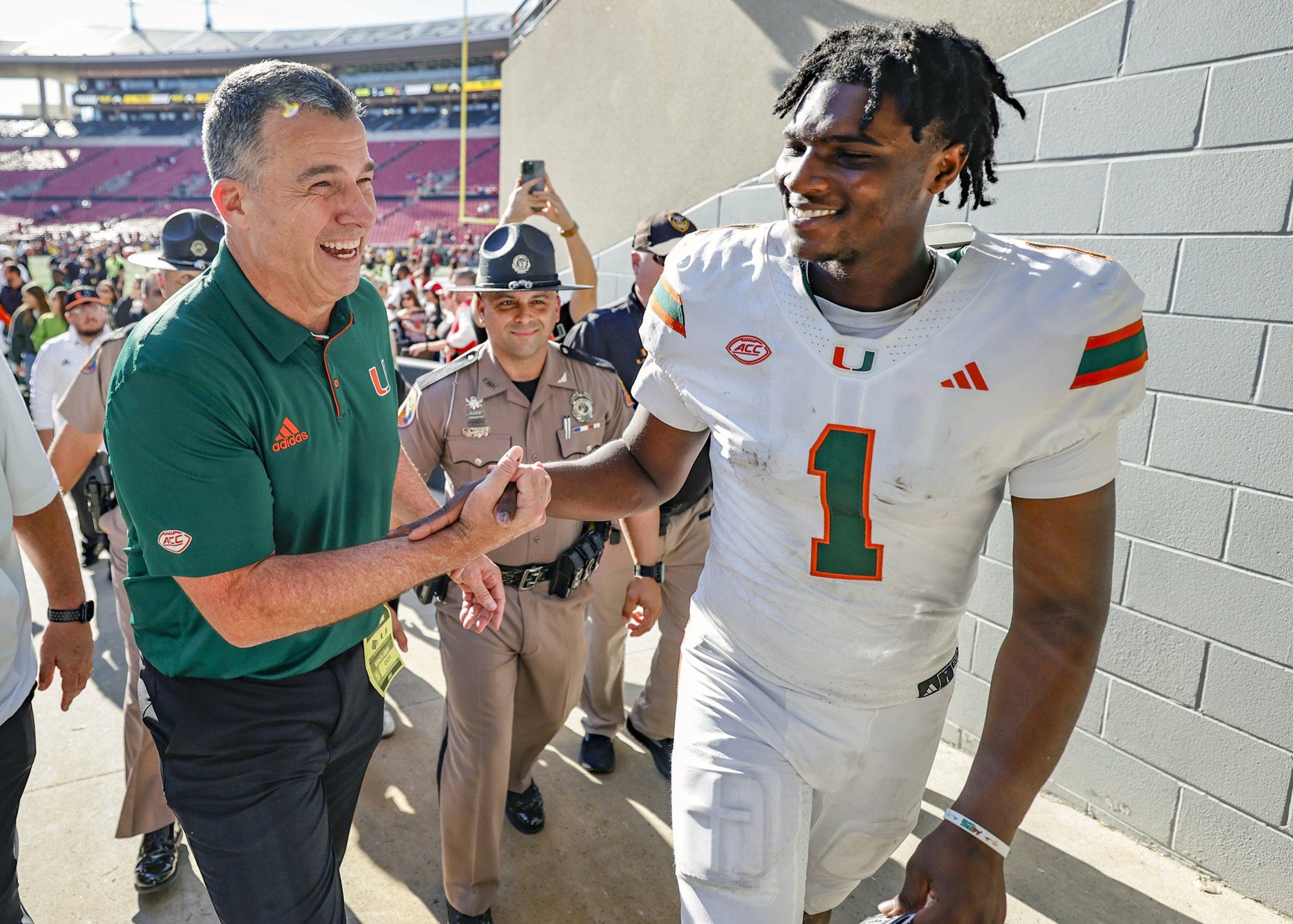
Cam Ward and the Miami Hurricanes would’ve almost certainly made the College Football Playoff if it was a 16-team field, regardless of the format. (Al Diaz/Miami Herald/Tribune News Service via Getty Images)

Here’s what the 16-team field would’ve looked like in this format:

  1. Oregon
  2. Georgia
  3. Texas
  4. Penn State
  5. Notre Dame
  6. Ohio State
  7. Tennessee
  8. Indiana
  9. Boise State
  10. SMU
  11. Alabama
  12. Arizona State
  13. Miami (Fla.)
  14. Ole Miss
  15. Clemson
  16. Iowa State

First two teams out: South Carolina, BYU

This format would’ve produced the exact same 16 teams and seeds as the first format we mentioned. The big difference is that the slight tweak would’ve given Miami an automatic bid, as none of the other formats would’ve given the Hurricanes a guaranteed spot in the field last season. It also would’ve given some more stability to the ACC or the Big 12, as their respective conferences’ third-place team typically isn’t ranked in the top 10 of the final CFP poll. 

4+4+3+3+1+1 format

In this proposed format, the ACC and the Big 12 would each get three automatic qualifiers, while the Big Ten and the SEC would still get four. There would also be an automatic qualifier for the highest-ranked Group of 5 conference champion to go along with one at-large bid.

As with the other two examples where the Big Ten and the SEC get four automatic qualifiers, we’ll assume the same eight teams make it into the field via the conference championship weekend. How the ACC and the Big 12 would determine their three automatic qualifiers in this scenario is anyone’s guess, but the simplest way would be to have the top two teams in each conference in the regular season occupying two of those spots, while the third would be determined through a play-in game. If the higher-ranked team won those games, we’d have SMU, Clemson and Miami representing the ACC, while Arizona State, Iowa State and BYU would get the Big 12’s three automatic qualifiers.
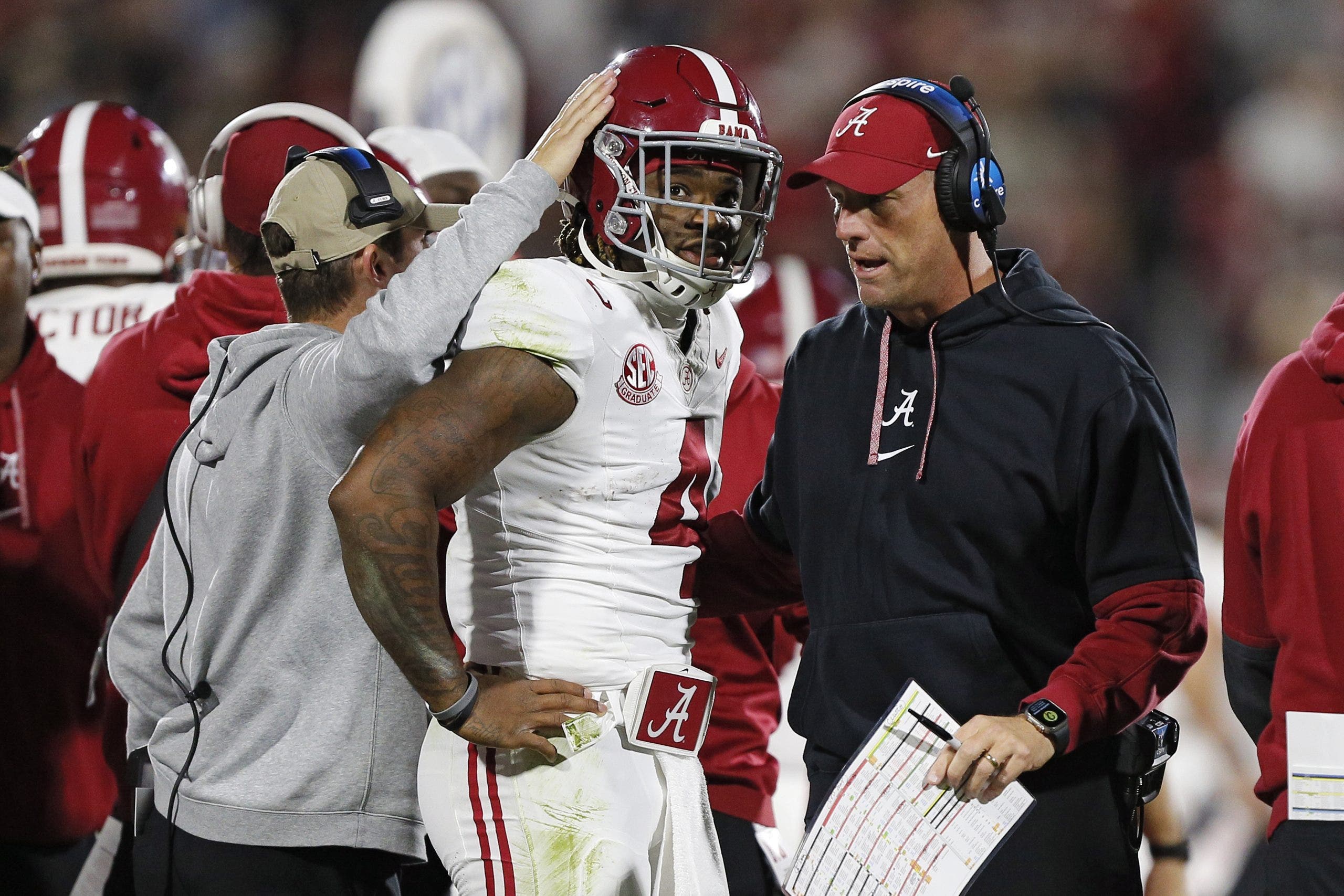
Jalen Milroe, Kalen DeBoer and Alabama could’ve made the College Football Playoff last season in an expanded field. (Photo by Brian Bahr/Getty Images)

Again, Boise State would be the Group of 5 representative and Notre Dame would likely occupy the lone at-large spot. 

Here’s how the field would’ve like in this scenario: 

  1. Oregon
  2. Georgia
  3. Texas
  4. Penn State
  5. Notre Dame
  6. Ohio State
  7. Tennessee
  8. Indiana
  9. Boise State
  10. SMU
  11. Alabama
  12. Arizona State
  13. Miami (Fla.)
  14. Clemson
  15. Iowa State
  16. BYU

First two teams out: Ole Miss, South Carolina

The big difference in this format is Ole Miss wouldn’t qualify for the CFP because it didn’t finish in the top six of the SEC, nor was it the highest-ranked remaining team for an at-large spot. A potential play-in weekend in this scenario would’ve featured two ACC-Big 12 battles, while the top 12 seeds remain consistent with the other three formats we’ve gone over so far.

14 team format: 4+4+2+2+1+1

While it seems unlikely, a 14-team format is still on the table for the latest round of CFP expansion. The most common format for a 14-team playoff features four automatic bids for the Big Ten and the SEC, while the ACC and the Big 12 get two apiece. The highest-ranked Group of 5 conference champion would also get an automatic bid, while there would be an at-large bid for the highest-ranked remaining team.

This format is comparable to the first format we mentioned; it just has two fewer at-large bids. So, the four teams representing the Big Ten and the SEC would remain the same in our practice scenario. The same goes for the ACC (SMU and Clemson) and the Big 12 (Arizona State and Iowa State), but as we mentioned earlier, it’s unclear what each of those conferences would likely do for a conference championship weekend if it had two automatic bids. 
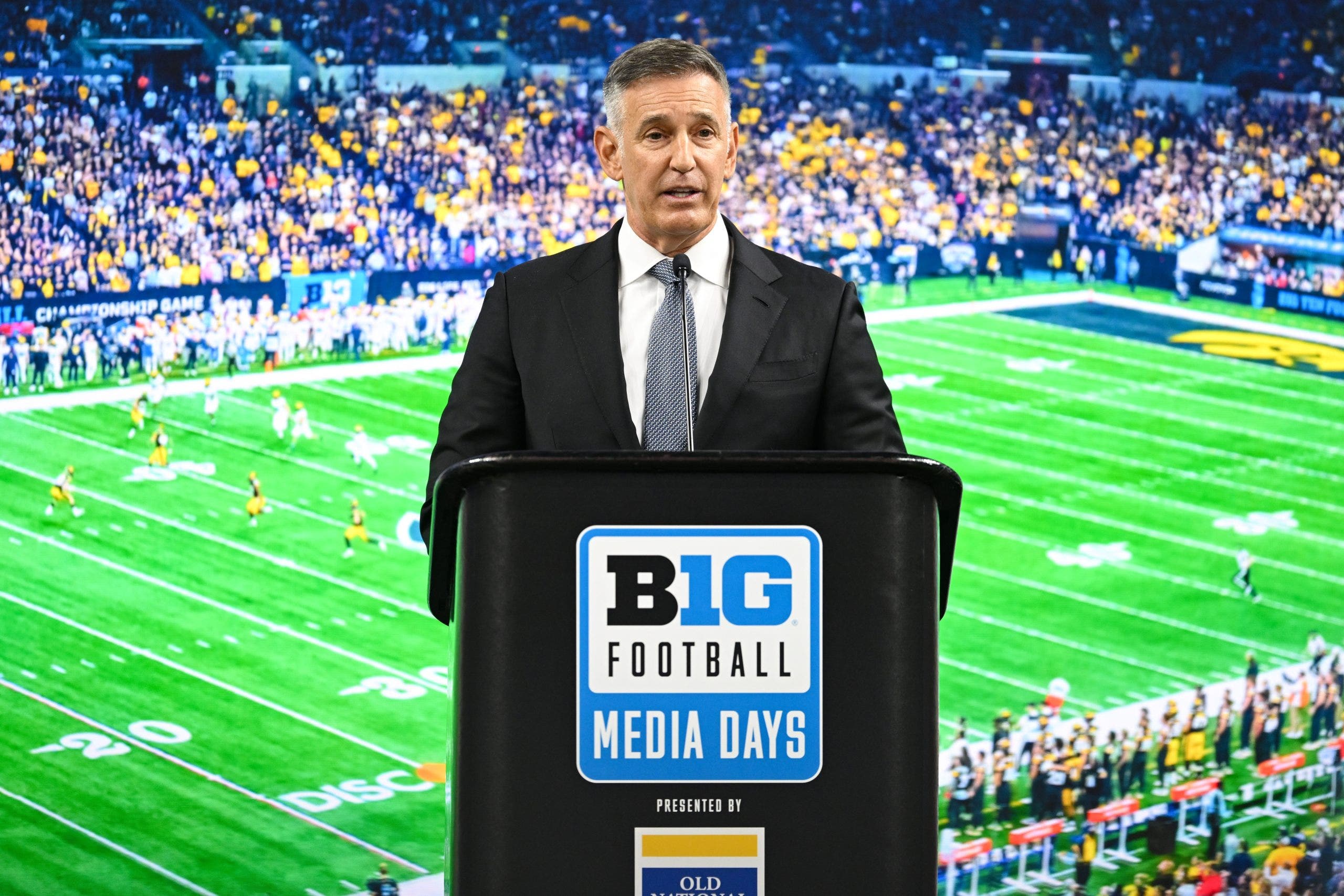
Big Ten commisioner Tony Petitti could help his conference receive four automatic bids in the next round of College Football Playoff expansion. (Photo by James Black/Icon Sportswire via Getty Images)

Just like the other formats, Boise State (highest-ranked Group of 5 champion) and Notre Dame (highest-ranked at-large team) would also make the field.

Here’s how a potential 14-team CFP format would’ve looked like last season:

  1. Oregon
  2. Georgia
  3. Texas
  4. Penn State
  5. Notre Dame
  6. Ohio State
  7. Tennessee
  8. Indiana
  9. Boise State
  10. SMU
  11. Alabama
  12. Arizona State
  13. Clemson
  14. Iowa State

First two teams out: Miami, Ole Miss

The top 12 seeds in this format would’ve remained the same compared to the other four formats, but this is the first format that doesn’t include Miami. 

A play-in weekend also wouldn’t be possible in a 14-team format. Oregon and Georgia would’ve received first-round byes as the other 12 teams duked it out. Some of those first-round matchups would’ve included a game between former Big 12 foes (Iowa State-Texas), Clemson making the trip up to Happy Valley to take on Penn State and Alabama facing Ohio State.

Want great stories delivered right to your inbox? Create or log in to your FOX Sports account, follow leagues, teams and players to receive a personalized newsletter daily.


Get more from College Football Follow your favorites to get information about games, news and more


Link

Continue Reading
Click to comment

Leave a Reply

Your email address will not be published. Required fields are marked *

NIL

Trump calls NIL a ‘disaster’ for college sports and Olympics

Published

on


NEWYou can now listen to Fox News articles!

When President Donald Trump hosts an event in the Oval Office and opens things up to questions from the media, as he did on Friday while hosting members of the 1980 Miracle on Ice team, you get a lot of dumb questions.

I mean, I get that opportunities to ask the president a question are at a premium, but with Jim Craig and Mike Eruzione on hand, is that the time to ask about Venezuela?!

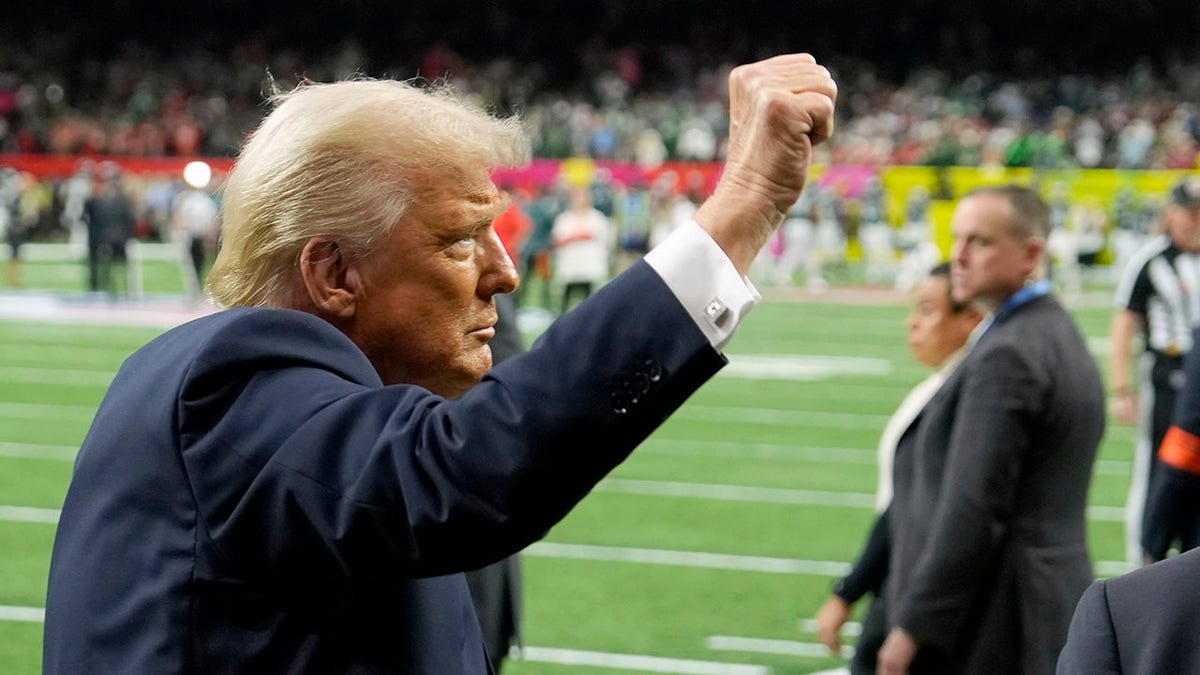
Donald Trump gestures to crowd

President Donald Trump gestures to the crowd before the start of the NFL Super Bowl 59 football game between the Philadelphia Eagles and the Kansas City Chiefs, Sunday, Feb. 9, 2025, in New Orleans.  (AP Photo/Ben Curtis)

Anyway, at least one member of the press asked a question that made a lot of sense, and it had to do with NIL.

CLICK HERE FOR MORE SPORTS COVERAGE ON FOXNEWS.COM 

That’s fitting, as back when the Miracle on Ice team played, the Olympics were strictly for amateurs, and most of the team was plucked from various collegiate rosters.

Had they played 40-plus years later, they may have been rolling in some of that NIL dough.

But, as the president noted — and Sen. Ted Cruz would agree with — the current state of NIL is simply not sustainable and could cause serious damage to college athletics, and even the Olympics.

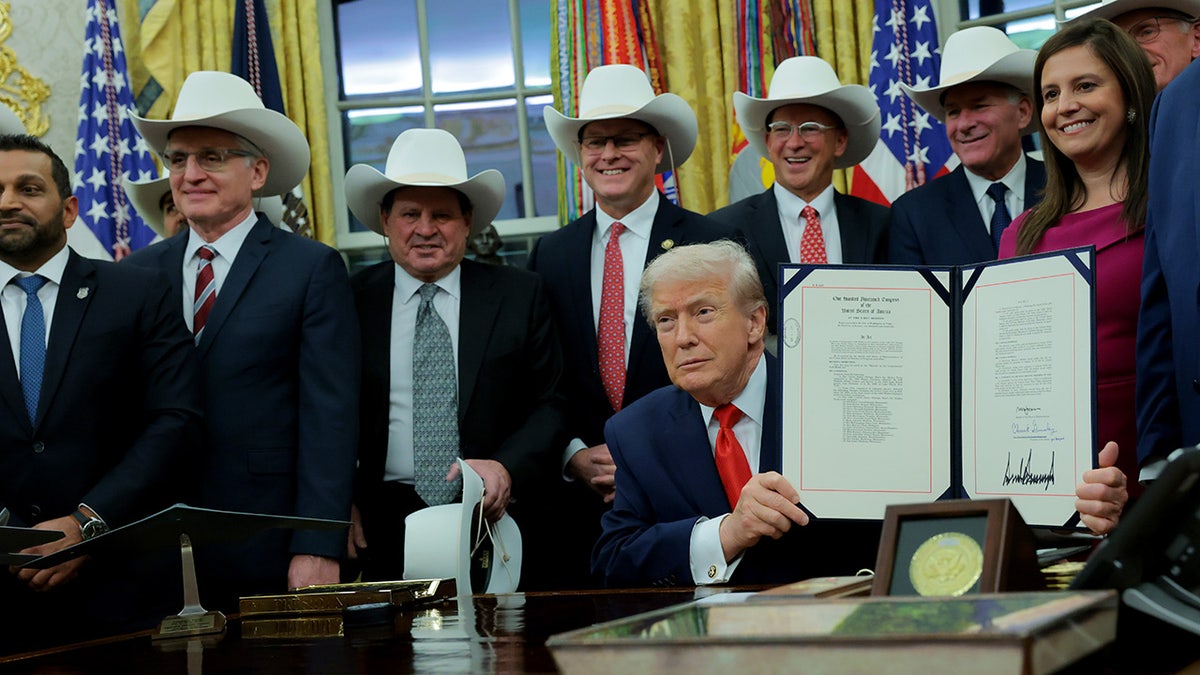
Trump signing Bill

U.S. President Donald Trump, joined by the 1980 U.S. Olympic men’s ice hockey team, holds up a bill to honor the team in the Oval Office of the White House on Dec. 13, 2025 in Washington, D.C.  (Anna Moneymaker/Getty Images)

TRUMP WARNS COLLEGE SPORTS ARE IN ‘BIG TROUBLE’ IN CRYPTIC POST

“I think that it’s a disaster for college sports,” President Trump said. “I think it’s a disaster for the Olympics, because, you know, we’re losing a lot of teams. The colleges are cutting a lot of their — they would call them sort of the ‘lesser’ sports, and they’re losing them like at numbers nobody can believe. They were really training grounds, beautiful training grounds, hard-working, wonderful young people. They were training grounds for the Olympics.

“And a lot of these sports that were training so well would win gold medals because of it. Those sports don’t exist because they’re putting all their money into football. And by the way, they’re putting too much money into it, into football.”

President Trump noted that the top-performing athletic programs aren’t making enough money to sustain themselves, given the rate at which they’re paying highly sought-after players.

Jack Sawyer, Donald Trump and Ryan Day side by side

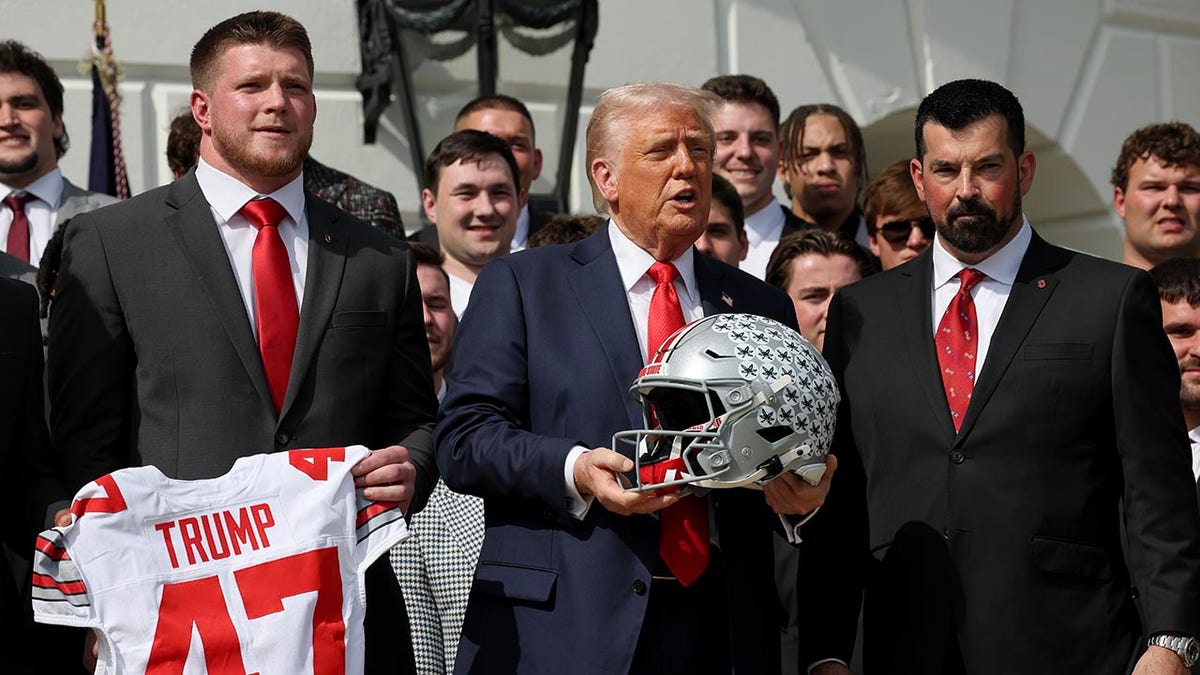
U.S. President Donald Trump stands with Ohio State Head Coach Ryan Day as he welcomes the 2025 College Football National Champions from Ohio State University to the White House during a ceremony on the south lawn in Washington, District of Columbia, on April 14, 2025. Ohio State won the national championship by defeating Notre Dame 34-23. (Win McNamee/Getty Images)

CLICK HERE TO GET THE FOX NEWS APP

“They’re putting all of their money in, and I know something about it,” President Trump said. “They will not be able to stop. You have a college president [saying], “I’m telling you, sir, we give a guard $7 million, we’re going to win the national championship,’ and they’ll give them seven, then they won’t win it.

“And even if they do win it, colleges cannot afford to be paying the kind of salaries that you’re hearing about.”

Follow Fox News Digital’s sports coverage on X, and subscribe to the Fox News Sports Huddle newsletter.


Link

Continue Reading

NIL

Kirk Herbstreit honors Arch Manning with major college football award

Published

on


The 2025 college football regular season is over and the time is now for ESPN analyst Kirk Herbstreit to hand out his personal awards for the year ahead of what’s sure to be an entertaining postseason. He calls them the Herbie Awards, which are given out to worthy somebodies across various categories.

For instance, you can go read who Herbstreit selected as his Offensive Player of the Year right here. But one of the awards Herbstreit came up with was called the Redemption Player of the Year, which he said is intended to award a guy who bounced back from an injury, a poor season the year before, or even someone who showed extraordinary growth from Week 1 to Week 14.

He nominated three players for the honor: Texas quarterback Arch Manning, Alabama linebacker Deonte Lawson, and Notre Dame defensive end Boubacar Traore. As you should already know, Herbstreit opted to give the Redemption Player of the Year honor to the most famous name in college football, Arch Manning, for navigating a difficult year into a very positive finish for he and the Longhorn program.

“I think he came in with unrealistic expectations,” Herbstreit said of the Texas QB. “When this season started, people were talking about, ‘He’s going to win the Heisman Trophy. He’s better than Payton. He’s better than Eli. He’s better than his grandpa. He’s going to win a national championship. It’ll be the first pick next year in the draft.'”

Texas Longhorns quarterback Arch Manning throws a pass

Texas Longhorns quarterback Arch Manning throws a pass | Scott Wachter-Imagn Images

Obviously, the season didn’t turn out that rosy. For Herbstreit, it was seeing Manning undergo the ego hit and the piling on of critics but still turn his season around to finish so strong that impressed him so much.

“When that didn’t pan out in the first half of the season, people were very, very critical,” Herbstreit continued. To his credit, he blocked all of that out. Didn’t take any of it personally. If anything, I think it motivated him to go out and help his teammates win games. And I was really happy for him enduring that and coming out on the other side.”

In his first year as the full-time starter, Manning finished with just under 3,000 total passing yards while guiding Texas to a solid 9-3 season given the harsh schedule they were saddled with. After some early-season offensive struggles and two losses in their first five games, Manning and the Longhorn offense hit a groove as the Longhorns won six of their last seven.

Across Texas’ final five games, Arch Manning threw for 300+ yards in three wins against Mississippi State, Arkansas and Vanderbilt, and then led a 27-point outing and scored two touchdowns, one passing and one rushing, to lead Texas over rival Texas A&M.

More on College Football HQ


Link

Continue Reading

NIL

Rodriguez collects Bednarik Award for fifth national honor

Published

on


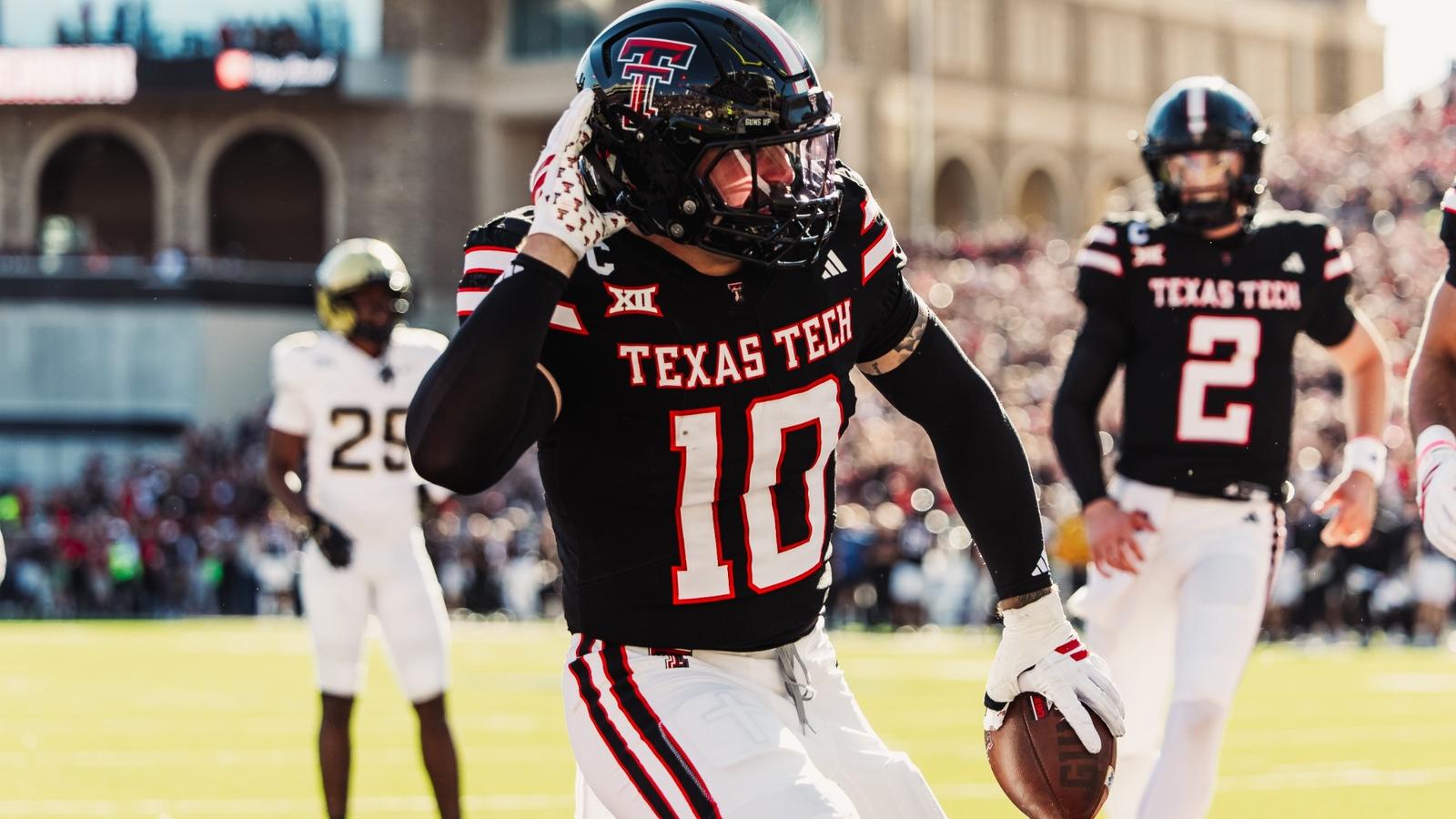
LUBBOCK, Texas – Texas Tech senior linebacker Jacob Rodriguez collected his fifth national award this season Friday evening as he was tabbed the winner of the Bednarik Award during the College Football Awards Show live on ESPN.

Rodriguez is the first Red Raider in program history to win the Bednarik Award, which is presented annually by the Maxwell Football Club to the nation’s top defensive player. The Bednarik Award selected Rodriguez over Ohio State safety Caleb Downs and Texas A&M defensive end Cashius Howell.

With the addition of the Bednarik Award, Rodriguez is now the winner of the Butkus Award (nation’s top linebacker), the Bronko Nagurski Trophy (nation’s top defensive player), the Lombardi Award (nation’s top lineman or linebacker) and the Pony Express Award (nation’s top duo with David Bailey) this season alone. He is the third player in history to win the Butkus Award as well as the Nagurski Trophy and Bednarik Award in the same season, joining Miami’s Dan Morgan (2000) and Notre Dame’s Manti Te’o (2012). Rodriguez joins Te’o as the only players to also win the Lombardi Award.

Rodriguez, who was also tabbed a first team All-American by the Walter Camp Foundation during the ESPN broadcast, has bolstered one of the nation’s top defenses, leading the Red Raiders to their first Big 12 title in program history this season and their first appearance in the College Football Playoff. The Red Raiders enter a potential matchup with either No. 5 Oregon or No. 12 seed James Madision at 12-1 overall, marking the most wins in program history.

Rodriguez has now led Texas Tech to four-consecutive bowl appearances during his career after going from a scholarship quarterback at Virginia, to walk-on linebacker with the Red Raiders and now a national award winner. He was joined during the ESPN College Football Awards Show by his parents, Joe and Ann Rodriguez, and his wife, Emma.

Rodriguez enters bowl season as the FBS leader with seven forced fumbles and ranks among the top-15 players nationally with 117 tackles. He is the first FBS player since 2005 to record at least five forced fumbles, two fumble recoveries and four interceptions all in the same season. His impact has bolstered a Texas Tech defense that leads the nation with 31 takeaways and ranks third nationally in scoring defense at 10.9 points per game. Rodriguez was responsible for nine takeaways himself — all in Big 12 play – thanks to his ability to punch the ball out and also read the quarterback in coverage.

Rodriguez is currently the highest-rated player in all of college football, according to Pro Football Focus, grading out at 93.3 overall so far this season. He is the top-rated player in the country in terms of rush defense, receiving a 95.5 grade in that area for a Red Raider defense that is easily the nation’s best in stopping opponents on the ground. Texas Tech is giving up only 68.5 rushing yards a game thanks to Rodriguez, who also ranks fifth nationally in coverage with a 92.3 grade.

Established in 1995, the Chuck Bednarik Award is one of the most-prestigious honors in college football, awarded annually to the most outstanding defensive player. This accolade recognizes exceptional talent, tenacity and impact on the defensive side of the ball. The award is named in tribute to Chuck Bednarik, a revered figure in football history known for his remarkable career as a linebacker.


Link

Continue Reading

NIL

$15 million college football coach sues Big Ten school over buyout dispute

Published

on


It’s a darn tootin’ time to be a lawyer in the college sports space, eh? As college footbal programs all around the country change coaches, hand out buyouts and sign ridiculous new contracts, even some former coaches are trying to get what’s theirs.

Just this week, as the dust seemed to be settling nation-wide on a chaotic spin of the coaching carousel this fall, we had Sherrone Moore’s firing at Michigan and the ugly fallout from that ordeal, plus the somewhat surprising retirement of legendary Utah Utes head coach Kyle Whittingham, setting up a changing of the guard at Utah plus a brand new search in Ann Arbor — which may kickstart a whole other chain of coaching searches.

Amid all this talk of contracts and big buyout money, one former Nebraska coach, Scott Frost, has come out of the woodwork to sue Nebraska, alleging the ‘Huskers have shorted him on the agreed-upon buyout payments. Local news outlet WOWT had the news Friday evening:

“Former Nebraska football coach Scott Frost filed a lawsuit Friday, accusing the school of breaching his contract and mishandling millions in buyout payments and taxes,” they wrote. “In the complaint filed in Lancaster County District Court, Frost claimed the university wrongly stopped payments he said are owed for 2025 and 2026 under his employment contract. Frost is seeking a court order confirming Nebraska’s right to reduce those payments and seeking at least $5 million in damages.

Scott Frost was fired on the heels of a 10th consecutive loss in a one-possession game, this time to Georgia Southern, 45-42, following a poor start to the team’s season in 2022. At the end of that season, Nebraska placed former Baylor and Carolina Panthers coach Matt Rhule at the helm of the program, and he’s guided it ever since.

Scott Frost buyout details

Former Nebraska Cornhuskers head coach Scott Frost

Former Nebraska Cornhuskers head coach Scott Frost | Dylan Widger-Imagn Images

When Frost was fired in September of 2022, his buyout came out to roughly $15 million, and that number would have been split in half had the Cornhuskers merely waited a few weeks, until Oct.1, to officially pull the trigger. Now, per Yahoo Sports, the argument centers on some tax mumbo jumbo.

“According to the filing, Nebraska told Frost in December 2022 that it planned to count the projected value of his 2025 and 2026 buyout payments as income on his W-2 for that year,” wrote Jim Recalto for Yahoo. “Frost argues that move was improper and left him with a $1.7 million tax liability for money that had not been paid.”

Yahoo adds: “Frost says those future payments were guaranteed under his contract and could not be reduced or taken away. However, he also claims the university said in the same email that the payments could later be adjusted, without explaining how or why.”

Seek out your local CPA for a better read on this situation, but from the bird’s eye view, it appears that Frost had future buyout payments lumped into the same year he was fired, which definitely heavied his tax burden vs. taken the payments over several years. Then, the university tried to adjust or change those payments they had already lumped onto the W-2 which Frost had been taxed for.

Essentially, the man was taxed on money he hadn’t yet received, and then when it came to receiving said money, the process for getting it was changed around despite the fact Frost was already liable for the money. At least, that’s how Frost’s side puts it. Nebraska may have some explaining to do here.

More on College Football HQ


Link

Continue Reading

NIL

Meet The Two Oregon Freshmen Ready To Make Ducks History Under Dan Lanning

Published

on


The Oregon Ducks have one of the best running back duos in college football. And they are only freshmen.

Jordon Davison and Dierre Hill Jr. provided the Ducks’ with an electric one-two combo behind starting running back Noah Whittington. The freshmen combined for over 1,000 yards and 15 touchdowns during the regular season.

Freshmen Bursting Onto The Scene

Oregon Ducks dan lanning Dante moore Jordon Davison Dierre Hill Jr. Penn State Nittany Lions Notre Dame Fighting Irish NIL

Nov 22, 2025; Eugene, Oregon, USA; Oregon Ducks running back Jordon Davison (0) scores a touch during the first half against the Southern California Trojans at Autzen Stadium. Mandatory Credit: Troy Wayrynen-Imagn Images | Troy Wayrynen-Imagn Images

It’s been a year to remember for the Ducks’ ground game this season. Whittington have provided a stable presence in the backfield in the 10 games he’s played in. In the regular season, he rushed for 774 yards and six touchdowns.

Davison ran for 535 yards and 13 touchdowns, meanwhile Hill accumulated 481 yards and four touchdowns.

The two became stars seemingly overnight as coming into the season, it looked like they would be buried on the depth chart with Makhi Hughes, Da’Juan Riggs, Jayden Limar, and Noah Whittington all ahead of them. But the duo stayed consistent and eventually earned carries early in season and both evolved into bigger roles as the year progressed.

At this rate, Davison and Hill Jr. are poised to make history in Lanning’s system and dominate in the Big Ten for years to come. Former Ducks running back Royce Freeman set the record with 18 rushing touchdowns in his true freshmen season, but Davison is close behind with 13.

Thanks to Oregon’s depth at the position, the single-season rushing record is far from reach. LaMichael James owns the freshman record with 1,546 yards in a single season, while Freeman holds the outright record with 1,836 rushing yards in a season.

Former Ducks star Kenjon Barner set Oregon’s single-game rushing record against USC, rushing for 321 yards in the Los Angeles Memorial Coliseum in 2012. Could either Hill or Davison catch that number?

Jordon Davison on his Relationship With Dierre Hill Jr.

Davison opened up about how he immediately clicked with Dierre Hill Jr.

“It’s kind of crazy, because coming in, they was like, who do I want to play with? And we was like watching each other’s film, and it was a couple backs, and I actually chose Dierre. And his film stuck out to me. And then we was connecting before we got here, and then as soon as we got here, it just clicked, like, that’s my right-hand man. People probably think like, it’s just on the field, but we together every day, off the field, all the time.”

“We’re kind of like opposite personalities. I’m a bit more quieter. He’s a loud one, but we complement each other very well. And I just love Dierre. I love being around him. I love being around everybody in the running back room. They all brought me in as a brother, and they all helped me grow as a player and a person,” Davison continued.

Oregon’s History Of Running Back Duos

Oregon Ducks dan lanning Dante moore Jordon Davison Dierre Hill Jr. Penn State Nittany Lions Notre Dame Fighting Irish NIL

Nov 29, 2025; Seattle, Washington, USA; Oregon Ducks head coach Dan Lanning during the second half against the Washington Huskies at Husky Stadium. Mandatory Credit: Steven Bisig-Imagn Images | Steven Bisig-Imagn Images

It shouldn’t come as a surprise to the Ducks having another powerful running back duo. Over the course of Dan Lanning’s tenure at Oregon, he has always had at least one 1,000-yard rusher and one 500-yard rusher. But it looks like that trend will end this year with the emergence of Davison and Hill in addition to Whittington.

Lanning’s first year at Oregon in 2022 saw the emergence of Bucky Irving and Whittington. Irving ran for 1,058 yards and Whittington rumbled for 779 yards. The following season in 2023, it was Irving with 1,180 yards and Jordan James with 759 yards as Whittington nursed a torn ACL. Last year in 2024, James went for 1,267 yards and Whittington ran for 540 yards.

Add in Oregon running back coach Ra’Shaad Samples, who is among the best position coaches in the country, and it looks likely the trend of having two great running backs will continue.

MORE: Oregon’s Breakout Freshman Emerges As Potential X-Factor For The Playoff

MORE: Why Cleveland Moving On From Dillon Gabriel Could Be a Blessing in Disguise

MORE: Four-Star Safety Makes Recruiting Announcement With Oregon, Alabama, Ohio State 

SIGN UP FOR OUR NEWSLETTER HERE! 

Finding Recent Comparisons

Oregon Ducks dan lanning Dante moore Jordon Davison Dierre Hill Jr. Penn State Nittany Lions Notre Dame Fighting Irish NIL

Nov 22, 2025; South Bend, Indiana, USA; Notre Dame Fighting Irish running back Jeremiyah Love (4) celebrates scoring against the Syracuse Orange during the first half at Notre Dame Stadium. Mandatory Credit: Michael Caterina-Imagn Images | Michael Caterina-Imagn Images

Having multiple starting-caliber running backs isn’t something that is extremely uncommon in college football, just take a look at Notre Dame and Penn State for example.

The Fighting Irish have Jeremiyah Love and Jadarian Price. Love has garnered most of the attention this season and rightfully so as he is a Heisman Trophy finalist after rushing for 1,372 yards and 18 touchdowns. But Price is no slouch himself. He ran for 674 yards and 11 touchdowns playing as the No. 2 back for Notre Dame.

At Penn State, Kaytron Allen became the program’s all-time leading rusher this year. He ran for 1,303 yards and 15 touchdowns, while Nicholas Singleton ran for 549 yards and 13 touchdowns.

The blueprint is there for Hill and Davison to reach national recognition. Considering they are only in their first season of college football, the Ducks’ freshmen could potentially become their best running back duo in program history.

Recommended Articles


Link

Continue Reading

NIL

Notre Dame running back Jadarian Price uses NIL money for Salvation Army Angel Tree gifts

Published

on


MISHAWAKA, Ind. (WNDU) – Notre Dame running back Jadarian Price used his Name, Image and Likeness (NIL) sponsorship money to buy Christmas gifts for three local children through the Salvation Army’s Angel Tree program on Friday afternoon.

Price shopped for toys at the Walmart in Mishawaka as part of the nationwide program that provides hundreds of thousands of Christmas gifts for children each year.

College athletes earned nearly $500 million from NIL sponsorships this year. While some spend the money on jewelry or cars, Price chose to give back to the community.

“I’m just a kid from a small town: Denison, Texas. I didn’t come from much as a kid myself. As a guy who comes from a large family, I have a lot of siblings and little cousins running around that I helped raise. And I know it meant a lot to them, what I am doing in my position right now. It was truly a blessing to be able to be in this position to do that, do it for a lot of other kids in the community means a lot to me,” Price said.

Price has worked as a fifth-grade teaching assistant in his hometown of Denison, Texas, and coaches young athletes in Mishawaka. As the oldest of three children, he credits his humble upbringing for his charitable spirit.

For a 9-year-old boy, Price selected a monster truck, Legos and a football, thinking back on his own favorite childhood toys.

Price strives to make youth sports more accessible so all children can learn the same valuable lessons he did in athletics.

“The world is starting to become more individualized. People are starting to become more selfish and individual. So, just being able to stay around people, get outside. And the biggest thing is being part of a team. No one can take that away from you because of the relationships you make. So, just being able to be part of something bigger than yourself is what it’s really about,” Price said.

Price hopes his involvement will bring more attention to the Angel Tree program and encourage other college athletes to use their money to benefit local communities.

“It felt nostalgic doing a little Christmas shopping for a kid. I have two younger sisters, so this isn’t new to me. I used to help my mom out with getting them gifts. This is a time of joy and holiday spirit, and I think we take for granted some of that the older we get. Everyone deserves to have some joy during the season, so I’m here to help in any way that I can. If you’re in a position to do what you can to help others, I encourage you to do so, like I did today, and merry Christmas,” Price said.

The Salvation Army will continue accepting Angel Tree gifts through the weekend and will distribute them Tuesday.


Link

Continue Reading

Most Viewed Posts

Trending