AI-assisted summaryMississippi State basketball star Josh Hubbard returns with a largely new supporting cast for the 2025-26 season.The Bulldogs added six transfers, including guards Jayden Epps and Ja’Borri McGhee, to improve 3-point shooting efficiency.STARKVILLE — Only two players who averaged more than 10 minutes last season are returning to Mississippi State basketball in 2025-26.
That means star guard Josh Hubbard will have an almost completely new supporting cast for the second straight season. The junior withdrew from the NBA draft after consecutive seasons on the All-SEC second team.
The Bulldogs and fourth-year coach Chris Jans added six transfers after reaching a third consecutive NCAA tournament.
Here’s how those transfers can help Hubbard after he scored a career high 18.9 points per game last season.
Mississippi State can improve 3-point efficiency with ‘scary’ backcourt
The Bulldogs attempted the third-most 3-pointers in the SEC last season but had the 14th best efficiency at 31.4%.
The 3-point shot is a massive part of Hubbard’s game. He holds program records for 3s in a season (108 in each of his two seasons) and consecutive games with a made 3-pointer at 47. However, the 3-point shooting around him wasn’t consistent enough last season.
Jayden Epps, a Georgetown guard transfer, shot 34.4% from 3 on 154 attempts in 2024-25. UAB transfer guard Ja’Borri McGhee was even more efficient at 40.8%, but only on 71 attempts. Epps started 50 games in the last two seasons, averaging 15.8 points, 3.3 assists and 2.4 rebounds. McGhee averaged 11.1 points, 2.8 assists and 2.7 rebounds last season.
“Us three in the backcourt is definitely going to be scary,” Epps told reporters on July 17.
Montana State transfer Brandon Walker, a 6-foot-7 forward, was a 36.8% 3-point shooter last season but only on 1.5 attempts per game. He was an All-Big Sky honorable mention, scoring 14.7 points per game with 4.9 rebounds and 1.6 assists.
Quincy Ballard is a different style for Mississippi State in the postMississippi State will be a different team in the paint after KeShawn Murphy and Michael Nwoko transferred. They didn’t protect the rim the same as Wichita State transfer Quincy Ballard does.Ballard swatted 1.9 blocks per game last season while hauling in 9.2 rebounds. His 62 dunks and 75.1 field-goal percentage were single-season records for Wichita State. The 6-foot-11, 251-pound center also scored a career-high 10.0 points per game.”I like to bring the force on both sides,” Ballard said. “Obviously with defense, people already know how I am on defense. I’ve been working on my offense and everything pretty much all summer. I feel like it’s going to be a big factor by the time the season starts.”MORE: Mississippi State basketball releases full nonconference schedule, including season opener
Amier Ali, Achor Achor add length at the wing
Shawn Jones Jr. made strides as an improved two-way player on the wing. He returns for the 2025-26 season, and Mississippi State has some other intriguing wings to complement him.
Amier Ali from Arizona State is a 6-foot-8 guard/forward. He was a four-star in the 2024 recruiting class who played 19.1 minutes per game mostly off the bench with the Sun Devils. Ali scored 5.5 points per game while shooting 32.6% from 3 on 92 attempts.
“Individually, I just want to be able to play harder,” Ali said. “The main thing is to get me on the floor and all that stuff.”
Achor Achor, a 6-foot-9, 227-pound wing, only played nine games at Kansas State last season but was All-Southern Conference first team in 2023-24 at Samford with 16.1 points and 6.1 rebounds per game.
Sam Sklar is the Mississippi State beat reporter for the Clarion Ledger. Email him at ssklar@gannett.com and follow him on X @sklarsam_.
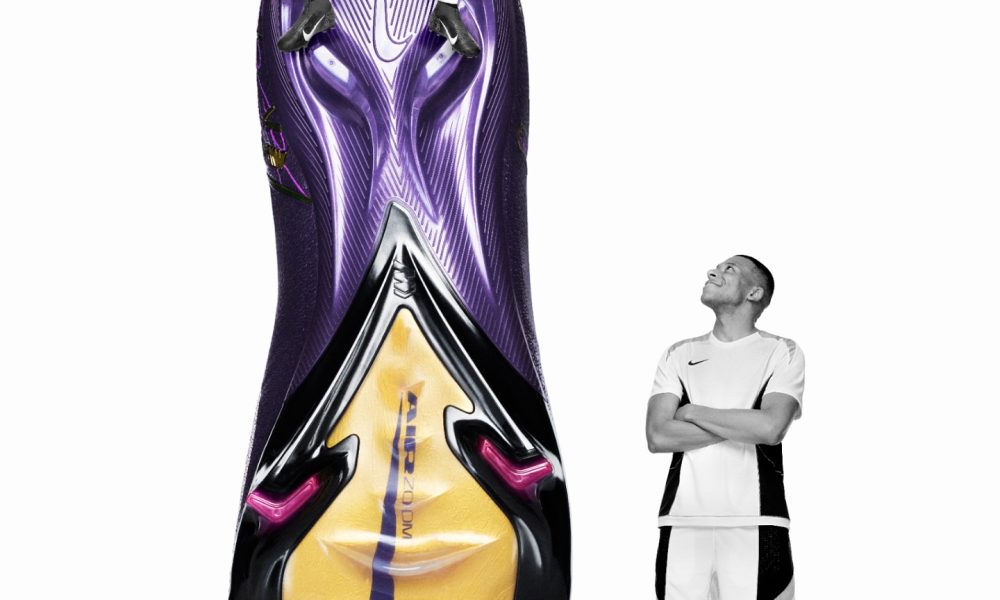
Nike announces a new NIL venture, and it has chosen LSU as the first school to partner with.
Nike, along with other equipment manufacturers, have been partnering with university athletic departments for decades. But Nike’s Blue Ribbon Elite NIL program is the first to partner with the athletes themselves.
Zach Greenwell, LSU’s deputy athletic director for external affairs, said Nike is partnering with ten athletes on a very extensive campaign to promote Nike products.
“They brought in a very large-scale production company from out of town to work with those athletes, and it was 15-hour days with our athletes doing individual shoots,” Greenwell said. “They did a big group shot, which was a big part of our roll-out.”
Among the LSU student-athletes joining Nike’s growing roster of elite NIL athletes are: Kailin Chio, Gymnastics, Derek Curiel, Baseball, Tori Edwards, Softball, Casan Evans, Baseball, Trey’Dez Green, Football, Jayden Heavener, Softball, ZaKiyah Johnson, Basketball, DJ Pickett, Football, Jurnee Robinson, Volleyball and Dedan Thomas Jr., Basketball. Greenwell said Nike is working with them on product that they like, and they’re promoting products on the Nike store that’s specific to them and their respective sports.
“It’s a big thing for Nike to work with this demographic whether it be college kids, teenagers, so they’re going to work with all of those ten athletes across seven sports to tap into that demographic and they think LSU is a great place to start,” Greenwell said.
Greenwell said it’s a tremendous honor for LSU to be the first school that Nike selected for its new Blue Ribbon Elite NIL program.
“I think we’re the envy of a lot of people around the country to be able to launch this program with them (Nike) and we know they’ll work with other teams as they go, but our first immediate thoughts are, ‘How can we grow this? How can we take this to the next level?’” Greenwell said.
Along with the Blue Ribbon Elite NIL program, LSU Athletics and Nike have announced an extension to their five-decade long partnership through 2036.
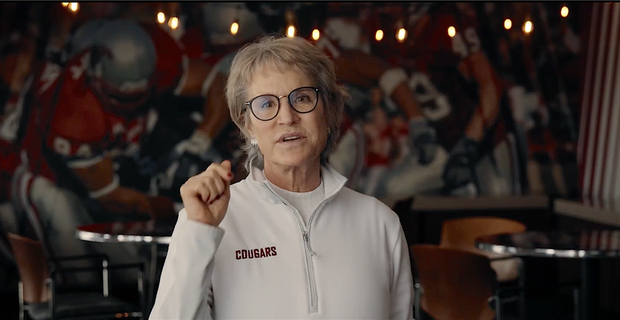
WSU President Betsy Cantwell delivers strong appeal to Cougar fans. (Photo: WSU)
WASHINGTON STATE President Betsy Cantwell took to social media Friday evening to deliver as clear a picture as you’ll hear as to why support for NIL is critical not just to the success of Cougar football but to the entire athletic department and the broader university.
Just hours after WSU announced Kirby Moore as the new head coach of the Washington State football team with what is believed to be a five-year contract, Cantwell videotaped a two-minute message asking WSU alums and fans to help push NIL funding to new heights through the CAF’s tax-deductible coaches excellence funds.
“By now, you know we’ve announced a phenomenal new football coach,” she said. “He’s ready to lead us into winning in the new Pac-12 Conference. What will get us there and show the world that we are deadly serious about winning will be our willingness to give this coach the tools to win. And for us, that means building $5 million in new NIL support immediately to compete — a fund that acknowledges the modern world and says, we are ready. We are in it.
“We all know that NIL isn’t an option. It’s an essential tool today,” she added. “Whether we love it or not, it’s part of the game. But NIL isn’t just about keeping up. It’s about giving our Cougs every chance to excel on the field, in the classroom, and in life beyond sports. Your investment in NIL through the Cougar Athletic Fund helps us recruit, retain, and elevate our WSU student-athletes.”
Last month Cantwell told Cougfan.com that WSU Athletics needs to raise an additional $20 million per year for revenue sharing and NIL to compete at the highest levels of the new Pac-12, which kicks off in 2026.
Related: New Cougar coach Kirby Moore’s background remarkably similar to legendary Mike Price’s
“Athletics is the front porch of our university,” Cantwell noted in her Friday video. “It’s the place that draws people to us. That means that winning football leads to healthy sports across the spectrum, leads to higher enrollment, leads to a healthier WSU.
“So strong Cougar teams lift the entire WSU family. We boost pride, we boost enrollment, we boost national visibility. This is the moment for Cougs everywhere. Let’s hit $5 million together. Let’s set our new coach and our student -athletes up for success. Go to the Cougar Athletic Fund website and choose NIL. Do it now.”
You can watch her full commentary in the Twitter post embedded at the bottom of this story.
CANTWELL’S COMMENTS echoed remarks earlier in the day by former WSU and Seattle Seahawks standout Robbie Tobeck when he was asked for his reaction to Moore’s hiring.
“In this day and age, I don’t care how good your coach is, you need the resources to compete and win,” Tobeck said. “It’s imperative the university, regents and alums back up this program and give Kirby a chance to excel. If you want to boost enrollment, field a good football team. It’s time to step up to the plate and invest in winning.
“I’m talking about dominating the new conference and going to the playoffs. We have an opportunity at WSU if we invest. We should be the bell cow of this new conference and we need to come out of the gate quickly.”
Related: Instant reaction from WSU luminaries to Kirby Moore’s hiring at WSU
INSUFFICIENT NIL SUPPORT was a growing frustration for former WSU coach Jimmy Rogers and his staff. While WSU has kept the numbers tight, Rogers apparently shared them with his new athletic director at Iowa State, Jamie Pollard, who somehow felt at liberty this week to disclose that Rogers told him WSU had a $2.5 million NIL budget in 2025. That number is believed to be the combined total of WSU’s revenue sharing program and the fundraising efforts of the independent NIL organization Cougar Collective.
At the CougsFirst! Show in Spokane last month, Cantwell told WSU partisans that “we’re at the bottom of every team coming into the Pac for football in NIL. We’re at the bottom. We cannot stay there and compete and win.”
She added, “We must be winners, we must, in football, within four years (sit atop the Pac-12) because that is the time that every single media rights contract across all of college football, every conference, is up for grabs again,” she said.
Cougar Nation, the time is now! Success starts with $5M in NIL support to recruit, retain, and elevate student-athletes—setting the stage for a winning future in the Pac-12. #GoCougs
After Michigan terminated head coach Sherrone Moore “for cause,” the program now faces immediate roster and reputation questions, most pressingly the status of true-freshman quarterback Bryce Underwood.
Underwood, the class of 2025 No. 1 recruit, committed to Michigan in December 2024 with an NIL package reportedly valued at around $3 million, among the largest in college football, helping swing national recruiting attention to Ann Arbor.
Moore’s firing followed an internal investigation that the athletic department said found “credible evidence” of an inappropriate relationship; Michigan named associate head coach Biff Poggi interim head coach for the Wolverines’ Dec. 31 Cheez-It Citrus Bowl.
On CBS Sports HQ, Chris Hummer suggested that Moore’s dismissal creates an opening to “reset” the quarterback-staff relationship, arguing a coaching change could be a good thing for Underwood’s development and future at Michigan.
“There was an awareness around Michigan that Bryce Underwood had a bit of discontentment with the offense. So, this change might actually provide an opportunity for Michigan to reset that relationship a little bit and find something that fits for Bryce Underwood’s vision of offense and also fits for the future of Michigan football.”
Michigan quarterback Bryce Underwood (19) looks on after warms up at Michigan Stadium in Ann Arbor. | Junfu Han / USA TODAY NETWORK via Imagn Images
Underwood started as a true freshman and posted 2,229 passing yards, nine passing TDs, and six interceptions during the 2025 regular season, while adding 323 rushing yards and five rushing TDs.
His dual-threat ability was a key factor in Michigan’s 9-3 (7-2 Big Ten) finish, highlighted by a five-game win streak before a 27–9 loss to rival Ohio State to close the regular season.
Underwood flipped his high-profile recruitment from LSU to Michigan in November 2024 and signed in the early period, a move widely reported to be tied to a historic NIL package orchestrated by Michigan’s primary collective.
As for who might replace Moore, national outlets have floated a wide board of potential candidates, including established Power Five coaches such as Alabama’s Kalen DeBoer, as well as offensive architects known for quarterback development, like Arizona State’s Kenny Dillingham.
Whoever’s hired will need to sell both winning and a clear developmental plan to keep Underwood from entertaining portal approaches, notably reported interest from LSU and others.
Read More at College Football HQ
$29 million college football coach surges as favorite to replace Sherrone Moore at Michigan
$1.3 million college football coach reportedly accepts head coaching job
First-team All-Conference WR enters college football transfer portal
College football program loses 11 players to transfer portal
The decision by Notre Dame to decline playing in a bowl game turned out to be one of the most-discussed choices made by any school in the 2025 college football season.
Now, one of the team’s most talented players is going public with why they decided to forgo the postseason entirely after missing the College Football Playoff.
Notre Dame running back and Heisman Trophy finalist Jeremiyah Love says the players were the deciding factor in ending their season.
Notre Dame made a team decision
“It was kind of a full team decision, full consensus decision,” Love said on SportsCenter.
“Our captains asked all of the players that they could, you know, what they think about the bowl games and things like that. And we all came to a consensus, or final decision, that we didn’t think that playing in that bowl game would really represent our 2025 football team in the right way.
“Because we feel like our team was just very special throughout the year, we did a lot of great things, and in that bowl game, a lot of people are going to opt out. A lot of people are just going to not play, or have their own plans … which, rightfully so. They have that right.”
Notre Dame was left out of the playoff
Notre Dame looked poised to take one of the dozen places in the College Football Playoff, but the selection committee reversed course on the last day, and swapped it out for Miami instead.
While most observers agreed in theory with that move since Miami beat Notre Dame this season, the timing of the decision and perceived lack of an explanation as to why then and not before, left the Irish enraged.
Enough to decline playing any bowl game at all.
“We didn’t feel like that team that would go into that bowl game was a great representation of how special this 2025 football team was,” Love said.
“So we all came to a consensus of, you know, we don’t want to put this team in a bad light because we feel like it was a great team.”
He added: “We’re not saying playing in a bowl game would put us in a bad light, but it just wouldn’t be the best representation of our team. So that ultimately led us to come into that decision.”
What Jeremiyah Love has done for Notre Dame
Love was a crucial element in the success Notre Dame had on the field that put them in playoff contention in the first place.
The running back had 199 carries for 1,372 yards and 18 touchdowns on the ground, catching 27 passes for 280 more yards and another 3 touchdowns.
His 21 total touchdowns set a new single-season Notre Dame record, surpassing Jerome Bettis.
But that could be the last time we see him on the field in the gold helmet given the Irish will not play again this season, and if he decides to enter the NFL Draft this spring.
Scandal is an inevitable thread in the fabric of college football. Pretty much every major school as waded through one or two notable scandals involving administrators, coaches or players on a particular team. But there’s one Big Ten school, and college football program, who might be the new “Scandal U.”
That was a popular phrase around Louisville, KY in regard to the Cardinals’ run of scandals that included mismanaged funds by a university president, a strippers-in-the-dorms basketball scandal, an FBI probe, a playbook-stealing scandal called Wakey-Leaks (after Wake Forest) and the list goes on. Well, the Ville can now mover over after getting their act together in the 2020s, because Michigan is the new big bad rulebreaker in college athletics.
In light of Michigan head football coach Sherrone Moore’s firing this week, one of the largest news outlets in America, CNN, decided to do dig into the noticeably high number of scandals that have rocked Michigan of late. Of course, Moore was fired, for cause, do to an inappropriate relationship with a staffer. But he’s only the latest in a long line of Michigan men who’ve gotten their hands a bit dirty.
CNN noted the following occurrences all within the Michigan athletics department over the last few years:
Michigan Scandal Rundown
Head football coach Sherrone Moore was fired over an inappropriate relationship with a staffer, then later arrested the same night he was fired.
Head football coach Jim Harbaugh was suspended for several games during the 2023 national championship season over recruiting violations.
Head football coach Jim Harbaugh left college football after 2023 with a 10-year show cause, four years of probation for Michigan, plus millions in fines over a sign-stealing scandal that dominated the entire 2023 college football news cycle.
Football assistant Connor Stalions was let go for his very direct involvement in organizing and enacting the sign-stealing scandal.
Head basketball coach Juwan Howard was suspended for slapping an opposing assistant coach during a handshake line and then fired after that season.
Head hockey coach Mel Pearson, was not retained after investigations discovered the program urged athletes to lie on COVID tests and also had reports of verbal assaults on female staff members.
Football assistant Matt Weiss was let go after it was discovered that he was hacking into students’ accounts to steal private photos of them.
That’s a tornado of bad ripping through Ann Arbor over just a couple of seasons. And while the basketball and hockey stories were tough situations, most of these scandalous missteps have come from the football program. According to CNN, there’s just one big culture problem under athletic director Warde Manuel.
CNN notes deeper problems with UM athletics
Michigan Wolverines’ Sherrone Moore (left), head coach Jim Harbaugh (center) and special teams coordinator Jay Harbaugh | Mark J. Rebilas-Imagn Images
“People associated with Michigan athletics have told CNN that they believe there is a cultural problem, if not of indifference, certainly of arrogance,” they wrote. Going beyond just the bad behavior from people hired by Michigan, CNN reports that the school’s firing process itself raises major red flags.
“A source familiar with the matter said that Manuel dismissed Moore without anyone from human resources present, and – while that is not required – it is standard behavior at most companies,” CNN added, which is true, especially for a situation like Moore. In fact, he’s the example of why HR is used in that capacity, to maybe prevent something messy from transpiring afterward, which is exactly what happened.
Perhaps 2026 can offer a new day for Michigan. The Jim Harbaugh era ended with raging success on the field but has left a disastrous wake. With Moore now out, the Wolverines can start anew and bring in a head coach completely severed from the Harbaugh era and the baggage it brought.
The University of Colorado is a remarkable place. It sits at the foot of the Flatirons, draws students from around the world, and shapes the state’s scientific, cultural and economic life more than almost any other institution. I have spent a lifetime connected to this university, and I say this as someone who cares deeply about its success: CU probably will never be a “sustained” national football powerhouse. And that’s not an insult. It’s an honest acknowledgment of the landscape we now live in and, if anything, a plea that we stop chasing a mirage that drains time, money and energy from what CU actually does best.
Jim Martin for the Camera
Let me be clear: CU can have great seasons. It can produce electrifying moments, top-10 rankings, thrilling Saturdays at Folsom Field (hopefully not at 8:00 p.m.) and the kind of storylines that make the country look west for a couple of weeks. But a powerhouse, the kind that reloads every year, bulldozes competition, outspends everyone and expects to contend for national titles as a matter of routine, is a different category altogether. And Colorado simply doesn’t have the structural ingredients to be competitive at a very high level every year.
Start with geography. The equation is simple: football powerhouses sit atop enormous recruiting bases. Texas, Georgia, Florida and Ohio each produce dozens of blue-chip recruits every year. Alabama has no major in-state competition and can pull from the entire Southeast. Colorado produces a handful of elite prospects, usually fewer than five. You can’t build a perennial top 10 program when your home state gives you a roster the size of a pickup basketball team. You have to fly everywhere, fight everyone and overpay for out-of-state talent just to stay competitive.
Then consider stadium economics. Folsom is one of the most beautiful venues in America, but beauty doesn’t pay the bills. At just over 50,000 seats, it isn’t even in the top 50 nationally. Meanwhile, the schools we’re comparing ourselves against have 85,000 to 105,000-seat cathedrals humming with revenue: premium clubs, suites, donor boxes, end-zone complexes. That difference alone produces tens of millions of dollars in additional annual operating revenue. CU will never be able to replicate that scale in Boulder, nor should it try.
Which brings us to finances. Even before the current deficit, CU’s athletic budget has hovered around $140 million, going up recently toward $160 million. That sounds large until you look around. Ohio State is over $290 million. Texas is not far behind. Georgia and Alabama are in the same orbit. LSU just hired a coach for $91 million in a multi-year deal — at a public institution. This is not a market CU can play in. It’s not even in the same country.
And now we’ve entered the branding (NIL) era, a world where the top programs spend $20-40 million annually not on coaching, not on facilities, but on the players themselves.Colorado’s donor base, corporate landscape, and statewide culture simply do not support that kind of annual fundraising.We have generous donors, but not South East Conference (SEC) style or Big-Ten boosters who treat Saturdays as a religion. NIL branding is not a temporary trend; it is the defining financial mechanism of modern college football. And CU is on the wrong side of the arms race. Maybe one area of hope with raising the needed money to be competitiveis in a third-party private equity agreement. The University of Utah’s athletic department is about to create a new partnership with a private equity firm that could generate an estimated $500 million in revenue.
Culture matters too. Boulder is a place people choose for lifestyle, for mountains, for climate, for academics, for entrepreneurship. This isn’t Tuscaloosa, Columbus or Baton Rouge, where football saturates daily life and where a losing season is treated as a civic crisis. CU students disperse to ski slopes, hiking trails and concerts. Faculty are nationally recognized researchers who did not come to Boulder to live inside the roar of a football machine. That’s not a criticism, it’s precisely what makes Boulder special. But it’s also why Colorado may never be, and should never try to be, an Alabama or Ohio State of the Rockies.
And even in the years when CU succeeds, its success carries its own penalty. Bigger programs simply poach CU’s coaches, coordinators, strength trainers, analysts and recruiters. They can double or triple salaries with little effort. Sustained powerhouses rely on stability and pipelines of talent behind the talent. CU is a destination when things go well, not a home you stay at for decades.
So where does that leave us?
It leaves me with a simple conclusion: CU should aim to be good, competitive, exciting, fiscally healthy and academically aligned, not an imitator chasing a model that doesn’t fit our mission or our reality. The pursuit of “powerhouse” status isn’t just unrealistic; it distorts priorities and pressures the institution to behave in ways that undermine its purpose.
Colorado is at its best when it embraces what it truly is: a world-class research university with a vibrant campus, a beautiful stadium and a football program that can surprise the country every now and then. That is more than enough. It is something to be proud of. And it is infinitely more sustainable than pretending Boulder sits on the same tectonic plates as Austin, Columbus, Tuscaloosa or Athens.
We can love CU football passionately, without insisting it become something it cannot be. That is not cynicism but is realism, spoken with love, for the place that has shaped so much of my life.
Go Buffs!
Jim Martin is a former regent, past chair of CU’s athletic subcommittee, and adjunct law professor, having taught Sports and the Law. Martin regularly provides presentations to various groups on the topic: “The Wild West of Today’s College Athletics.” He can be reached at jimmartinesq@gmail.com.
To send a letter to the editor about this article, submit online or check out our guidelines for how to submit by email or mail.




 AI-assisted summaryMississippi State basketball star Josh Hubbard returns with a largely new supporting cast for the 2025-26 season.The Bulldogs added six transfers, including guards Jayden Epps and Ja’Borri McGhee, to improve 3-point shooting efficiency.STARKVILLE — Only two players who averaged more than 10 minutes last season are returning to Mississippi State basketball in 2025-26.
 Quincy Ballard is a different style for Mississippi State in the postMississippi State will be a different team in the paint after KeShawn Murphy and Michael Nwoko transferred. They didn’t protect the rim the same as Wichita State transfer Quincy Ballard does.Ballard swatted 1.9 blocks per game last season while hauling in 9.2 rebounds. His 62 dunks and 75.1 field-goal percentage were single-season records for Wichita State. The 6-foot-11, 251-pound center also scored a career-high 10.0 points per game.”I like to bring the force on both sides,” Ballard said. “Obviously with defense, people already know how I am on defense. I’ve been working on my offense and everything pretty much all summer. I feel like it’s going to be a big factor by the time the season starts.”MORE: Mississippi State basketball releases full nonconference schedule, including season opener