Connect with us
https://yoursportsnation.com/wp-content/uploads/2025/07/call-to-1.png

NIL

How NIL has changed college sports and what changes could still come

Published

on

How NIL has changed college sports and what changes could still come

S1: Hey , San Diego , it’s Andrew Bracken in for Jade Hindman. Today we hear about the state of nil and its impact on college sports. This is KPBS Midday Edition. Connecting our communities through conversation. Should college athletes be paid ? Are they students or professionals ? These are questions that have been debated for decades before lawsuits led to Nil deals for many college sports stars. That’s name , image and likeness. And it’s at the heart of a transformation in college athletics in recent years. But universities , athletes and fans are awaiting a final ruling to a long running lawsuit that could change the rules for college sports. Kim Massey is the executive director of athletics at the University of San Diego. He spoke to KPBS Midday Edition host Jade Hyneman last week. Here’s that interview.

S2:

S3: No , no , it’s a really good question. I appreciate you having me on to talk about it. It’s really important that the general public understands what this is , where we’ve been , where we’re headed. You know , nil now has been around almost four years , and it’s really changed the landscape of college athletics. And it’s been a long time coming in terms of allowing the athletes to profit off their name , image and likeness the way any student has been able to for many years. And , you know , I think many of us in the industry saw a lot of different rabbit holes and where this could go and how it has gone has been a little bit exactly like we thought. And it’s gone a little bit , frankly , off the rails. We live in the West Coast and it is the true wild , wild West. And in some ways it’s a complete mess. That being said , there are some values. There are some good things about it that I’m sure we’ll talk about.

S2:

S3: Um , now they can do a camp. You know , they can make a public appearance and be paid for it. They can , um , be a part of a social media campaign and promote a business or an organization and be paid for their , for their time and efforts. In the past , that was not the case yet. A student who was a great piano player could be paid to go to downtown San Diego and play at an event and be paid $500 for their three hours of playing. You know that that was not the case for an athlete. And now we’re in a situation whether it’s equitable , whether now they can do things that other students could do for years , but it’s really gone off the rails in terms of the pay for play side of things that we’re unfortunately seeing. Right.

S2: Right. So , you know , to make a playing college , athletes are now able to get paid for their work. Um , and it’s more equitable.

S3: Essentially , they’re being recruited out of high school , recruited from one school to the next. There’s a there’s some guardrails , but probably a lack of a real structure. In every year you’re seeing specifically in men’s basketball rosters , turnover by half or more because As athletes have , you know , feel like they have value to go somewhere else and get paid more money. And it’s really challenging to control this. And I think there’s a lack of structure in terms of how do we manage the expectations of the athletes. But also there’s , I would say a lot of bad actors out there who are not really helping the athletes in terms of being consultants and guides and agents , and it’s really gotten to a point where it becomes this bartering zone of one school to a next school , trying to have a roster , but also still still get the right kids at the right institution who want to get a degree , feels like that’s that’s where I say going off the rails. Yeah.

S2: Yeah. So so right now it’s equitable for athletes. Not so much for colleges. Yeah.

S3: Yeah. It’s just really hard , you know , when you are building something special on your roster and you’re trying to build chemistry. And ultimately we want all our athletes to get degrees. And many of them now are looking at a one year scenario where maybe they go somewhere for a year and they play really well , which is great. And now they’re more marketable and now they’re heading to the next institution. So , you know , I think we’re trying to figure out how do we still keep the higher ed principles , because we are working for institutions of higher education still in place , while really negotiating a scenario where it’s very much like a professional sports organization and it’s a business. And what’s that juxtaposition between the two , and how do we still keep it , keep the integrity of what we’re trying to accomplish with 18 to 23 year olds ? Hmm.

S2: You know , one piece you touched on there is the ability for athletes to to move to a different school , when in the past they were kind of tied to to a school , right. I mean , how do you find a balance there ? Yeah.

S3: You know , it’s a tough balance. Um , you know , I think a lot of high school athletes , right , came to school for they wanted to get a business degree. They wanted to play for a certain coach. They want to be geographically close to where their family is , and they can see them play. And I feel like a lot of that now is a little bit gone by the wayside. It’s okay , I’m going to go to this place because I can get playing time and increase my value. And again , I do want to say this. This is not the norm. I mean , there’s a certain percentage of athletes in this case , the vast majority are still coming to school for the right reasons. They want to get a great degree. They want to have a good college experience. They are coming to have that collegial opportunity to win championships. But there is a subsection of athletes that where it’s really hard to really find that true identity of why they’re coming to the institution , and how do we build that identity with that within that team. Okay.

S2: Okay. Well , all of that leads to this settlement that’s currently being finalized.

S3: Essentially , this settlement is the culmination of multiple lawsuits , mostly hinging around the fact that athletes for years did not profit off their name , image and likeness. And , you know , looking at the culmination of what the lawsuits might lead to in terms of both dollars and time. You know , plaintiffs decided along with the NCAA , let’s let’s do a settlement that’s going to allow something to have come in place where there’s some back pay for for former athletes up to a certain number of years , but also moving forward , it does allow institutions to essentially do revenue sharing with the current athletes. So it’s twofold. In addition to that , probably the most controversial piece of this settlement is that there are now going to be roster limits in place for each team in each program , so that typically outside of for most sports has not been the case. So now there’s going to be a roster limit. Essentially we can share revenue with athletes. And then there’s going to be a back pay for athletes for who did not profit out their name , image and likeness. So that’s in a nutshell. Uh , this settlement would be in place for ten years. And that’s what we are sort of trying to navigate what this actually looks like as we move forward. Mm.

S2: Mm. So one question a lot of people have is , you know. How did we get here with college athletics ? What was the spirit behind this push for Nil deals in college sports ? Yeah.

S3: You know , it’s a great question. You know I think this has been a long time coming. And I think if you look back at the early 2000 , you saw a proliferation of coaches salaries , administrator salaries. You saw a lot more money being tied into the conferences in terms of multimedia rights. Conferences started to profit from TV deals. And that filtered down , of course , to the institutions. And , you know , it came a point in time where I think a lot of the athletes and others said , wait a second. You know , these institutions are profiting off of us and making millions of dollars in some cases , and we’re not getting paid anything , although they were on scholarship and getting paid through , you know , with , with food and things of that nature. But through a culmination of many years , I think there was a groundswell , really , that probably became untenable to the point where we get to where we are now , where , you know , in 2021 , this , this nil became in play. And this has been a probably 15 to 20 years , if not more in the making , though , because there is such a proliferation of money , uh , being involved. And it did feel like you were becoming a little bit more professionalized , specifically in a few sports. And the question is , why are we not sharing this with the athletes ? So that’s sort of why we came to where we are. I , you know , being someone who’s been in college athletics 24 years , I wish earlier on the process , years and years ago , there was some kind of revenue sharing. There was the ability for the athletes to profit off their name , image and likeness. And I don’t think we’d be where we are. It’s just it’s a it’s a runaway train. And I think we could have maybe started this as slowly and built it and put some guardrails around it. But here we are and we have to figure it out. Yeah.

S2: Yeah. I mean , yeah , but I you know , I recall hearing a story about , um , a college athlete who had his name and image and likeness and all of that on jerseys and all kinds of things. Um , but couldn’t afford to even buy a jersey for himself. So. Yeah. Um , you know , I mean , how much. So let’s talk about. I mean , how much were you ? Our university’s making off of these athletes and teams.

S3: You know , it really depends on institution. You know , there’s a lot of different types of institutions. I think that’s another one of the challenges in Division one. You know , there’s 360 plus different institutions. And they range from budgets that are 5 or 6 million up to , you know , the Texas and Ohio states of the world who are well over 200 million. And they’re literally all in the same division with the same amount of same rules. So it really depends also on the conference. You know , some conferences specifically what we call the power for now , the SEC , the big 12 , the ACC in the in the Big Ten are at a level that’s just much higher. And even within that for the SEC and Big Ten are at a different level than the other two. So many of these institutions are getting a significant amount of funds on multimedia rights that come to their institution every single year. And , you know , we’ve gone. We’ve just gone through a cycle of some of those conference distributions changing , and you’ll see another one coming up here in 2028 to 29 , 2030. Um , so the shifting is is underfoot and it’s happening rapidly , but in some cases it’s very significant in other cases. It’s not a big distribution. You know , there isn’t maybe a large market or perhaps they don’t have a football program that brings in a lot of money or a basketball program that does. So it’s quite a significant gap between many schools that are still in the same division , if that makes sense. Mhm.

S2: Mhm. How much are players making right now. How big are these NFL deals. Yeah.

S3: Yeah. You know the vast majority are actually not that big. You’re talking several maybe a couple hundred bucks. That’s the vast majority. But you do have cases now where you have certain quarterbacks or point guards or centers and people like that and making literally in the millions. And , you know , you might have a few other student athletes who might not be as successful on the court or on the field , but their social media influencers , and they’re doing really very well. I think about Libby Dunn , who is a gymnast at LSU , and Angel Reese , who played basketball there. You know , there’s some good examples of people who’ve used their social media influence in a really creative , entrepreneurial way and made a ton of money. And then you have the cases with some of the men’s basketball and football players and a few of the women’s basketball players as well , who , based on their on court , on field exploits , have had valuations in the millions as well. So it’s again , that’s probably the 1 or 2% , the vast majority. Much , much less. And frankly , there’s probably , you know , a high percentage of athletes not engaging in all activities at all. It takes time , it takes energy , it takes and creative spirit. And some are very , very busy with their studies and being a college athlete as it is. So I think the narrative from the media a lot of times is that everybody’s earning hundreds of thousands or millions of dollars. That is very far from the truth.

S2:

S3: A little bit more parity. You don’t see someone just three or 4 or 5 schools that are just way better than everybody else. I think you’re seeing institutions that have had , frankly , large budgets , and they’re able to pay athletes better than others , and that’s going to help them. But also , you see athletes who maybe started at a large institution that’s a high profile school , and they didn’t get playing time , and they’re good players , but now they’re transferring down a level to a school. That’s still Division one , but maybe it’s what we call a mid-major or or smaller institution. And you find that players are staying in school even longer. And we got through Covid and they had an extra year there. And some athletes who are not draft prospects , instead of trying to declare for a draft , they say , well , I can actually make more money in college now I’m staying in college. So you’re seeing rosters get older. You’re seeing more individual athletes who’ve had more experience. So you’re seeing a little bit more parity , I think. And like in the college basketball and maybe football to an extent than you did before , which is not bad for the game. Um , so I think we’ll see over time. It’s only been a few years , but it’s been really interesting to see some of the talent actually being leveled out in certain ways on different rosters at different sized schools.

S2:

S3: You know , I think there are quite a few sports where there’s been very , very little impact. You’re starting to see it creep into other sports like baseball , volleyball for sure , a little bit softball. You know , you have softball player for Texas Tech. She’s reportedly making a million plus a year. Sometimes you don’t know what’s true and what’s not true , but a lot of the quote unquote Olympic sports have been less impacted. Um , and I think part of that is due to what is deemed market value ? And they’re non-revenue sports. But occasionally you will see the athlete who again is very good on social media. They’re influencers. They’re really good at selling their name , image and likeness and utilizing that skill set an entrepreneurial way. But you are seeing some impacts and some other sports that you didn’t see probably 2 or 3 years ago.

S2: What role does the NCAA play in all this ? Yeah.

S3: They’re involved. I mean , they’re part of the settlement , you know , and I think they’ve come to the decision. And I’m not going to speak for their their president of the NCAA or their director. But you know , they’ve been a part of this House settlement. And they feel like there is still a little bit of protections here for amateurism , but also over the next ten years , potentially maybe less lawsuits. I don’t know if that’s the case. I would probably beg to differ. But , you know , I think there frankly , in some ways , you know , working with the plaintiffs on this and trying to determine what’s the best possible path forward that still retains the integrity of what collegiate sport is. And again , we are in institutions of higher ed , yet allowing some flexibility for athletes to profit and sort of , again move towards a professional model , but not truly as an employee. So there’s this fine line and balance. But yes , they’ve been very much at the table for all these discussions.

S2:

S3: And honestly to you know , as a private school , I think we do have some advantages at times because we can really help enrollment in a private school the way maybe a public institution is a little bit different. Um , you know , we are in a , in a place at a very stable conference , the West Coast Conference. And , you know , we have to be who we are. We’re not the same as a lot of power for schools , and we’re not going to have that kind of budget or revenue that to share. If we don’t have a football program that’s selling out on Saturdays , um , providing 70% of the revenue like some of those institutions do. So I think we have to temper expectations , but also be transparent about what our revenue sharing looks like and how we can compete. And I think part of us being where we’re at is understanding culturally how we can still bring in the right student athletes to the institution who can still get a degree at are academically rigorous school , a school that’s a faith based institution , but also in a large city that has a great marketplace for sports. You know , I do think optimistically , we can be extremely successful and very competitive , even with schools that are larger than us and have larger budgets. But I do think we have to be more careful and more considerate of funding the right fit for our athletes here in the midst of of all the chaos that’s going on around us.

S2: I’ve been speaking with Kim Yamasaki. He is the executive director of athletics at the University of San Diego. Kim , thank you so much for joining us.

S3: Of course , anytime. I appreciate you having me.

S1: That’s our show for today. I’m Andrew Bracken. KPBS Midday Edition airs on KPBS FM weekdays at noon , again at 8 p.m.. You can find past episodes at KPBS or wherever you listen. Thanks again for listening. Have a great day.

Continue Reading
Click to comment

Leave a Reply

Your email address will not be published. Required fields are marked *

NIL

James Madison vs. Oregon prediction: Odds, picks, best bet for College Football Playoff

Published

on


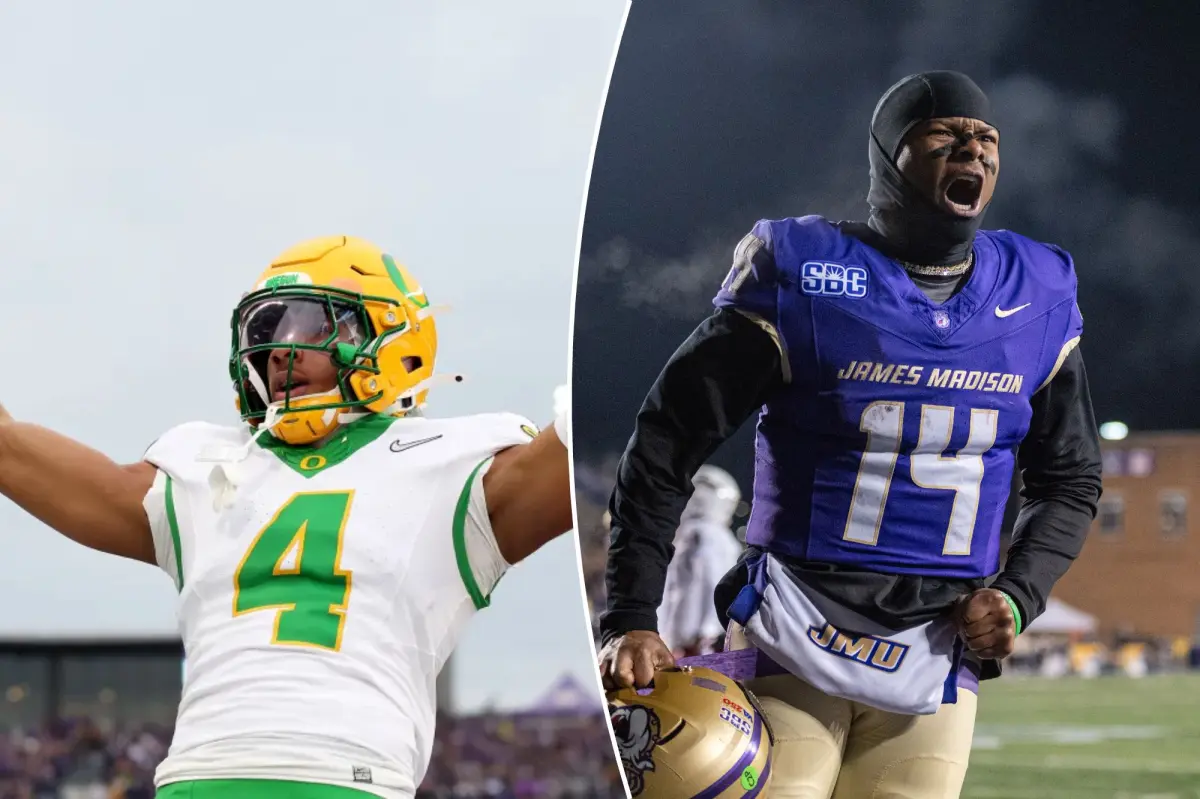
James Madison vs. Oregon. In the College Football Playoff. These are the weirdest of times.

When the field expanded to 12 teams, it meant we were eventually going to get a matchup like this.

On one side of the field stands Oregon, a juggernaut backed up by one of the most robust NIL budgets in the country, and on the other, James Madison, playing in just its fourth season at the FBS level.

James Madison now heads across the country to Eugene as 21-point underdogs, hoping to pull off one of the most profound upsets in the history of the sport.

James Madison vs. Oregon odds, prediction

The Dukes were unquestionably one of the best teams in the Group of 5 this season, but they also ranked 121st in strength of schedule, with their only loss coming against their lone Power 4 opponent — Louisville.

You can only beat the teams in front of you, however, and James Madison did that in style in 2025.


Brandon Finney #4 of the Oregon Ducks reacting during the second half against the Washington Huskies.
Brandon Finney of Oregon celebrates. Getty Images

The Dukes had an average margin of victory of 21.5 points, went 8-5 against the spread and won eight games by at least three possessions.

James Madison hit the 45-point mark five times, including against a couple of decent sides in Old Dominion and Texas State.

That kind of scoring power certainly makes the Dukes a tough out as a 21-point underdog, especially since James Madison excels at controlling the clock.

Only two teams (Army, Miami) average more time of possession per game than the Dukes, who lean into the run more than just about anybody outside of the Service Academies.


Betting on College Football?


Whether or not the Dukes will be able to pull that kind of game plan off against an elite Oregon defense remains to be seen, but it bodes well for James Madison’s chances to cover a large spread that it is committed to the run. That should keep the clock moving, which is a great thing for underdog bettors.

Oregon is likely going to prove to be too much for James Madison over the course of 60 minutes, but the Dukes are uniquely set up to be a thorn in the Ducks’ side on Saturday night.

The Play: James Madison +21 (-110, bet365)


Why Trust New York Post Betting

Michael Leboff is a long-suffering Islanders fan, but a long-profiting sports bettor with 10 years of experience in the gambling industry. He loves using game theory to help punters win bracket pools, find long shots, and learn how to beat the market in mainstream and niche sports.


Link

Continue Reading

NIL

Freshman Ebuka Okorie scores season-high 32 to lead Stanford over Colorado 77-68

Published

on


PHOENIX (AP) — Freshman Ebuka Okorie scored a season-high 32 points to help Stanford beat Colorado 77-68 on Saturday night in the Hall of Fame Series at Mortgage Matchup Center.

Okorie made 6 of 13 shots with two 3-pointers and 18 of 21 free throws for the Cardinal (10-2). He entered averaging 21 points per game.

Benny Gealer hit three 3-pointers and scored 13, adding three steals for Stanford in a third straight victory. Chisom Okpara scored 11 but made only 3 of 12 shots and 4 of his 10 free throws.

Barrington Hargress had 16 points and six assists to pace the Buffaloes (10-2). Sebastian Rancik totaled 14 points and eight rebounds, while reserve Isaiah Johnson scored 11.

Rancik and Hargress both had nine points by halftime to help Colorado build a 35-33 lead.

Hargress followed his 3-pointer with a fastbreak layup, and the Buffaloes took their largest lead at 29-22 with five minutes left. Gealer had 3-pointers on both sides of one by Ryan Agarwal, and the Cardinal used a 9-2 run to tie it 33-all. Felix Kossaras scored with 1:37 remaining for the final points of the half.

Gealer hit a 3-pointer to tie it 37-all, sparking a 9-0 run for a six-point lead, and the Cardinal led for the final 18:20. Oskar Giltay scored to give Stanford its largest lead at 65-49 with six minutes left.

Up next

Stanford: Hosts Cal State Northridge on Saturday.

Colorado: Hosts Northern Colorado on Dec. 28.

___

Get poll alerts and updates on the AP Top 25 throughout the season. Sign up here. AP college football: https://apnews.com/hub/ap-top-25-college-football-poll and https://apnews.com/hub/college-football


Link

Continue Reading

NIL

Jesse Palmer calls for changes to limit G5 schools’ inclusion amid Ole Miss blowout of Tulane

Published

on


As many feared would happen, No. 6 seed Ole Miss completed dominated No. 11 seed Tulane 41-10 in its College Football Playoff First Round matchup Saturday night.

For weeks, college football fans have called for change to the CFP, which would keep Group of Five teams out. At the minimum, in still a rule that would prevent two Group of Five teams from making the College Football Playoff, which Tulane and James Madison both did this season.

The first game featuring a GO5 team was completely uncompetitive, as Ole Miss led 41-3 late into the fourth quarter until Tulane finally found the end zone with four minutes remaining. No. 12 seed James Madison will clash with No. 5 Oregon Saturday night in Autzen, providing one last chance for these such teams to prove they belong.

Late in the Ole Miss/Tulane broadcast Saturday night, ESPN’s Jesse Palmer pleaded with the sport of college football to limit GO5 schools’ inclusions into the Playoff.

“Listen, I’m all about inclusivity and I’m fine with one Group of Five team making it into the 12-team (Playoff),” Palmer said. “That team deserved to be Tulane. They won the best Group of Five conference and beat Duke, the eventual ACC Champion. But as a fan, I want to see the other 11 teams that have a legitimate chance of winning a National Championship.”

Jesse Palmer wants to cap the GO5 participation at just one team

“I think having seen Notre Dame in person this year, I think you (referring to broadcast partner Joe Tessitore) and I both feel that Notre Dame had a legitimate chance to compete for a National Championship,” Palmer continued. “I don’t know if James Madison really does. As we keep talking about and keep working towards getting the 12 best teams in the Playoff, I do think you have to cap the Group of Five participation at just one team.”

In the first iteration of the 12-team College Football Playoff last season, the Mountain West Conference’s Boise State earned the GO5 bid into the bracket. Unlike this season, the top four ranked conference champions earned a First-Round bye, before it was changed. The Broncos clashed with No. 6 Penn State in their Quarterfinals matchup and were blown out 31-14, adding even more fuel to the fire in the argument.

If James Madison is to get blown out Saturday night, chatter regarding the subject matter will continue to grow louder and louder. You can now add Jesse Palmer‘s name to the list of public figures calling for change to the College Football Playoff.


Link

Continue Reading

NIL

Oregon vs. Texas Tech set for Orange Bowl: Preview and odds for CFP quarterfinal

Published

on


The quarterfinals of the College Football Playoff are upon us, which means the four top seeds will finally get their postseason campaigns underway after a lengthy break following conference championship weekend.

No. 4 Texas Tech waited the longest to officially learn its quarterfinal opponent. But given that No. 5 Oregon entered the first round as a three-touchdown favorite over No. 12 James Madison, the Red Raiders likely got a head start preparing for the Ducks. Despite a spirited effort from the Dukes, Oregon overwhelmed the Sun Belt champions to set up the expected Orange Bowl showdown with Texas Tech — a matchup that could be one of the best games of the entire Playoff.

There’s a fitting symmetry to the pairing. Oregon, once college football’s “new money” program, will face the NIL era’s fastest riser in Texas Tech. The Ducks have established themselves as a consistent national contender over the past two decades, while the Red Raiders poured major resources into their program and surged to the top of the Big 12 this season as a result.

In many ways, Oregon represents a blueprint for how a program like Texas Tech can build sustained excellence. On New Year’s Day in Miami, the Red Raiders will get a chance to show they’ve already closed that gap.

For two programs long defined by high-powered offenses, the defining trait of this season has been dominant defense. Both teams have been excellent offensively — they’re both top 10 nationally in scoring — but their defenses have been the engines of their success. As a result, both offenses will face a significant challenge trying to move the ball consistently in this matchup.

What to know about Texas Tech

The Red Raiders earned the No. 4 seed by riding one of the nation’s best defenses to a dominant season in the Big 12. Aside from a midseason stumble at Arizona State, Texas Tech bullied its way through the conference, including a pair of blowout wins over BYU that cemented a top-four finish in the CFP rankings and secured a first-round bye.

Texas Tech’s defense ranks among the elite nationally, finishing third in scoring defense at 10.9 points allowed per game — trailing only top seeds Indiana and Ohio State. All four of the Red Raiders’ AP All-America selections came on the defensive side of the ball, including first-team honors for linebacker Jacob Rodriguez and EDGE David Bailey.

That star-studded unit will be tasked with slowing an Oregon offense that found its rhythm in the second half of the season and finished ninth nationally in scoring at 38.2 points per game. When the Ducks have the ball, it will be a true strength-on-strength battle. Oregon ranked 14th in rushing offense at 218.4 yards per game, while Texas Tech finished No. 1 nationally in rushing defense, allowing just 68.5 yards per game.

Oregon faced two other top-10 defenses in 2025 and failed to crack 21 points against either — scoring 18 in a win over Iowa and 20 in a loss to Indiana. The Iowa game was played in a downpour, but Indiana held the Ducks to 81 rushing yards on 30 carries. Expect Texas Tech to study that film closely in hopes of replicating what the Hoosiers did up front with their own ultra-talented front seven.

The biggest question for Texas Tech is whether its No. 2 scoring offense can hold up against Oregon’s stout defense. The Red Raiders overwhelmed the Big 12, but in their biggest games — against Utah and BYU twice — the defense led the way. Oregon represents another step up in competition, and Behren Morton, Cameron Dickey and the rest of the offense will need to bring their A-game.

What to know about Oregon

The Ducks did what was expected in a convincing first-round win at home, overpowering James Madison to set up a heavyweight clash in the Orange Bowl.

The challenge for Oregon will be creating space for its playmakers against a hard-hitting Texas Tech defense. Against James Madison, the Ducks enjoyed a clear speed advantage and exploited it throughout the game. The margins will be far tighter against the Red Raiders.

Oregon typically sets up the pass with the run, but that approach may be flipped against Texas Tech. Quarterback Dante Moore could be asked to shoulder more of the load early, using the passing game to loosen the Red Raiders’ front and open opportunities on the ground.

Saturday night’s game against James Madison saw Oregon get almost anything it wanted offensively. That will not be the case on Jan. 1, but Moore looked sharp throwing the ball. His confidence and willingness to push it downfield will be critical if the Ducks’ offense is going to have success against Texas Tech.

Defensively, the question is whether Oregon can create negative plays to knock Texas Tech off schedule. The Red Raiders would prefer to lean on the run game and avoid putting too much on quarterback Behren Morton. Despite a strong overall defensive season, Oregon ranked near the bottom nationally in havoc metrics, finishing with 57 tackles for loss (113th in FBS) and 23 sacks (81st).

Texas Tech’s offense stalled early at times against Utah and BYU, largely due to backfield pressure. While both defenses eventually wore down after spending extended time on the field, the blueprint for slowing the Red Raiders is clear: generate pressure and speed up Morton’s decision-making.

Oregon has been steady defensively all season, but it may need to be more creative in manufacturing the disruption necessary to give Texas Tech problems.

Odds below via FanDuel Sportsbook.

Orange Bowl odds, prediction 

I expect a highly competitive game in Miami between the Red Raiders and Ducks as I think there are a lot of similarities between these two teams. Both defenses are excellent and when at their best, the offenses can put up points in bunches. To me this game comes down to which offense can create more explosive plays in a variety of ways, because both defenses are so talented and so good at adapting in-game. I give the Ducks the edge in that department thanks to Moore and see him leading Oregon to a bit of quarterfinal revenge after last year’s dud in the Rose Bowl. PICK: Oregon -1.5


Link

Continue Reading

NIL

After Signing Extension To Stay At Arizona State, Kenny Dillingham Sounds Off

Published

on


If Sun Devil fans want to stay competitive in the Big 12, they better pony up the big bucks.

Arizona State Sun Devils head coach Kenny Dillingham has enjoyed quite a successful tenure so far in Tempe.

After his first year in which his squad put up a dismal 3-9 record, Dillingham went to work and completely flipped the fortunes of the ASU football program, posting a 19-7 record over the last two seasons, including a Big 12 championship and a College Football Playoff berth.

For his efforts, Dillingham recently received a massive extension and larger salary pool for his assistants, fending off the circling Michigan Wolverines in the process.

Though I’m sure Dillingham is happy to be staying in the Valley of the Sun and is thrilled with his new paycheck, the 35-year-old head coach was recently chatting up the local media and stumping for a different kind of payday.

It’s easy to look at Dillingham saying these things and see him as greedy or ungrateful, but he’s spot on, and the sad reality is that this is the new norm for the sport of college football.

The name of the game is roster building and retention, and if you want to compete in the Power 4 leagues and consistently make the College Football Playoff, you had better pony up some serious dough.

A sum like $20 million might seem like a ridiculous demand, but that’s a pretty reasonable number in today’s NIL arms race.

The Texas Techs of the world are going to do whatever it takes to win, and if Dillingham wants the Big 12 to run through Tempe and not Lubbock, then he is doing the right thing by lobbying for some of those billionaires living in Arizona to stroke a check.

It’s disgusting and gross and goes against everything that college football used to be about, but this junk isn’t going anywhere, so you either adapt or die.

Dillingham is adapting, now we will see if the big money players will follow his lead.

Because if they don’t, things could get very dark very soon for the Sun Devils.


Link

Continue Reading

NIL

2025-26 College Football Playoff: What’s next for each eliminated playoff team?

Published

on


And then there were eight.

The 2025-26 College Football Playoff is here, and Saturday evening has given us our fourth eliminated team of the playoff in the James Madison Dukes. So what happens now?

We’ll tackle big questions, recruiting outlooks, portal and offseason priorities and even offer predictions for next season for every eliminated squad.

Jump to:
James Madison | Tulane
Texas A&M | Oklahoma

2025 record: 12-2

Biggest question moving forward: Can JMU make it three-for-three on coaching hires? Curt Cignetti reached the top of the mountain in the FCS and led JMU to a stellar start at the FBS level. When he left for Indiana, Bob Chesney arrived and delivered equally impressive results, getting the Dukes into the College Football Playoff. Now, Chesney is off to UCLA, and James Madison turns to Billy Napier, a coach with a history of success in the Sun Belt but who is coming off a disastrous turn at Florida. JMU’s goal has always been to measure itself against its peers rather than the upper echelon of college football, but 2025 offered a taste of the good life, and it’s now on Napier to continue to build toward that again in 2026 and beyond. The job of winning consistently at the Group of Five level has never been harder, and JMU’s aspirations have never been higher. — David Hale

Recruiting outlook: The Dukes emerged as one of the Sun Belt’s premier programs under Cignetti and Chesney, and there’s no reason to think they’ll fall off moving forward with Napier in charge. James Madison’s latest class is led by three-star cornerback Kamden Jennings, an undersized but explosive defensive back from Alpharetta, Georgia. He’s joined in the program’s secondary class by cornerback Kyle Bynes and safety D’Kwan Thomas, while defensive tackle Cory Simon arrives as a high-upside prospect. Within a deep wide receiver class, three-star Ben Whitver marks an intriguing addition with Power 4 measurables at 6-foot-2, 190 pounds. — Eli Lederman

Biggest portal priority: When Cignetti left to take over at Indiana after the 2023 season, he and his coaches took 13 players with them to Bloomington, many of whom became program leaders and All-Big Ten performers. How many Dukes will choose to move across the country to UCLA with Chesney? Alonza Barnett III, Wayne Knight, Sahir West and the rest of their top returning players have big decisions to make now, and Napier will do what he can to hold this roster together before shifting his focus to reloading in the portal. The combination of graduating seniors and potential portal defections in January likely means JMU’s starting lineup will feature lots of new faces to open the 2026 season, but Chesney’s tenure proved this program can quickly recover from a coaching transition and get right back to Sun Belt contender status. — Max Olson

Under-the-radar offseason priority: James Madison has played 40 games in three years at the FBS level, so there’s a certain level of expectation that the dominance will continue. Expectations can be dangerous, however. On its third coach in five years, maintaining high standards can be tough. With so much success, bigger schools are waiting to pick off the best talent, as is life in the Group of Five these days. But even on top of all that, so much continuous winning can breed a level of apathy when the locker room is also changing rapidly — with new players arriving and expecting the same results without fully appreciating what went into achieving that historic success. Just in the Sun Belt, App State, Coastal Carolina and Napier’s former team, Louisiana, have all had their stretches at the top, but tumbled back to earth. Reenergizing JMU after reaching what feels like a new mountaintop in 2025 will be a critical job for Napier in Year 1 on the job. — Hale

2026 prediction: JMU’s 2026 schedule looks inviting. The Dukes get a Liberty team that has been down as of late, a UConn team in the first year with a new coach and a Virginia Tech team that will just be getting its sea legs under James Franklin. Run the table out of conference, and this year showed the door is wide open for a playoff berth. The Sun Belt isn’t likely to struggle in 2026 quite as much as it did in 2025, but JMU still seems to be the clear front-runner. To aim for a second straight playoff bid is reasonable, even if realistic expectations should focus on winning the Sun Belt again and hoping the other dominoes fall into place from there. — Hale


2025 record: 11-3

Biggest question moving forward: Tulane has handled challenging coaching transitions before, going from longtime boss Willie Fritz to Jon Sumrall without any significant backslide. But Sumrall leaves a significant void as he leaves to become the head coach at Florida, and though promoting Will Hall as his successor creates some immediate stability, Hall will have to reprove himself as a program leader after a very rough end to his tenure at Southern Miss. The expectations have changed at Tulane, which is 33-13 since the start of the 2022 season. The program is set up not to revert to its pre-Fritz struggles. But the American Conference will remain a challenge, especially with significant investments at programs such as South Florida and Memphis. Similar to a lot of Group of 5 CFP teams, Tulane will lose a lot, both to graduation and the portal, and Hall and his staff will need to identify a new quarterback, replenish the offensive line and replace key defenders such as Santana Hopper and Sam Howard. — Adam Rittenberg

Recruiting outlook: The Green Wave’s 2026 class faded late, with five decommitments after Nov. 18 amid coach Jon Sumrall’s departure for Florida, headlined by the exit of four-star wide receiver Trez Davis. Still, Tulane is set to add some intriguing talent in 2026. In three-star signee A.J. Westfield, the program has its highest-ranked defensive tackle since the Green Wave landed defensive tackle Alfred Thomas and Jeffery Johnson in the 2018 class. Offensive tackle Aiden Martin and guards Tylan George and Andre Amos Jr. will provide reinforcement on the other side of the line of scrimmage. And in the skill positions, first-year coach Will Hall will have three exciting newcomers to work with — wide receivers Keyshaun Coleman and Gary Hadley Jr. and tight end Colby Simpson. — Eli Lederman

Biggest portal priority: Like any Group of 5 program going through a head coaching transition, Tulane will likely have a lot of work to do when the transfer portal opens Jan. 2. We’ll see how much roster attrition newly promoted coach Will Hall and his staff endure now that the season is over and players have Power 4 opportunities to consider. The Green Wave lost a dozen transfers to P4 programs last offseason, and all-conference defensive lineman Hopper has already announced he plans to enter the portal next month. Players who have a chance to go to Florida will have a tough time turning down those lucrative offers. There are also a bunch of freshmen on this roster who played big roles in 2025, including Jamauri McClure, Javin Gordon, Reese Baker, E’zaiah Shine and Zycarl Lewis Jr. If the new staff retains some players over these next few weeks, that’d be a good place to start. — Max Olson

Under-the-radar offseason priority: The defensive line will be an area to watch, with Hopper already heading out and others possibly to follow, but Tulane also must fortify its depth on the offensive line. First-team all-conference guard Shadre Hurst would be a massive retention, but if he moves on, along with seniors Derrick Graham, Jack Hollifield and Jordan Hall, Tulane will have to devote a lot of energy toward building around its lone returning starter, right tackle Reese Baker. Hall and Hollifield were valuable additions in last year’s portal, and Tulane should be an attractive destination for transfers with the offensive system likely not changing too much under Will Hall. — Rittenberg

2026 prediction: The Hall hire will be closely scrutinized, as Tulane prioritized continuity over candidates with more appealing credentials. Hall knows the place well after two stints as a Green Wave assistant, and he had success as a head coach earlier in his career at West Alabama and West Georgia, before the struggles at Southern Miss (14-30). Tulane’s 2026 schedule features nonleague road trips to Duke (former Tulane QB Darian Mensah is back to lead the Blue Devils) and Kansas State, as well as conference games at Army and South Florida. Given the turnover with the coaching staff and roster, Tulane is probably a seven- or eight-win team. — Rittenberg


2025 record: 11-2

Biggest question moving forward: Mike Elko loses both coordinators, with OC Collin Klein heading to his alma mater to be the head coach at Kansas State and DC Jay Bateman joining new Kentucky coach Will Stein to run the defense. Elko has opted for continuity in both roles, promoting co-OC and wide receivers coach Holmon Wiggins to take over playcalling duties and elevating Lyle Hemphill, Elko’s associate head coach for defense, to DC. Hemphill has worked with Elko since his days at Hofstra in 2006, and also served as his defensive coordinator at Duke, rejoining his staff earlier this year. Wiggins, however, is more of an unknown since this will be his first role as the coordinator. But his impact on A&M’s offense over the past two years is evident in the receivers he has identified and developed, from the additions of Mario Craver and KC Concepcion to the development of Ashton Bethel-Roman. — Dave Wilson

Recruiting outlook: The Aggies stocked up on elite defenders for another cycle on their way to landing the nation’s No. 6 class. The headliner is five-star athlete Brandon Arrington (No. 18 overall), a star sprinter from San Diego who is expected to play cornerback and could contribute on special teams from the jump. Arrington will be joined by another pair of top 100 cornerbacks in Victor Singleton (No. 56) and Camren Hamiel (No. 85) in a Texas A&M class filled with nine ESPN 300 defenders. The Aggies beat in-state rivals to an intriguing running back prospect over the summer in four-star rusher K.J. Edwards (No. 50). And Mike Elko is already rolling in the 2027 cycle, too, entering the offseason already holding onto pledges from seven members of the ESPN Junior 300, led by No. 3 dual-threat quarterback Jayce Johnson and a trio of top 70 defensive backs between JayQuan Snell, Kamarui Dorsey and Raylaun Henry. — Lederman

Biggest portal priority: Texas A&M has done an excellent job of evaluating talent in portal recruiting under Elko and finding players who fit. Last year, the glaring need was wide receiver, and the duo of Concepcion and Craver far exceeded expectations. This time around, the focus probably starts up front. Expect the Aggies to be in the mix for the top offensive tackles available as they try to find an SEC-caliber big man to take over for four-year starter Trey Zuhn III and two-year starter Dametrious Crownover. They’ll likely look into blue-chip defensive linemen as well to keep building on what this D-line achieved in 2025, and a linebacker could be needed as well if Taurean York goes pro. Craver has already re-signed to return in 2026, but there will be many more difference-makers available at wide receiver when the portal opens on Jan. 2. — Olson

Under-the-radar offseason priority: The Aggies were just 15 of 24 on field goal attempts this season, including getting a 22-yarder blocked by Jared Zirkel, who began the year as a kickoff specialist, against Miami, in a game where every point mattered. Randy Bond, the Aggies’ starting kicker, was 12-of-19 this season. The Aggies signed kicker Asher Murray out of Shreveport, Louisiana, who was 18-of-22, with a career long of 56 yards in his high school career. Elko said during his signing day news conference that Murray has a chance to be a weapon for the Aggies. — Wilson

2026 prediction: Quarterback Marcel Reed returns, but after a season in which he showcased his development, he also struggled down the stretch against South Carolina (until he played brilliantly in the second half), Texas and Miami. He’ll need to find another gear if the Aggies hope to repeat their historic 2025 season. Another 11-1 regular season looks difficult with a regular season that ends with a five-game slate that includes trips to Alabama, South Carolina and Oklahoma and home games against Tennessee and Texas. A 9-3 season looks to be challenging but also a success in the SEC’s new nine-game lineup. — Wilson


2025 record: 10-3

Biggest question moving forward: Oklahoma made important investments in its offense after the 2024 season, adding quarterback John Mateer and coordinator Ben Arbuckle from Washington State, wide receiver Isaiah Sategna III from Arkansas and other reinforcements. The Sooners now need to see the unit take a sustained step forward, or advancing in the CFP will become increasingly difficult. The offense was extremely limited during OU’s stretch run, even in wins against Alabama, Missouri and LSU. If not for superb defense and special teams, OU would have missed the CFP for a fifth consecutive season. Arbuckle will get another chance to truly upgrade the unit, and if Mateer returns rather than entering the NFL draft, the Sooners will have some beneficial continuity. OU’s offense has been hit hard by injuries in recent years, and getting Mateer healthy along with the running back room gives the unit a chance for a true breakthrough in 2026. The Sooners need to get their run game out of the 100s and ideally into the top 35 next season. — Rittenberg

Recruiting outlook: The Sooners enter the offseason prepared to add ESPN’s 16th-ranked recruiting class in 2026. The gem of coach Brent Venables’ latest class is five-star defensive end Jake Kreul (No. 25 overall), a technically-advanced edge rusher from Florida and Oklahoma’s fifth five-star signee over the past four cycles. The Sooners secured a pair of intriguing offensive additions just before the early signing period between No. 5 running back Jonathan Hatton Jr. (No. 71) and four-star wide receiver Jayden Petit (No. 178). Bowe Bentley, ESPN’s No. 2 dual-threat passer, was a priority target for Oklahoma offensive coordinator Ben Arbuckle, and he should be viewed as a potential quarterback for the Sooners when he joins the program in January. — Lederman

Biggest portal priority: Assuming Mateer bypasses the NFL draft and returns in 2026, it’ll be interesting to see how general manager Jim Nagy and the Sooners attack this upcoming January portal cycle to surround their QB1 with more premium help on offense. Expect the Sooners to go out and get proven starters at tight end and wide receiver to complement their returning playmakers and help Arbuckle’s offense take the next step in his second year. Linebackers could potentially emerge as a major need for Venables’ defense if Kip Lewis and Kobie McKinzie enter the draft and if Owen Heinecke can’t get an NCAA waiver for an extra year. Sammy Omosigho will need to step up if starters depart at that spot, but he will certainly need more help. — Olson

Under-the-radar offseason priority: Oklahoma should bring back a chunk of its depth chart on offense for 2026, but the Sooners — just like any contending team — could always use more experience on the line. The team will lose second-team All-SEC guard Febechi Nwaiwu and veteran right tackle Derek Simmons, and it needs to invest around returning players such as Michael Fasusi, who started all but three games at left tackle as a freshman. The Sooners also need playmakers for Mateer, as wide receiver Deion Burks and tight end Jaren Kanak move on and Sategna, a fourth-year junior, is a candidate to leave for the NFL draft. — Rittenberg

2026 prediction: Oklahoma was far from dominant — the Sooners won four SEC games by seven points or fewer — but showed it could hold up in a challenging SEC schedule and earn a CFP spot, albeit short-lived. The personnel picture should continue to improve in Norman, and Oklahoma should bring back enough to be in the CFP mix again. There are some significant questions about an offense that stalled out too often, though, and will be challenged early next season with Georgia (road), Texas (neutral) and Michigan (road) all within the first five games. The middle portion of the schedule softens a bit before Oklahoma closes with two CFP teams, Ole Miss and Texas A&M, in Norman and a trip to Missouri. Another 10-win season is possible, but I’ll say 9-3 for Oklahoma and very much on the CFP bubble. — Rittenberg


Link

Continue Reading

Most Viewed Posts

Trending