
 It’s a good feeling, just being able to be a part of the New Balance family. It’s a great honor, and I’m ready to go forward with this journey and enjoy the ride. To join this roster with Marvin and Chase, those two great guys, its something that I’ve never really imagined. I’ve never imagined that I’d get to this point, but here I am, and its an honor to be here. I’m just excite to grow with the brand. Need a break? Play the USA TODAY Daily Crossword Puzzle
 We haven’t really talked that deep yet, but New Balance is my family. We are all a family here, and any ideas that I have, I’m sure they’ll be all ears, and try to help me in any way they can. We haven’t really talked that deeply yet. The journey is just now started, and if we can get to that at some point in the future, that’s great, but I’m just here to grow with this brand, and grow off each other. New Balance will do whatever to make both of us happy. What drew you to New Balance?
 What drew me to New Balance, when I met Jack. He’s a great guy. Jack came to me and automatically felt like family. That’s what New Balance is as a whole, its really a family, everybody cares about each other. I know that New Balance cares, they’re willing to do anything to help me grow, on and off the field. That family type of environment, I really wanted that, and also they have great products, great cleats. New Balance is very comfortable, I’m all about comfortability. I feel like this was just the right fit for me, me and my family to be honest because they love New Balance as well. How was the transition with Ja’Juan Seider coming over from Penn State?
 It was a smooth transition, coach Deland was a great guy, great coach, great father, great husband. Losing him was big for us, but just got to move onto the next thing. Me and coach and still in contact to this day, I talked to him yesterday. He’s going to be my coach forever. He’s my guy. The transition from him to coach Seider, it felt pretty seamless because they are both great coaches, both great guys. I’ve grown to love coach Seider more and more as I am being coached by him. Not just me but everybody in the room loves coach Seider, he just brings a different style of coaching. He brings more on intellectual side to the room, he tries to educate us more about safety rotations, what fronts that the d-lineman are in, what are they going to do. It’s brings a very intellectual base, coaching style and I love that. Coach D was very big on being detailed and just doing the right things all the time. That set a great foundation for me, and with coach Seider I’m getting more of the focus not only on what I have to do, but what everybody else’s job is. It’s all coming full circle which I really love, but I’m really getting the best of both worlds, that’s why the coaching change was so seamless. What led to you taking reps at wide receiver in the spring?
 For me, the whole idea is being more versatile, being able to be put into different places to make more plays. I played receiver in high school a bit, but me doing it in the spring is to make sure that I’m still able to run good routes, make sure that I’m understanding not only what I have to do in the running back room, and tie it to the receiver room. The cross training is just to really make sure that I still keep my foundation that I’ve already built at receiver, just in case there’s a situation in the game where I go out wide and need to make a play. That’s really just the whole basis of it, just allow coaches to game plan and put me wherever they need to me be to make plays. Why Notre Dame?The biggest factor was it felt like family, a lot like New Balance. I guess that just goes to show that I’m looking to go places where I can build real connections with people, and not just in-the-moment connections. I’m really looking for people to grow with, build things with, and Notre Dame was that place for me, and also New Balance is that place for me. The family side of things is what brought me to Notre Dame. I came into this program with a great coach like Marcus (Freeman) and a great coach in Deland, they care about me off the field. They just don’t think of me as a football player, they think of me as family and that really drew me to Notre Dame. Also, its a great program, great sports, great academics, because football is going to end one day, and I have to get my degree that is meaningful. When I visited other places and compared it to Notre Dame, it was obvious that was the place that I wanted to be, and help me get to the place I want to be. At what moment did you feel like the team clicked in the College Football Playoff?I would say after the Georgia win. I’m not going to say it was after the Indiana win because everyone already felt like Indiana wasn’t supposed to be there. We just went on and beat the SEC Champion, and everybody realized that Notre Dame is serious, we are real contenders. I felt like that was the moment everyone felt like we can make this run, we can actually go and do this. The win over them shocked everybody because we were the underdogs in that game, and we defied the odds. We the doubters, that game pushed us past toward us thinking like we just gotta get past these guys, we can go and win it all. What individual goals do you have for the 2025 season?
 There’s really nothing numbers based, I just want to go out there and just make sure that I give it my all. I want to be better than I was last year. I want to win the Doak Walker Award, and even more importantly, I want to win the Heisman. To do that it will require a lot of hard work that I’m willing to put in. A lot of things that I have to sacrifice, but I’m willing to do it all to win that trophy. How did the “Love Leap” start?The hurdling came from the Northern Illinois week and this safety kept ankle biting me the whole game. And then at halftime I was telling one of my teammates, that he kept going for my ankles, and pull my knees out. I told Gi’Bran that if this dude keeps going for my ankles, I swear I will hurdle him. I’m just going to jump and do it. And we came out the second half, it was the third quarter, and it was an inside-zone and I broke out and I saw the safety, the same due that was ankle biting me the whole game.I see him coming down, and I already know what he’s going to try to do. He’s going for my knees, my ankles, so I just gave it to God and I jumped and went over him. That’s when I realized that I can jump completely over people, and as the season went on, the thoughts kept in my head. It was almost like intrusive, even when I said I’m not going to do it, if the moment presents itself, I’m just going to jump. I just give it to God. If they clip me, they clip me. If they don’t great. It’s not really planned, its an in the moment type of thing and I just do it. Contact/Follow us @IrishWireND on X (Formerly Twitter), and like our page on
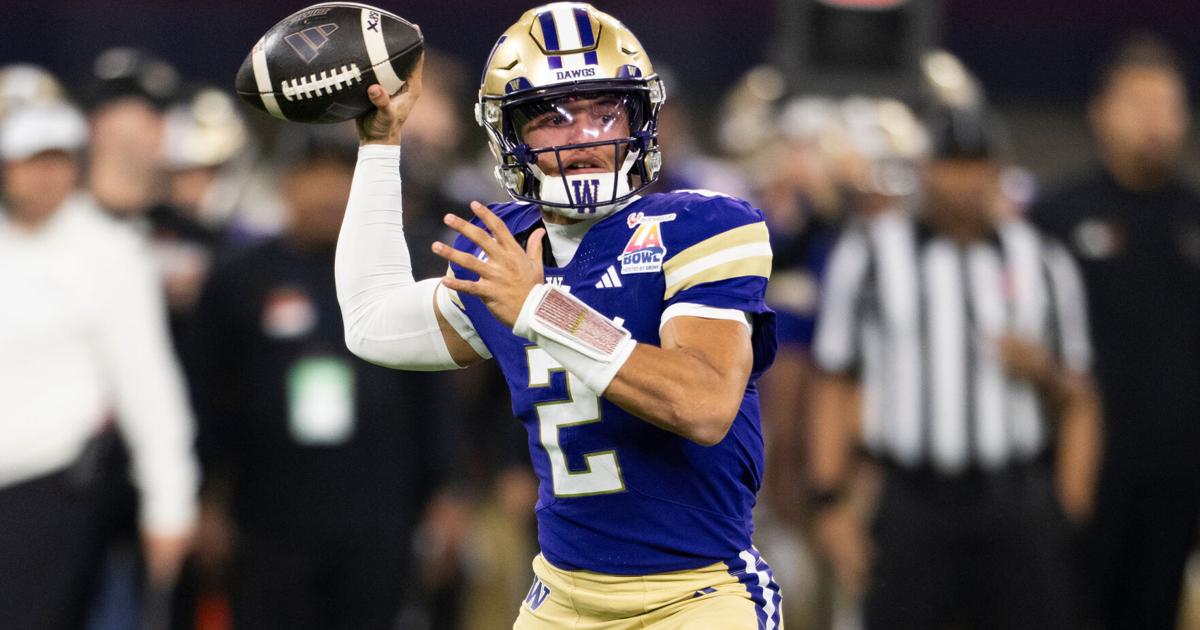
A quarterback reportedly reneging on a lucrative deal to hit the transfer portal, only to return to his original school. Another starting QB, this one in the College Football Playoff, awaiting approval from the NCAA to play next season, an expensive NIL deal apparently hanging in the balance. A defensive star, sued by his former school after transferring, filing a lawsuit of his own.
It is easy to see why many observers say things are a mess in college football even amid a highly compelling postseason.
“It gets crazier and crazier. It really, really does,” said Sam Ehrlich, a Boise State legal studies professor who tracks litigation against the NCAA. He said he might have to add a new section for litigation against the NCAA stemming just from transfer portal issues.
“I think a guy signing a contract and then immediately deciding he wants to go to another school, that’s a kind of a new thing,” he said. “Not new kind of historically when you think about all the contract jumping that was going on in the ’60s and ’70s with the NBA. But it’s a new thing for college sports, that’s for sure.”
Washington quarterback Demond Williams Jr. said late Thursday he will return to school for the 2026 season rather than enter the transfer portal, avoiding a potentially messy dispute amid reports the Huskies were prepared to pursue legal options to enforce Williams’ name, image and likeness contract.
Edge rusher Damon Wilson is looking to transfer after one season at Missouri, having been sued for damages by Georgia over his decision to leave the Bulldogs. He has countersued.
Then there is Ole Miss quarterback Trinidad Chambliss, who reportedly had a new NIL deal waiting while he asked the NCAA for approval to play another season after leading the Rebels to Thursday night’s Collge Football Playoff semifinal against Miami. The NCAA a day after Miami’s win denied his request.
On that Miami roster? Defensive back Xavier Lucas, whose transfer from Wisconsin led to a lawsuit from the Badgers, claiming he was improperly lured to Miami by NIL money. Lucas has played all season for the Hurricanes and now gets a chance at a national championship. The case is pending.
What to do?
Court rulings have favored athletes of late, winning them not just millions in compensation but the ability to play immediately after transferring rather than have to sit out a year as once was the case. They can also discuss specific NIL compensation with schools and boosters before enrolling. Current court battles include players seeking to play longer, without lower-college seasons counting against their eligibility, and earning NIL money while doing it.
Ehrlich compared the situation to the labor upheaval professional leagues went through before finally settling on collective bargaining, which has been looked at as a potential solution by some in college sports over the past year. Athletes.org, a players association for college athletes, recently offered a 38-page proposal of what a labor deal could look like.
“I think NCAA is concerned, and rightfully so, that anything they try to do to tamp down this on their end is going to get shut down,” Ehrlich said. “Which is why really the only two solutions at this point are an act of Congress, which feels like an act of God at this point, or potentially collective bargaining, which has its own major, major challenges and roadblocks.”
The NCAA has been lobbying for years for limited antitrust protection to keep some kind of control over the new landscape — and to avoid more crippling lawsuits — but bills have gone nowhere in Congress.
Universities have long balked at the idea that their athletes are employees in some way. Schools would become responsible for paying wages, benefits, and workers’ compensation. And while private institutions fall under the National Labor Relations Board, public universities must follow labor laws that vary from state to state; virtually every state in the South has “right to work” laws that present challenges for unions.
Ehrlich noted the short careers for college athletes and wondered whether a union for collective bargaining is even possible.
A harder look at contracts
To sports attorney Mit Winter, employment contracts may be the simplest solution.
“This isn’t something that’s novel to college sports,” said Winter, a former college basketball player who is now a sports attorney with Kennyhertz Perry. “Employment contracts are a huge part of college sports, it’s just novel for the athletes.”
Employment contracts for players could be written like those for coaches, he suggested, which would offer buyouts and prevent players from using the portal as a revolving door.
“The contracts that schools are entering into with athletes now, they can be enforced, but they cannot keep an athlete out of school because they’re not signing employment contracts where the school is getting the right to have the athlete play football for their school or basketball or whatever sport it is,” Winter said. “They’re just acquiring the right to be able to use the athlete’s NIL rights in various ways. So, a NIL agreement is not going to stop an athlete from transferring or going to play whatever sport it is that he or she plays at another school.”
There are challenges here, too, of course: Should all college athletes be treated as employees or just those in revenue-producing sports? Can all injured athletes seek workers’ compensation and insurance protection? Could states start taxing athlete NIL earnings?
Winter noted a pending federal case against the NCAA could allow for athletes to be treated as employees more than they currently are.
“What’s going on in college athletics now is trying to create this new novel system where the athletes are basically treated like employees, look like employees, but we don’t want to call them employees,” Winter said. “We want to call them something else and say they’re not being paid for athletic services. They’re being paid for use of their NIL. So, then it creates new legal issues that have to be hashed out and addressed, which results in a bumpy and chaotic system when you’re trying to kind of create it from scratch.”
Employment contracts would not necessarily allow for uniform rules with an athlete able to go to transfer when terms have been met. Collective bargaining could include those guidelines.
“If the goal is to keep someone at a school for a certain defined period of time, it’s got to be employment contracts,” Winter said.
Get poll alerts and updates on the AP Top 25 throughout the season. Sign up here. AP college football: https://apnews.com/hub/ap-top-25-college-football-poll and https://apnews.com/hub/college-football