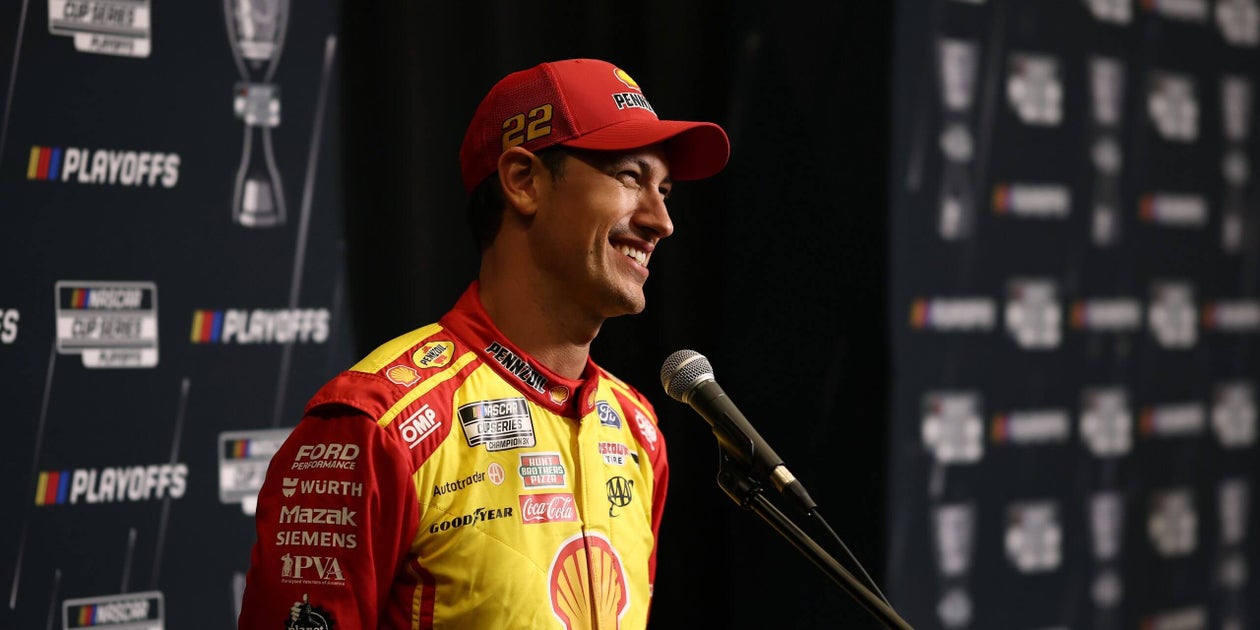
HUNTERSVILLE, N.C. — As usual, Joey Logano’s laugh precedes him.
It floats down the hallway of the production studio owned by the three-time NASCAR Cup Series champion — fittingly named Clutch Studios — and serves as trumpet-like fanfare for his arrival.
Except Logano doesn’t have a royal aura when he enters a room. Wearing his typical squinty smile and business-casual office attire — a golf polo shirt, slacks and sneakers — he looks like any typical 30-something father of three.
But despite being an unassuming and affable figure away from the racetrack, the Team Penske driver also happens to be one of the biggest irritants for NASCAR fans. That annoyance is thanks in part to how he has mastered winning championships under the current playoff format — a system that has recently grown less popular in fan sentiment.
In fact, NASCAR may change the format as soon as next season. But before any change can occur, there’s bad news for Logano’s detractors: He just might win it again.
“I mean, don’t get mad at me for it,” he said.
The expression, “Don’t hate the player, hate the game,” doesn’t really apply to Logano when it comes to NASCAR’s championship format, because Logano loves the game. He defends the game. He may even be the No. 1 advocate for the game.
So when fans criticize the format, Logano is inextricably linked to it. And when he keeps winning, particularly in the survive-and-advance, how-did-they-do-that method his No. 22 team has employed, Logano has become the face of it.
“As a fan, I want to see (drivers) scared, and our playoff system now does that,” Logano said. “I’ve always been the person to say, ‘If you’re complaining about it, then just do better.’ If you scored a bunch of points during a regular season and you didn’t make it to the Championship 4, then shame on you. You had a head start, and you still couldn’t do it.
“But don’t say it’s not legit. You could have gone out there and won to get in. You didn’t. Just because it didn’t work for you, it doesn’t mean change the rules.”
While Logano feels strongly about the merits of the current system, many fans (and some drivers) do not agree. When The Athletic asked fans on X what championship format NASCAR should use, only 8.5 percent in a poll with more than 30,000 respondents voted for the current system to remain.
To that end, Logano said he realizes there’s an opportunity “for some tweaks to be made” that would increase the credibility of the championship and added he’s “come to be OK with a lot of the ideas.”

Joey Logano’s win at Texas in May was his only victory of the regular season. In an underwhelming statistical season, he’s still a top threat for the championship. (Tim Heitman / Getty Images)
But he’d certainly be just fine if NASCAR decided not to change anything.
Logano isn’t the first driver to be the face of the negatives about a championship format. When Jimmie Johnson won five straight Cup Series titles in the old “Chase,” in which the title was determined over a 10-week mini-season, fans grew restless and bored.
NASCAR then changed the format months after Johnson won his sixth championship, and Logano has been the most successful driver in the present playoff format, which has a series of three-race elimination rounds ending in a championship race among four remaining eligible drivers.
In the 11 editions of the current system, Logano has made it to the “Championship 4” race six times, won the title in half of them and has 15 victories during the playoffs. He leads every driver in those categories.
So in a system that emphasizes big moments over the traditional season-long consistency of motorsports greatness, Logano believes he has excelled as someone built to embrace pressure.
After all, that type of pressure has been present for the 35-year-old’s entire life.
As a child racing prodigy, Logano was always the youngest driver on the track. His father, Tom, forged Joey’s birth certificate so his 9-year-old son could race Legend cars before the required minimum age; that made Joey feel the pressure of being “one mistake away from not getting to drive anymore,” he said.
The pressure continued when Logano moved into bigger cars as a 14-year-old, which Logano noted was four years younger than the next-closest driver at the time. By age 15, Logano was labeled as the next racing superstar by NASCAR Hall of Famer Mark Martin; Logano said that spotlight made him feel like he had to live up to the hype.
Then, as an 18-year-old, he replaced Hall of Famer Tony Stewart at NASCAR’s top level, driving Joe Gibbs Racing’s famed No. 20 car.
So in Logano’s eyes, there has never been anything but high-pressure situations when it comes to his racing career. The playoffs are just a concentrated version.
“Everyone is going to say they love pressure, because that’s the thing you tell a reporter to make it sound good,” he said. “But the truth is, it’s hard. There’s a ridiculous amount of pressure from everybody — fans, sponsors, yourself. Some people just don’t handle it.
“I’ve learned you can’t hide from it, you can’t run from it. You have to find a way to manage it.”
Because the Connecticut native has been in the Cup Series for so long, he has lived through NASCAR’s decline from its peak in the mid-2000s — something many current drivers have only heard about and did not experience themselves.
That leaves Logano, an optimist by nature anyway, feeling more positive about the sport’s direction than some of his peers. There was a decline, he acknowledged, but “if you zoom out, there’s an uptick. We’re better than a few years ago.”
Logano said the outside perception of NASCAR is trending positive, too. When he travels the country to promote it — which he does more frequently than any driver, as evidenced by earning the top prize in a NASCAR driver incentive program earlier this season — Logano notices people ask about what NASCAR is doing right, not wrong.
“What I hear from people is that we’ve done a good job telling the story of the sport’s momentum,” Logano said. “There are a lot of positives right now. People are showing up at racetracks. Our racing has been exciting. Our schedule is changing and going to new places.”
But inside the NASCAR bubble, there’s still much hand-wringing about topics like the playoff format — which was only exacerbated when Logano won again last year, this time with the worst season average finish of any champion in NASCAR’s 76-year history. Because Logano took advantage of the system by winning races just at the right time, sometimes in strange circumstances, he was viewed by some as an undeserving participant in the 2024 championship race.
Except then he won it, again, and became one of just 10 drivers in NASCAR history to win at least three Cup titles.

A wild, unlikely win in Nashville in June 2024 is the only reason Joey Logano made the playoffs last year. Then he carved his way to another championship. (James Gilbert / Getty Images)
Both fans and those in the garage have wondered what role the championship system has played in NASCAR’s lack of popularity compared to its glory days, and NASCAR has formed a committee to examine whether changing the system for next year is the right move.
Logano acknowledged to The Athletic that he is a member of that committee. As such, he’s been privy to various models of alternative playoff systems — and Logano said some show “I would have won four times instead of three.”
“I wish people knew that, because I’m sick of people talking crap about our championships,” he said.
That talk is highly unlikely to end if Logano wins again this season. He enters the playoffs as the No. 12 seed and with only the seventh-best odds among bookmakers despite winning two of the last three championships.
If he’s being overlooked, it’s for good reasons statistically: Logano has won just one race this season — in early May — and has been among the top five finishers in only two other races. And yet as crew chief Paul Wolfe told members of the No. 22 team when he gathered them for a meeting last week: “There’s a pretty realistic pathway to make it to Phoenix (for the championship race) if we all just execute and do our part.”
That’s in part because this year’s playoff schedule plays exceptionally well to the strengths of the Team Penske cars — which are best on flatter, shorter tracks. Penske has won three straight titles by excelling at Phoenix, a 1-mile track that fits that description. But this year, two of Phoenix’s cousins — World Wide Technology Raceway near St. Louis and New Hampshire Motor Speedway — have joined the playoff schedule.
Additionally, all of the Penske drivers (which also include 2023 champion Ryan Blaney and former Daytona 500 winner Austin Cindric) are exceptional at superspeedways — and Talladega Superspeedway has moved into Round 3, which means a victory there can secure a Championship 4 berth.
“There’s no reason we shouldn’t be the favorite going into it,” Wolfe said. “Up to this point in the season, nothing looks any different than it did in those two years we won with this car.”
That should be alarming for the field, as if Logano’s record wasn’t enough already. He has won at least one race on nine of the 10 tracks on the playoff schedule and has multiple wins at six of them.
“As Paul says, you’ve got to find that last little bit,” Logano said. “It sounds simple, but it’s hard to do, and that’s the difference-maker now.
“At most tracks, I’m probably not the fastest, but I can be close enough to capitalize when people make mistakes. That’s been our strength.”
(Top photo of Joey Logano: Jared C. Tilton / Getty Images)