Connect with us
https://yoursportsnation.com/wp-content/uploads/2025/07/call-to-1.png

Motorsports

Judge frustrated as NASCAR antitrust trial drags on with no end in sight | Sports

Published

on


CHARLOTTE, N.C. (AP) — The slow pace of the federal antitrust suit lodged against NASCAR continued Monday at the start of the second week of the trial, with high-profile witnesses not expected to make it to the stand anytime soon.

Jeffrey Kessler, lead attorney for the two teams suing NASCAR, indicated he plans to call NASCAR Commissioner Steve Phelps after an expected lengthy testimony from an accountant who will analyze team finances. After Phelps, Kessler said he will call Hall of Fame team owner Richard Childress and finally NASCAR chairman Jim France.

But the case is moving far too slow for U.S. District Judge Kenneth Bell’s liking and he’s repeatedly asked both 23XI Racing and Front Row Motorsports, as well as NASCAR, to speed it up. Monday was already off to a delayed start because Bell had to open court in the Western District of North Carolina early to address a slew of motions filed over the weekend.

He was particularly bothered by objections he received at 2:55 a.m. Monday and then 6:50 a.m. before the morning session. He took an hour to get through the rulings, and testimony resumed 30 minutes behind schedule.

It took until the first break of the day to finish testimony from Jonathan Marshall, the executive director of the Race Team alliance, a formal organization meant to represent all of the teams.

In his second day of testimony about the negotiations process on new revenue models, Marshall testified that a week before teams were given the take-it-or-leave-it final offer, a first version of the agreement was presented and team owners Joe Gibbs, Rick Hendrick and Roger Penske all indicated they planned to sign.

Marshall informed the other teams that the top three owners in NASCAR felt they had been presented with the best deal they would receive and planned to accept it, and he testified he believed all other team owners would follow the trio.

“There was a lot of discussion that these three men had been speaking to Jim France, trying to get accommodations on issues and it was clear it wasn’t going to happen,” Marshall said. “These were very friendly team owners with the France’s, in some cases over 50 years. Once those three signed, no one felt a better deal would be available.”

When Kessler gets to his final three witness, testimony should shed more light on the animosity between teams and series executives during the contentious two-plus years of negotiations on a new revenue sharing agreement.

Who is still to come?

Childress was the subject of derogatory text messages in which Phelps called the six-time championship-winning owner a redneck who “needs to be taken out back and flogged.”

The texts came out in the discovery phase of this messy saga in which Basketball Hall of Famer Michael Jordan refused to accept NASCAR’s final offer on a new charter agreement and decided to sue the Florida-based France family, which founded NASCAR in 1948 and privately owns the stock car racing series.

It took Jordan’s testimony Friday to bring the national spotlight to NASCAR, but not for its racing product or its competition. Instead, Jordan is out to prove NASCAR is run by a family of dictators enriching themselves at the expense of the teams and drivers. Jordan and three-time Daytona 500 winner Denny Hamlin, along with Front Row Racing, were the only two teams out of 15 to refuse the new charter agreements offered in September 2024 with a six-hour deadline to sign the 112-page document.

A charter is similar to the franchise model in other sports, but in NASCAR it guarantees 36 teams spots in the 40-car field, as well as specific revenue.

NASCAR publicly admitted it wants to settle the case in comments made ahead of the November season finale by Phelps, but the first week of testimony revealed Jordan and Front Row owner Bob Jenkins want a combined $340 million in damages. Jordan has previously said he’s open to a settlement; several mediation sessions failed to find a solution.

The case had a dreadfully slow first week in which Bell told both sides to pick up the pace but it seems certain the trial will carry into a third week as NASCAR remains days away from beginning its defense.

Every twist in the yearlong court battle has been a setback for NASCAR, which maintains it did give teams an improved revenue model from the original 2016 charter agreement and everything it has done is for the benefit of growing the sport.

However, Jenkins has claimed he’s never turned a profit in more than two decades of racing and has stated losses between $70 million and $100 million. Jordan and Hamlin have admitted 23XI Racing has been profitable in its five years of existence, but largely based on Jordan’s ability to draw high-dollar sponsors.

Jordan, who testified he’s a lifelong NASCAR fan, felt as one of the newer owners in a sport in which the top teams have existed for decades, that he was the only one who could actually challenge the France’s on their way of doing business.

“Someone had to step forward and challenge the entity,” Jordan testified. “I sat in those meetings with longtime owners who were brow-beaten for so many years trying to make change. I was a new person, I wasn’t afraid. I felt I could challenge NASCAR as a whole. I felt as far as the sport, it needed to be looked at from a different view.”

Among witnesses NASCAR is expected to call are Hall of Fame team owners Hendrick and Penske, two of the most powerful figures in motorsports. Penske tried to set his court appearance schedule by telling NASCAR he was only available to testify Monday, but the plaintiffs objected to Penske being called in the middle of their presentation.

Bell sided with 23XI Racing and Front Row and told NASCAR to work it out with Penske, who as owner of Indianapolis Motor Speedway and IndyCar, which recently adopted its charter system, can testify to race sanctioning agreements, the revenue models and financial health of race teams.

Hendrick, a close friend of the France family for decades, is a car salesman and Charlotte local who can use his communication skills to support the theory everyone in racing understands the financials and willingly enters into NASCAR and the France’s business model.


AP auto racing: https://apnews.com/hub/auto-racingv


Link

Continue Reading
Click to comment

Leave a Reply

Your email address will not be published. Required fields are marked *

Motorsports

Why Jimmie Johnson Thinks San Diego ‘Is the Perfect Location’ for a NASCAR Cup Race

Published

on


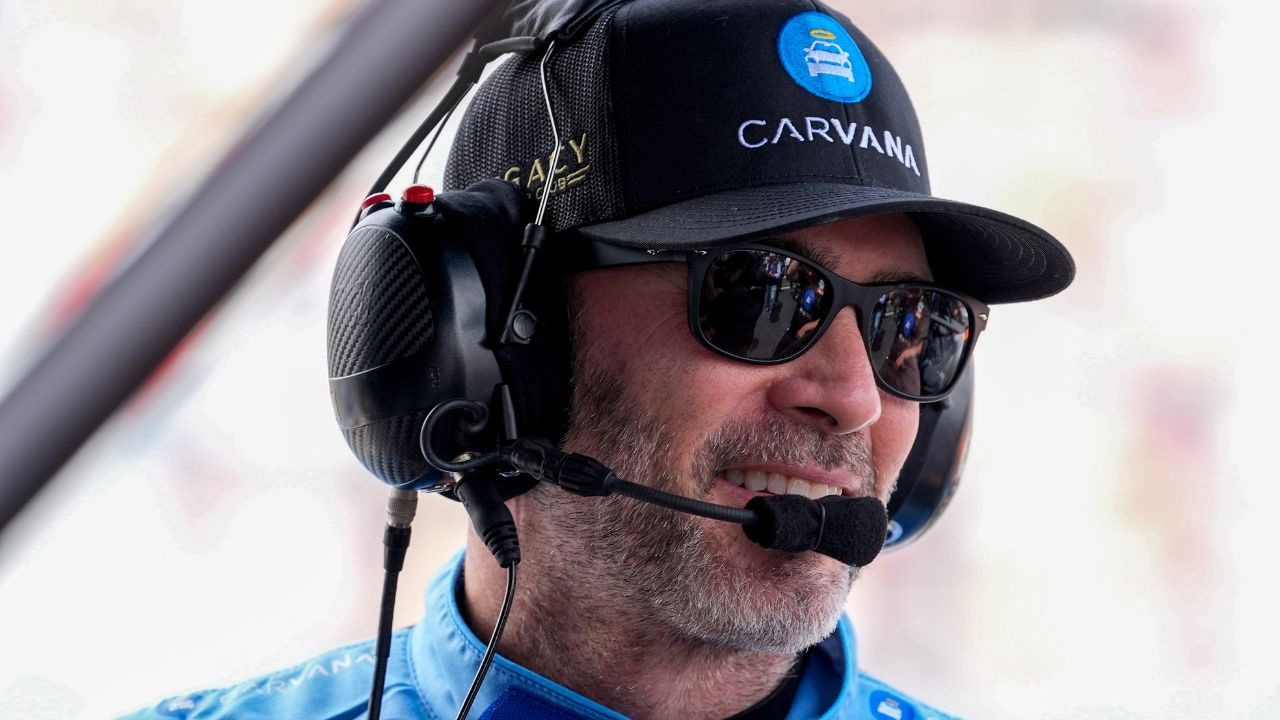
In July 2025, NASCAR announced that it would return to Southern California in 2026 with a street race at Naval Base Coronado. And while the news excited every NASCAR fan, given that the seven-time champion, Jimmie Johnson, grew up in El Cajon, just a short drive from San Diego, the upcoming event will offer him a chance to compete at the highest level in his own backyard.

During Brandweek in Atlanta in November, Johnson confirmed that he will take part in the first Cup Series race at Coronado, with his partner Carvana returning as the primary sponsor of his No. 84 LMC Chevy. He explained that, as a kid growing up just miles from San Diego, he often imagined racing in the city in a NASCAR machine, but the idea felt like a dream beyond the horizon.

He never believed it could happen because he couldn’t envision a place where NASCAR could realistically build or host a track.
Now that the improbable is on the calendar, Johnson views the location as pitch-perfect for a Cup Series showcase. He highlighted the region’s energy and lifestyle, describing San Diego as a community that thrives on weekend experiences.

“The community loves something to do on the weekends,” he said, pointing to the weather, the social atmosphere, and the city’s laid-back rhythm as natural ingredients for a marquee event. He added that the market has established race fans, along with an audience waiting to be tapped.

He emphasized that San Diego’s proximity to Los Angeles elevates the event’s potential reach. The cultural gravity of L.A., paired with San Diego’s distinct identity, makes the region a strategic play in NASCAR’s broader expansion.

Johnson argued that Coronado’s layout offers a more manageable logistical challenge than staging an event in downtown Los Angeles, which remains notoriously complex. “I’m biased,” he said, adding, “I think it’s the perfect location. I can’t wait for San Diego to shine.”

Johnson noted that community support is central to why NASCAR should test its footing in the area. While he hasn’t lived there on a full-time basis for many years, he still recognizes the rhythm of the city’s calendar: the Padres’ fan base, the void left by the Chargers’ departure, the annual Del Mar Fair, and the consistent stream of events that fill San Diego’s beaches and venues.

All of it, he believes, underlines a community eager for entertainment.

That’s why Johnson views NASCAR’s San Diego street-course venture as more than a scheduling shift. To him, it’s a natural extension of a city that thrives when it has something big to rally around, and he’s ready to be part of the moment when the hometown crowd gets its shot at the Next Gen engine sounds echoing off the Pacific.


Link

Continue Reading

Motorsports

Daniel Suárez Hailed as the Best NASCAR Driver to Represent Longtime Sponsor in 2026

Published

on


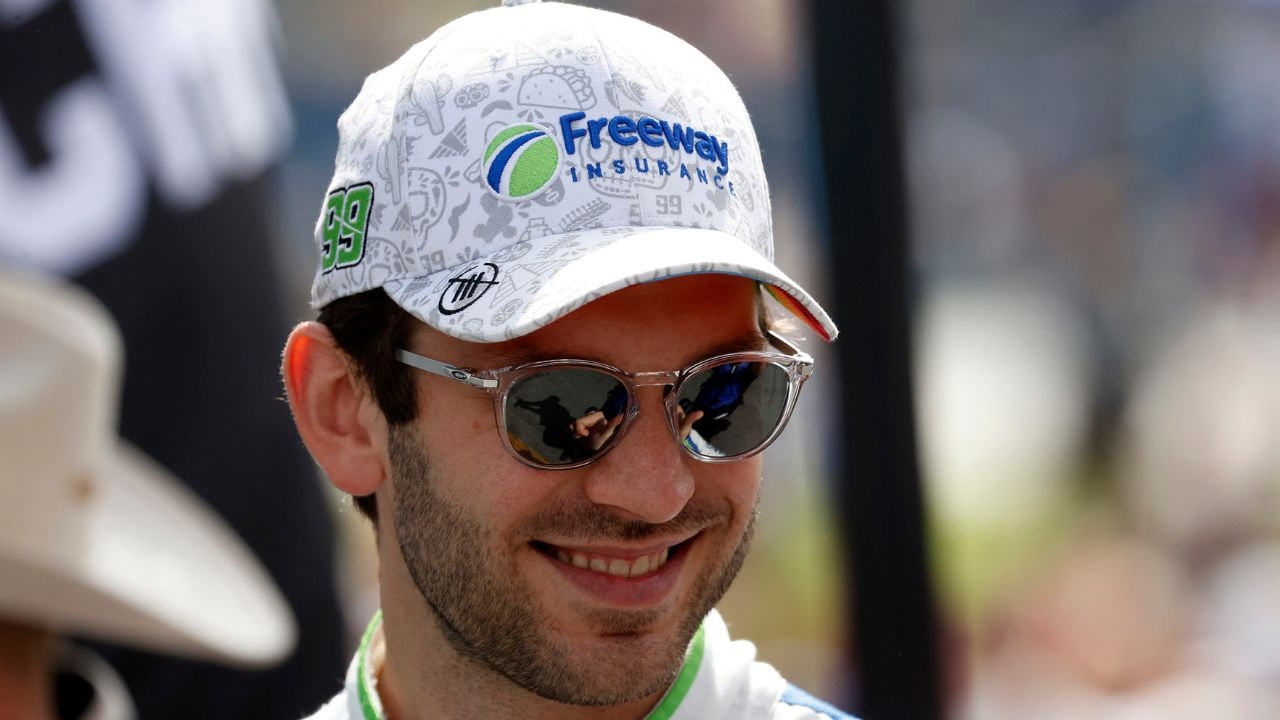
Daniel Suárez’s move to Spire Motorsports for the 2026 season marked one of the headline shifts of the fall, with the 2016 Xfinity champion taking over the No. 7 Chevrolet Cup car from Justin Haley. But the driver wasn’t the only one switching garages. Freeway Insurance, Suárez’s long-time backer at Trackhouse Racing, chose to follow him to Spire, extending a partnership that has become one of the most personal and value-driven relationships in the Cup Series. For CEO Cesar Soriano, staying with Suárez was never a question; it was a conviction.

Freeway Insurance has been deeply embedded in NASCAR’s ecosystem for years, and the company aligned itself with Suárez in 2021, long before Trackhouse found its competitive stride. When Spire Motorsports announced Suárez as its new driver, Freeway seamlessly shifted its support, signaling that the relationship rested on more than team allegiances or competitive forecasts.

Soriano explained that their decision hinged on finding someone who could represent their brand authentically and with a personal touch.

In his view, “There’s no better driver, in my personal opinion, than Daniel Suarez, who is living that dream. He demonstrates that with hard work, perseverance, loyalty, and trust, you can achieve all your goals, and he’s doing it today,” Soriano said.

He added that loyalty cuts both ways, and Freeway has remained committed to Suárez because he continues to mirror the principles that define the company’s culture.

As a U.S. Army veteran, Soriano stressed the importance of discipline, teamwork, and resilience, qualities he believes Suárez carries to the grid every weekend. He went on to describe Suárez as an “incredible ambassador,” someone who understands how to connect with people beyond the racetrack.

Suárez echoed that sentiment, noting that his bond with Freeway Insurance extends far beyond business. For him, the partnership aligns with his mission to uplift his community and serve as a visible example for the Hispanic population within the sport.

He emphasized that Freeway’s base of Hispanic customers and employees adds even more weight to the relationship, making it a meaningful extension of his own story and purpose.

October brought another milestone when NASCAR revealed Freeway Insurance, a division of Confie, as the fourth Premier Partner of the NASCAR Cup Series. Joining Coca-Cola, Busch Light, and Xfinity, Freeway’s entry elevated its visibility and cemented its investment in the sport’s future.


Link

Continue Reading

Motorsports

Daniel Suárez Hailed as the Best NASCAR Driver to Represent Longtime Sponsor in 2026

Published

on


Daniel Suárez’s move to Spire Motorsports for the 2026 season marked one of the headline shifts of the fall, with the 2016 Xfinity champion taking over the No. 7 Chevrolet Cup car from Justin Haley. But the driver wasn’t the only one switching garages. Freeway Insurance, Suárez’s long-time backer at Trackhouse Racing, chose to follow him to Spire, extending a partnership that has become one of the most personal and value-driven relationships in the Cup Series. For CEO Cesar Soriano, staying with Suárez was never a question; it was a conviction.

Freeway Insurance has been deeply embedded in NASCAR’s ecosystem for years, and the company aligned itself with Suárez in 2021, long before Trackhouse found its competitive stride. When Spire Motorsports announced Suárez as its new driver, Freeway seamlessly shifted its support, signaling that the relationship rested on more than team allegiances or competitive forecasts.

Soriano explained that their decision hinged on finding someone who could represent their brand authentically and with a personal touch.

In his view, “There’s no better driver, in my personal opinion, than Daniel Suarez, who is living that dream. He demonstrates that with hard work, perseverance, loyalty, and trust, you can achieve all your goals, and he’s doing it today,” Soriano said.

He added that loyalty cuts both ways, and Freeway has remained committed to Suárez because he continues to mirror the principles that define the company’s culture.

As a U.S. Army veteran, Soriano stressed the importance of discipline, teamwork, and resilience, qualities he believes Suárez carries to the grid every weekend. He went on to describe Suárez as an “incredible ambassador,” someone who understands how to connect with people beyond the racetrack.

Suárez echoed that sentiment, noting that his bond with Freeway Insurance extends far beyond business. For him, the partnership aligns with his mission to uplift his community and serve as a visible example for the Hispanic population within the sport.

He emphasized that Freeway’s base of Hispanic customers and employees adds even more weight to the relationship, making it a meaningful extension of his own story and purpose.

October brought another milestone when NASCAR revealed Freeway Insurance, a division of Confie, as the fourth Premier Partner of the NASCAR Cup Series. Joining Coca-Cola, Busch Light, and Xfinity, Freeway’s entry elevated its visibility and cemented its investment in the sport’s future.


Link

Continue Reading

Motorsports

Jeffrey Kessler Puts On a Clinic in Day 8 of NASCAR Antitrust Trial

Published

on


There’s something simply magical about watching someone elite at their craft, showing off their incredible skill set. Michael Jordan showcased this for 15 years in the NBA as he cemented a legacy as possibly the greatest basketball player of all time. On Wednesday, Jeffrey Kessler, the lead attorney for Jordan’s 23XI Racing team and Front Row Motorsports, showed why he is regarded as one of the best antitrust attorneys in the country.

Kessler continually laid out traps in his lines of questioning, and without fail, the witness he was questioning would find themself caught in the trap. As he finished his re-direct of Jim France, NASCAR’s Chairman, and pressed John Probst, NASCAR’s Executive Vice President and Chief Racing Development Officer, and Greg Motto in cross-examination, NASCAR’s Chief Financial Officer, Kessler put on a true masterclass.

By the end of the day, Kessler possibly strung together some of the most entertaining pieces of testimony from his witnesses.

NASCAR attorney Christopher Yates allowed France to tell the story of how his family started NASCAR, and why he is personally invested in racing to begin his cross-examination. As expected, Yates lobbed softballs for France, but some good details came from the line of questioning.

France explained that he received business advice from his mother and father growing up. France said his mother taught him to always pay his bills, while his father, Bill France Sr., told him to always do what he says he is going to do.

That intrinsic advice from his father laid the foundation for France’s explanation of why he couldn’t support permanent Charters. France explained, “I don’t have a straight line for the future, and I don’t want to make a promise that I can’t keep forever.”

France would also describe the current NASCAR executive team as “the best”.

Yates allowed France to push past the “brick wall” persona, which he didn’t shake on Tuesday as he constantly failed to recall details when pressed by Kessler in direct examination. That wouldn’t last long as Kessler dug in.

While France had testified that he had nothing to do with the original Charter negotiations in 2016, Kessler had France confirm that he was on the NASCAR board during the 2016 Charter Agreement negotiations, and France would admit that he did indeed take part in the talks through his position on the board.

Kessler then questioned if France had built a defense fund for NASCAR to utilize if someday they found themselves in a lawsuit with the race teams. France explained that his defense fund wasn’t put in place to fight a lawsuit from teams.

Then, Kessler showed an email thread between Lesa France Kennedy and Ben Kennedy in 2015. In the emails, Lesa indicated that the RTA could bring legal action against NASCAR, to which Ben Kennedy responded that, “Jim has been building a defense fund for years in case we got into this jam.”

Ben Kennedy would then call France a smart guy.

France would explain to Kessler that it was a generic defense fund for NASCAR to use for ay type of litigation that would come.

Kessler would ask France if he personally led the 2025 Charter negotiation meetings. France responded that he met with teams individually, but didn’t meet with the Team Negotiating Committee.

In came a 2023 email from Scott Prime, which laid out talking points for Jim France to use for upcoming team Charter meetings. France didn’t begin meeting individually with teams until negotiations had stalled in 2024.

France then said that he went to a lot of meetings with teams during 2023, but they weren’t meetings to specifically discuss Charters. He said Charters came up, but it wasn’t the primary subject of the meeting.

Kessler pressed France on whether teams indicated that they desired permanent Charters in these meetings. France would respond, “I can’t say all of them, but it was a constant theme.”

As for why he couldn’t commit to permanent Charters, France explained there were too many unknowns about the future, including schedule, broadcast agreements, and more.

Kessler attempted to shut that response down by asking France if he was aware that teams proposed permanent Charters with negotiable financial terms. France said he didn’t recall seeing a proposal on permanent Charters from the teams.

After this, Kessler would bring up the fact that France described his executive team at NASCAR as “the best.” Kessler asked if France felt it was consensus-building when he became a “brick wall” in regard to permanent Charters, while his executive team indicated in internal emails and texts that they were in favor of awarding teams permanent Charters.

France said he doesn’t hire “yes men” and that he wouldn’t call the talks at this time consensus-building. He admitted that Phelps had his own ideas.

Kessler asked about O’Donnell calling one of the proposals that NASCAR sent to the teams a “fuck the teams” offer, and whether France considered that consensus-building?

France answered that he didn’t know how to answer that question.

The contentious battle turned to Kessler asking if France was proud of his family’s business, and if he hopes to be able to pass it down to the next generation of the France and Kennedy families. France said he is proud and would like to pass the company down.

Kessler fired back, “How would you feel if a monopoly said they would take it away at any time because it has an expiration date?” Kessler asked France if the teams had to accept his final offer to keep their teams.

France refused to agree with that assessment and said that NASCAR made compromises with teams in regard to their four pillars on the path to 13 of 15 teams signing the Charter Agreement.

Kessler then quizzed France on whether the teams got any of the four pillars they were asking for in the negotiations. France agreed that the teams didn’t get permanent Charters. He agreed that NASCAR eliminated the three-strike rule. He admitted teams didn’t get 30% of revenue from all new business; instead, they can only earn additional revenue if their team IP is used.

Kessler said, and the teams didn’t get the money. France responded that they gave the teams more money than they had in the previous agreement. And with that, France’s time on the stand was over.

John Probst Revealed as An Author of “Gold Codes”

After Kessler was finished with France, John Probst became the first witness called to the stand by the defense. Under his direct examination, Probst, using his previous experience with Red Bull Racing and Chip Ganassi Racing to tell the tale of wild spending by teams in the pre-Next Gen car era, in what was essentially an arms race.

Probst said teams would burn through millions of dollars in engineering and wind tunnel time trying to maximize every advantage in the name of winning races. Probst even recalled Red Bull Racing labeling NASCAR Cup Series cars as “ARCA” cars, and they would test the car roughly nine times a year to skirt the testing limitations.

The excessive spending, Probst said, wasn’t sustainable.

After joining NASCAR in 2016, Probst said he was tasked to lead the way in the development of the Next Gen car, which he said was created with the idea of reducing costs for teams.

According to Probst, NASCAR spent $14 million developing the Next Gen car, and at no point did the sanctioning body request teams to pay for any testing or development of the car. In addition to cost reduction, Probst explained that another reason for the development of the car was the quest for additional parity in the sport.

Probst said more parity allows for more teams to be able to obtain sponsorship. An interesting note, Probst also said the entry of new OEMs in the sport is also a good thing for teams, as it forces existing OEMs to offer better terms in an effort to keep their teams from jumping ship.

While that thought is common sense, it completely undermines an argument presented by NASCAR’s legal team earlier in the trial, which explained that NASCAR would not offer teams better financial terms in the “but for” world had a rival series formed. Now, a NASCAR executive is explaining that OEMs would do that very thing if a new OEM emerged in the NASCAR landscape.

Probst confirmed that NASCAR had looked at making an update to the Gen 6 car before deciding to create the Next Gen car. He explained that the investment would have been essentially the same, as they would have had to update old 1950s and 1960s technology from the previous model of car to modern times.

Additionally, the defense showed the jury an email from Rob Kauffman, the head of the RTA, who said at that time, 30 of 36 Charter Holders supported the Next Gen car. Probst said he felt that was quite the endorsement for the Next Gen car.

Probst said after the Next Gen car was adapted, NASCAR issued a memo to teams in an effort to show them that spending more money in the Next Gen era didn’t necessarily correlate to winning more.

Team Penske, by comparison, underspent, yet went on to win the title in 2022, 2023, and 2024. Meanwhile, 23XI Racing was among the top-three spending teams at the time and didn’t garner nearly as many wins.

Probst also addressed the issue of NASCAR’s $180,000 WiFi that it offers to teams at the track. Probst explained that NASCAR has different tiers of WiFi. The lowest tier is $12,000 per year, while the top tier is $180,000. He said 23XI Racing subscribes to the top-tier WiFi, but that they don’t have to do that.

After NASCAR’s legal team allowed Probst to lay out the foundation of his testimony, Kessler brought his wrecking ball to wipe out all that had been built.

Kessler reminded Probst that the plaintiffs aren’t suing over the Next Gen car, but rather the restrictions that prevent them from using the car in other series. Probst indicated he didn’t know the ins and outs of the lawsuit.

Things got rockier from there.

Kessler asked Probst if NASCAR could achieve the cost-cutting effects it claims it sought out to achieve without restricting the car’s IP. Probst agreed. Kessler followed up by asking in order to achieve parity with the Next Gen car, NASCAR didn’t have to restrict the car’s IP. Probst agreed. And Kessler questioned if allowing the use of the car in other series would impact the fan interest of the Next Gen car. Probst said it wouldn’t.

In three questions, Kessler knocked out the three main pillars of Probst’s direct examination and brought into question the true reasoning behind NASCAR’s desire to develop the Next Gen car.

Kessler brought up an internal NASCAR deck involving the options for the next generation of race car, where the option of an updated Gen 6 car was posed, and it compared the pros and cons of creating the Gen 7 car.

In the deck, a pro for the Gen 7 car was that NASCAR could apply IP protections, which would diminish the risk of a copycat league from using NASCAR’s car against them.

Probst, who momentarily lost his cool, said NASCAR could remove the IP today, but that he didn’t know of any big company that wouldn’t try to protect its innovations. He said if Coca-Cola created a new flavor, they wouldn’t share the formula with Pepsi.

He would then go on to say no team has requested to use the Next Gen car in another series.

Kessler then asked if NASCAR used an updated Gen 6 car, would it be easier for teams to create a competing series if they could use the car? Probst answered that it would. Kessler asked the same question regarding the Next Gen car, which Probst again agreed.

Pulling from internal NASCAR documents, Kessler asked if executives had conversations about how not restricting the IP of the Gen 7 car could lead to a copycat series. Probst said, for sure. Kessler asked if he remembered other executives discussing using IP to eliminate the risk of a copycat series. Probst said he’s sure they did.

That opened a can of worms for Probst, who Kessler reminded had previously said that NASCAR was “fine” with competition.

Kessler asked if NASCAR was “fine” with competition, why would they restrict the race tracks? Probst said he wasn’t in charge of tracks. He then asked if NASCAR was “fine” with competition, why would they restrict owners from supporting another series? Probst indicated he didn’t know.

Using his own testimony, Kessler asked Probst if forbidding the use of the Next Gen car in other series would protect NASCAR from a copycat league. Probst said they did it to protect their investment, and all teams have to do to use the car in another league is ask.

Kessler then pointed to the Japan exhibition event, where NASCAR approved 23XI, among other teams, to run laps in the Next Gen car, which Probst used as an example in his direct examination that NASCAR would approve requests from teams.

Kessler asked if that exhibition involved a rival stock car series. Probst said no. Kessler then asked if the White House sent a request to NASCAR for them to approve the use of Next Gen cars in Japan. Probst said that was above his pay grade.

Trying to catch him off guard, Kessler then asked Probst if NASCAR is “fine” with competition, why did Steve Phelps want to stick a knife through SRX? Probst said Kessler would have to speak to Phelps.

Kessler then pointed to a budget that Probst shared in direct examination showing what NASCAR determined the start up costs for a NASCAR Cup Series team to be. Kessler asked if that budget was compiled for the “Gold Codes”, which was NASCAR’s plan for vertical integration to field the cars in the Cup Series without team owners.

Probst said no. But then a major reveal came. Kessler asked if Probst was the author of the Gold Codes, to which Probst answered that he was a main contributor to it.

Kessler asked if Gold Codes were to be used if the team owners didn’t sign the Charter Agreement. Probst said it was a fallback plan for if the teams left the sport, but that NASCAR didn’t seriously consider it. Probst then said that time ran out for NASCAR to develop Gold Codes in the end, and it wasn’t a viable option.

After he explained that, Kessler pulled out a text conversation between Probst and another NASCAR employee, Tom Swindell, from the morning after the infamous September 6, 2025, Charter Agreement deadline.

In the text, Swindell starts the conversation by saying, “RIP Gold Codes.” This indicates that Gold Codes were very much still in play had the teams jointly agreed to all abstain from signing the agreement.

Kessler then asked that once the deadline had passed, if the only thing teams who disagreed with the agreement could do was bring forth a lawsuit. Probst said that they felt a lawsuit was coming, but that NASCAR continued trying to negotiate.

Kessler fired back, asking Probst if he was aware that Phelps told the teams that negotiations were over, and that they would not be reopened, to which Probst said he wasn’t aware of that.

Kessler Uses EBITDA to Catch NASCAR CFO Trying to Conceal Cash Flow

The defense called Greg Motto, NASCAR’s Chief Financial Officer, next. With Motto on the stand, the defense was able to construct the narrative that NASCAR could not afford to match the broadcast revenue distribution that teams originally asked for in the 2025 Charter negotiations.

Motto said there isn’t enough money to pull it off.

When the defense asked Motto if NASCAR could sell off some of its $2 billion in assets to pay the teams, he indicated that those are cash-generating assets, and that if they were to sell those, there would be less money in future years for the teams.

Motto said the broadcast revenue payments to teams increased by $98 million with the 2025 Charter agreement, while the broadcast rights agreement only grew by $55 million.

When questioned about the $394 million in distributions to the France Family trusts from 2021 to 2024, Motto said those payments were to pay taxes.

Through the defense’s exam of Motto, a lot of charts were shown, and true to their word, the numbers looked like the tale they laid out was correct. However, Kessler approached his cross-examination with the mindset that numbers can be deceiving.

Kessler alleged to Motto that the distributions to the France family for taxes were not for NASCAR’s taxes, but rather for the personal taxes of Jim France and Lesa France Kennedy. Motto denied that assertion at first, but upon further poking, Kessler was able to get Motto to confirm that the board has a contract that says it must distribute money to the France family trusts for their personal taxes.

Motto also agreed that if that contract wasn’t in place, the board would not have to pay the France family taxes. Kessler then drew attention to the 2020 season, where most NASCAR employees took pay cuts due to the COVID pandemic.

Kessler showed that even during COVID, the France family received a $21 million distribution payment from the board, despite NASCAR reporting a loss of $11 million that year.

Then, Kessler pointed to how NASCAR used the funds from the $492 million sale of land at Auto Club Speedway. He asked Motto if NASCAR used that money to pay down its debt from the acquisition of ISC. Motto said it was. Kessler then asked if that increased the equity of NASCAR. Motto agreed.

Kessler asked if that money could have instead been used to pay the teams, to which Motto said a lot of options existed.

Then, Kessler pulled a nugget from the testimony of Steve Phelps, and used it to perfection in his questioning of Motto.

In the direct examination of Motto, the defense and Motto focused on NASCAR’s profit/loss statement, which included depreciation of assets in the losses, despite that not being physical money that was actually paid out during the year.

Kessler asked if Motto said operating basis was the most important thing? Motto said he didn’t believe he said that. Kessler, who knew what he was doing, said, oh, that’s right, it was Mr. Phelps, he said he only cares about EBITDA. That’s operating, correct?

Motto responded, “mostly.”

Kessler then pulled up a deck from the France Enterprises Inc. Shareholder meeting, which had a section titled “Implement Tax Strategies to Support Shareholder Objectives”. Kessler asked if this meant that they would do whatever it took to maximize tax returns for the France family. Motto said yes.

Next, Kessler asked if EBITDA wasn’t just important to Phelps; he questioned if it was the main metric that Motto checks, to which Motto replied, “Correct.”

Kessler noted that the numbers shown in the slides during direct examination were much lower than the numbers that Motto presented to the shareholders in his presentation in 2024. Motto said that was because his presentation reflected operating profit.

Kessler asked if the EBITDA was much higher than what he showed the jury. Motto agreed.

It got worse from there.

Kessler then questioned capital expenditures on racetracks. Kessler asked if most major expenses had been completed under ISC before NASCAR acquired the company. Motto indicated that NASCAR has made big expenditures on tracks since acquiring ISC. When asked what those were, Motto stated that they installed WiFi at all tracks.

Another trap was successfully placed by Kessler.

Kessler, using what he was told by Probst, asked Motto if he knew how much NASCAR charges teams for WiFi at the tracks. Motto said he thought it was on a bandwidth agreement, but wasn’t sure (Probst indicated teams pay $12,000 to $180,000 per year for the at-track WiFi). Kessler then asked if NASCAR has a sponsorship for the WiFi. Motto said he believed Xfinity sponsors the WiFi.

That was a perfect opportunity for Kessler to reconfirm with Motto that NASCAR doesn’t share its sponsorship revenue with teams for the jury. When asked if NASCAR made more or less revenue in 2025 compared to 2024, Motto said it was less, and he believes by roughly $10 million (after increasing payments to the teams by almost $100 million).

Kessler questioned if $10 million for a company that earns $1.7 billion in revenues in a year is the equivalent to a material rounding error. Motto said it wouldn’t be considered a rounding error in his audits.

To end out his questions for Motto, Kessler asked if he was involved in any of the Charter negotiations, to which Motto said no. Kessler asked if Motto was tasked to make any calculations when NASCAR was presenting offers to the teams. Motto said no. Kessler then asked if Motto received a text message about Jim France not budging on Evergreen or permanent Charters. Motto said I may have. Kessler said no further questions.

The day ended with NASCAR’s expert witness, Professor Mark Zmijewski, on the stand. Professor Z, who has noted how proud he is of a textbook he wrote at the University of Chicago, has been poking holes in the calculations that Professor Snyder estimated for the team’s losses due to anti-competitive actions by NASCAR.

Professor Z’s opinion is now being ripped apart by the plaintiff’s counsel. We’ll see how the testimony shakes out for Professor Z as it concludes on Thursday.

NASCAR indicated to Judge Kenneth Bell that they have whittled their witness list down and are more confident that they will be able to rest their case on Friday. Bell expects the trial to have final exhibits and closing arguments on Monday/Tuesday, and when that is completed, the jury will be able to begin deliberations.

Following NASCAR attorney Christopher Yates using a document that had not been admitted into evidence, and should have been protected under an NDA during the testimony of Richard Childress, the plaintiff’s counsel is still waiting to hear the answer to six questions about the acquisition of the document.

Judge Bell explained that if the defense doesn’t provide those answers by Thursday morning, he will exercise his power to get to the bottom of it all.

Day 9 of the NASCAR antitrust trial is set to begin on Thursday, December 11 at 8:30 AM ET.



Link

Continue Reading

Motorsports

Top NASCAR Sponsor Calls Out Commissioner Steve Phelps and His “Lieutenants” in Response to Childress Comments

Published

on


What’s Happening?

In the fallout of shocking comments made by NASCAR Commissioner Steve Phelps directed at owner Richard Childress, Bass Pro Shops founder Johnny Morris stepped up to the plate with a stirring three-page statement directed at NASCAR.

In late November, text messages from 2023, unsealed by the court, showed then NASCAR President, and current Commissioner, Steve Phelps, referring to legendary owner Richard Childress as a “stupid redneck who owes his entire fortune to NASCAR.”

Childress, known for his outspoken nature, was not going to back down to these comments. In fact, RCR even released a statement saying they were considering legal action, though that has not happened as of press time.

The fallout of these comments has resulted in fanfare and support for Childress and his NASCAR legacy, and now, in a twist of fate, Childress has the support of one of NASCAR’s and RCR’s most well-known sponsors, with Bass Pro Shops founder Johnny Morris releasing a scathing letter pushing back at these comments made by Phelps.

In his letter, Morris, who has, at times, sponsored upwards of three cars in a single race and, at times, even served as the title sponsor of the race itself, fires back, saying he and many others are “outraged by how Richard and his family have been treated by some senior NASCAR leaders.”

Morris goes on to call Phelps’s text messages “shockingly offensive and false criticisms” of Childress, saying that this is an attack on “one of the pillars of the sport.”

The 77-year-old businessman and conservationist even says that Phelps’s comments have damaged not just his reputation, but that of NASCAR.

“The commissioner has repeatedly labeled Richard as “an idiot,” a “dinosaur,” “a stupid redneck” and a “clown.” The fact is Richard Childress has done as much to build and promote NASCAR as anyone in the history of the sport! The commissioner, in all his rant, has only managed to bring discredit to himself and the sport.” — Johnny Morris

In closing, Morris seemingly calls for a settlement in the ongoing antitrust lawsuit between NASCAR and two of its teams, 23XI Racing and Front Row Motorsports.

“We hope the France family and team owners will reflect carefully on the damage that’s being done to NASCAR in the ongoing dispute and dig deep and strive hard for compromise,” Morris wrote.

What’s Happening?

Friday, documents, including messages from NASCAR officials and interteam communications, were unsealed as part of the ongoing lawsuit between…

Bass Pro Shops in NASCAR

Bass Pro Shops made its sponsorship debut in NASCAR on the hood of Dale Earnhardt’s Richard Childress Racing No. 3 in the 1998 Winston All-Star Race. Though the brand would not return to RCR or the sport as a primary sponsor until the 2004 Daytona 500, it has since grown to a staple of NASCAR.

This includes sponsorship of multiple drivers across OEMs throughout the past two decades, including multiple seasons in which they served as the primary sponsor for several drivers. Furthermore, the chain of outdoor retail stores also serves as the title sponsor for NASCAR’s iconic night race at Bristol Motor Speedway.

The fallout of the letter from Morris in the online NASCAR community has supported his stance, with fans feeling heard by one of the most consistent and powerful brands in modern NASCAR.

What do you think about this? Let us know your opinion on Discord or X. Don’t forget that you can also follow us on InstagramFacebook, and YouTube.


Link

Continue Reading

Motorsports

Bass Pro Shops Founder Johnny Morris Releases Blistering Letter Blasting NASCAR For Texts About Richard Childress

Published

on


Brutal.

In case you somehow missed it, NASCAR has been in court the past week and a half defending themselves from an antitrust lawsuit filed by two teams, 23XI Racing and Front Row Motorsports.

The antitrust lawsuit accuses NASCAR of using unlawful conduct to protect its monopoly on premier stock car racing, with the teams taking issue with (among other things) the charter deal offered by the series back in 2024 and the fact that NASCAR owns the majority of the tracks it races at, while having exclusivity agreements with those tracks to prevent a viable competitor series from forming.

It’s been an explosive couple of weeks, and at times has been pretty embarrassing for NASCAR and its executives.

Before the trial even started, text messages were revealed between NASCAR Commissioner Steve Phelps calling team owner Richard Childress a “stupid redneck” and that he needs to be “taken out back and flogged.”

And during the trial, Phelps and other NASCAR executives have been forced to face team owners like Childress and Joe Gibbs Racing President Heather Gibbs who testified that NASCAR “had a gun to their head” and forced them to sign a charter agreement that they felt was unfair by sending them an agreement and forcing them to sign it within hours while threatening to take their charters if they didn’t agree.

It’s a big mess for NASCAR, made worse by the fact that 23XI is owned by one of the most famous athletes in the world, Michael Jordan, who testified in the trial late last week.

No matter who wins, the lawsuit and trial have done serious damage to NASCAR’s public perception, especially after seeing communications from NASCAR executives that shows them seemingly working against – and insulting – the teams that it relies on week in and week out to put on a show.

But now, even the sponsors are speaking out.

Johnny Morris, the CEO and co-founder of Bass Pro Shops, just released a blistering letter calling out Phelps and NASCAR leadership for the way they talk about those in the sport, especially their comments on Richard Childress:

As I write this today, way too many of my fellow teammates, our valued customers, our independent dealers and respected members of the conservation and military communities… are outraged by how Richard and his family have been treated by some senior NASCAR leaders.

We are extremely upset by the recent disclosure of shockingly offensive and false criticisms of Richard by the Commissioner of NASCAR Steve Phelps. For the Commissioner and his allies, to attack one of the pillars of the sport is incredibly irresponsible and a disservice to everyone involved in NASCAR and its partners, sponsors and fans…

The commissioner has repeatedly labeled Richard as “an idiot,” a “dinosaur,” “a stupid redneck” and a “clown.” The fact is Richard Childress has done as much to build and promote NASCAR as anyone in the history of the sport! The commissioner, in all his rant, has only managed to bring discredit to himself and the sport.”

Morris didn’t come out and say it, but it sounds like he’s strongly suggesting that NASCAR needs to fire Steve Phelps, calling his comments a threat to the sport:

“Many of our teammates have validly expressed concern that the commissioner’s recently revealed contempt for Richard Childress makes it abundantly clear that he and his lieutenants are not capable of being fair and objective when it comes to impartially enforcing the rules and regulations that govern the sport, including the objective assessment of fines and penalties. This is a threat to the very integrity of the sport.”

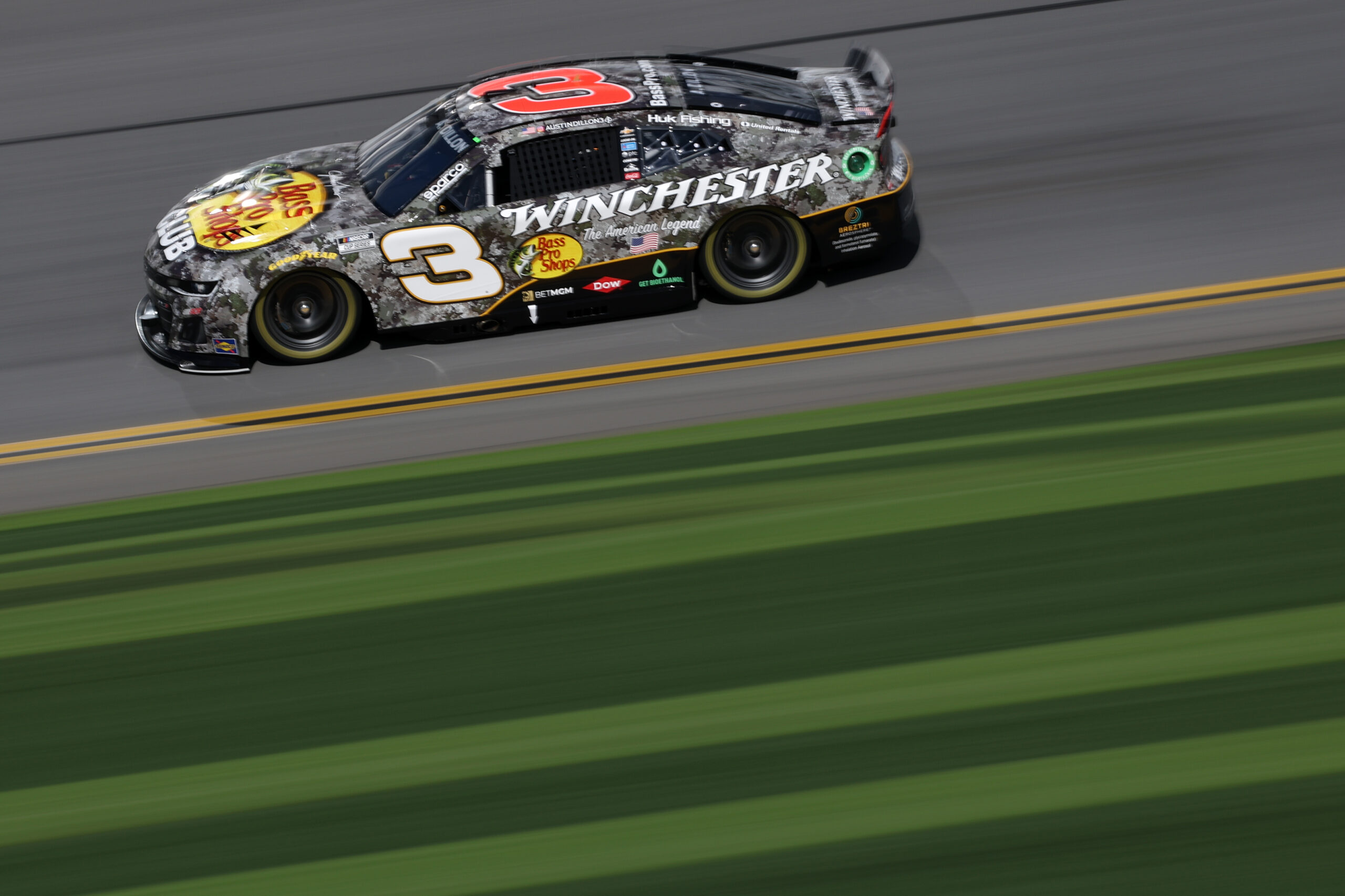
Of course sponsors are the lifeblood of NASCAR: Everything is sponsored, from the teams themselves to the gas that they use to the white flag lap of the race. And Bass Pro Shop is one of the biggest sponsors that NASCAR has. They not only sponsor the #3 car for Richard Childress Racing driver Austin Dillon, but also the #19 Joe Gibbs Racing car of Chase Briscoe, as well as the annual night race at Bristol Motor Speedway.

You’ve got to think that of everybody who’s spoken out against NASCAR, a major sponsor like Bass Pro probably scares and upsets the sport’s leadership more than just about anybody, because implicit in the criticism is the threat of pulling their sponsorship from the sport. And once one sponsor leaves, it’s only going to create a domino effect that could seriously damage NASCAR.

It’s nice to see Morris speaking up, not only for his friend but for the sport, after the embarrassing texts from NASCAR leadership. Throughout this whole trial, it’s looked to me like NASCAR leadership sits in their ivory tower and rules with an iron fist, and that they need a reminder of where their priorities should be.


Link

Continue Reading

Most Viewed Posts

Trending