

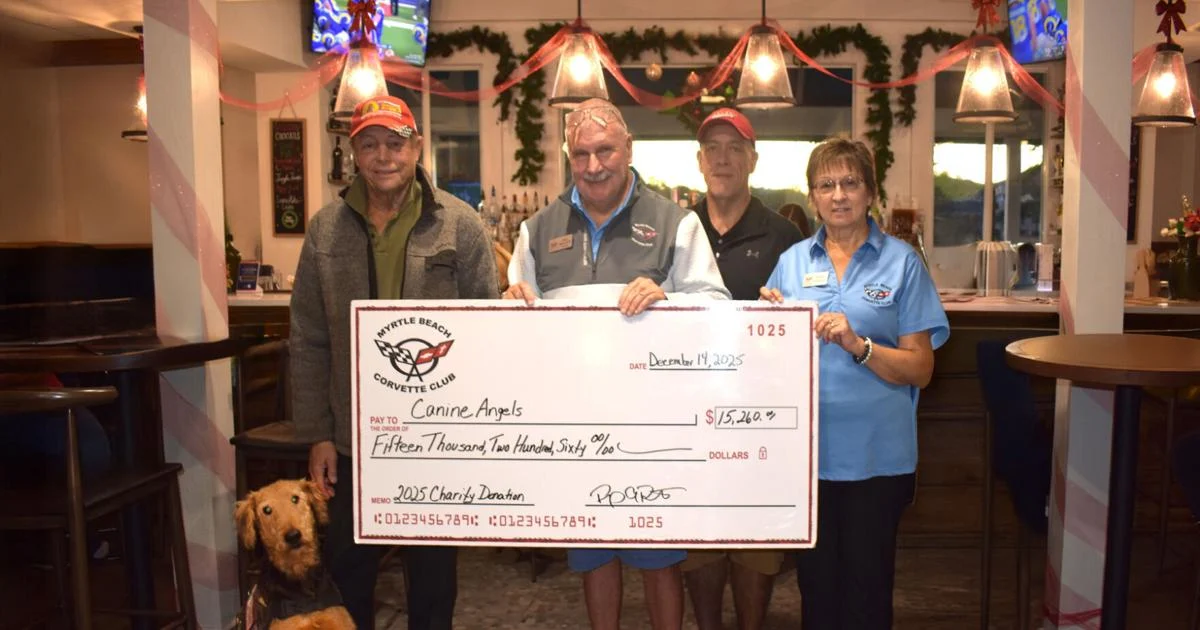
The Myrtle Beach Corvette Club (MBCC) recently presented checks to two local nonprofit charities that the club supports.
Rec Sports
Leveling the playing field for women


She brought women’s soccer to Palestine. Now Honey Thaljieh is advancing equity in sports on a global pitch.
This is where it began.
This patch of cracked cement strewn with broken glass and gravel, ringed with a beaten-up chain-link fence that can barely contain the errant soccer balls. “It’s the same. Nothing has changed,” says Honey Thaljieh, sweeping her gaze over the lot where she and a handful of young women played soccer more than two decades ago as students at Bethlehem University in the West Bank, the occupied Palestinian territory.
On an overcast day in April, a group of young boys, their shoes crunching over the debris, kick a ball into the goal. Thaljieh remembers how bad it hurt to fall on the unforgiving surface. Still, it’s like home, she says. She tells the boys a photographer will be taking photos of the makeshift pitch. “It’s not a pitch; it’s a prison,” a short 9-year-old named Mohammed answers back. Honey breaks out in her trademark gusty laugh. Prison. She has used that same word to describe her own obstacles: Her gender was a prison, her nationality, the social restrictions of Arab society, war, all of it.
But prison or not, for Honey Thaljieh, this patch of ground was a launchpad.
Young and determined
Thaljieh grew up in a tiny one-bedroom apartment in Bethlehem’s old city, a street away from the Church of the Nativity, which is built over the grotto where tradition holds Jesus was born.
The third of five children in a Palestinian Christian family of modest means, Thaljieh had little to do at home. In the conservative Palestinian society of the 1980s and early 1990s, girls were discouraged from playing outside. She was stir-crazy. “I used to come back from school and watch the boys playing football,” Thaljieh says, sitting on a heavily stuffed old-fashioned sofa in the family’s living room, where her soccer trophies still decorate the shelves. She’s here for the Easter holiday, visiting from Zurich, where she works at the headquarters of FIFA, the international soccer governing body, and where she’s a member of the Rotary Club of Zurich Circle International.
Here at home, the memories are everywhere, especially of the pull of soccer and of her intuition, already as a kid, that the game could deliver at least a sense of freedom. One day, as a 7-year-old Thaljieh passed the boys, the ball happened to roll in her direction. She started skillfully imitating the dribbling and kicking that she’d seen players do at the World Cup on her family’s black-and-white TV. The boys were shocked. As in many parts of the world, soccer was a male-only domain in Palestinian society. “But when they started to see how good I was with the ball, they started to fight over me and which team I should belong to,” she says. So Thaljieh began joining them, kicking a ball made of wadded-up newspaper around the impossibly narrow alleyways outside her home, often in her bare feet.
Less impressed was her father, who did not want his daughter playing outside with the boys and definitely not playing soccer. When he returned from a long day of work, he would scold her and force her inside. “I would cry and cry, and then the next day, repeat. Every day, same story. I didn’t give up. He gave up!” she says.
Now 70 years old, Micheal Thaljieh looks sheepish when asked about his opposition. Sitting behind the counter of his modest shop near Manger Square where he sells dish-washing liquid and cold drinks alongside Palestinian olive oil and soap, he does his best to explain. “You know, it was Arab society here and it was a little difficult then for a girl to play football, but in the end, she had to play and see her life and the world progress,” he says. The shop is decorated with flags and banknotes from the countries where Thaljieh has played.
“There was no safety, no freedom anywhere. I grew up with these traumas.”
So the determined girl kept playing. She wore shorts, breaking another cultural taboo on the modesty of women’s attire. She’d come home bruised and sometimes bleeding. Her defiant spirit would define her attitude toward future obstacles. And they would be many.
‘No safety, no freedom’
Israel has occupied the West Bank, the larger of the two Palestinian territories (the other is Gaza), since the Arab-Israeli war of 1967. Today, Palestinian cities and villages are hemmed in by a tortured patchwork of Israeli military checkpoints, tall concrete walls and fences, and Israeli settlements, considered by most of the world to be illegal under international law. For the territory’s 3 million Palestinians, trying to get somewhere a short distance away can be a dangerous, hourslong exercise in frustration because of Israeli restrictions on movement throughout the territory.
Multiple uprisings against the occupation have triggered Israeli military crackdowns and years of bloodshed, dashing hopes for Palestinian statehood and independence. “There was no safety, no freedom anywhere,” Thaljieh remembers. “I grew up with these traumas.” During her junior year of high school in 2000, a conflict known as the second intifada, or uprising, broke out. Backed by tanks and helicopters, Israeli forces invaded Palestinian cities and imposed a siege on residents.

Israel has occupied the West Bank, the larger of the two Palestinian territories (the other is Gaza), since the 1967 Mideast war.
Illustration by Madison Wisse
The fighting lasted for more than four years. In the streets of Bethlehem, gunbattles raged and, in one of the most dramatic moments of the conflict, a group of Palestinian fighters holed up inside the Church of the Nativity near the Thaljiehs’ home. The Israeli military deployed tanks in Manger Square and snipers took positions around the sixth-century church in a standoff that lasted more than a month. During that time, Thaljieh and her family were forced to stay in their home. “We were only allowed out for short periods to buy food,” she says.
Israeli soldiers raided hundreds of homes, including Thaljieh’s. In the dead of night, her sister shouted for her to get up. Thaljieh remembers thinking she was having a nightmare until the voices of soldiers coming down the hall got louder. They forced the family into the street in a trauma that still sometimes disturbs her sleep.
Amid the turmoil, Thaljieh was trying to complete normal teenage rituals, including preparing for her final high school exams, known as tawjihi, essential for anyone seeking to go on to a university. It’s a nerve-wracking affair in the best of times. The day Thaljieh was to take one of the exams, an Israeli tank crushed the family car that would have gotten her to the testing location. Determined to get there, she flagged down an ambulance and pleaded with the driver, “Please, can you take me?” To her astonishment, as she opened the doors, she discovered other desperate students also hitching a ride to the exam. Despite the odds, Thaljieh finished second in her class and was accepted to Bethlehem University.
Forming a team
Thaljieh started at the university in 2002, as the conflict rolled on, and was restless. “Nobody was playing football because they were scared of the Israeli soldiers,” she says. She saw an advertisement hanging in the cafeteria recruiting young women interested in football. Samar Araj Mousa, the first woman to direct the university’s sports programs, wanted to create a women’s football team.
To see if this new student could really play, she sent Thaljieh to the men’s soccer coach, Raed Ayyad. In an encounter that echoed her first street matches with the boys in her neighborhood, the man with a long beard looked at her and said, “You play football? Take a ball. Show me.”
“I started dribbling,” Thaljieh says, “and then I shot the ball. It hit the fence and burst. He looked at me and said, ‘Now we can start to play football.’”
But a team of one is not a team. Araj Mousa advertised around other schools and at a home for orphans. One young woman was spotted competing in a men’s cycling race and was recruited to join. Thaljieh also tried to persuade women playing on basketball and volleyball teams. But soccer was seen as a man’s sport. “They said, ‘No football, we will become masculine,’” Thaljieh recalls. “And I said, ‘Look at me. Nothing changed!’”
Four young women joined. They trained on the concrete court next to the university and played younger boys’ clubs since there were no other women’s teams. Newspapers and TV stations began telling their story, and soon three more women’s teams were established, in the West Bank cities of Ramallah and Jericho and in Gaza. “Their stories were like mine,” Thaljieh says. “They started in the streets somewhere, or in a refugee camp, or in an orphans village.”

Thaljieh walks the streets in Bethlehem, where she attended university and played soccer, eventually joining an unofficial national women’s team.
Image credit: Samar Hazboun
The effort grew into an unofficial national women’s team of more than a dozen players. In 2005, they traveled on a shoestring budget to neighboring Jordan to play in their first tournament with a full 11 players on the field per side. “We lost — epically,” Thaljieh says. And they continued to lose. With no money, no league, little equipment, and inadequate infrastructure, they were the ultimate underdogs.
On top of that, Israeli military checkpoints made it difficult for players from different cities to train together. The women could get held up for hours at checkpoints, sometimes late at night. Even those parents who encouraged their daughters to play worried about their safety on the roads, and players began to leave the team.
The women desperately needed support. To get it, they first needed official recognition from the Palestinian Football Association. Only then could they form a professional league and formally compete at the international level. While finishing her bachelor’s degree, Thaljieh and the team’s backer, Araj Mousa, campaigned for recognition, including lobbying officials and appearing for TV interviews.
Later, Thaljieh even got hold of the phone number of the president of the Palestinian Football Association, Jibril Rajoub, a senior figure in the ruling Fatah party and a former top security official. “He was surprised. He said, ‘How did you get my number?’” Thaljieh recalls. “He’s a very powerful man.” Soon after, they met face-to-face at a men’s match at the Khader stadium near Bethlehem, where she sold him on the idea of a national women’s team. “He was very open-minded to the girls playing football, very encouraging, very supportive,” she says. “So it was like a win-win.”
A career with FIFA
A turning point came in 2008, when FIFA representatives arrived and officially launched a Palestinian women’s league. It was a dream come true: national and international recognition. Within a year, the national team was playing on a full-size turf field in the West Bank in front of thousands of spectators. “When I started in football, no one wanted to recognize girls playing,” Thaljieh says. “So that was the moment that I said, ‘Wow. I made it happen. It worked.’”
Thaljieh captained the team for a total of seven years until injuries forced her from the playing field. She began developing youth sports programs around the West Bank and realizing the impact she and her teammates could have on children there — and around the world — who needed to see someone who looked like them to imagine themselves as champions, as leaders.

Thaljieh looks through photos of her playing days, which included seven years as captain of the Palestine women’s national team.
Image credit: Samar Hazboun
Thaljieh earned a master’s degree in sports management from the FIFA Master program and in 2012 landed an internship and then a job at the organization’s Zurich headquarters — completing a remarkable rise from Bethlehem’s alleyways to the highest body for soccer in the world. With FIFA, she began working in its women’s football development program, which supports 211 member associations with everything from league development and commercial strategy to leadership and coach mentorship. The role opened her eyes to the fact that women’s fight for equality in athletics, among other arenas, extended far beyond her homeland.
“I came to Europe and I was shocked that women are not represented,” she says. At the time, there were no women on FIFA’s top decision-making body. Women’s teams, banned in many European countries until the 1970s, still lacked resources, adequate facilities and pay, and were subjected to harassment, sexism, and social stigma. In the United States, the four-time World Cup champion women’s national team fought for years to wrest from U.S. Soccer in 2022 a promise to equalize pay with a men’s team that has made it to a World Cup quarterfinal only once since finishing third in the inaugural tournament in 1930.
Today, Thaljieh is FIFA public relations manager with focuses on spreading the message that football is for everyone and using the sport as a platform for social change, diplomacy, and inclusion. Initiatives she’s been part of have included helping female refugees become involved in the sport and running campaigns to end violence against women. One mission she especially cherishes is delivering new soccer cleats to children in refugee camps and poor communities around the world. She knows how it feels; she didn’t get proper playing shoes until she was 21. “I see the happiness on their face,” she says. “I feel it. It gives me goose bumps.”
Around the world there are signs of change, including the appointment of FIFA’s first female secretary general, Fatma Samoura, in 2016. Growth in sponsorships, attendance, and broadcast viewership point to the value of the professional women’s game.

Thaljieh picks up one of the many trophies from her soccer career
Image credit: Samar Hazboun
And Thaljieh uses her platform to push for inclusivity in football and for women’s empowerment, capturing the attention of audiences at TEDx Talks and other high-profile venues. One such talk, at a Rotary club in Zurich, led to an invitation to join the Rotary Club of Zurich Circle International as it was forming in 2020. For the first project she proposed as a member, the club purchased and distributed water fountains to Bethlehem public schools with the help of Rotary members there. The club’s charter president, Hermann W. Delliehausen, says Thaljieh has brought energy to the group and a willingness to do things differently. “When she enters the room everyone is focused on her,” he says. “She’s a very, very, very special person. She’s the sunshine of our club.”
The next generation
As her visit home to Bethlehem nears an end, Thaljieh stops by the Diyar Women’s Football Club that she’s supported for years. Seven teenage girls are passing balls back and forth while their coach watches at the expansive Dar al-Kalima Indoor Sports Hall. Inaugurated in 2014, it’s one of the largest indoor sports venues in the West Bank. The squeak of the girls’ sneakers, the coach’s shouts, and the thud of the balls echo through the high-ceilinged hall.
“I took football as a tool to fight oppression, inequality, injustice.”
Thaljieh walks in, dressed in a knit blue blazer and fitted black jeans with her recognizable curly black mane framing her large eyes and big smile. Thaljieh isn’t tall, but here, too, her presence is clearly felt.
Selina Ghneim, a 15-year-old with a long ponytail, pink shoelaces, and a big sore on her left knee, exchanges looks with her friends. Thaljieh approaches the girl, a member of the Palestine national team for women under 20, and gives her shoulders a squeeze. “Do you know who I am?” she asks playfully.
“Yes,” the teenager says shyly. “You are Honey Thaljieh.”
“What else?”
“You work at FIFA.”
Honey knows who Selina is too. “She made the goal against Jordan,” she says.
The teen smiles softly, looking down, simultaneously proud and starstruck. Ten days earlier the U-20 team won the West Asian Football Federation championship, the first international title for a Palestinian national women’s team.

Thaljieh (center) with some of the women and girls of the Diyar Football Club that she supports in Bethlehem.
Image credit: Samar Hazboun
Two women, Maha Araj and Sarab Shaer, have come to the hall to see Thaljieh. Two decades earlier, the three played together on the newly formed team at Bethlehem University and later on the national team. Today Araj is the coach of the Diyar club and Shaer is coaching the club’s under-15 players. Shaer, who was living in a home for orphans when she started playing soccer, credits Thaljieh with changing her life. “She encouraged me to take courses, to develop myself,” she says. “I received a bachelor’s degree in sports management. Without her I would never have made such achievements.”
The women marvel at the indoor training facility. It’s a far cry from their cracked concrete court. From their original group of five players there are today more than 300 girls and women playing in 15 clubs around the West Bank competing locally and internationally. Teams established in Gaza fared far worse under an Israeli blockade of the territory starting in 2007 and the current war. “We don’t even know if any of the girls are still alive,” Thaljieh says.
Adversity is ever present, and looking back Thaljieh doubts she’d be the person she is today without the hardships and without football, which she regards as an instrument of liberation. “I took football as a tool to fight oppression, inequality, injustice, and poverty, to fight for equality, women’s rights, and opportunity. It gave me all the opportunities I needed to bring me where I am today.” Now, in her footsteps, countless others can follow.
This story originally appeared in the September 2025 issue of Rotary magazine.
Continue Reading

Three Edwards County residents has had felony charges filed against them this week by Edwards County State’s Attorney, Eric St. Ledger.
Phillip Walden, 54, of Albion, has been charged with domestic battery with a prior conviction. This charge was also filed on Monday, and a court date is pending.
25-year-old Bradley Cummins of Grayville has been charged with possession of a firearm with a defaced serial number, a Class 3 felony. He also faces charges of aggravated assault, a Class A misdemeanor, and possession of an expired FOID card. No court date has been scheduled.
43-year-old Martin A. Williams of Grayville faces aggravated drunk driving charges—his third such offense—as well as aggravated DUI while driving on a revoked license. The charges were filed on Monday, and a court date has not yet been set.
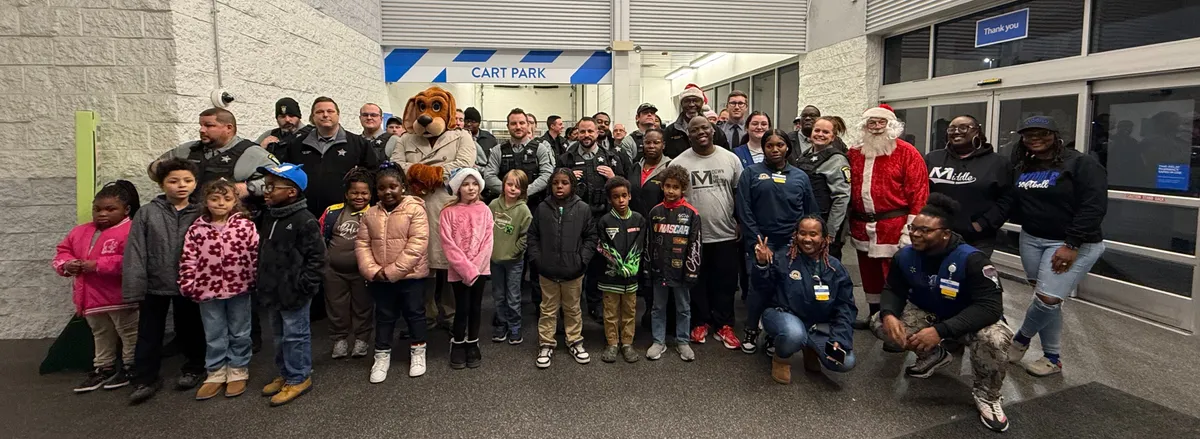
Down the Middle Foundation (DTMF) and its partners helped brighten the Christmas holiday for children across the area through its sixth annual Shop with a Cop event.
DTMF founder Darnell Lee Jr. noted that the event gives area children the opportunity to cultivate a positive relationship with area law enforcement as they participate in an exciting shared endeavor — shopping for presents that the children can have for Christmas.
This year’s iteration of the event took place Tuesday, Dec. 16, and featured second graders from Capron Elementary School, Meherrin Elementary School, Nottoway Elementary School, Riverdale Elementary School and Kilby Shores Elementary School in Suffolk.
Participating law enforcement agencies included Southampton County Sheriff’s Office and Virginia State Police.
“The goal is to have 20 (children involved) every year, and we’re trying to increase it every year, but this year we were able to have 13 kids in the store,” Lee said.
The store partnering with DTMF for the event is the Walmart located in the city of Franklin.
“What Walmart does, they provide little goodies for the kids at Walmart, and then each kid will be partnered with a police officer, and they will shop for $100 of whatever they want,” Lee said. “And after that, we go to the (Dr. Martin Luther King Jr. Community) Center, we have volunteers that wrap gifts and (we) eat pizza. (Franklin) Parks and Rec partners with us, they provided the crafts at the MLK Center.”
As noted on its website, Down the Middle Foundation, which Lee founded in 2009, has a mission “to support the character development and athletic skills of youth through community service, mentorship, team building, and sports education.”
Lee explained that the Shop with a Cop event aims to develop youth in a positive way by dispelling fears they may have about law enforcement, helping them to understand that officers are here to help the community.
A lot of local teams have a lot of different needs
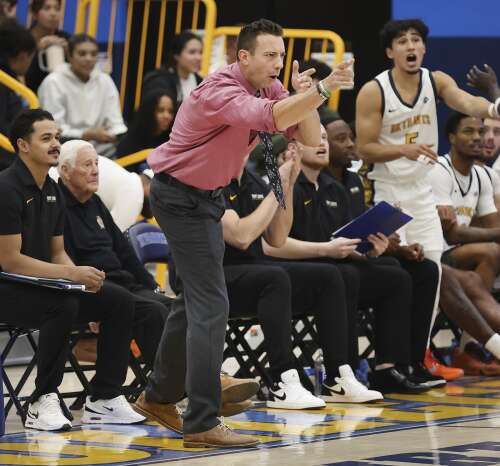
Fort Lewis College men’s basketball head coach Jordan Mast cheers his team on while playing Adams State University on Dec. 13 at FLC. (Jerry McBride/Herald)
Jerry McBride
It’s the holiday season, so there’s no time like the present for a fun Christmas-themed article that looks back at the first part of the winter sports season.
Local winter sports teams have had varying amounts of success, but all of them want to improve in certain areas to reach their potential.
Let’s look at some local sports teams and what gifts their coaches should’ve asked Santa for this Christmas.
Fort Lewis College men’s basketball: The gift of health
The FLC men’s basketball team has had a decent start to the season at 6-5 overall and 4-0 in the Rocky Mountain Athletic Conference. FLC has a win over a top-25 team in Division II, and four of its five losses were against teams that were either in the Division II top 25 or were receiving votes in the poll.
However, the season has already started to turn into a what could’ve been story with all the injuries the Skyhawks have had. It began in the preseason with senior guard Jude Tapia tearing his meniscus, freshman guard Daniel Steverson tearing his ACL and freshman forward Garrett Barger breaking his collarbone.
Tapia was the RMAC’s leading scorer at Adams State last season and was expected to be a big part of FLC’s success this season; Tapia is still out. Steverson is a promising guard who will miss the rest of the year, and Barger has only played a few games since his return.
After the season started, the Skyhawks lost redshirt sophomore guard for a few games to a sprained MCL. Senior forward Cassius Carmichael missed a few games with a concussion and redshirt sophomore guard Nate Penney has only played in three games with a broken foot.
FLC still has the depth and talent to do well in the RMAC even with the injuries. However, FLC needs the gift of health so no more players get hurt.
FLC women’s basketball: The gift of free-throw shooting
The Skyhawks women’s basketball team is off to its best start in six years, with the team at 9-3 overall. FLC is having a great year so far despite struggles at the free-throw line.
FLC ranks last in the RMAC in team free-throw percentage at 60%. Free-throw shooting hasn’t cost FLC a close game, but it’s only a matter of time before that happens.
The schedule will get much tougher for FLC in RMAC play, and if the Skyhawks want to keep a winning record, make the RMAC tournament and secure some key upsets along the way, FLC will need to hit its free throws at a higher percentage.
Durango High School boys basketball: The gift of role-player production
It’s a transition year for the Durango boys basketball team after the Demons lost valuable seniors from last season’s state-tournament team.
Durango is 3-4 overall after two non-league tournaments down in New Mexico. The Demons have gotten great production out of their top two players, junior King Kerlin and sophomore Taj Batiste.
After that, the production hasn’t been so reliable from the role players, which isn’t surprising considering a lot of these role players don’t have experience at the varsity level.
Once the Demons get into league play, teams will be keying in on Kerlin and Batiste. Durango can’t expect those players to play well every night, so the role players will have to produce on some nights for Durango to win.
Durango High School girls basketball: The gift of consistent offense
The Durango girls basketball team lost a lot of production from last year’s Great 8 squad, with four experienced seniors graduating. Therefore, it’s not surprising the offense has been inconsistent for the Demons with some new main characters.
Durango failed to hit 40 points in its first four games, and the Demons have scored at least 49 points in their last four games. Can the offense be consistent? That’ll likely be the key to Durango’s success as the Demons have always been strong defensively under head coach Lauren Moran.
Durango High School boys wrestling: The gift of experience
Like Durango boys basketball, the Durango boys wrestling program is going through a reset year after losing star wrestler Ryan Dugan to graduation.
The Demons have some experience, but even those wrestlers haven’t hit the heights of competing in top matches at state. After that, the Demons have a lot of inexperienced wrestlers who are still trying to figure it out on the mat.
Head coach Jason Silva has said this year is all about his team getting experience, as most of the wrestlers will be back for next year.
Ignacio High School wrestling teams: The gift of continued success after big tournaments
The Ignacio boys and girls wrestling teams have had a great start to the season with Lincoln deKay picking up a few wins, other wrestlers making it to the finals and other Bobcats placing.
Ignacio has competed in some of the top local tournaments, including the Western Slope Showdown and Warrior Classic. For a 2A school, the Bobcats faced a lot of wrestlers from bigger schools that they won’t see again this season.
The question is: Can the Bobcats take this early-season success to the postseason tournaments? deKay has shown he can wrestle at the top of the state after finishing second last season. Larissa Espinosa also placed last season for the Ignacio girls.
Can either of these two get over the hump and win a state title? Using what worked for them in those bigger tournaments early in the season will help.
bkelly@durangoherald.com
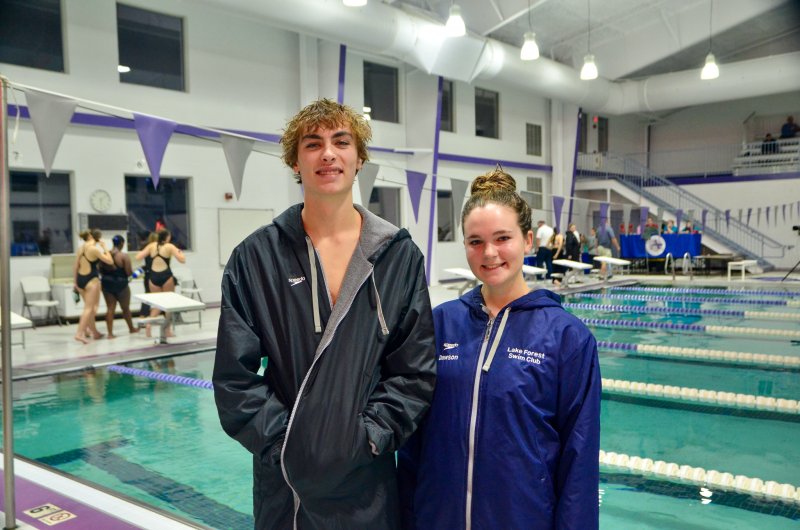
Hosting an ESIAC quad meet Dec. 19 proved to be an early present for Delmarva Christian’s swim teams.
The boys scooped up their first two wins of the year by besting Sts. Peter & Paul 41-4 and Salisbury School 39-15. Salisbury Christian’s talented team got the best of the Royals 49-31.
“Tonight, we just got every guy qualified for states,” said senior Cole Parker. “Last year, almost everybody went.”
A legend was born during the quad meet when the 200 freestyle relay team qualified. Trax Rogers was the second swimmer to leap off the blocks, and if you can believe it, the junior had just wrapped up swimming the 500.
“The 500 is distance, a long-haul race, and Trax gave it his all in that race and turned around and did the relay right after,” said coach Laurel Kamosa. “He did great, and they ended up qualifying for states at the exact time, which was amazing.”
Diving over to the girls, they got a taste of each outcome in the quad meet, edging out the Dragons 39-36, tying the Sabres 31-31 and losing to the Jaguars 66-16. The girls stand at 2-3-1 with just three meets left when they come back from their January term.
“We’re doing really good,” said senior Libby Dawson. “We’re pushing ourselves to be the best we can with limited practice in limited time.”
At 2-5, the lads have a bit more ground to make up, but lucky for them, one of the three meets is a tri-meet and another is a quad meet.
“We’ve had our ups and downs a little bit, and like Libby said with limited practices and stuff, I think that’s made it a little bit tougher, but other than that, I think all the guys at least have been pushing themselves, and that’s just great to see,” Parker said.
“We’ve got a lot of good swimmers,” Kamosa said. “We’re working on technique, we’re working on getting faster, and we’re definitely seeing that with the kids. At the end of the day, we want to have fun and have a good time, but make strides along the way, so I think we’re doing that.”
Gains this season are a result of buy-in from the older swimmers who have seen the program grow year by year.
“Freshman year to now, the growth is insane, and just building the program more and more each year is just the biggest thing we can do,” Dawson said. “Building it more in our school and putting more of a light on swimming at Delmarva Christian.”
“The confidence is definitely building with the kids,” Kamosa said. “They’re building that camaraderie with each other, and with the other teams as well. I really appreciate their sportsmanship with the other schools.”

Orange High School is the site of the 60th annual Orange Holiday Basketball Classic beginning Friday, Dec. 26. The event will include both boys and girls divisions and wrap up on Tuesday, Dec. 30.
Coach Jake Rhodes will lead his Orange Panthers boys basketball team into the long-running tournament.
In the boys division, Pool A consists of Incline, Nev; Irvine, Orange and Shadow Ridge, Nev. Pool B will include Boulder City, Nev., Cerritos, Fullerton, and Long Beach Wilson.
In the girls division, Pool A includes Apple Valley, Laguna Hills, Montclair, and Valley Christian. Pool B includes Cabrillo, Fullerton, Irvine, Orange.
Pool play games:
FRIDAY, DEC. 26:
Girls: Orange vs. Cabrillo, 9 a.m.; Irvine vs. Fullerton, 10:30 a.m.; Valley Christian vs. Montclair, noon; Apple Valley vs. Laguna Hills, 1:30 p.m..
Boys: Cerritos vs. Long Beach Wilson, 3 p.m.; Orange vs. Incline, 4:30 p.m.; Shawdow Ridge vs. Irvine, 6 p.m; Fullerton vs. Boulder City, 7:30 p.m.
SATURDAY, DEC. 27:
Girls: Laguna Hills vs. Valley Christian, 9 a.m.; Cabrillo vs. Irvine, 10:30 a.m.; Montclair vs. Apple Valley, noon; Fullerton vs. Orange, 1:30 p.m.
Boys: Cerritos vs. Fullerton, 3 p.m.; LB Wilson vs. Boulder City, 4:30 p.m.; Shadow Ridge vs. Orange, 6 p.m.; Irvine vs. Incline, 7:30 p.m.
MONDAY, DEC. 29:
Girls: Fullerton vs. Cabrillo, 9 a.m.; Laguna Hills vs. Montclair, 10:30 a.m.; Apple Valley vs. Valley Christian, noon; Orange vs. Irvine, 1:30 p.m.
Boys: Irvine vs. Orange, 3 p.m.; Incline vs. Shadow Ridge, 4:30 p.m.; Long Beach Wilson vs. Fullerton, 6 p.m.; Cerritos vs. Boulder City, 7:30 p.m.
The tournament wraps up on Tuesday, Dec. 30 with games starting at 9 a.m. The girls championship will be at 6 p.m. followed by the boys tournament final at 7:30 p.m.
“Looking forward to helping our AD host the oldest running Christmas Tourney in Orange County,” Rhodes said on X this week. “We have great teams ranging from LA County, OC, San Bernardino County and Southern and Northern Nevada.”
Send basketball news to timburt@ocsportszone.com

Sports2 minutes ago
2025 Volleyball Player of the Year: Witherow makes big impact on Central program | Nvdaily

NIL17 minutes ago
Notre Dame’s 2025 Christmas Wish List

Sports18 minutes ago
Seven Volleyball Student Athletes Named NEWMAC Academic All-Conference

Rec Sports29 minutes ago
FELONY CHARGES FILED AGAINST THREE IN EDWARDS COUNTY CIRCUIT COURT

Sports34 minutes ago
Colorado volleyball poised to repeat success

Rec Sports37 minutes ago
Myrtle Beach Corvette Club donates to local charities | News

Sports50 minutes ago
Badgers news: Wisconsin adds top setter in 2026 freshman class

Sports1 hour ago
A 2026 wishlist for Arizona Wildcats athletic programs

NIL1 hour ago
NIL Funds Are at Top of Arizona State’s Christmas Wishlist

Sports1 hour ago
Tennessee volleyball signs Georgia State transfer

Sports2 hours ago
Gators Perform Well in Classroom During Fall 2025 Term

Sports2 hours ago
Syracuse.com winter girls volleyball rankings (through Week 4): 2 new teams enter top 10

NIL2 hours ago
Kirby Smart gives fiery response to question about conversations with players on future

Rec Sports2 hours ago
Area kids ‘Shop with a Cop’ for Christmas

Rec Sports3 hours ago
What gifts should local coaches ask Santa for to help their teams?

Rec Sports4 weeks ago
Fargo girl, 13, dies after collapsing during school basketball game – Grand Forks Herald

Sports4 weeks ago
Utah State Announces 2025-26 Indoor Track & Field Schedule

Motorsports2 weeks ago
SoundGear Named Entitlement Sponsor of Spears CARS Tour Southwest Opener

Motorsports4 weeks ago
Jo Shimoda Undergoes Back Surgery

Motorsports4 weeks ago
Redemption Means First Pro Stock World Championship for Dallas Glenn

Sports4 weeks ago
Texas volleyball vs Kentucky game score: Live SEC tournament updates

NIL4 weeks ago
Bowl Projections: ESPN predicts 12-team College Football Playoff bracket, full bowl slate after Week 14

Rec Sports3 weeks ago
Black Bear Revises Recording Policies After Rulebook Language Surfaces via Lever

Rec Sports4 weeks ago
Robert “Bobby” Lewis Hardin, 56

Motorsports2 weeks ago
Donny Schatz finds new home for 2026, inks full-time deal with CJB Motorsports – InForum

Rec Sports4 weeks ago
How this startup (and a KC sports icon) turned young players into card-carrying legends overnight

Rec Sports3 weeks ago
How Donald Trump became FIFA’s ‘soccer president’ long before World Cup draw

NIL4 weeks ago
Indiana’s rapid ascent and its impact across college football

Sports3 weeks ago
Men’s and Women’s Track and Field Release 2026 Indoor Schedule with Opener Slated for December 6 at Home

Rec Sports2 weeks ago
David Blitzer, Harris Blitzer Sports & Entertainment






-
 Motorsports2 weeks ago
SoundGear Named Entitlement Sponsor of Spears CARS Tour Southwest Opener
-
 Motorsports2 weeks ago
Donny Schatz finds new home for 2026, inks full-time deal with CJB Motorsports – InForum
-
 Rec Sports2 weeks ago
David Blitzer, Harris Blitzer Sports & Entertainment
-

 Motorsports3 weeks ago
JR Motorsports Confirms Death Of NASCAR Veteran Michael Annett At Age 39
-
Sports3 weeks ago
Elliot and Thuotte Highlight Men’s Indoor Track and Field Season Opener
-
Sports3 weeks ago
West Fargo volleyball coach Kelsey Titus resigns after four seasons – InForum
-

 Motorsports2 weeks ago
Rick Ware Racing switching to Chevrolet for 2026
-

 NIL2 weeks ago
DeSantis Talks College Football, Calls for Reforms to NIL and Transfer Portal · The Floridian
-
 Sports2 weeks ago
#11 Volleyball Practices, Then Meets Media Prior to #2 Kentucky Match
-
 Sports3 weeks ago
Temple Begins Indoor Track & Field Season at UPenn This Weekend