
NIL
Looking for the world’s biggest stadiums? Why American college football has most of them

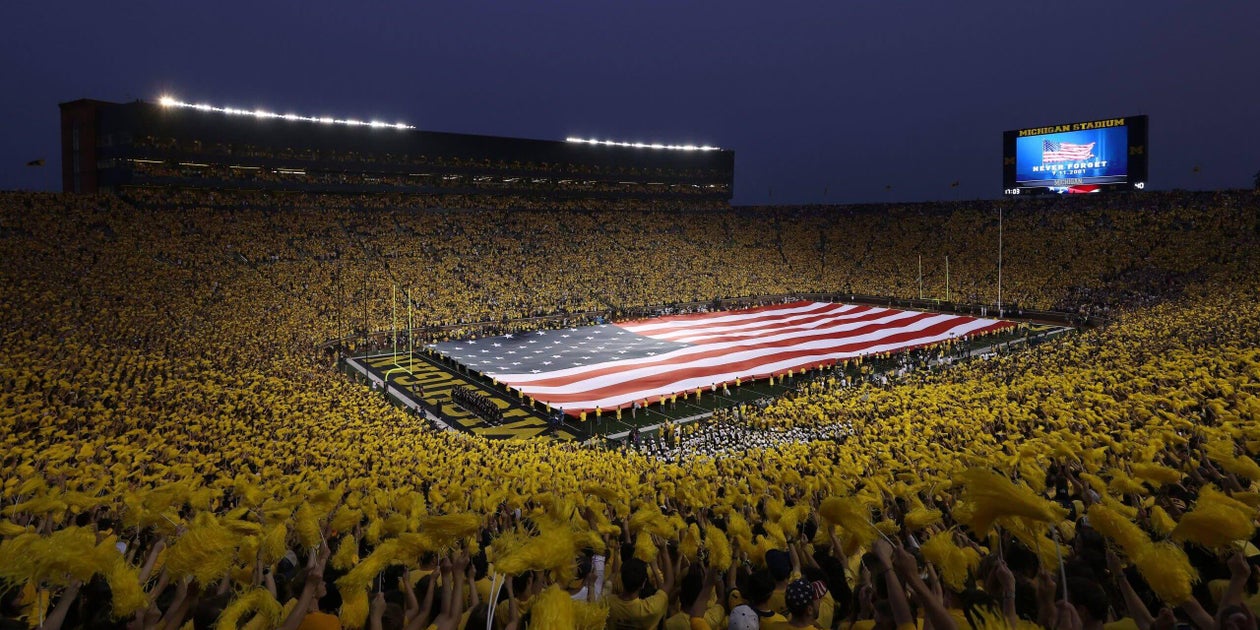
Editor’s note: This article is part of our College Football Stadium Rankings series, highlighting the most interesting venues across the country.
Georgia punter Brett Thorson grew up on a dairy farm in Australia, about two hours from Melbourne. When he goes home, occasionally someone will ask what American college football is like, which leads to this back-and-forth:
“Oh, is the stadium big, or do you play in front of big crowds?”
“Oh yeah, our stadiums are pretty big.”
“How many?”
“Ninety-three thousand.”
Then there’s silence.
“It’s almost like they get hit with a bucket of water. They’re like, ‘Wait, 93,000?’”Thorson said, smiling. “It is crazy, because it’s so hard to comprehend that you have these NFL stadiums, baseball stadiums, but the biggest stadiums are for technically semi-professional students, 18- to 22-year-olds.”
Stephen Fry, the English actor, had the same reaction when he visited Auburn for the Iron Bowl in 2011. A video of his experience summed it up well:
“It’s an indication of the size of the U.S. economy, and their passion for sport, that this is the stadium for Auburn, no more than a medium-sized college, and this is their annual game against another college within the same state, the University of Alabama, based in Tuscaloosa only a few hours drive away. This fixture has the scale, intensity and hoopla of a grand national final, but in reality is nothing more a local derby between amateur students.
“Only in America.”
The European mind truly can’t comprehend. Fry wasn’t even in the biggest American college football stadium. Not even close. And Georgia’s 93,000-seat stadium that awes Thorson’s compatriots in Australia? Not the biggest on Georgia’s schedule.
100,000-seat stadiums
| Rank | Stadium | Location | Capacity |
|---|---|---|---|
|
1 |
Narendra Modi Stadium |
Ahmedabad, India |
132,000 |
|
2 |
Rungrado 1st of May Stadium |
Pyongyang, North Korea |
114,000 |
|
3 |
Michigan Stadium |
Ann Arbor, Mich. |
107,601 |
|
4 |
Beaver Stadium |
State College, Pa. |
106,572 |
|
5 |
Ohio Stadium |
Columbus, Ohio |
102,780 |
|
6 |
Kyle Field |
College Station, Texas |
102,733 |
|
7 |
Tiger Stadium |
Baton Rouge, La. |
102,321 |
|
8 |
Neyland Stadium |
Knoxville, Tenn. |
101,915 |
|
9 |
Darrell K Royal-Texas Memorial Stadium |
Austin, Texas |
100,119 |
|
10 |
Bryant-Denny Stadium |
Tuscaloosa, Ala. |
100,077 |
|
11 |
Melbourne Cricket Ground |
Melbourne, Australia |
100,024 |
By seating capacity, college football stadiums are eight of the 10 biggest in the world — and 14 of the top 25. The stadium for the college football team in Athens, Ga., holds 11,000 more people than the stadium in Athens, Greece, that hosted the 2004 Olympics.
College football stadiums in locales such as Lincoln, Neb., Clemson, S.C. and Norman, Okla., rank in the top 50 of the world. Others in Iowa City, Fayetteville, Ark., and Columbia, S.C., rank in the top 100.
All for a sport played by college students. How and why did this happen? There’s simple geography. There’s arithmetic. And, of course, there’s money.
But also a healthy dose of competition.
The first stadium boom
Franklin Field in Philadelphia, built in 1895 to house Penn’s football team, is credited as the first stadium built primarily for college football. But it was quickly deemed too small for big games and replaced eight years later. That set the tone.
Football was becoming popular, and there were no NFL teams yet.
The powerful college teams played in the Northeast, where the stadium boom began: Harvard built a 40,000-seater in 1903, Syracuse followed with a similar stadium in 1908 and six years later Princeton built one seating 45,000-plus. Then Yale blew past that with the Yale Bowl, seating 64,025, with temporary seats that could take it above 70,000.
Things really got rolling after World War I. More people had cars, and the highway system improved, making it easier to get to games. Student enrollment grew, too. And there was a general economic boom in the roaring ’20s, so schools poured money into their football stadiums.
“After the war, the country’s enthusiasm for having a good time and casting off the last vestiges of its restrictive Victorian principles would be one of the driving forces in the escalation of college football’s popularity during the 1920s,” Raymond Schmidt wrote in his 2007 book: “Shaping College Football: The Transformation of an American Sport, 1919-1930.” “In a nation still on a high from its performance in the war, football provided an opportunity to peacefully continue experiencing the excitement.”
Stanford opened its 65,000-seat stadium in 1921, largely as an answer to rival California having a successful team. In the century before NIL, you couldn’t (legally) buy a better team, but you could build a much bigger stadium. So Cal answered just two years later by expanding to 73,000.
Meanwhile, Ohio Stadium went to 63,000 and Memorial Stadium at Illinois went to 67,000. The Rose Bowl (57,000 then 76,000 by 1928) and Los Angeles Coliseum (75,000) were built to try to lure the Olympics.
Chicago built Soldier Field in 1924, with a capacity of 75,000-plus that could expand to 100,000. But while it eventually became the NFL’s home, it was originally built as a multiuse facility, including college games.

Army-Navy drew more than 100,000 to Soldier Field in 1926. (Getty Images)
Even with capacities going up, people still couldn’t get in. The New York Times wrote: “Each year finds the interest in football growing more widespread, and greater numbers being turned away from the classic games of the season … As large as they build the stadiums, they are never large enough to meet the growing need.”
There was then — and still is — a fundamental economic motivation: There are few college football games per year. To maximize revenue, you need to maximize seats.
Notre Dame under Knute Rockne still had a small field — Cartier Field seated only 27,000 in 1927 — and that made it hard to convince good teams to play there. Rockne threatened to resign if he didn’t get a bigger stadium. Notre Dame Stadium opened in 1930, shortly before his death.
The big one was Michigan Stadium, built in 1927 with a capacity of 75,000. But Fielding Yost wanted as many as 140,000, which is why the footings in the stadium allowed it to be expanded to at least 100,000. Michigan’s administration backed him up, with a report calling for the stadium to be built with “the utmost simplicity. No attempt should be made to give it the form of a monument or memorial.”
In other words, focus on capacity.
Michigan got crowds of more than 84,000 for Ohio State and Minnesota (homecoming) and 83,000-plus for Navy. Two expansions took capacity to 100,001 for the 1956 season — athletic director Fritz Crisler added the one, meant to be a mystery.
When the Great Depression hit, gate receipts did go down. But the stadiums were already built. It simply stopped other schools from building large stadiums or expanding them — for a while, at least.
The South catches up
There were economic and political tensions in college sports after World War II: The Big Ten, northern and western schools wielded the most clout in the NCAA and tried to push through a “Sanity Code” that hinged on outlawing athletic scholarships. Southern schools chafed at it, alleging Big Ten schools were working around it with job plans for athletes.
“The Big Ten and its allies greedily wanted to resume their prewar domination of big-time college sports and its revenues; the upstart Southern, Southeastern and Southwest conferences wanted to expand their athletic programs, acquiring a larger piece of the economic pie,” Murray Sperber wrote in his 1998 book, “Onward to Victory.”
This wasn’t about stadium building, but it did symbolize what was to be the rise of the southern schools, which acquired more money to pour into their programs, especially the stadiums, in the days before players — or even coaches — were getting that money.
Tennessee, for instance, had a 17,860-seat stadium as of 1930. It gradually added seats, but by 1948 was still at only 46,290. As the sport gained in popularity and money grew after WWII, Tennessee kept building: 64,000-plus by 1968, 80,000-plus by 1976, then about 10,000 more seats in expansions in 1980 and 1996.
Enrollment was going up across the South, making it a factor: Not only were more students on campus, but more alumni felt an attachment to the school. When Georgia expanded Sanford Stadium yet again in 1966, athletic director Joel Eaves called it a “necessity” and said “we have regretted being unable to take care of all the ticket requests of alumni and Bulldog fans.”
As more southern stadiums expanded, the same competitive motivation from the 1920s kicked in. Georgia coach and athletic director Vince Dooley, when arguing for expansion from 59,000 to 77,000 in the early 1980s, mentioned keeping up with stadium expansions at Florida, Tennessee and Auburn. And in an answer to criticism that it would end a campus tradition — fans watching games from train tracks — Dooley answered: “We don’t want to change that tradition, but when it comes down to talking about a lot of money, it becomes an important factor — a deciding factor.”

Georgia’s Sanford Stadium seats 93,033, making it merely the sixth-largest in the SEC. (Todd Kirkland / Getty Images)
That leads to another seeming question: What about NFL stadiums?
For one thing, college football had a big head start. Pro football didn’t become very popular — and lucrative — until the television era. Even as the NFL became the richest league in the country and glitzy stadiums sprang up for teams like the Cowboys and Rams, the capacities generally didn’t approach the college level: MetLife Stadium in New Jersey, which serves two teams in the largest metropolitan area in the country, seats 25,000 fewer people than the one four hours away at Penn State in the middle of nowhere in Central Pennsylvania.
The NFL has more games per year and less need to maximize every home game. There’s less competition to one-up your rivals, which drove much of the college football race. Many NFL stadiums are historically funded by taxpayers, so there were slightly more financial limitations. And even in the new era of luxury stadiums, the emphasis has been on making money via suites and other amenities rather than pure attendance. In contrast, many college stadiums were built with bleacher seating, with the aim of packing in more students and alumni.
College football, in fact, is often compared to another sport: European soccer, especially when it comes to passion, history and charm. But when it comes to stadium sizes, there’s still no comparison.
European soccer vs. American football
Professional soccer began its rise in Europe just before college football began in the U.S., and soccer stadiums cropped up first in Britain and elsewhere on the continent. The sport only grew, with the Premier League becoming the biggest destination for the most popular sport in the world after its formation in 1992. So why are its stadiums still eclipsed by college football?
Part of it is simple geography: There isn’t as much room in Europe, which often has multiple clubs in the same city or close by. Plus, American universities almost always own their stadium and the land around it. If they want to expand, they just do it. Or in the case of Penn State, just move the stadium, as it did with Beaver Field in 1960, when it was moved to the outskirts of campus and became Beaver Stadium, with extra space used for several rounds of expansions that took it over 100,000 seats by 2001.
European clubs have a harder time. When Arsenal, one of the top clubs in Europe, wanted to expand its London-area stadium in the late 1990s, it was denied permission by the town council, partly because it would have required demolishing 25 neighborhood houses. So the club found a spot at an industrial and waste disposal estate, bought it and built a stadium that now seats 60,704.
“A lot of it was restricted in the plot of land they had, and the cost,” said George Somerville, a Glasgow-based sportswriter who writes about college football. “Because until the money really came into the Premier League, it was going to be difficult to redevelop a football stadium. And I think that’s the difference.”
And, of course, international soccer teams are made up of pros. They have to acquire players through the transfer system and pour the money into that. College football programs didn’t have to do that until recently.
When clubs did spend on their stadium, it tended to be maintenance: Somerville said fans tend to complain more about the quality of the facilities.

Manchester United’s Old Trafford is the Premier League’s largest stadium at 74,197, with plans to expand. (Carl Recine / Getty Images)
The Hillsborough tragedy in 1988 had a huge impact, including legislatively, on getting rid of standing enclosures and making them all seated. The bathrooms, the concessions, sitting on concrete. These are old stadiums, many built in the late 19th century.
Somerville also pointed to the European soccer relegation system: Teams fluctuate between divisions based on performance, so revenues are dictated by what league they’re in. It’s more volatile, so there isn’t assurance of revenue.
Still, there is recent movement on bigger stadiums: Manchester United announced in March it intends to build a 100,000-seat stadium, and Barcelona is in the process of expanding Camp Nou past 100,000. But that’s on the higher end.
Tottenham Hotspur, building on the site of its original stadium (1909) in London, opened a new facility six years ago with a capacity of 62,027. That made it the third-largest stadium in England.
In the SEC, it would rank 12th.
Shock and awe
Somerville’s first college football game was at Alabama nine years ago. He called that an eye-opener. Then, last month, he went to The Athletic’s No. 1 college football stadium — LSU’s Tiger Stadium — for the first time.
“For all the sporting experiences I’ve had over the years, that was, ‘Wow, this is something else,’” he said. “This is a different planet.”
It’s not just the actual number of fans, Somerville added. It’s what they’re doing in that stadium.
“I think it’s the noise of college football stadiums that brings it home,” Somerville said.
Thorson echoed that. He had already been to Melbourne’s Cricket Grounds, the 11th-largest stadium in the world, when he went to Georgia. But the Melbourne stadium doesn’t always fill up, Thorson said, like stadiums do in college football.
“They’re loud for four hours,” Thorson said. “When we got housed at Tennessee a few years ago (giving up a touchdown), to hear that sound, it was almost deafening. It was almost like there’s a dream going on.”
That’s how Fry sounded that night at Auburn, a town with a population of 76,143, less than the number who crowd inside Jordan-Hare Stadium with its capacity of 88,043. Fry shook hands with the student section, touched the eagle mascot, looked around and marveled.
“I don’t know if anything sums up America better: It’s simultaneously preposterous, incredibly laughable, impressive, charming, ridiculous, expensive, over-populated, wonderful … America.”
The College Football Stadium Rankings series is part of a partnership with StubHub. The Athletic maintains full editorial independence. Partners have no control over or input into the reporting or editing process and do not review stories before publication.

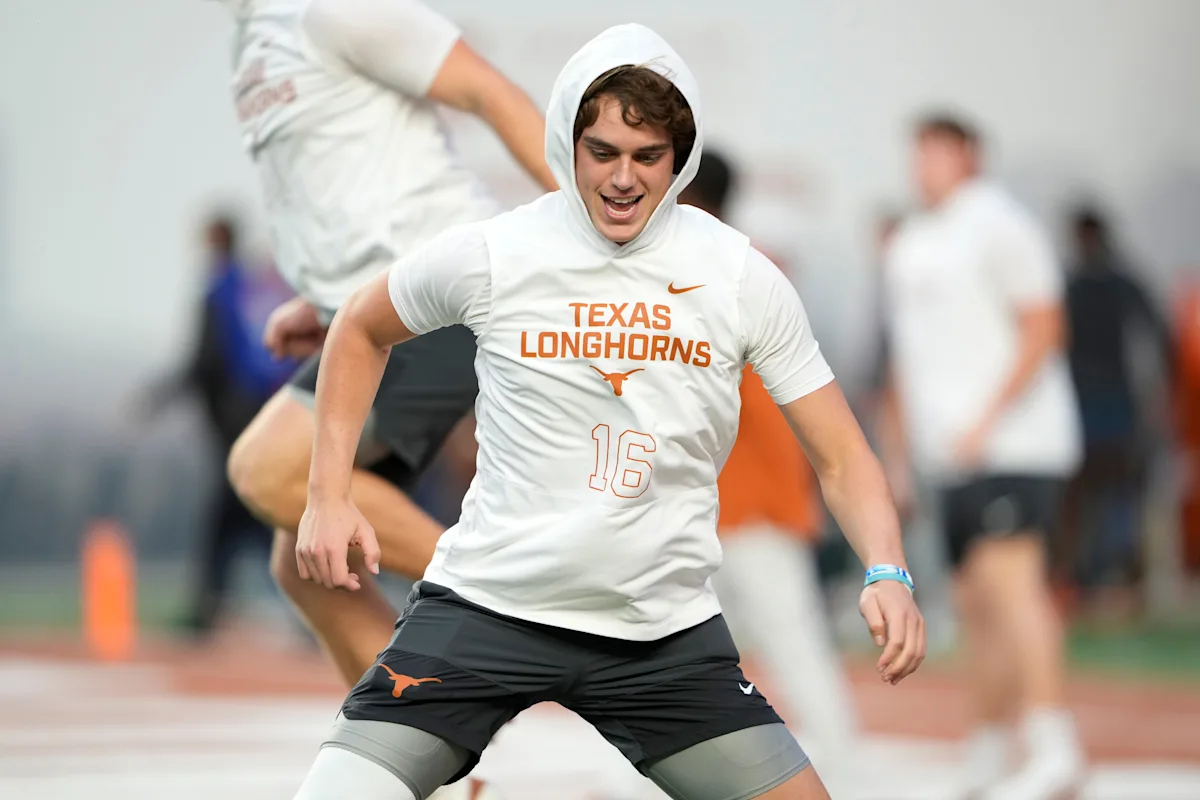
There are plenty of examples of a star in pro sports taking less money in order to help the overall roster. But it isn’t something that’s hit college football yet … until now, thanks to Arch Manning. Manning has asked to take a reduced portion of the Longhorns’ direct payout pool.
Manning’s aim at taking less NIL funds is to help improve the roster around him. Just like Patrick Mahomes, who regularly gives up millions to help the Kansas City Chief’s roster. Tom Brady did it with New England. Dirk Nowitzki, Tim Duncan, LeBron James, Kevin Durant, Jalen Brunson, Aaron Rodgers and Ben Roethlisberger have all helped the rosters around them by taking less.
Advertisement
In the pros, there are salary caps to negotiate. While college has no salary cap (yet), there is a finite amount in the NIL house pool. Texas can only spend what it has available. And while that pool is one of the biggest in the nation, Texas still follows a budget.
No doubt, Manning will be hoping the Texas coaching staff uses some of the freed up football revenue sharing funds on the offensive line. The line struggled in front of Manning all season and certainly inhibited his development early in the season.
Two offensive linemen are gone after the Citrus Bowl and Texas might lose a third. Left tackle Trevor Goosby was named first-team All-SEC is now contemplating going pro. Running back Jadan Baugh from Florida is also on Texas’ radar. The talented RB won’t be cheap.
Of course, it’s not like Manning will starve. The redshirt sophomore has one of the highest NIL valuations in nation. Manning has NIL deals with Red Bull, Panani, Uber and Warby Parker. Manning made north of $3.5 million in NIL deals in 2025, according to the Houston Chronicle.
Advertisement
With a big name that attracts major brands, Manning doesn’t need his big deals supplemented. But most college athletes are paid by the common pool of funds. Manning frees up some of that money for transfers.
This article originally appeared on Longhorns Wire: Manning Pay Cut: Texas QB asks for less NIL money to help boost roster
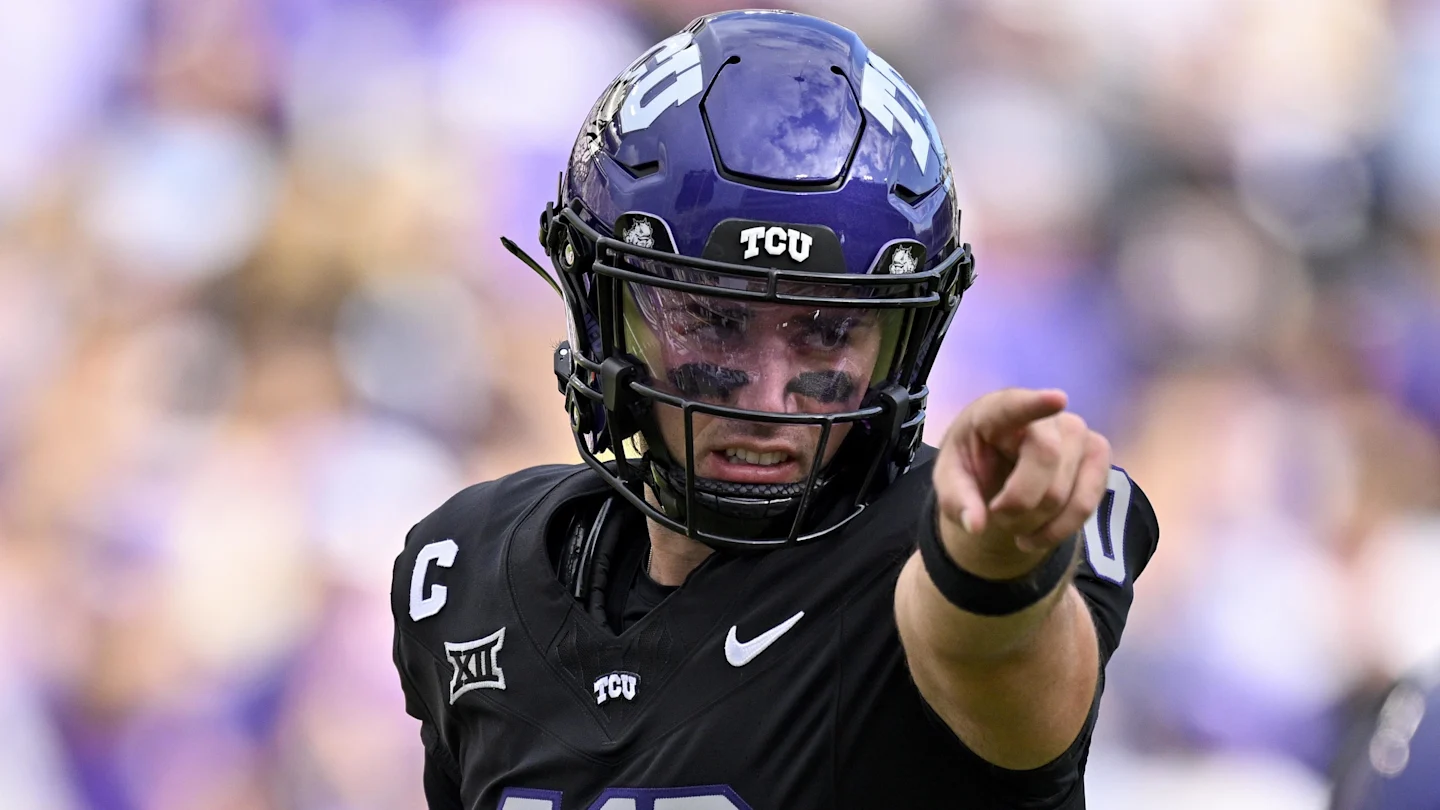
The NCAA Transfer Portal claimed another big name on Thursday night.
TCU star quarterback Josh Hoover has announced he intends to move on from the program. Hoover spent the last four seasons with the Horned Frogs, taking over as the starter midway through the 2023 campaign and putting up big numbers in each of the last two years.
In 36 career games, Hoover has completed 771/1183 passes for 9,629 yards with 71 touchdowns to 33 interceptions. He added eight more scores on the ground. There’s a very real likelihood that Hoover’s the most productive quarterback returning to the sport in 2026.
Hoover ranks in the top 5 in TCU program history in touchdown passes and total offense. He’s expected to be a coveted option in the portal.
Where are five landing spots that make sense for Hoover?
Indiana Hoosiers

Back in the College Football Playoff with a different starter for the second consecutive season, Indiana has put together one of the most impressive runs in the sport since Curt Cignetti took over the program.
The undefeated Hoosiers produced their first Heisman Trophy winner in school history last weekend as star quarterback Fernando Mendoza ran away with the award. Mendoza has another season of eligibility remaining, but is projected to be a top selection in the 2026 NFL Draft.
Indiana has already been linked to Hoover, per CBS Sports’ Chris Hummer.
Miami Hurricanes

Miami has lived in the transfer portal over the past few years, investing plenty of time and money into building a contender for Mario Cristobal. The moves finally worked out in 2025 as a massive financial commitment to secure Carson Beck from Georgia helped power the Hurricanes to the playoffs.
Though the conclusion of the 2024 season was a disappointment, former Miami quarterback Cam Ward was developed into the No. 1 pick in the most recent NFL Draft. Beck will likely get a shot at the professional level as well.
With little proven depth on the roster, it makes sense to bring in another experienced quarterback like Hoover to keep the Hurricanes on the right track. Miami has proven it’s willing to pay up.
Oregon Ducks

Oregon is a known quarterback factory, sending former stars such as Marcus Mariota and Justin Herbert to the NFL. That hasn’t changed since Dan Lanning took over the program in 2022.
The Ducks have had a quarterback drafted in back-to-back years, with Bo Nix going in the first round in 2024 and Dillon Gabriel being selected within the top-100 picks in 2025. Lanning could do it again next April with Dante Moore, who is nearing the end of a career year.
If Moore does leap to the professional level, Hoover would be a solid fit. Nix, Gabriel, and Moore all began their college careers at different schools and later transferred to Oregon, a similar path Hoover is embarking on.
Texas Tech Red Raiders

Suiting up for a playoff contender is pretty cool. Having a chance to win championships and staying home in the process might be even cooler.
Texas Tech has firmly entrenched itself as a program to reckon with in the modern age of the sport. The Red Raiders have plenty of money, and they’ve shown they’re willing to use it to pull in elite talent from the transfer portal and high school ranks.
With Behren Morton exhausting his eligibility following the playoff run, Texas Tech has to decide if it wants to turn the program over to another transfer or a homegrown talent like Will Hammond.
Either way, Hoover is from Texas and he’s already in the state.
Houston Cougars

An outlier among four other programs that have a chance to win it all, Houston is on the come-up. The Cougars haven’t been shy about writing checks, evidenced by the program signing five-star quarterback Keisean Henderson during the Early Signing Period.
Redshirt junior starter Conner Weigman does have one season of eligibility remaining and has stated he intends to return next season. Decisions are quick to change in this era, so never say never.
Would Houston bring in Hoover while Henderson develops for a season? Or should the program stick with Weigman as a veteran leader for Henderson?
Weigman just joined the program as a transfer last year. He was fine, but unspectacular this fall, and an upgrade could help the Cougars break their ceiling.
Read more on College Football HQ
• $45 million college football head coach reportedly offers Lane Kiffin unexpected role
• Paul Finebaum believes one SEC school is sticking by an ‘average’ head coach
• SEC football coach predicts major change after missing College Football Playoff
• Predicting landing spots for the Top 5 college football transfers (Dec. 17)

South Carolina Upstate Spartans (8-6) at Youngstown State Penguins (7-5, 2-1 Horizon League)
Youngstown, Ohio; Saturday, 1 p.m. EST
BOTTOM LINE: Youngstown State hosts South Carolina Upstate after Cris Carroll scored 31 points in Youngstown State’s 80-77 overtime loss to the Robert Morris Colonials.
The Penguins are 4-0 on their home court. Youngstown State scores 80.2 points and has outscored opponents by 10.9 points per game.
The Spartans are 2-5 on the road. South Carolina Upstate is fifth in the Big South scoring 79.6 points per game and is shooting 46.2%.
Youngstown State averages 10.4 made 3-pointers per game, 3.8 more made shots than the 6.6 per game South Carolina Upstate gives up. South Carolina Upstate has shot at a 46.2% rate from the field this season, 3.3 percentage points greater than the 42.9% shooting opponents of Youngstown State have averaged.
TOP PERFORMERS: Carroll averages 3.0 made 3-pointers per game for the Penguins, scoring 16.4 points while shooting 48.6% from beyond the arc. Rich Rolf is averaging 10.8 points over the last 10 games.
Mason Bendinger is scoring 16.1 points per game and averaging 3.1 rebounds for the Spartans. Carmelo Adkins is averaging 1.9 made 3-pointers over the last 10 games.
LAST 10 GAMES: Penguins: 6-4, averaging 81.3 points, 33.6 rebounds, 15.2 assists, 9.1 steals and 3.3 blocks per game while shooting 49.6% from the field. Their opponents have averaged 67.7 points per game.
Spartans: 5-5, averaging 75.4 points, 33.5 rebounds, 14.1 assists, 6.1 steals and 5.0 blocks per game while shooting 43.9% from the field. Their opponents have averaged 73.2 points.
___
The Associated Press created this story using technology provided by Data Skrive and data from Sportradar.
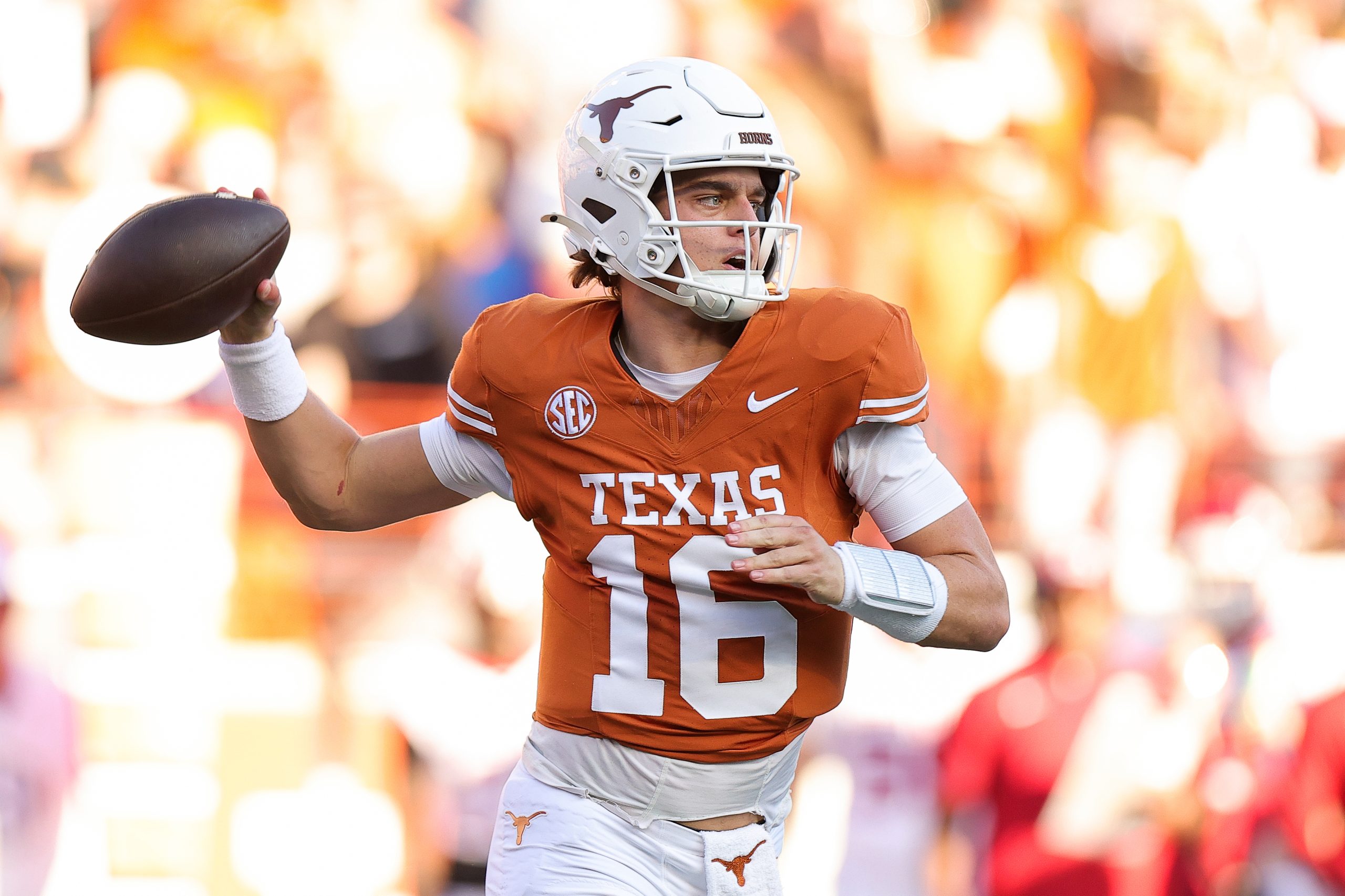
In a college football world where NIL numbers keep climbing, Arch Manning is going the other way.
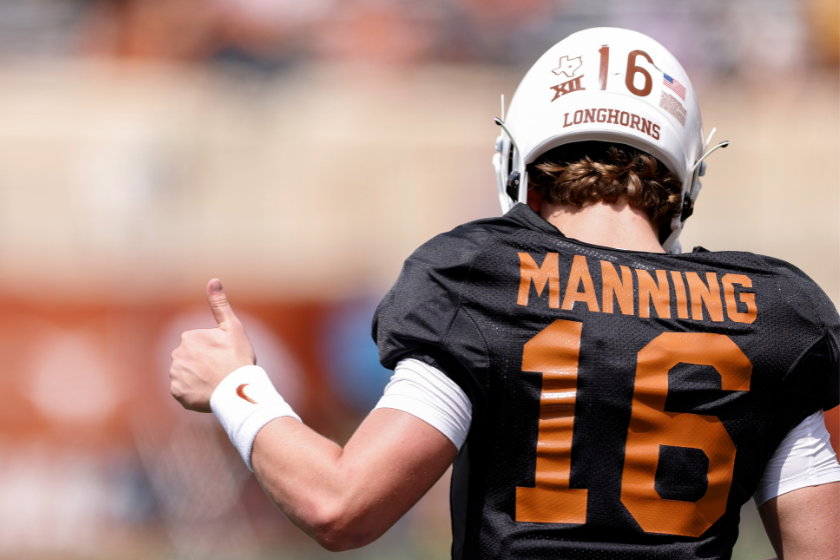
Photo by Tim Warner/Getty Images
The Texas quarterback has agreed to take a reduced share from the Longhorns’ revenue-sharing pool for the 2026 season, according to Justin Wells of Inside Texas. Manning was entitled to a full portion of the program’s revenue cap but opted to scale it back in an effort to give Texas more flexibility to strengthen its roster.
It is a move that stands out in the current landscape. It is also one Manning can afford to make.
Manning remains one of the most marketable players in college football and has a long list of endorsement deals that will continue to pay handsomely. Even with less money coming directly from the school, he is still expected to earn millions in 2026.
This is not the first time he has shown restraint, either. Manning has consistently been selective with his NIL opportunities since arriving in Austin.
The timing matters. The 2026 season is widely expected to be Manning’s last at Texas before he makes the jump to the NFL. From that perspective, the decision is straightforward. He wants the best possible team around him for one more run at a national championship.
Manning has already demonstrated his commitment to the program. He waited his turn behind Quinn Ewers for two seasons without entertaining a transfer and now is willing to sacrifice a portion of his compensation for the good of the roster.
On the field, the growth showed. After a shaky start in 2025, Manning finished with 2,942 passing yards and 24 touchdowns. Texas rebounded from a 3-2 opening to win six of its final seven games, punctuated by a decisive win over Texas A&M.
It is not a common move. It is a very Arch Manning one.

Ahead of the College Football Playoff opener, Malachi Toney added a notable NIL deal. The Miami wide receiver has inked a partnership with apparel company Hellstar.
Toney is Hellstar’s first NIL athlete, the Los Angeles-based brand said in an Instagram post. He became a crucial part of the Hurricanes’ offense during the regular season, helping lead the program to a College Football Playoff appearance as the last team in the field.
SUBSCRIBE to the On3 NIL and Sports Business Newsletter
It was part of a decorated freshman year for Toney, who’s emerging as one of the top young stars in the sport. Repped by NETWORK, he has a $878,000 On3 NIL Valuation.
“We are so proud to announce our first Hellstar Sports College Athlete NIL signing – Malachi Toney,” Hellstar wrote in its announcement. “We had the privilege to coach @malitoney10 while he was apart of our high school 7 on 7 program, so now seeing him shine on the collegiate level we couldn’t be more proud.
“We will continue to do our part to help these young athletes stay on the right path, and shine their light to the rest of the world. From Liberty City to the stars!”
It’s the latest notable NIL deal for Toney amid his freshman season. He also secured a partnership with Leaf Trading Cards in October.
More on Malachi Toney’s freshman season
Through his freshman year at Miami, Malachi Toney emerged as a top target for Carson Beck. He led the Hurricanes with 84 receptions for 970 yards, and his seven touchdown catches put him atop the ACC. Toney also added 89 rushing yards this year, as well as a rushing touchdown against Louisville.
Those numbers helped Toney become an On3 True Freshman All-American this year. In addition, he was a central figure in Miami’s run to the College Football Playoff.
“Toney’s quickness and playmaking instincts make him dangerous after the catch. He accounted for 350 yards after the catch with an average depth of target of 6.6, according to Pro Football Focus,” On3 | Rivals’ Charles Power wrote. “Whether working out of the slot or moving around the formation, the South Florida native has proven nearly impossible to contain. His playmaking ability was pivotal to Miami’s playoff push as he became the focal point of the Hurricanes’ passing attack.
“Given his play as a true freshman, it’s safe to say the Fort Lauderdale American Heritage product will enter next season as one of college football’s premier wide receivers. Toney’s performance as a true freshman is even more impressive considering that he should still be in high school, having reclassified into the 2025 cycle late in the recruiting process.”
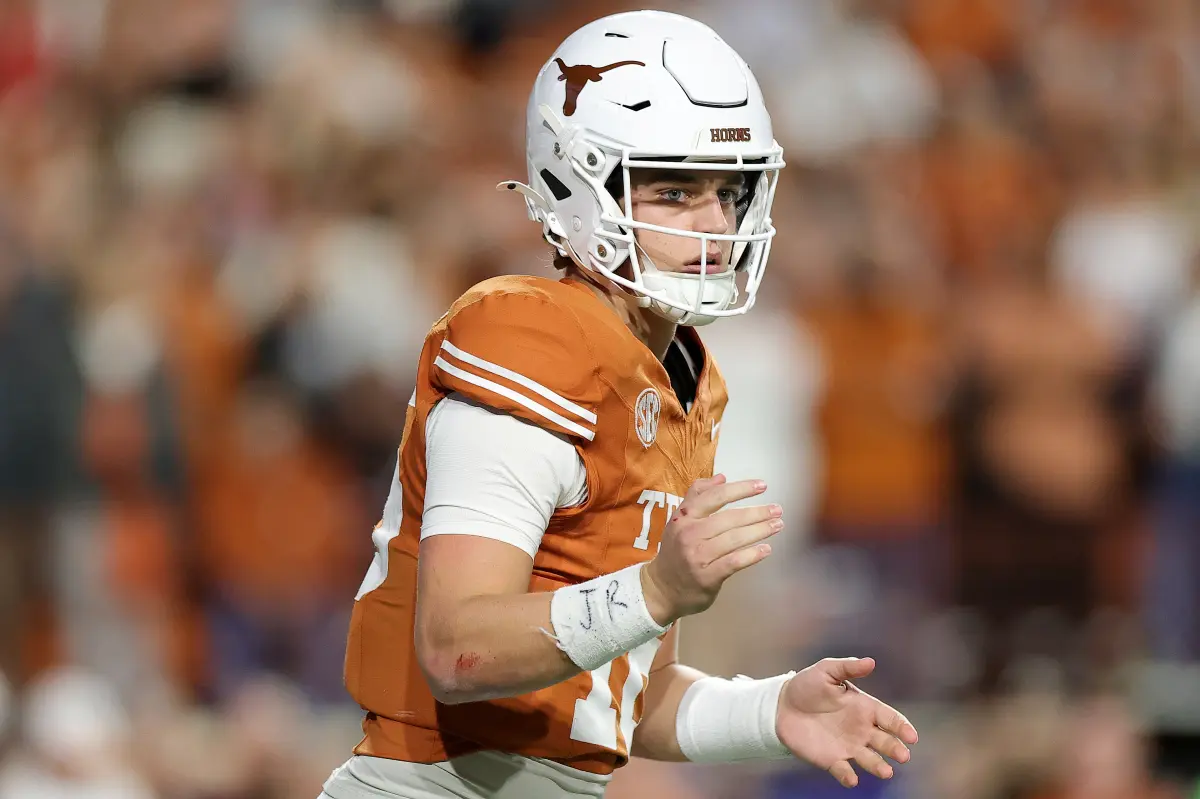
Arch Manning is taking a pay cut.
The Texas quarterback agreed to take a reduced share of the team’s revenue-sharing pool “as part of an effort to help the Longhorn football program do whatever it takes to support a 2026 championship run,” according to On3’s Justin Wells.
The savings “could be used on transfer portal talent or as part of retention efforts” for the Longhorns, per Wells.
This season, athletic programs were capped at $20.5 million in revenue-sharing, although that number is likely to increase next season and beyond.

Manning, the nephew of NFL icons Peyton and Eli Manning and the grandson of legendary quarterback Archie, is one of the most marketable athletes in college sports.
On3 currently gives Manning an NIL valuation of $5.3 million, which leads all student-athletes.
Although he is getting less money from Texas, Manning still holds NIL deals with brands like Red Bull, Uber and EA Sports, among others.
However, Manning sometimes struggled in a season that started with Heisman hype and the Longhorns ranked No. 1 in the nation.
Texas finished the season 9-3 and out of the College Football Playoff, a disappointing midseason loss against a poor Florida team all but ended their chances of being in the 12-team field.
Manning’s season was underwhelming as well, throwing for 2,942 yards with 24 touchdowns and seven interceptions.
The news comes after Manning’s father, Cooper Manning, told ESPN earlier this week that his son would return to the Longhorns in 2026 for his junior season despite previously mulling entering the 2026 NFL Draft.
“Arch is playing football at Texas next year,” Cooper said.
Texas finished No. 13 in the end of season rankings and will be on the sidelines for the College Football Playoff, which kicks off on Friday.

TOYOTA GAZOO Racing Unveils 2026 Season Plans

Curb Records and Motorsports manager reflects on Biffle’s legacy

Arch Manning takes NIL pay cut to boost 2026 Texas Football roster

Top 5 transfer portal landing spots for TCU quarterback Josh Hoover

A wave of resignations is hitting Maine high school basketball

Chisago County Press

New youth prison funding approved in Fitchburg to replace Lincoln Hills | News

MSU tribal communities partner to bring holiday spirit to local Native youth | MSUToday

Expandable eSports Laptop Models : Lenovo Legion Pro Rollable

South Carolina Upstate visits Youngstown State after Carroll’s 31-point outing

NBA news: Nets honor Australia Hanukkah attack victims, light menorah

New York Liberty and Ant International’s Alipay+ Announce Multiyear Partnership Focused on Empowerment, Sustainability and Youth Development

Brooklyn Park Area Drumline and Dance Team Gives Area Youth Positive Outlet

Nets Center hosts Brooklyn basketball youth clinic

Special Olympics Completes Georgetown University Innovation Hub Fellowship to Advance Young Athletes App

First Tee Winter Registration is open

Fargo girl, 13, dies after collapsing during school basketball game – Grand Forks Herald

CPG Brands Like Allegra Are Betting on F1 for the First Time

F1 Las Vegas: Verstappen win, Norris and Piastri DQ tighten 2025 title fight

Sycamores unveil 2026 track and field schedule

Two Pro Volleyball Leagues Serve Up Plans for Minnesota Teams

Utah State Announces 2025-26 Indoor Track & Field Schedule

SoundGear Named Entitlement Sponsor of Spears CARS Tour Southwest Opener

Jo Shimoda Undergoes Back Surgery

Redemption Means First Pro Stock World Championship for Dallas Glenn

Bowl Projections: ESPN predicts 12-team College Football Playoff bracket, full bowl slate after Week 14

Texas volleyball vs Kentucky game score: Live SEC tournament updates

Robert “Bobby” Lewis Hardin, 56

How this startup (and a KC sports icon) turned young players into card-carrying legends overnight

Indiana’s rapid ascent and its impact across college football





-
 Motorsports1 week ago
SoundGear Named Entitlement Sponsor of Spears CARS Tour Southwest Opener
-
 NIL3 weeks ago
Bowl Projections: ESPN predicts 12-team College Football Playoff bracket, full bowl slate after Week 14
-

 Motorsports2 weeks ago
Donny Schatz finds new home for 2026, inks full-time deal with CJB Motorsports – InForum
-

 Rec Sports2 weeks ago
How Donald Trump became FIFA’s ‘soccer president’ long before World Cup draw
-
 Sports3 weeks ago
Men’s and Women’s Track and Field Release 2026 Indoor Schedule with Opener Slated for December 6 at Home
-

 Rec Sports2 weeks ago
Black Bear Revises Recording Policies After Rulebook Language Surfaces via Lever
-

 Motorsports3 weeks ago
Michael Jordan’s fight against NASCAR heads to court, could shake up motorsports
-
 Rec Sports2 weeks ago
David Blitzer, Harris Blitzer Sports & Entertainment
-
 Motorsports2 weeks ago
JR Motorsports Confirms Death Of NASCAR Veteran Michael Annett At Age 39
-
 Motorsports2 weeks ago
Rick Ware Racing switching to Chevrolet for 2026