Connect with us
https://yoursportsnation.com/wp-content/uploads/2025/07/call-to-1.png

NIL

Louisiana panel eyes agent changes for high school athletes | Local Politics

Published

on


With elite high school football and basketball traditions stretching from Shreveport to New Orleans, the new pay-the-players era that allows kids to profit from paid endorsements has led to big business in Louisiana, and some athletes are bringing home six-figure incomes before they even graduate.

But it’s also spawned a host of concerns around a lack of financial protections for young athletes, and who can claim a stake in the money they’re now allowed to earn.

Those concerns were a key focus this year of a 22-person legislative task force involving Louisiana lawmakers, lawyers, college athletic administrators, coaches and student athletes. The group was empaneled to study the effects of paid endorsements and salaries for the state’s high school and college players.

They began shortly after a landmark NCAA settlement in June, which allowed college athletes to begin collecting salaries directly from their universities this season. For the past four years, college athletes could earn money through outside endorsement deals but not directly from their schools.

Over the course of five meetings, the panel zeroed in on the so-called “NIL” era in high school sports, named for the money that athletes have been allowed to earn since 2021 through endorsements or other use of their name, image and likeness.

Under the task force’s recommendations, which will be forwarded to lawmakers in January, the state would require that anyone other than a parent who helps high schoolers negotiate endorsement contracts must register as an agent with the Louisiana Attorney General’s Office. That requirement is already in place for professional sports agents in Louisiana.

The agents would also be subject to background checks and required to complete training.

Lawmakers could craft the changes to allow high schoolers to recoup any money paid to an unlicensed agent, said Harry J. “Skip” Philips, Jr., assistant Chief Deputy Attorney General.

“You’d try to get back as best you can the ill-gotten gains, as it were, and give it to the student athlete,” Philips said during the task force’s December meeting.

“I’m not sure we’ve fixed this problem altogether,” Philips added, but the changes give authorities a mechanism for pursuing what Phillips called “renegaders,” or people posing as professional agents in order to reap the benefits.

The panel’s chair, Rep. Rashid Young, said in an interview that the recommendations are meant to be a starting point, and lawmakers are welcome to add revisions.

“This is sort of one of those building-a-plane-as-we-fly type of situations,” said Young, a Homer Democrat and former linebacker and strong safety at Grambling State. “We’ll see how it works. If we need to come back and adjust, I think everybody is open to doing that.”

The task force didn’t recommend any specific NIL-related changes to state law regarding college athletics, other than a resolution that would study the “funding structures of athletic departments” and “evaluate the financial implications of NIL activities.”

The panel did recommend a list of best practices for Louisiana college athletic departments, including educating athletes on “available mental health resources” and to “carefully consider Title IX implications” when deciding how to dole out college athlete salaries.

LSU has said 90% of the $18 million it has earmarked in salaries will go to football and men’s basketball players. The university — and all others in the state — have rejected public records requests to turn over salary data per individual athlete.

The task force turned its attention to high school agents after J.T. Curtis, football coach at John Curtis Christian School in River Ridge, told the panel of “rampant” problems among the state’s premier football schools.

Adults with no professional certifications or backgrounds in the law swoop in to secure representation from Louisiana’s top recruits, some as young as 12 or 13 years old, Curtis told the panel.

“Until we find a way to get outside influences out of the lives of our high school athletes, we’re going to continue struggling with this,” Curtis said during an August meeting.

In the task force’s final meeting in December, Curtis called the panel’s recommendations “a good beginning.”

Historically, Louisiana has one of the nation’s largest shares of high school football players who are recruited by Division I colleges.

In the upcoming 2026 class, eight football players from Louisiana high schools are ranked in the Top 200, according to 247 Sports. In 2025, it was nine.

For athletes under the age of 17, the task force recommended legislation requiring them to deposit a portion of their compensation into a trust account, which they’d have access to later as an adult.

The account could be drawn from “under specified conditions, such as educational expenses or milestone events, while maintaining safeguards to prevent misuse,” per the task force’s adopted language.

The task force also recommended the Louisiana High School Athletic Association adopt a formal set of NIL bylaws that it would police among the state’s members.

They include prohibiting athletes from endorsing products associated with alcohol, cannabis, tobacco, adult entertainment and gambling.

The rules would allow schools to prohibit students from NIL activities if they interfere with classes, practices, games or competitions.

Link

Continue Reading
Click to comment

Leave a Reply

Your email address will not be published. Required fields are marked *

NIL

No. 1 transfer portal QB strongly linked to four college football programs

Published

on


The NCAA transfer portal is officially open for any college football players seeking different destinations for the 2026 season. The portal is open for a two-week period, closing on Jan. 16.

Thousands of players chose to enter the transfer portal in the weeks after the 2025 regular season ended. At the Power Four level, these announcements have led to a realignment of starting quarterbacks.

The first quarterback that decided to search for a new school was former Arizona State starter Sam Leavitt. He will have two seasons of eligibility at his third school.

The 6-foot-2, 205-pounder began his college football journey at Michigan State under Mel Tucker in 2023. He appeared in the four games needed to keep a redshirt, completing 15 of 23 passes for 139 yards, two touchdowns and two interceptions.

Tucker was let go for cause in the middle of the season, and Leavitt entered the transfer portal the following offseason.

Leavitt started all 14 games for Arizona State in 2024. He passed for 2,885 yards, 24 touchdowns and six interceptions while rushing for 443 yards and five touchdowns. He guided the Sun Devils to a 12-2 overall record, Big 12 Championship victory and College Football Playoff appearance.

Leavitt was recognized as the Big 12 Offensive Freshman of the Year and received All-Big 12 Second Team distinction. His 2,885 yards are the most by a freshman quarterback in Arizona State history.

A foot injury limited Leavitt’s 2025 season to just seven games. He passed for 1,628 yards, 10 touchdowns and three interceptions and accumulated another 306 yards and five touchdowns on the ground.

While Leavitt is sure to draw plenty of interest in the coming weeks, he has entered the portal with a “do not contact” tag, meaning he likely has a destination in mind. Pete Nakos of On3 reported that four different schools were in the mix for Leavitt on Saturday.

Kentucky

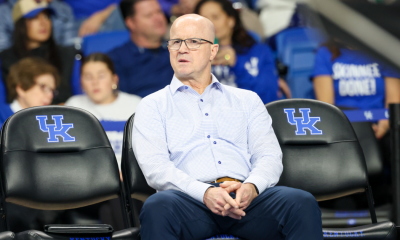
The Wildcats are a team that has found itself in the mix for Leavitt since the portal opened. Kentucky figures to be a more quarterback-friendly offense now that it has hired Oregon offensive coordinator Will Stein.

Kentucky will have to address its quarterback depth in the transfer portal since Cutter Boley departed for the portal. The Wildcats are confident in incoming freshman Matt Ponatoski, but Leavitt could be the bridge they need to a potential multi-year starter.

Oregon

Dan Lanning during the Orange Bowl.

Oregon head coach Dan Lanning watches from the sideline as the Oregon Ducks take on the Texas Tech Red Raiders | Ben Lonergan/The Register-Guard / USA TODAY NETWORK via Imagn Images

In the years between the end of Mario Cristobal’s tenure and the beginning of the Dan Lanning era, the Ducks have turned portal-heavy at quarterback. Anthony Brown (Boston College), Bo Nix (Auburn), Dillon Gabriel (UCF and Oklahoma) and Dante Moore (UCLA) have all started for Oregon from the transfer portal.

The other draw for Leavitt to Oregon is its proximity to his hometown. He is from West Linn, Oregon, a suburb just south of Portland and about an hour and a half north of Eugene.

Miami

Mario Cristobal following the Cotton Bowl.

Miami head coach Mario Cristobal leaves the field following the 2025 Cotton Bowl and quarterfinal game of the College Football Playoff | Raymond Carlin III-Imagn Images

Mario Cristobal’s approach at quarterback has featured a turn to portal acquisitions in his last two seasons with the Hurricanes. Miami has produced a No. 1 overall pick in the NFL draft with Cam Ward (Washington State) and is in the midst of a College Football Playoff run with Carson Beck (Georgia).

It would not be a surprise if the Hurricanes once again decided to take a look at the transfer portal in the 2026 offseason. Leavitt has been a target for Miami since before the portal opened.

LSU

Lane Kiffin has a reputation with successful transfer portal quarterbacks. Jaxson Dart (USC) was a first-round draft choice in the 2025 NFL draft, and Trinidad Chambliss (Ferris State) is in the midst of leading Ole Miss on a College Football Playoff run.

As a program, each of the last two quarterbacks to transfer in and start for LSU have Heisman Trophies to their names. Jayden Daniels transferred from Arizona State to LSU in 2022, a path Leavitt would take should he choose the Tigers.


Link

Continue Reading

NIL

Sports Economist Concocts His $25 Million Recipe for Silverfield’s First Arkansas Roster

Published

on


Sports Economist Concocts His $25 Million Recipe for Silverfield’s First Arkansas Roster
photo credit: Craven Whitlow

Add as a preferred source on Google Smash That “Follow” Button

In this era of college football, one of the most pressing questions facing Arkansas – and every program, for that matter – seems simple on the surface, but is actually quite complex upon closer inspection: How should teams spend their budget when it comes to building a roster?

The Razorbacks, in particular, are trying to sort this out as we speak. As things currently stand, they have just one scholarship quarterback, one semi-proven running back, two returning starting offensive linemen, one established defensive end, three scholarship linebackers and very limited experience in the secondary. (The partridge in a pear tree just entered the transfer portal.)

That’s a lot of holes to fill – a task made even more difficult by the fact that there is no centralized clearinghouse of contracts like in the NFL. That means college football programs are left trying to figure out how much each player and position is worth and how to keep talent contributing now and into the future.

It’s a question at the top of mind for every FBS staffer, as well as most fans, so Trey Biddy over at HawgSports took a stab at it last week, giving himself $25 million to distribute across the Razorbacks’ roster. It’s an interesting breakdown and one we strongly recommend reading for yourself.

Best of Arkansas Sports, though, wanted to take a slightly different approach to the topic, so they asked sports economist Parker Fleming to take a stab at it from an analytics perspective. Here’s what he came up with…

Using the NFL as a Guide

When building a college roster, many front offices look to the NFL, which has a centralized database of player contracts as part of its Collective Bargaining Agreement. Valuing a player in the NFL becomes as straightforward as looking at a few key metrics, seeing where that player ranks in those key metrics, and then slotting their earnings in accordance with their production.

Poll

Want to Get Paid for Following Arkansas Sports?

In fact, many college teams have hired directly from the NFL ranks to have someone with professional experience help with their cap and contract management. While the experience and general principles from the NFL have great value, there are still some unique realities in college football one must consider. 

First, uncertainty around player quality in college football is dramatically higher than the NFL. New Arkansas general manager Gaizka Crowley mentioned this in a recent interview with The Athletic, citing college being distinct from the pros because there is “a ton of variance” among and between programs. College prospects are developmental, and that means the range of outcomes on a player are much larger than their more polished pro counterparts. Due to that uncertainty, investing all your resources in just a few players is going to increase your risk. 

Second, and perhaps more important, is the fact that the NFL is a passing league, where college football features the run game much more prominently. In 2025, college football teams rushed about 15% more than an average NFL team, given down, distance and game state. That means we must recalibrate our positional value relative to the NFL: QB passing and WR/CB play become slightly less important, while the run game – running backs, offensive and defensive linemen, linebackers, blocking tight end – becomes more important.

Ryan Silverfield’s Memphis was a slightly pass-heavy team in 2025, passing 2.9 percentage points more than the average team (56th most-pass happy in the nation, per cfb-graphs.com), so for this specific example, we won’t over-indulge in the run game, but we do know that’s a clear difference from the NFL example. 

Clearly, we can’t just map one for one the structure of the NFL and hope for the best with the rest of the roster. While a roster of 15 elite players and 90 replacement players would be a fun experiment, it also puts the team in a hole for recruitment (money you have to tie into players who need to develop to contribute), and at severe risk of an injury or bust derailing a season spectacularly. 

What we can do, though, is use NFL benchmarks for elite talent and adjust for rush rates to get us guiding principles for position-by-position group allocation. For our rushing adjustment, we want to increase the value of the rushing positions by about 15% and decrease the value of the passing positions by about 15%.

Then, we’ll adjust by number of players: we need more linemen and more wide receivers than we do quarterbacks or running backs, so we’ll adjust the pools accordingly. At this point, we’re entering into art not science, and different teams will have strong opinions about this adjustment. But as a guiding principle, this illustrates the roster building challenge and ways to attack it.

Position-by-Position Breakdown

One place many programs have started is with the NFL franchise tag. The franchise tag is a tool teams have where they can retain a free agent player for one season at a premium salary, designated by the average annual value of the top five salaries at that position over the last four years. 

In 2026, per overthecap.com, the franchise tag values are projected to look something like this:

Screenshot 2026-01-02 at 4.38.54 PMScreenshot 2026-01-02 at 4.38.54 PM

This table essentially reflects how the league values elite talent at each position. 

We can apply our rushing adjustment to these values to get guidelines for our position-by-position distribution. Applying the 15% adjustment to the positions as stated above, we get percentages and total amounts of a $25 million dollar budget as follows: 

Screenshot 2026-01-02 at 4.39.22 PMScreenshot 2026-01-02 at 4.39.22 PM

Following the Eagles’ Blueprint

Now that we have guardrails for positional value and overall spending, we need to think about how to distribute these amounts across players. In his article, Trey Biddy acknowledges this problem and articulates a reasonable solution: 

Related Articles

“I’m capped at 105 roster spots, but instead of giving something to everyone, I’m going to focus on 75 players and no more. Everyone else will have to be happy with a scholarship. At least 20 of those 75 players will be elite recruits. However, there might be the possibility that a recruit fits into a starter, backup or reserve role. In that case it would be 20-plus recruits.

Essentially, I’m going for 55 players who are going to see the field or provide insurance in case of an injury, plus 20 more I’m invested in for the future. I also considered limiting it to as few as 47 players (the two-deep plus special teams) plus 20 or so recruits.”

Biddy was on the right track with that final statement.

The Philadelphia Eagles, one of the NFL’s most savvy front offices, invest about 80% of the salary cap in 55% of their roster, which equates to about 47 players we want to really invest in, some of whom will be recruits. Ideally, some of those recruits can contribute immediately, especially wide receivers, running backs and defensive backs. We’ll bump that up to a round 50 to include two specialists and a fourth quarterback for depth.

We’ll use the percentages above and allocate $20 million of our $25 million to those 47+3 players on the roster to give us a $5 million reserve for recruitment and portal – that’s money we want to spend every year, but reserve to allow us to go over slot or over positional numbers as the roster needs dictate based on eligibility and turnover. 

To allocate this money within position groups, I’ll use a Pareto distribution to allocate the position budgets across players. Some of you may be familiar with the Pareto rule in business, where 20% of inputs yield 80% of outputs. In our context, what it means is simple: Top-end talent will have more influence on our results, and we want to pay accordingly. Using this Pareto distribution to spread money across position groups will allow us to invest our money in high-quality talent at the most impactful positions, yielding the best results on the field, both now and in the future.

Without further ado, let’s go position by position and allocate our 50 roster spots. 

QUARTERBACK (4 Players)

  • QB1: $2,500,000
  • QB2: $647,775
  • QB3: $254,000
  • QB4: $150,723

RUNNING BACK (4 Players)

  • RB1: $548,931
  • RB2: $245,654
  • RB3: $153,482
  • RB4: $109,933

WIDE RECEIVER (7 Players)

  • WR1: $1,022,607
  • WR2: $457,629
  • WR3: $285,922
  • WR4: $204,795
  • WR5: $158,090
  • WR6: $127,000
  • WR7: $107,003

TIGHT END (3 Players)

  • TE1: $602,161
  • TE2: $269,474
  • TE3: $168,365

OFFENSIVE LINE (10 Players)

  • OT1: $1,558,248
  • OT2: $710,761
  • OG1: $444,076
  • OT3: $318,074
  • C: $245,535
  • OG2: $198,730
  • OT4: $166,190
  • OT5: $142,342
  • IOL4: $124,164
  • IOL5: $109,880

DEFENSIVE END (4 Players)

  • DE1: $767,881
  • DE2: $343,636
  • DE3: $214,701
  • DE4: $153,782

DEFENSIVE TACKLE (4 Players)

  • DT1: $1,209,932
  • DT2: $541,460
  • DT3: $338,299
  • DT4: $242,310

LINEBACKER (4 Players)

  • LB1: $1,073,996
  • LB2: $480,627
  • LB3: $300,291
  • LB4: $215,086

SAFETY (4 Players)

  • S1: $795,899
  • S2: $356,175
  • S3: $222,534
  • S4: $159,393

CORNERBACK (4 Players)

  • CB1: $599,777
  • CB2: 268,408
  • CB3: $167,699
  • CB4: $120,116

SPECIALISTS (2 Players)

TOTAL: 50 Players, $19,726,000

  • OFFENSE: 28 Players, $11,010,000
  • DEFENSE: 20 Players, $8,572,000
  • SPECIALISTS: 2 Players, $144,000

RECRUITING BUDGET AND REST OF ROSTER: $5,418,000 ($235,565 per player for an average recruiting class of 23 players)

These are some of the key differences between mine and Trey Biddy’s methods: 

  • Less commitment to QBs: we want to keep the money on the field, and so while we want to entice backups to stay, we also need to walk a fine line between paying for players who aren’t contributing this season. 
  • Balance at the tails for premium positions: The value of a good running back is higher in college than the NFL, but we also know a couple things: Running Backs take a lot of wear and tear, and their success is dependent on their surroundings. The analytical approach would be to pay for an upper middle class veteran back, and play your young running backs as well, investing the rest of the top end money into the offensive line. 
  • Specialist numbers were too high. A good punting and kicking game is important, but ancillary to moving the ball well in the down-to-down business of football. We want to attract and retain talent without paying market premiums for positions that yield minimal influence on our overall success. I refrained from paying a long-snapper at all; long-snapping is a skill that can be taught, and I have faith in the coaching staff to find a walk-on who would be happy to have that role. 

What we’ve done above is taken an analytical approach to framing ideal targets for roster spending. This approach, one of many potential successful approaches, emphasizes top-end talent on on-field contribution, while leaving substantial funds for coaching preference at depth or paying premiums for transfer portal talent.

When building a roster, the current money on the books will be the biggest constraint for coaches, as well as the natural evolution of the roster due to eligibility limits. The analytical approach above attempts to tie spending to on-field impact and position Arkansas to build a championship caliber roster.

***

YouTube videoYouTube video

***

More coverage of Arkansas football and the transfer portal from BoAS…


Link

Continue Reading

NIL

Ranking potential CFP National Championship games: Miami vs. Oregon leads the way

Published

on


We have reached the College Football Playoff semifinals, and unlike last season when the favorites won all eight games in the first two rounds, we’ve seen some surprises this year. Gone are the likes of Ohio State, Georgia and Alabama. In are the upstarts like Indiana, Ole Miss and a Miami team that hasn’t played on a stage like this in over 20 years.

Between those three and Oregon, we are guaranteed to not only have a new national champion but a team that will win its first title in the CFP era. Of our final four teams, Miami is the only program to win a national title going back to the BCS era — its last natty coming in 2001.

For Ole Miss, you have to go back to 1960, which is the lone national title in program history. Indiana and Oregon? They’ve never won the national title.

College Football Playoff overreactions: Best postseason we’ve seen, Curt Cignetti on Hall of Fame track

Will Backus

College Football Playoff overreactions: Best postseason we've seen, Curt Cignetti on Hall of Fame track

NIL, the transfer portal and the College Football Playoff were supposed to bring us new blood, and it’s hard to argue with the results right now, isn’t it? So we’re either re-crowning a long-dormant national power or welcoming a new power to the fold, but I’m not here to figure out who will take the trophy at the end right now. No, the point of our exercise today is to determine what the best possible title game matchups would be. To figure that out, I looked at the possibilities from multiple perspectives. How competitive would the game likely be? How does the matchup look? Who has the coolest uniforms? And, while I’m not a television executive, I also considered which matchup would be most appealing to a broader audience.

Here are my highly scientific results.

1. (5) Oregon vs. (10) Miami

Oregon may not have a national title to its name, but it’s not exactly a stranger to the stage. This is Oregon’s third appearance in the CFP, and if it advances to the title game, it will be its second appearance in a national championship game since the start of the BCS era in 1998. Miami is the blue blood of the group. It has won a national title this century and has five in its history.

While neither team is a television draw the likes of Ohio State or Alabama, they are known commodities in the college football world and would draw more “casual” eyeballs in this spot than any other possible combination. As for the matchup itself, the teams are quite similar. They have physical run games that look to punish you for 60 minutes but also have accurate quarterbacks who can get the ball to dangerous playmakers at the wide receiver position.

They’re also both led by coaches who put a strong emphasis on building their program from the lines of scrimmage out, though Dan Lanning is more aggressive when it comes to gameday decisions than Mario Cristobal. Oh, and that brings up another fun storyline for this game. Mario Cristobal left Oregon to take the job at Miami and was replaced by Lanning. There was a lot of talk about the possibility of a Carson Beck vs. Georgia’s revenge game the last few weeks, but we all overlooked Mario vs. Oregon.

2. (1) Indiana vs. (10) Miami

A lot of what I said about the football matchup between Oregon and Miami applies here as well. Indiana may not have a bunch of blue-chip prospects on their offensive and defensive lines, but go ahead and ask all those blue-chip teams it’s beaten if they could tell the difference when facing them. The Hoosiers are just as mean as anybody, and I don’t know that there’s a defense in the country that takes as much joy in hitting ballcarriers as Indiana’s does.

Indiana also might have the best quarterback in the country. Fernando Mendoza won the Heisman Trophy for good reason and could be the first pick in the NFL Draft this spring. So that certainly brings some “sizzle” to the matchup for television purposes. Plus, you can always sell this as New Blood vs. Blue Blood.

3. (5) Oregon vs. (6) Ole Miss

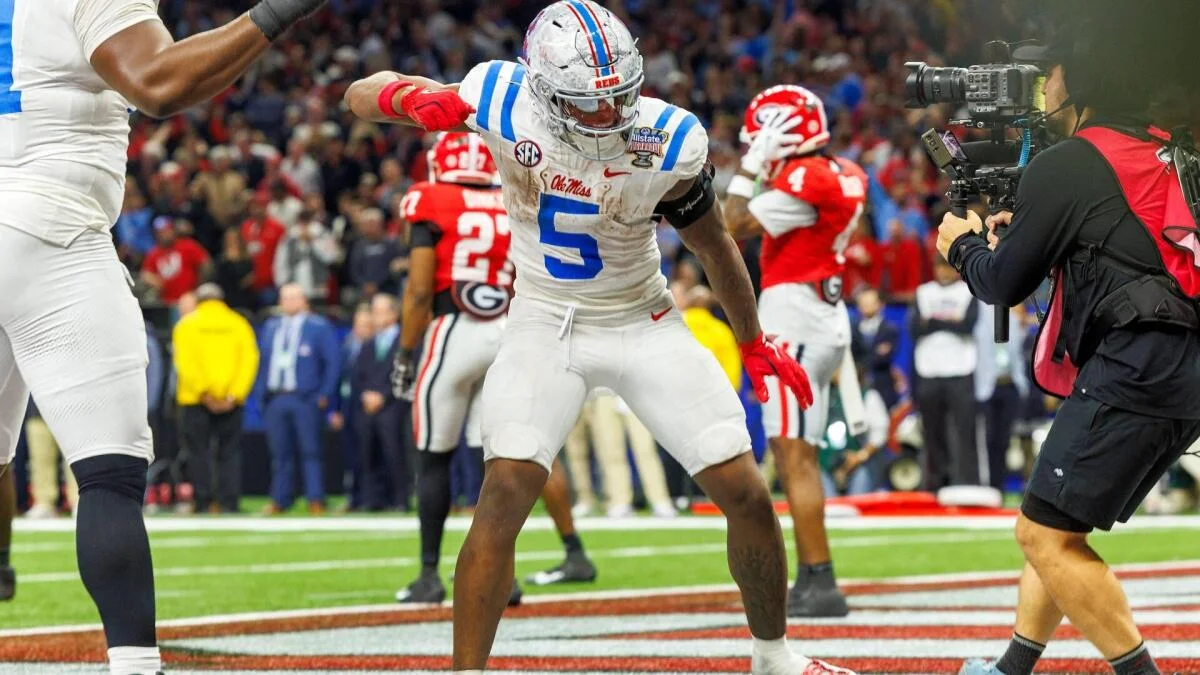
Of the four possible matchups, this is the one most likely to deliver us a shootout. Ole Miss has been involved in plenty of those all year, thanks to the likes of Trinidad Chambliss and an explosive offense. Lane Kiffin might be gone (oh, the irony of leaving for LSU to compete for national championships while then watching the team you just left do that), but he didn’t take the offense with him. Ole Miss has scored 80 points through its first two playoff games after averaging 37.6 during the regular season.

Oregon has shown more versatility. It can win a rock fight, but it’s also one of the most explosive offenses in the country. It has scored 40 points or more seven times this season and has cracked the 50-point mark four times.

4. (1) Indiana vs. (6) Ole Miss

This is the matchup that would have the largest spread. I don’t know where the final odds would be by the time the game came around, but using my power ratings, I’d have Indiana as roughly a 10-point favorite here. Of course, if this game happens, Ole Miss will have reached the title game after beating both Georgia and Miami as underdogs in the quarters and semis, so it’s not a position where the Rebels would be afraid.

Still, while I’ll be happy to watch this game if it’s the one we get. The blowout potential here is higher than anywhere else, which makes it the least appealing. Yes, there’s the angle of neither team having won or competed for national titles in the modern era before, but like Indiana, Oregon hasn’t won a national title either, so the novelty doesn’t carry much weight.


Link

Continue Reading

NIL

Should you enter NCAA transfer portal? What all athletes need to know

Published

on


Jan. 3, 2026, 7:02 a.m. ET


Link

Continue Reading

NIL

Washington Huskies Sign QB Demond Williams Jr. to New Deal For 2026

Published

on


Jan. 2, 2026, 3:44 p.m. PT

Washington Huskies sophomore quarterback Demond Williams Jr. will begin his third season at the school among the top compensated players in college football after agreeing to a new deal on Friday.

ESPN college football insider Pete Thamel reported the deal between the 5-foot-11, 190-pound signal-caller and the school on Friday, reuniting Williams and Jedd Fisch for the next two seasons through his senior year in 2027.

The Chandler, Arizona native emerged as one of the best quarterbacks in the Big Ten in his first year as the Huskies’ starter, throwing for 3,064 yards and 25 touchdowns with an additional 611 yards rushing and six touchdowns on the ground in 2025, leading the program to a 9-4 overall record in year two under Fisch.


Link

Continue Reading

NIL

Is Missouri football close to landing transfer portal QB? Reports say so

Published

on


Updated Jan. 2, 2026, 5:25 p.m. CT

Missouri football does not appear to be wasting much time on the most important question on its roster.

Multiple reports landed Friday, Jan. 2, indicating that the Tigers are the team to watch for Austin Simmons, who, at the beginning of the 2025 season, was widely expected to be the starting quarterback for the Ole Miss Rebels under then-head coach Lane Kiffin.

Simmons, according to a report Friday from national ESPN reporter Pete Thamel, has entered the transfer portal with a no-contact tag. That typically means that a player has a good idea where they would like to end up, and it bars other schools from reaching out to him or his representatives.


Link

Continue Reading

Most Viewed Posts

Trending