
As the cost of youth sports continues to rise, families across Arizona are being priced out of participation.
From local clubs to travel teams, the expenses add up with equipment, uniforms, tournament fees and more totaling thousands of dollars annually, putting pressure on families and widening the gap between those who can afford to play and those who can’t.
The financial strain is reshaping who gets to participate, raising concerns among researchers, nonprofits and parents about long-term access and equity.
According to a 2023 study by the Aspen Institute’s Project Play, Arizona ranked second to last in the country for youth ages 6-17 who played on a team or took lessons.
Less than half of high school students reported playing on one or more sports teams during the past 12 months according to research done by the Arizona Department of Health Services Bureau of Nutrition and Physical Activity.
“Costs are rising and as a result of that we are seeing lower rates of participation, particularly in under-resourced, traditionally underrepresented communities,” said Eric Legg, assistant professor in Arizona State University’s School of Community Resources & Development.
“It’s a wrecked relationship,” he said. “Costs go up, participation goes down, and it most impacts underrepresented communities.”
Youth sports play a crucial role in children’s development, allowing for positive social, emotional and physical growth.
The U.S. Anti-Doping Agency (USADA) found that physical activity enhances self-perceptions of body, competence and self-worth and that playing a sport can even protect against suicide risk in youth.
At the Boys & Girls Club of the Valley (BGCAZ), the importance of youth development is embedded in their subsidized sports, fitness and recreation programs.
“Unfortunately, as kids have started to specialize in sports, they’re dropping out of sport at a younger and younger age,” said Josh Stine, BGCAZ vice president of external affairs.
“Our goal is to keep [them] playing sports longer. We want you to play for the health benefits, for the social recreation, for the communication skills you build.”

In the past year, the average amount AZ families spent on all their children’s sports programs was just short of $1500.
Rising costs for both families and organizations like BGCAZ affect equipment, staffing and facility rentals.
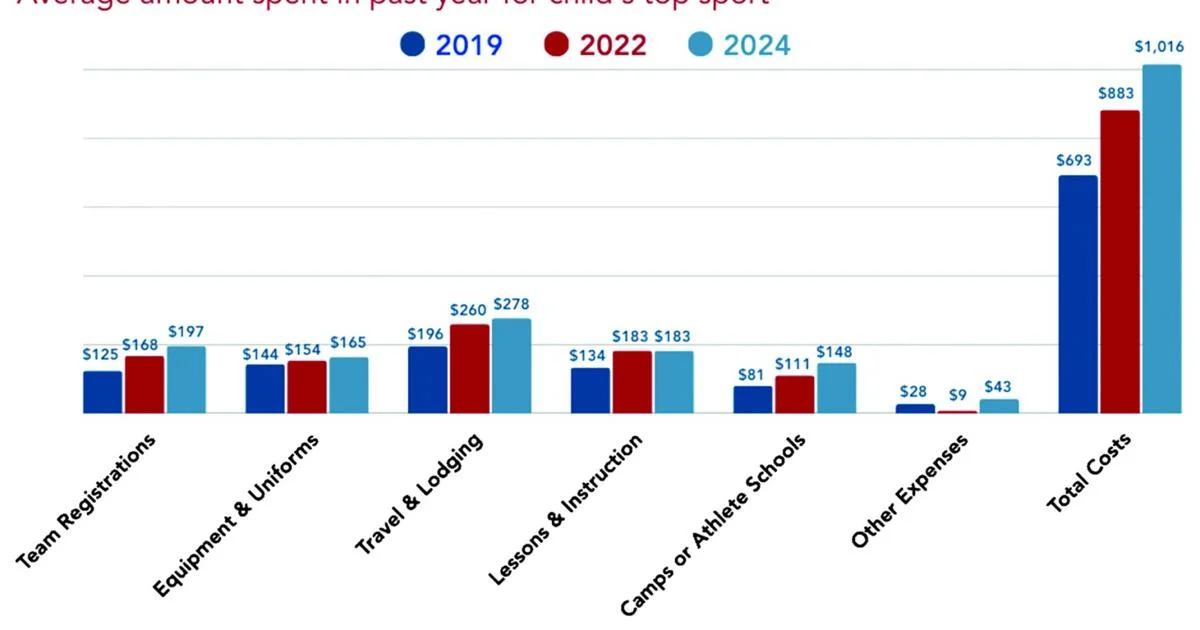
Project Play found that the average U.S. sports family spent $1,016 on a child’s primary sport in 2024. This is a 46% increase from 2019, twice the rate of price inflation in the U.S. economy during the same period.
Some companies and organizations are trying to fill the financial gaps for these families.
“Our corporate partners and our community partners are able to provide access to equipment and uniforms at a lower cost or donated so kids have access,” Stine said. “We don’t want a kid not playing or not signing up because they don’t have the proper shoes or the glove.
“It’s really trying to lean into our partners where we can to help cover the costs that were traditionally passed on to our students or players.”
Local government has been an option, but Legg said a major issue is the massive reduction in how much local governments invest in youth sports.
Legg said that youth sports programs were at one point primarily subsidized by tax dollars and community support. This practice has shifted as the more commonly used funding model is the “pay to play” model, where the program is supported by participant fees.
“Youth sports create healthy youth, healthy youth create healthy communities,” Legg said. “It’s actually a cost saver in the long term and investing more in those communities through tax dollar support.”
The “pay to play” model is just one of the effects of the rapid commercialization of youth sports. This commercialization is prominent in the increase in club sports, programs that are run by private associations and often have much higher fees than traditional school or nonprofit youth sports programs.
For many families, cost is often the most important factor when considering youth sports programs.
Nick Girard, father of two and current president of Recreation Association of Madison Meadows & Simis (RAMMS), said cost is something he and many other parents weigh thoroughly.
“From the parents’ standpoint, I see that [rising cost] when I pay the registration fees, in RAMMS recreational sports and club sports,” Girard said. “I have kids who do club sports so I see all aspects of this.”

Not surprisingly, the money parents pay for a child to participate in a primary sport and other sports along the way in one year varies with the child’s age.
RAMMS is a parent-run, volunteer-led nonprofit that provides recreational youth sports for children in North Central Phoenix. Like BGCAZ and similar nonprofits, it relies on registration fees and sponsorships to fund venues, uniforms, equipment and improvements to local schools.
RAMMS was created to provide recreational sport options for families who may be priced out of club or travel teams.
Another factor that often deters parents from club sports involves the number of costs involved. Unlike recreational sport programs that charge one upfront fee, club and travel teams come with add-ons parents may not have accounted for.
“In club sports, you’re typically paying a monthly fee for the club, you’re paying per event fees, you’re paying admission fees to get into those sports, you’re paying for the cost of uniforms separately oftentimes,” Girard said. :There’s a lot of different add-on pieces that add up.”
Even with the higher costs, parents often feel pressure to turn to club programs for many reasons, most notably when their child specializes in one sport.
Project Play found that the most common justifications for parents to enroll their children in club sports and specialize in one sport are that their child wants to play in high school, college or professionally.
The study also found that one in four parents felt societal pressure to have their child stick to one sport while parents of older children feel the most pressure from their child and school coaches to specialize.
Girard, who’s been involved in youth sports for over eight years, said he’s noticed more younger children being pushed into club sports out of fear of being left behind.
But the great fear these days may be one of being left out by costs.
“What worries me the most about where youth sports are headed is kids leaving,” Girard said. “If it’s too expensive to play and families can’t sign up then kids stop participating.”