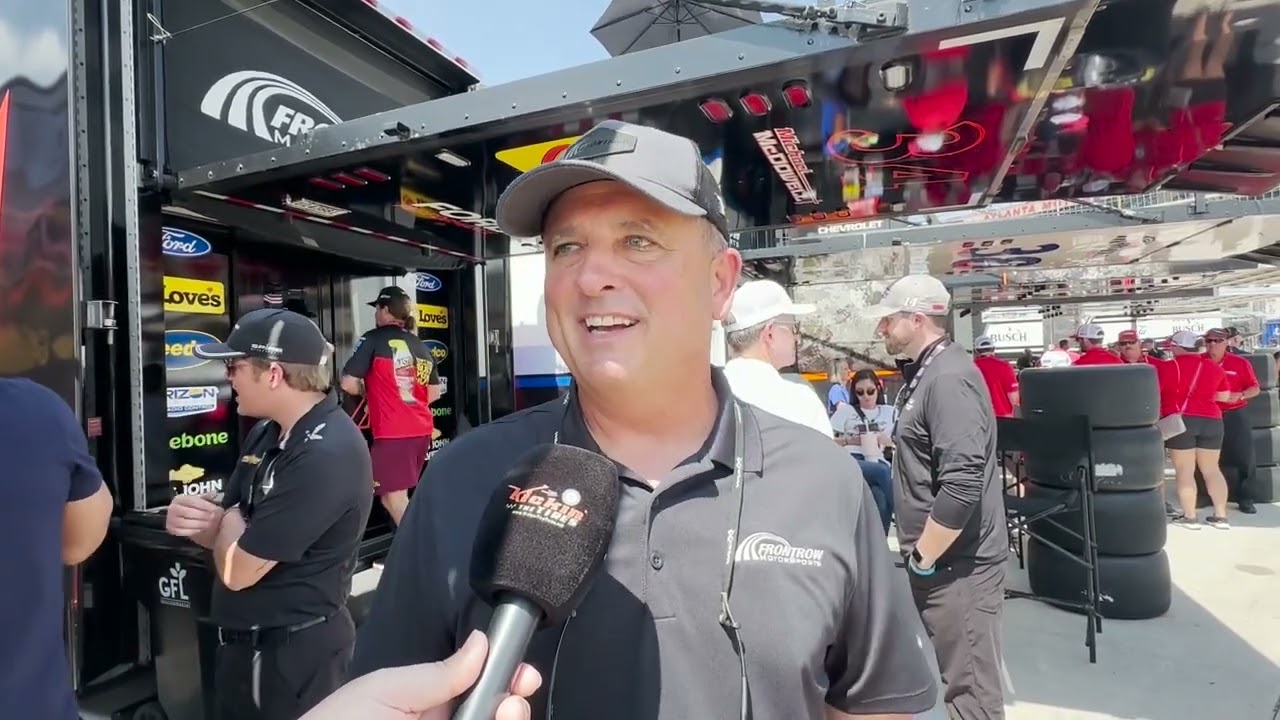
At their Charlotte sprawling motorsports campus, Bob Jenkins (pictured) pores over a ledger that might as well be written in blood. The owner of Front Row Motorsports, a scrappy three-car operation that’s punched above its weight for years, has poured over $100 million into his dream since buying the team in 2005.
–Mark Cipolloni–
But as of this week, unsealed documents from the federal antitrust lawsuit rocking NASCAR reveal the grim arithmetic: $60 million in losses since the charter system debuted in 2016, with compound deficits ballooning to $81.4 million across four seasons for one anonymous team. Jenkins, a soft-spoken real estate magnate turned racing visionary, has long voiced the frustration of mid-tier owners caught in the squeeze. “It’s not possible that I could recoup what I have spent on cars, and equipment, and people,” he said earlier this year, highlighting the insurmountable financial barriers that have pushed teams to the brink.
The lawsuit, filed in October 2024 by Jenkins’ Front Row and Michael Jordan’s 23XI Racing, isn’t just a legal salvo—it’s a financial autopsy of NASCAR’s underbelly. Set for trial on December 1 in U.S. District Court in Charlotte, the suit accuses NASCAR of monopolistic strangleholds: owning 13 of 20 Cup tracks, dictating $7.7 billion in media deals without team input, and hoarding 90% of the $1.1 billion annual TV revenue pie for itself. While NASCAR posted a tidy $103 million profit on $537 million in 2024 revenue, teams limp along on a $431 million payout pool for 2025—averaging $12 million per charter holder, or a paltry $141,000 base per race before performance bonuses.
Operating a single Cup car? Try $25-30 million annually: $400,000 per Next Gen chassis, hybrid engines pushing $1 million a pop, tire tests, and cross-country travel for 36 grueling weekends. Payouts grow a measly 3% yearly through 2031; costs? Double digits, fueled by inflation and R&D arms races.
The charter system, NASCAR’s 2016 stab at stability, was supposed to guarantee spots and revenue streams for 36 teams. Instead, it’s a gilded trap. The “Performance Plan” skews 70% of funds to points standings—36 shares for the top dog, a measly one for the backmarker—leaving mid-pack warriors like 23XI scraping by on sponsor scraps. Even winners feast unevenly: A championship nets $2.84 million from the $33.7 million points fund, but that’s chump change against the $81 million hole some teams have dug. As Denny Hamlin, co-owner of 23XI, quipped on his podcast amid the fallout, “NASCAR’s handing out participation trophies while we’re burning cash like it’s 2008.”
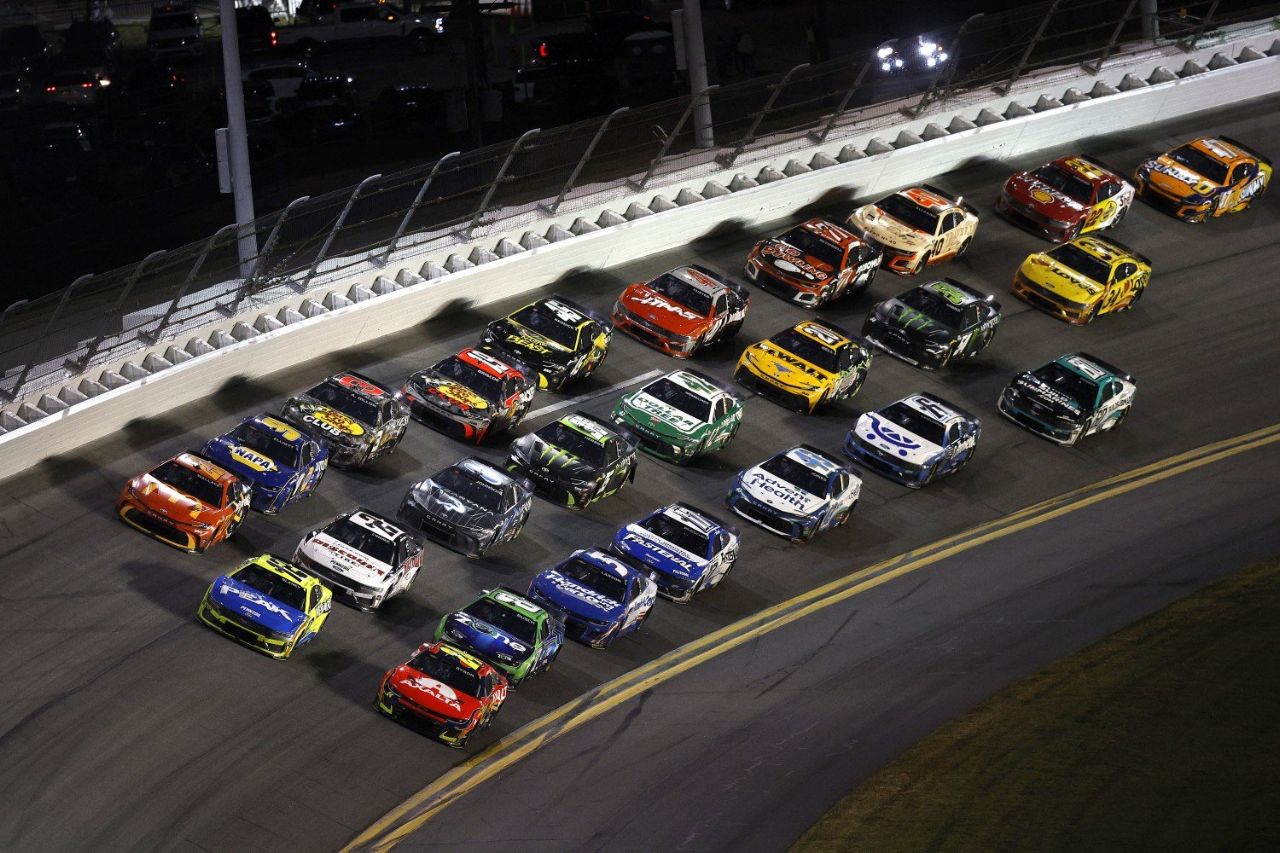
With big fields (40 cars), there are too many mouths for NASCAR to feed given the shrinking fanbase. NASCAR Cup Series Daytona 500 at Daytona International Speedway on February 16, 2025 in Daytona Beach, Florida. (Photo by Sean Gardner/Getty Images for NASCAR)
Related Article: Steve Phelps’ Bold Claims Sidestep NASCAR’s Decade-Long TV Ratings Slide
Veteran NASCAR broadcaster and former driver Kenny Wallace, never one to mince words, piled on this week, declaring that the sanctioning body had unleashed chaos by ever introducing charters in the first place. “NASCAR was ruling, and they were ruling hard,” Wallace said in a fiery video rant. “And they opened up Pandora’s Box by giving these teams what they asked for. And there’s that old saying, ‘Be careful, you give them an inch, they’ll take a mile.’
“They gave them the charter system. The rules were not in place properly at NASCAR for them to open this up and give them a charter. NASCAR had good rules in place, and then they ruined it by opening up a charter system.”
Wallace warned that the financial disclosures have only amplified the discord, with “nobody in the industry” thrilled about the current state of affairs: “When you give somebody an inch, they take a mile. Now, hopefully things will turn out for the better, but right now, this is not good. Because everybody in the industry does not like this.” He fretted that the infighting could erode the sport’s appeal, turning interpersonal beefs into barriers for growth unless a swift resolution reins in the teams without gutting the quality.
Enter the radical whisper circulating in team war rooms and garage whispers: Shrink the field. With 40 cars thundering to green each Sunday—36 charters plus four open entries—the grid is a feast-or-famine frenzy. Fewer mouths at the trough could mean fatter checks for survivors, echoing NASCAR’s own playbook when it culled the field from 43 cars in 2015 to 40 amid rising costs and sponsor droughts. Historical precedents abound: The Cup Series started with 33-35 car fields in the 1950s, ballooning to 43 by the 1970s amid the oil crisis and TV boom, only to contract as economics bit harder. Proponents argue a 32- or 35-car cap could redistribute the $431 million pool more equitably—perhaps $15-18 million per team—while slashing logistics costs by 20-25% on parts, crew, and travel.
Jenkins has been vocal about the need for a fairer system, refusing to sign the latest charter agreement alongside 23XI. “I have my own beliefs. I’m a fairly independent guy. And I think they felt similar to how I felt,” he explained.
“I did realize I couldn’t take this on on my own. So had they signed, I would have probably had to have signed, and then, just perhaps, sold my charters or got out of the sport at some point.” Front Row and 23XI’s refusal to ink the deal in 2025 slashed their guaranteed payouts but amplified their fight for reform. If victorious, the suit could mandate revenue audits or team veto power on deals, but insiders point to consolidation as a potential path forward.
As Jenkins has emphasized, “I think it’s been a concerted effort to pull back a lot of the teams’ rights as far as governance and we just feel like it was kind of repressive.” He added that the teams remain committed to growth: “We’re probably two of the more bullish teams in the garage as far as wanting to expand and buy another charter and grow. So, like, we’re passionate about it. We love the sport.”
The math tempts. A 2025 Forbes analysis of charter values—now fetching $25 million apiece, up sixfold since 2021—shows the system’s irony: Teams can’t afford to race but can’t sell out without devaluing the grid. Smaller fields could stem the “start-and-park” era’s echoes, where underfunded entries limp laps to collect purses, eroding competition. Richard Childress Racing, a charter signer, griped that a single points penalty could torch $1 million in future shares—multiply that by a leaner field, and mid-tier teams like his might break even.
But not everyone’s revving for a rollback. NASCAR Commissioner Steve Phelps, in a tense AP interview this week, dismissed the chaos as “settleable,” insisting the 2025 charters are “progress” with $1.1 billion in team pay—up from $500 million pre-2016. Shrinking fields risks backlash: Fans crave the pack-racing pandemonium, and a thinner roster could spike TV ratings woes (already down 14% this year) by muting the multi-car wrecks that juice highlights. Diversity takes a hit too—fewer spots mean fewer doors for young guns, women, and minorities like Jordan’s 23XI, which fields Bubba Wallace as NASCAR’s lone Black driver.
Team insiders at mid-tier outfits like Front Row echo the tension: A smaller field might streamline costs on paper, but it risks entrenching the Big Three—Hendrick, Gibbs, Penske—while squeezing out the scrappers in the middle. As garage chatter goes, “We’re already fighting for scraps; fewer spots just means fewer of us survive the cut.” They’ve seen Xfinity and Trucks, sans charters, hemorrhage teams to the tune of sub-$3 million weekend purses. A federal judge’s June order for 12 teams to cough up 11 years of financials—revenue, costs, net losses—lays bare the rot: Only the top half of Cup outfits turn paper profits; the rest bleed red.
As Phoenix’s championship dust settles this weekend, whispers of settlement swirl—Phelps claims talks are “our hardest push yet.” Jenkins, ever the optimist for the sport’s future, has called for a system that rewards investment: “I have been part of this racing community for 20 years and couldn’t be more proud of the Front Row Motorsports team and our success. But the time has come for change.
“We need a more competitive and fair system where teams, drivers, and sponsors can be rewarded for our collective investment by building long-term enterprise value, just like every other successful professional sports league.”
In NASCAR’s high-stakes poker game, the ante just rose—and the table might soon feel a whole lot emptier.
The NASCAR world has been hit by tragedy once again with the news that Racing America Chief Operating Officer Michael Printup has died.
He was 60.
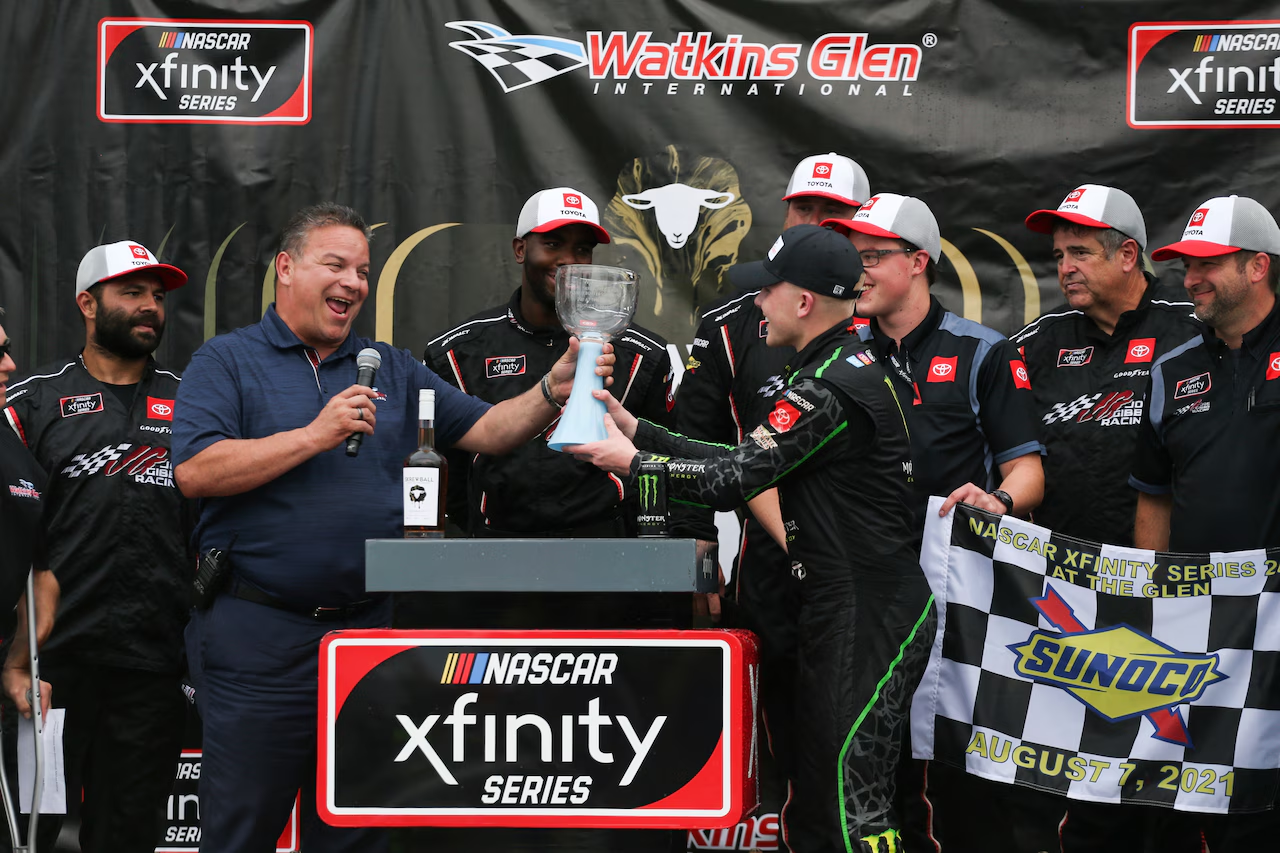
Per Racing America on SI, Printup spent 30 years working in NASCAR, including 15 as the track president at Watkins Glen International Speedway.
“Watkins Glen International is saddened by the passing for former President Michael Printup, who led the facility for 15 years,” Watkins Glen shared on X. “During his tenure, Michael played a key role in the continued growth and success of Watkins Glen International, helping to strengthen its operations, partnerships, and standing with the motorsports industry while honoring the venue’s storied history.
“Michael was a respected leader who left a lasting impact on the organization and those who worked alongside him. We extend our sincere condolences to his family, friends and colleagues.”
The Racing America account on X called Printup “a true motorsports icon and friend.”
“His passing and leadership shaped our sports and will never be forgotten,” the account added.
Printup is the fifth person with NASCAR ties to die since the start of December, joining former drivers Michael Annett, 39, Nick Joanides, 55, and Greg Biffle, 55 as well as Dennis Hamlin, 75, the father of driver Denny Hamlin.
Prior to Printup’s passing, Hamlin’s death was the most recent after he was killed in a house fire on Sunday in North Carolina. His wife, Mary Lou Hamlin, 69, has been hospitalized after sustaining burns in the tragedy.
Meanwhile, Biffle was killed along with his family and some friends when his plane crashed on Dec. 18 at the Statesville Regional Airport in North Carolina.
Biffle’s Cessna 550 was reportedly attempting to land at around 10:15 a.m. at the airport just outside of Charlotte when the crash occurred.
Biffle had a 16-year career behind the wheel in the NASCAR Cup Series, starting 515 races and winning 19. He had 175 top ten finishes.
His last race with the series came in the 2022 Geico 500 in Talladega.
Biffle also drove 244 races on the NASCAR O’Reilly Auto Parts Series. He won 20 of those and logged 149 more top 10 finishes. He also was behind the wheel for 83 NASCAR Craftsman Truck Series races, winning 17 of those with 55 top 10 finishes.
His death followed the passing of Nick Joanides on Dec. 5 and Michael Annett on Dec. 2.
Joanides, 55, was a star on the West Coast scene most recently making three starts in the ARCA West Series. He also drove in the NASCAR Xfinity Series when it was called the Nationwide Series.
Annett, 39, drove for JR Motorsports from 2017 through 2021 and the team shared the news of his death on social media.
A native of Des Moines, Iowa, Annett was behind the wheel for 106 NASCAR Cup Series races, but never managed to finish in the top 10. While his results at that level were not eye-popping, Yahoo Sports noted he drove for a pair of “underfunded teams” in Tommy Baldwin Racing and HScott Racing.
Annett had more success on the Xfinity Series where he drove in 321 races with 95 top-10 finishes. His lone win came in the 2019 NASCAR Racing Experience 300 at Daytona International Speedway.
He also drove in nine NASCAR Craftsman Truck Series races with two top-10 finishes.
ARCAposted a statement on Xabout both the deaths of Joanides and Annett that read, “We extend our deepest condolences to the family, friends and colleagues of ARCA Menards Series driver Michael Annett and ARCA Menards Series West driver Nick Joanides, both of whom passed away recently.”
CONCORD, NC, UNITED STATES, January 2, 2026 /EINPresswire.com/ — Wheelhouse Motorsports today announced a new strategic partnership with Robert Noaker Racing (RNR), uniting two leading organizations known for their development of competitive Mustang racing programs. The collaboration brings together RNR’s championship-winning expertise with Wheelhouse’s operational strength, deep technical resources, and nationally recognized driver development capabilities.
Robert Noaker Racing enters the partnership following back-to-back Team and Driver Championships in 2024 and 2025, including a flawless 2025 Mustang Challenge season in which the Noaker-prepared car led every lap of every race. Wheelhouse Motorsports will integrate this proven technical knowledge with its own established infrastructure, including its GT4 Mustang program competing in the World Racing League (WRL).
Operations will be based at the Wheelhouse Motorsports facility located on the campus of Charlotte Motor Speedway. The Wheelhouse team, including the manager, engineering staff, and technical crew, brings over 100 years of combined motorsports experience to the program. At the track, competitors will also recognize familiar faces, as the RNR crew, led by Bob Noaker, will collaborate with Wheelhouse personnel to support all Mustang Challenge efforts. “As we continue to expand Wheelhouse Motorsports, this partnership represents a significant step forward,” said Dan McKeever, owner of Wheelhouse Motorsports. “Robert Noaker Racing has demonstrated exceptional proficiency in the Mustang Dark Horse R platform, and by combining that expertise with our operational systems and our long-standing commitment to driver development, we are well-positioned to deliver a next-level experience for our customers and competitors.”
The alliance leverages Wheelhouse’s roots in operating the Ford Performance Racing School, the nation’s premier performance driving school since 2006. The organization operates owner-experience programs for Ford and offers 1-day, 2-day, and Advanced high-performance driving courses, giving clients access to top-tier coaching and continuous development. Integrating this expertise with RNR’s race-winning preparation provides a comprehensive solution for drivers seeking a pathway into professional competition.
“This partnership allows both of our organizations to do what we do best,” said Robert Noaker, owner of Robert Noaker Racing. “Wheelhouse brings unmatched operational depth, driver training, and a world-class facility. When we combine that with the experience our team has developed running and winning with the Dark Horse R, we create a program built to elevate any driver who wants to compete at a higher level.”
Through this partnership, drivers have the following opportunities: – Lease a Mustang Dark Horse R for the entire 2026 Mustang Challenge season. – Contract Wheelhouse/RNR to maintain and operate their own cars. – Compete with Wheelhouse Motorsports in the WRL series, piloting a GTO-class Mustang GT4.
Wheelhouse Motorsports and Robert Noaker Racing look forward to delivering a comprehensive, competitive, and professionally supported environment for drivers seeking championship-caliber performance in 2026 and beyond.
Bill Johnson Wheelhouse +1 910-658-1447 email us here
Legal Disclaimer:
EIN Presswire provides this news content “as is” without warranty of any kind. We do not accept any responsibility or liability for the accuracy, content, images, videos, licenses, completeness, legality, or reliability of the information contained in this article. If you have any complaints or copyright issues related to this article, kindly contact the author above.
There are a few deviations from recent years, but the local race calendar looks to be another strong one at Sebring International Raceway. As usual, much of the early action at the track will come in the form of preseason testing, some of it private team testing and other test days are sanctioned by the corresponding series.
The SSCA has a general test slated for Jan. 8, while the Trans Am Series presented by Pirelli will take over the track Jan. 21-22. IndyCar make its typical stop at Sebring on Feb. 9-10, where the cars test over the raceway’s short course.
The first event for fans will be the quick turnaround for the last major event held at Sebring, Historic Sportscar Racing’s Sebring Pistons & Props Presented by Alan Jay Automotive Network on Feb. 13-15.
The event will again feature a collection of top-notch vintage airplanes and cars for three days of action on and off the track. Tickets will go on sale shortly.
The season-opener for Sebring the past few years, the Trans Am Series, will now be the second event at SIR this season, running Feb. 26-March 1. The Trans Am races will again be run with the Sportscar Vintage Racing Association.
Trans Am will introduce the TA Sprint Championship at Sebring, a new series of five races that are 50 miles or 35 minutes. The series is designed to make it easier for club racers to make the move into a professional series.
“We couldn’t be more thrilled to announce the TA Sprint Championship”, said Trans Am President Andy Lally. “With shorter races and a limited schedule, we believe that TA Sprint will be an exciting opportunity for non-pro club racers who want to experience a professional-level event with live streaming. With TA Sprint holding its own races, it’s a great first step for those who may want to eventually step up into our TA2 Pro/Am Challenge.”
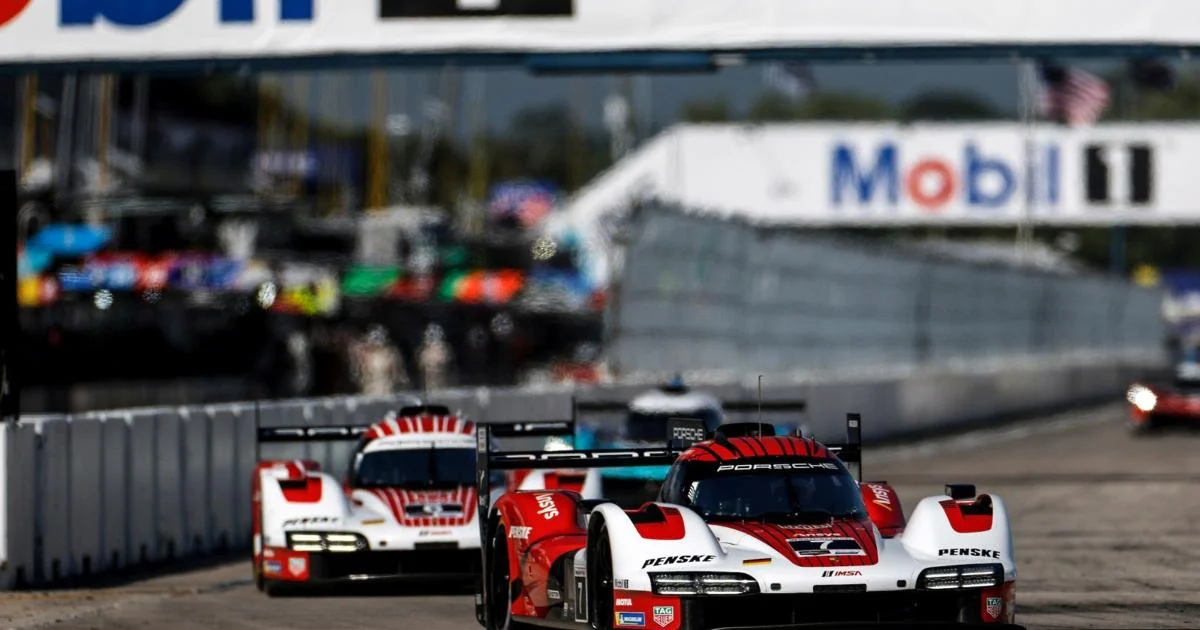
March 18-21 brings the marquee event of the year, the Mobil 1 Twelve Hours of Sebring, one of the top sportscar races in the world. There will be plenty of other racing action, with the IMSA Michelin Pilot Challenge Alan Jay Automotive Network 120, along with the Mustang Challenge, Lamborghini Super Trofeo and Porsche Carrera Cup North America races.
May 8-10 sees the return of SRO Motorsports and GT World Challenge America powered by AWS. The SRO series provide excellent GT racing and the races feature a handful of drivers who will be competing in the 12 Hours of Sebring.
There’s a bit of a lapse before the final big event of the season, the HSR Classic 12 Hour and Sebring Historics, which will feature some of the finest vintage sportscars still racing. The event is slated for Dec. 3-6. The Classic 12 Hour isn’t a 12-hour race, but rather 12 races for four different run groups, with the winner decided by cumulative time.
There will also be two appearances from the ChampCar Endurance Series, World Racing League and a number of club races, including the National Auto Sport Association Championships in September.
Chevrolet revealed its revised NASCAR Cup Series bodywork in November, shortly after Kyle Larson secured his second Cup championship at Phoenix. The updated body draws inspiration from a performance accessories package developed for the street-going version of the car. On track, the Camaro race body will now carry a taller hood dome, a reshaped front grille, and reworked rocker panels.
Chevrolet explained that those elements mirror the Carbon Performance Package Accessories Kit, which features carbon-fiber components on the hood and rockers, along with a new grille and front splitter. The changes have already sparked renewed belief inside the walls of Hendrick Motorsports.
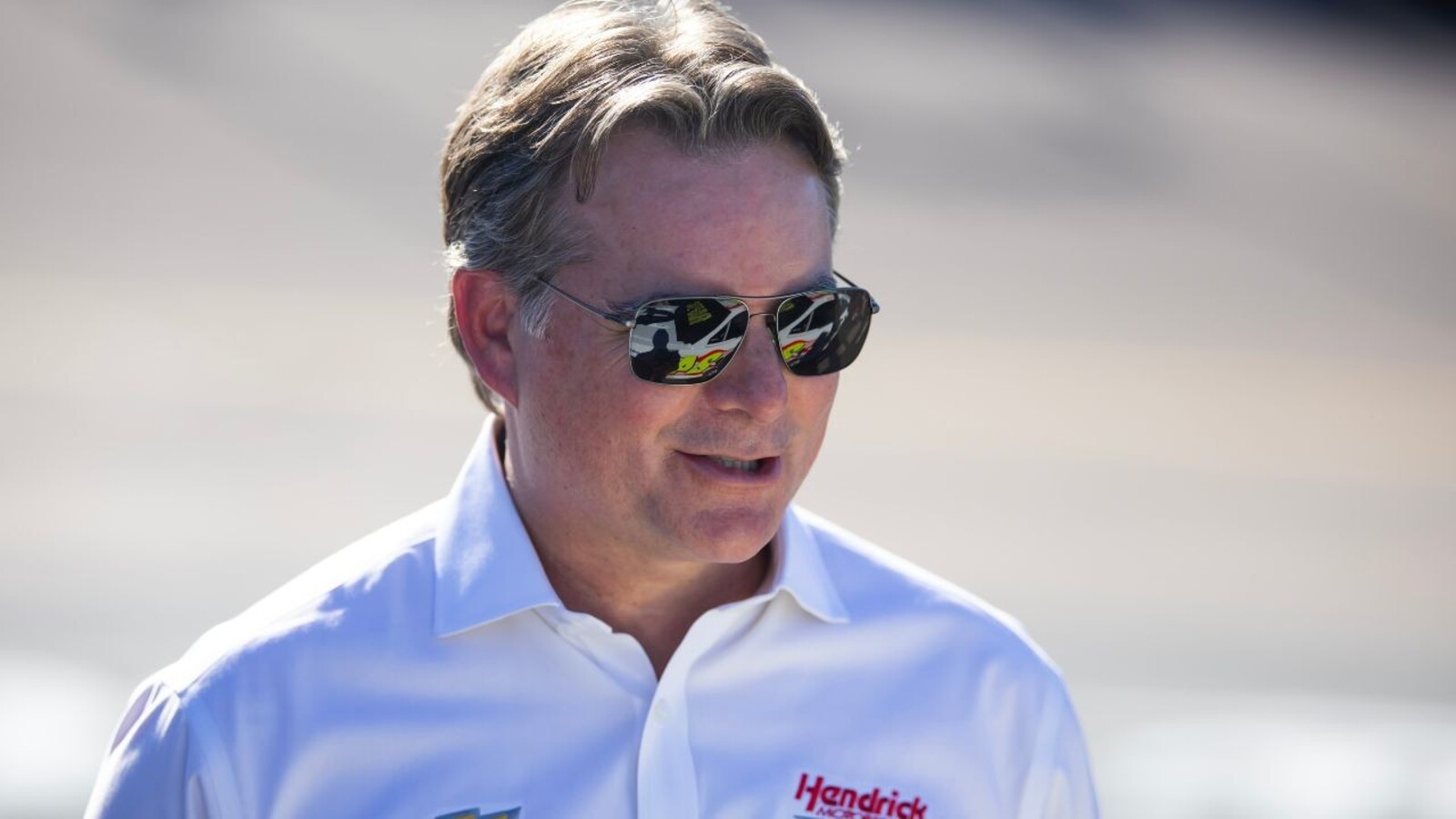
According to Jeff Gordon, the updated Chevrolet Camaro ZL1 could prove transformative when it makes its competitive debut at the season-opening Cook Out Clash exhibition at Bowman Gray Stadium. The new body underwent on-track testing in November, and the early indicators seemingly left the organization encouraged.
“When you’ve done what we’ve done with our car and our teams and one of those things is winning a lot of races and winning a championship, I get really excited when I think we’ve got something that’s an upgrade. I don’t want to get too caught up in that because sometimes, it takes time to fine-tune that change.”
Gordon acknowledged that HMS had been trailing some rivals in aerodynamic efficiency, particularly when comparing HMS Chevrolet entries to competitors. With the revised body now in hand, he believes the gap has closed. “I feel like we’ve gotten ourselves on a level playing field with them, so I’m very excited about that,”he said.
Though the visual changes appear restrained, their purpose runs deeper because the engineers designed the refinements to enhance stability and trim drag, a combination that could sharpen performance as Chevrolet aims to extend its run of five consecutive manufacturer championships. Improved airflow management should translate into greater downforce and a steadier balance at speed.
Chevrolet first introduced the Camaro ZL1 to NASCAR competition in 2018, replacing the outgoing Chevy SS. The body evolved into the Camaro ZL1 1LE in 2020, before transitioning to a Next Gen version when the platform arrived in the Cup Series two years later. On the consumer side, Chevrolet closed the chapter on the passenger-car Camaro after the 2024 model year.
Dale Jr. is skeptical about the new Chevy model
While many teams welcome the update, Dale Earnhardt Jr. finds himself split between anticipation and caution. The JR Motorsports co-owner, who plans another Daytona 500 entry in 2026, admitted the announcement unsettled him. His unease does not stem from budget or preparation but from the uncertainty that accompanies a brand-new body.
From a financial perspective, Junior views the timing as favorable, offering a chance to compete without bleeding resources. Still, the unknowns are haunting. He noted that when manufacturers roll out a new body, early returns at Daytona rarely come easily. Teams must first learn how that shape behaves in race trim, and without inside knowledge of the finer details, he said he will have to take the results as they come.
History also supports his concern. Fresh body designs often force teams into an early-season learning curve, deciphering aerodynamic traits under pressure. The task extends beyond power or mechanical grip, demanding balance where airflow and stability intersect. Manufacturers also tend to prioritize intermediate tracks when refining new bodies, a reality that explains Junior’s apprehension heading into superspeedway competition.
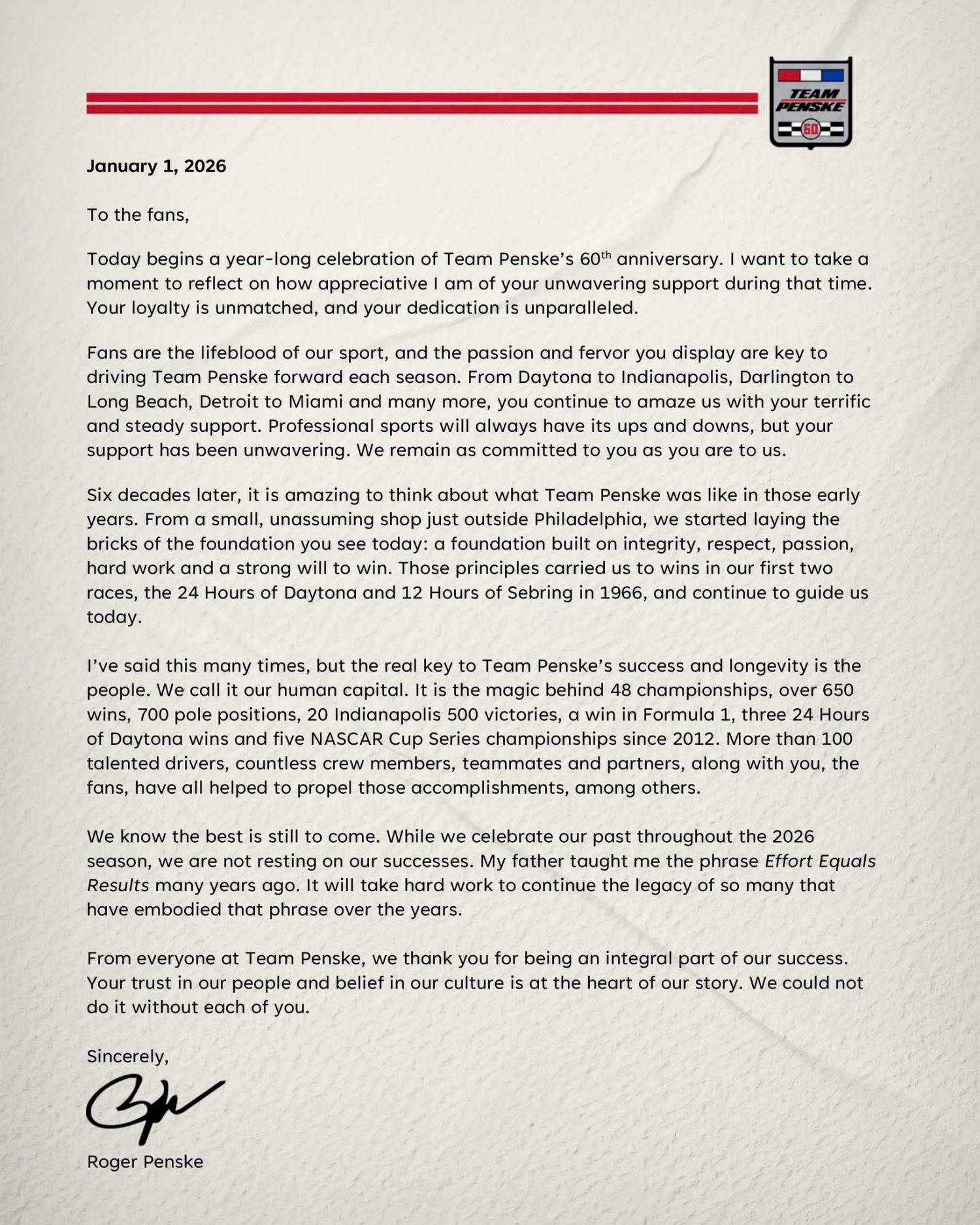
On January 1, 2026, Roger Penske, the legendary founder of one of motorsport’s most enduring empires, released a deeply personal open letter to fans, marking the start of a year-long celebration of Team Penske’s 60th anniversary.
–by Mark Cipolloni–
The letter, penned in Penske’s characteristic straightforward and grateful tone, reflects on humble beginnings, unwavering fan support, and a commitment to future success—reminding everyone why “The Captain” has built a legacy that spans generations.
What began in 1966 as a modest operation in a small shop just outside Philadelphia has evolved into a powerhouse with over 650 major race wins, more than 700 pole positions, and 48 championships across IndyCar, NASCAR, IMSA, and beyond. Penske vividly recalls those early days: victories in the team’s first two outings—the 24 Hours of Daytona and 12 Hours of Sebring—set the stage for decades of dominance, all grounded in core values of integrity, respect, passion, hard work, and an unrelenting will to win.
Yet, amid recounting milestones like 20 Indianapolis 500 triumphs, five NASCAR Cup Series titles, three Daytona 500 wins, and recent back-to-back GTP championships with Porsche Penske Motorsport, Penske reserves his warmest words for the fans. “Your loyalty is unmatched, and your dedication is unparalleled,” he writes, calling supporters the “lifeblood” of the sport whose passion fuels the team through highs and lows.
He also emphasizes the human element—”our human capital”—crediting countless drivers, crew members, partners, and fans for the organization’s longevity. A poignant nod to his father introduces the guiding mantra: “Effort Equals Results,” a principle Penske vows will drive the team forward as they honor the past without resting on it.
The 2026 season promises to be unforgettable, with celebrations including retro paint schemes across entries in multiple series, a refreshed 60th anniversary logo on cars, uniforms, and merchandise, an elevated Team Penske Hall of Fame program, and a special Fan Day offering behind-the-scenes access and driver meet-and-greets.
Highlights include dedicated exhibits showcasing historic cars, trophies, and rare artifacts at the NASCAR Hall of Fame in Charlotte, the Indianapolis Motor Speedway Museum, and the Penske Racing Museum in Scottsdale.
Iconic victories like these will be relived throughout the year.
As Penske signs off with sincere thanks, he affirms: “We know the best is still to come.” For a team that has defined excellence in American motorsport for six decades, 2026 isn’t just a milestone—it’s a launchpad for the next chapter. Fans are invited to join the journey using #Penske60.
CONCORD, NC, UNITED STATES, January 2, 2026 /EINPresswire.com/ — Wheelhouse Motorsports today announced a new strategic partnership with Robert Noaker Racing (RNR), uniting two leading organizations known for their development of competitive Mustang racing programs. The collaboration brings together RNR’s championship-winning expertise with Wheelhouse’s operational strength, deep technical resources, and nationally recognized driver development capabilities.
Robert Noaker Racing enters the partnership following back-to-back Team and Driver Championships in 2024 and 2025, including a flawless 2025 Mustang Challenge season in which the Noaker-prepared car led every lap of every race. Wheelhouse Motorsports will integrate this proven technical knowledge with its own established infrastructure, including its GT4 Mustang program competing in the World Racing League (WRL).
Operations will be based at the Wheelhouse Motorsports facility located on the campus of Charlotte Motor Speedway. The Wheelhouse team, including the manager, engineering staff, and technical crew, brings over 100 years of combined motorsports experience to the program. At the track, competitors will also recognize familiar faces, as the RNR crew, led by Bob Noaker, will collaborate with Wheelhouse personnel to support all Mustang Challenge efforts.
“As we continue to expand Wheelhouse Motorsports, this partnership represents a significant step forward,” said Dan McKeever, owner of Wheelhouse Motorsports. “Robert Noaker Racing has demonstrated exceptional proficiency in the Mustang Dark Horse R platform, and by combining that expertise with our operational systems and our long-standing commitment to driver development, we are well-positioned to deliver a next-level experience for our customers and competitors.”
The alliance leverages Wheelhouse’s roots in operating the Ford Performance Racing School, the nation’s premier performance driving school since 2006. The organization operates owner-experience programs for Ford and offers 1-day, 2-day, and Advanced high-performance driving courses, giving clients access to top-tier coaching and continuous development. Integrating this expertise with RNR’s race-winning preparation provides a comprehensive solution for drivers seeking a pathway into professional competition.
“This partnership allows both of our organizations to do what we do best,” said Robert Noaker, owner of Robert Noaker Racing. “Wheelhouse brings unmatched operational depth, driver training, and a world-class facility. When we combine that with the experience our team has developed running and winning with the Dark Horse R, we create a program built to elevate any driver who wants to compete at a higher level.”
Through this partnership, drivers have the following opportunities:
– Lease a Mustang Dark Horse R for the entire 2026 Mustang Challenge season.
– Contract Wheelhouse/RNR to maintain and operate their own cars.
– Compete with Wheelhouse Motorsports in the WRL series, piloting a GTO-class Mustang GT4.
Wheelhouse Motorsports and Robert Noaker Racing look forward to delivering a comprehensive, competitive, and professionally supported environment for drivers seeking championship-caliber performance in 2026 and beyond.
Bill Johnson Wheelhouse +1 910-658-1447 email us here
Legal Disclaimer:
EIN Presswire provides this news content “as is” without warranty of any kind. We do not accept any responsibility or liability
for the accuracy, content, images, videos, licenses, completeness, legality, or reliability of the information contained in this
article. If you have any complaints or copyright issues related to this article, kindly contact the author above.