
Rec Sports
Orangeburg selected to host 2027 Diamond Youth Baseball World Series


ORANGEBURG, S.C. (WIS) – One of the largest youth baseball tournaments in the country will soon make its way to Orangeburg.
The City of Orangeburg recently announced it was selected to host the 2027 Diamond Youth World Series. Further details, including dates for the event, were not immediately announced.
The tournament will have 72 teams. Players ranging from ages 9-12 will compete over two weekends in four divisions of play: Division I and Division II AAA Minors, Majors, and “O” Zone.
“This is a major win for Orangeburg, which overwhelmingly outbid three other municipalities to secure the tournament,” the city said in a statement. “The city previously hosted the 2024 Coach Pitch World Series, which had an estimated $1.4 million economic impact. The upcoming 2027 tournament is projected to bring three times that economic benefit, highlighting the City’s continued commitment to youth sports and community development.”
Orangeburg Mayor Michael C. Butler called the bid to host an “incredible opportunity” and said it will provide “a tremendous economic boost and opportunity to share all that our city has to offer with families from across the nation.”
“The City of Orangeburg is committed to providing a memorable tournament experience with top-notch facilities, hospitality, and entertainment for athletes and fans alike,” Bulter continued.
Feel more informed, prepared, and connected with WIS. For more free content like this, subscribe to our email newsletter, and download our apps. Have feedback that can help us improve? Click here.
WATCH US LIVE
Watch WIS live during newscasts and Soda City Living in the livestream player below. When WIS is not on the air, the player will feature Gray Media’s Local News Live.
Copyright 2025 WIS. All rights reserved.


To the editor: As a member of this island community and a supporter of Nantucket’s young people, I want to speak from both the heart and the facts about our proposed synthetic turf field.
Much of the recent conversation has focused on fear — fear of PFAS, fear of microplastics, and fear of change. Those concerns deserve to be heard and addressed. But they also deserve to be balanced by current science and an understanding of what this project truly means for our kids, our schools, and the fabric of our island community – not backdoor lobbying and fear mongering.
What the Science Shows: Earlier generations of turf fields did contain PFAS additives used to strengthen plastic fibers. However, today’s technology has changed dramatically. In March 2025, FieldTurf released independent testing results showing no detectable PFAS in new turf products using natural infills such as cork and sand — verified through EPA’s most advanced testing protocol FieldTurf, 2025. Similarly, AstroTurf announced in 2023 that all U.S. fields are now manufactured without intentionally added PFAS AstroTurf, 2023. These shifts show an industry moving toward safer, more sustainable materials.
Yes, we must remain vigilant and ensure ongoing testing. But painting all synthetic fields as environmental hazards ignores this progress and prevents honest discussion of what our students truly need.
What Our Students Need: Over 70% of Nantucket High School students participate in athletics — nearly twice the national average. That’s not just a statistic; it’s a lifeline. Organized sports are linked to lower rates of substance use and improved mental health among teens, particularly in small or geographically isolated communities like ours CDC Youth Risk Behavior Data, 2023.
Our island faces one of the lowest ages of initiation for drugs and alcohol in the country. The more opportunities we provide for safe, structured, year-round activity, the better our chances of keeping kids engaged, connected, and healthy.
A turf complex does more than withstand weather. It gives teams consistent practice time, reduces cancellations, and allows for shared spaces that promote inclusion and camaraderie. When athletes feel pride in their facilities, it spills over into school culture: better attendance, improved grades, and fewer students feeling the need to leave the island for boarding schools to pursue athletics.
The evolution of artificial turf technology has led to products that offer enhanced safety, playability, and durability, addressing many historical concerns associated with earlier generations Gosnell et al., 2022; Russo et al., 2022. These advancements include improvements in infill materials and shock pad designs, which collectively contribute to reduced impact forces and improved biomechanical responses during athletic activities Gosnell et al., 2022. This allows for more consistent playing surfaces, reducing the risk of injuries compared to natural grass fields that can degrade over time due to weather and overuse. Furthermore, artificial turf fields have demonstrated the potential to significantly increase participation opportunities in sports by providing reliable playing surfaces year-round, which is particularly beneficial in regions with challenging climates or high facility demand May & Parnell, 2018. This expanded access to sports facilities can lead to numerous positive outcomes, including improved physical health, enhanced mental well-being, and greater social cohesion within communities Logan et al., 2023. The increased usage of these surfaces can also lead to economic benefits through enhanced revenue generation from rentals and event hosting, while simultaneously reducing maintenance costs associated with natural grass fields Barnes & Watkins, 2022; May & Parnell, 2018. Beyond these tangible benefits, participation in high school athletics has been linked to improved academic performance, increased accountability, and enhanced communication skills, translating directly from the field to classroom success Selber & Selber, 2021. These comprehensive benefits underscore the strategic value of investing in high-quality athletic infrastructure to foster holistic student development and community engagement Popek, 2024. Specifically, the overall injury rates on modern artificial turf are often comparable to, and in some cases lower than, those on natural grass, particularly as design and maintenance protocols have become more standardized Gosnell et al., 2022; Jastifer et al., 2018. For instance, third-generation artificial turf has significantly improved shock absorption and player-surface interaction characteristics, addressing concerns such as injury occurrence, physiological fatigue, and biomechanics during activities like cutting, turning, and kicking Strutzenberger et al., 2020.
A Healthier Island Spirit: Athletics are community-building. Friday night lights, youth clinics, and shared victories bring us together in a way few things can. They give our young people — and all of us — something to rally around. That unity matters on Nantucket, especially at a time when our community often feels divided.
This project isn’t just about turf. It’s about belonging, opportunity, and hope. By investing in a modern, responsibly designed athletic complex, we are choosing to believe that our island’s future will be stronger when our youth are supported, active, and proud to call Nantucket home.
Sincerely,
J. Brent Tartamella

DICKINSON — Hockey in Dickinson is continuing to grow and evolve since it was established back in 1985. The sport expanded four years later with Dickinson High getting a boys and girls team. Over the past 11 years, enrollment in youth and high school programs has tripled — increasing from about 200 participants to nearly 600.
“As Dickinson has grown with the oil boom, it’s created another opportunity for kids. One thing that I think we do really well at hockey that other sports can’t compete in is we’re able to get them in the door at 3, 4, 5-years-old,” Dickinson hockey coordinator Dallas Kuntz said. “You never know if they’re going to be stellar athletes, but I feel we’re getting more of those athletes coming out and playing hockey because we’re able to target that age range to get them hooked on the game.”
The Dickinson Hockey Club, known as the Dickinson Outlaws, expanded further heading into the 2025-26 season. They added an additional bantam B team, for kids aged 13-14, to go along with its four peewee teams and five squirt teams.

Jacob Cheris / The Dickinson Press
“I think hockey, more than any other sport or activity, teaches life lessons. It’s a sport very similar to golf in the aspect that till the day you quit playing, you will not attain perfection — skating, puck skills, all that kind of stuff,” Kuntz said. “It’s a sport that you’re not going to get better at unless you truly dedicate yourself to it. I also think that it’s the best team sport.”
One program that continues to grow exponentially is the girls hockey clubs. Dickinson now fields separate 10U and 12U teams instead of one group composed of players aged 9-14.
Most players that go through these youth programs at an early age tend to have more success when they arrive at the high school level. Meanwhile, there have been a small number of individuals who are still playing hockey past high school. While the pipeline is small, Kuntz expects that pipeline to grow.
“We have a lot of kids in our youth program that we’re gonna be seeing in the next year or two. I’m really excited to see what our high school programs are gonna look like and that’s a credit to the kids that are coming up,” Kuntz said. “We have more kids today that are on the ice 12 months a year, or they’re putting the work in away from the rink. We started our summer program here three to four years ago. We got over 200 kids that are on the ice in the summer, Monday through Thursday from 8 a.m. to 3 p.m.”

Jacob Cheris / The Dickinson Press
Two of the most notable figures that are still playing are Michael McChesney, who is in his third season in the Southern Professional Hockey League with the Peoria Rivermen, and Sierra Raatz, who is in her third season of ACHA club hockey at Adrian College.
One of the foundations of the success of the Dickinson Hockey club is its Learn to Play program. This is the grassroots of young players in the area to get their feet wet and hold a stick and shoot a puck for the first time. The high school players also hop out on the ice to provide instruction and guidance.
“It’s giving those kids that introductory balance. We just want these kids buzzing around on the ice. We can teach them proper knee band, proper stride, but we just want the balance and we want them to be super aggressive,” Kuntz said. “The best hockey players that I’ve seen come through are the ones that, when you put them on the ice and they don’t know how to skate, they literally run three feet and then just wipe out.”

Jacob Cheris / The Dickinson Press
The community support is what drives the programs to build for the future. A big goal for the club is to build a third sheet of ice so more kids can have more access and reduce competition for ice time. That has been one of the biggest challenges that the Dickinson hockey community has had to face for the past few years.
“I know a lot of people don’t think it’s a top priority for us but the hockey community here in Dickinson is very strong and very big. More ice time is going to be big for us,” Kuntz said. “We want kids to keep coming out and playing. It’s challenging because they only have a half-ice for their practice. So there’s a lot of challenges but we’re ready to tackle them and just kind of adapt and overcome as we can.”

Jacob Cheris covers a variety of high school and college sports. A graduate of Penn State University’s class of 2023, with a degree in broadcast journalism, he covered Penn State Men’s Hockey for three years. Jacob also covers Big Ten Hockey for College Hockey News.
Dec. 23, 2025, 4:04 a.m. ET
- Plymouth Youth Baseball and Softball is launching a new adaptive co-ed Challenger division in April.
- The league is for children aged 7 to 12 with physical or intellectual challenges from across the South Shore.
- There is no registration fee for the league, which aims to provide an inclusive and accessible baseball experience.
There’s a new brand of baseball coming to Plymouth Youth Baseball and Softball this spring thanks in major part to the efforts of West Plymouth resident John Devito.
The PYBS will open an adaptive co-ed Challenger baseball division in April for children aged 7 to 12 with physical or intellectual challenges. Players in the league will practice once each week with a field day planned for the end of the season. The league promises to provide an inclusive and accessible baseball experience for everyone involved.

Sports are a huge part of the DNA of the DeVito family. John’s grandfather is a member of New York Coaching Hall of Fame and his brother Mike Devito played nine years in the NFL with the New York Jets and the Kansas City Chiefs before retiring in 2016.
The idea behind the Challenger baseball experience hits close to the heart of DeVito and his family.
“My wife Autumn and I are big believers in promoting athletics for children. Our sons, Vincent and Dominic, are involved in different sports in town, but our youngest son Johnny was diagnosed with autism, so he doesn’t have the same opportunities to play sports as his brothers,” explained DeVito. “I brought the idea of opening a Challenger league to town and the PYBS board was all for it. They’ve been incredible about getting this idea off the ground. We couldn’t have done this without them.”
DeVito said Steve Nearman, owner of The Great Blizzards special needs youth hockey program, was also a huge help in pointing organizers in the right direction to getting the new program off the ground in Plymouth.

A unique part of the program is that there is no registration fee. It is also open to players from all over the South Shore.
“We’ll be open to anyone who would like to be involved. It’s a very inclusive environment and we won’t turn anyone away,” said DeVito, who serves as the league’s director. “When we announced we were looking to start a Challenger program earlier this month, the response on social media was tremendous.”
Founded by the Little League organization in 1989, there are more than 35 Challenger baseball leagues operating in the state of Massachusetts at the moment. The closest leagues are in Hanover, Middleboro, and Braintree.
Coaches from the PYBS will run the weekly practices at the Nook Road baseball field. DeVito hopes to get the Plymouth North and Plymouth South baseball teams to be a part of the program, as well.
“We just did about $30,000 worth of renovations at Nook Road and the facility is looking great,” said DeVito.
For more information of the program, contact DeVito via email at challenger@Plymouthybs.org.

Ask the Ravens about Lamar Jackson and they’ll tell you he’s Rembrant. Picasso. Mozart. Einstein. Newton. This means two things. One is that he’s brilliant, the kind of comet that flies past our periphery once every 100 years. The other? No one else sees the world or the game of football quite like him. That can be both a tremendous advantage and something to work through.
That’s the thing about genius: It rarely translates from one person to another. It cannot be absorbed or passed on. It takes an infrastructure to support it and, most of the time, is so reliant on the continued stability of the genius themself. It came to mind on Sunday night, when Baltimore was effectively eliminated from the playoffs after Jackson went down with a back injury. Jackson will end up having played at most 14 games this year, though that seems like a stretch. He has played two complete seasons in the NFL, two 15-game seasons, two 12-game seasons and his rookie season when he was not a regular starter all year.
Obviously, without Jackson—at full strength and not hampered by any kind of soft tissue or lower-body injury that impacts his mobility—the Ravens lose the tailwind that comes from having a player who can regularly conjure the impossible. The offense looks pedestrian without him and, in 2025, has scored about 12 fewer points per game and swung from a 1.51 EPA per play rate to a minus-8.47 EPA per play rate. I don’t think it’s controversial to say that the team, placing a great deal of faith in its offensive personnel and coaches, overlooked the backup quarterback position this offseason. Baltimore’s inability to even partially replicate its offensive efficiency with Cooper Rush during the early portion of the season ended up costing Baltimore a playoff spot.
When taking all of this into consideration, adding in that Jackson’s mega-extension will again need to be reworked, the solution seems abundantly clear to me: The Ravens do not need to trade Jackson. They don’t need to fire John Harbaugh. But they do need to make 2026 their “Jordan Love” year and draft a worthy successor to Jackson, which would buttress the Ravens against the kind of collapse we saw this season, give the team a position of strength at the negotiating table and facilitate a situation like Green Bay enjoyed with late-Packer Aaron Rodgers, who won back-to-back MVP awards, in part, after submitting to an offense that more effectively balanced his skill set with a sensible run game. Having a young, cost-controlled backup quarterback with upside is often the ultimate revelation of character at the starting position and gives the team a multitude of options.
And it’s not out of character for the organization whatsoever. Jackson, who will turn 29 in a few weeks, was a luxury pick at the back end of the first round in 2018, with Joe Flacco having just completed his age-32 season. Baltimore had just 8–8 and then 9–7, missing the playoffs each time. While Flacco was clearly losing his effectiveness in that offense and the Ravens desired to make a hard pivot, the circumstances were quite different, yet the ethos is still the same. Being prepared and having foresight, especially at the quarterback position, is the smartest preventative measure a team can make.
This is exceedingly true when it comes to Jackson. While he has come out of his shell—or at least something closer to it—Jackson is self-represented and keeps a tight circle. Negotiations almost always become contentious. It could easily reinforce his belief that few people should be trusted. Of course this complicates everything, from getting an authentic read on what he’s feeling, parsing what is important to him and, at the most basic level, finding ways to understand football through his incredible mind.
Sign Up. SI NFL Newsletter. Get MMQB’s Free Newsletter. dark
Personality aside, it is difficult to ignore the injury factor and the ravages of time. If you remove illness and rest with a playoff spot already clinched, Jackson has appeared on an NFL injury report 17 times. Jackson also has only about 800 fewer carries than Saquon Barkley, who was drafted the same year (1,077 to 1,807). Many of those are kneeldowns in victory formation, but you can add in that Jackson has been sacked 225 times in his career and hit in the pocket 178 times. I have zero—zero—doubt that Jackson’s arm talent can help him translate seamlessly into a different phase of his career once his outlier athleticism winnows to the point where it is no longer an advantage. But Baltimore does not know what that looks like yet.
Which brings us to this year’s draft. Baltimore would have the 14th pick based on current standings, in a quarterback class that serves as the preamble to a much more anticipated 2027 group, which could mean a shorter line between the Ravens and a promising option at the position. If Jackson is healthy next season, the Ravens are going to almost certainly be boxed out from taking a top-tier quarterback in the following draft.
The Ravens, organizationally, also have the flexibility and foresight to be able to take a prospect fewer teams see value in and build an offense specific to his skill set, which is exactly what happened when the team deftly read the tea leaves of the NFL and pivoted to a multidimensional offense that set the Ravens up for another half-decade of success and competitiveness.
Obviously, it’s simplistic for any of us to say, Just do that again, but it’s imperative that the Ravens try. Because failing to do so leaves them at the fragile whim of genius, and all that entails, both good and bad. No one is saying that Jackson needs to go, but the sensible among us are saying that Jackson needs a safety net that can one day grow into his replacement on a structured rookie contract. That way if Jackson is hurt, disaffected, on his way out or simply less himself, it won’t matter nearly as much as it did Sunday.
More NFL From Sports Illustrated
Rec Sports
Police Athletic League (PAL) reports engagement numbers are down, offers youth sports programs
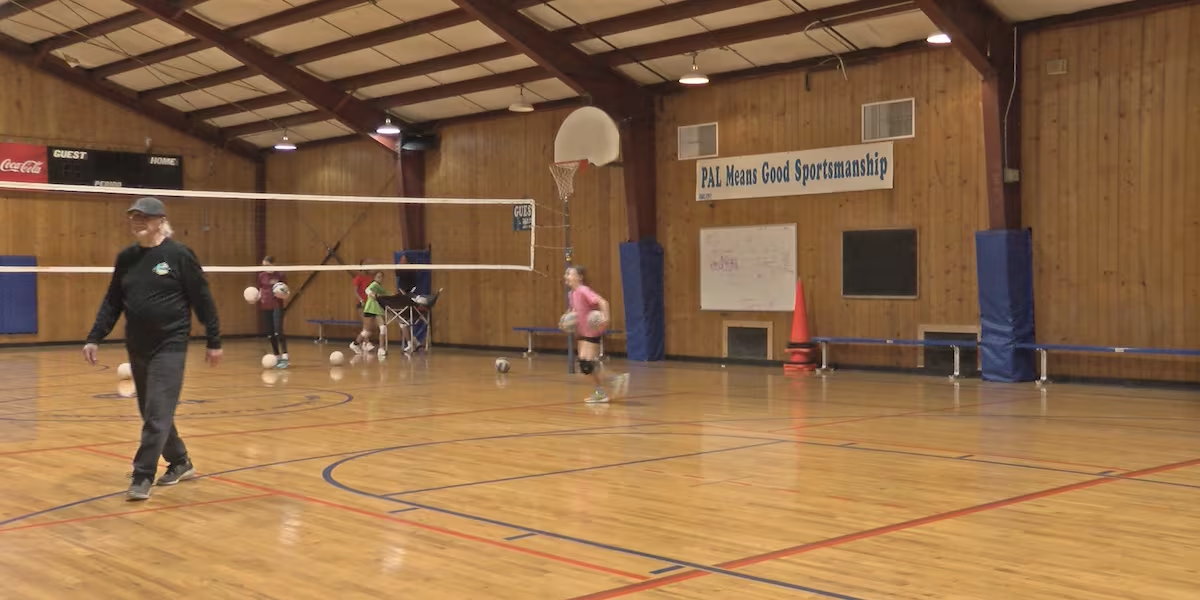
FORT WAYNE, Ind. (WPTA) – Leaders with Fort Wayne’s Police Athletic League, or PAL, say 2025 has been a difficult year for the program due to low attendance.
PAL offers youth programs in Football, Basketball, Boxing, and Girls’ Volleyball, but they say it goes beyond athletics.
”It’s more of a community. Our volunteers don’t just focus on athletics, but they get to the heart of the child, and they truly care and mentor them, and care about them as a person,” said PAL Coordinator Tristin Lichtsinn.
The program, established in 1956, “was founded with the vision of empowering the youth of Allen County. Through athletics, we aim to foster character development and create positive opportunities for young individuals in our community,” as written on their website.
Although football has long been their biggest draw, Lichtsinn says 2025 has been unusually slow due to more programs popping up in the community.
For the first time this year, they are offering a Spring football program, taking in registrations right now.
Her husband, Nicholas, is a police officer who has volunteered as a football coach for 5 years.
“I didn’t know that it would be something that I would truly enjoy. I thought it would just be exhausting. Watching the kids grow and learn, and accomplish new tasks, and watching them just mature into young men and women has been really rewarding,” he said.
The philosophy he brings into the gig is all about character development.
“I’m one of those horrible coaches who don’t really care if we win. I want the kids to truly enjoy it. I want them to grow up and really love this sport. Odds are they aren’t gonna grow up and play professionally, odds are they won’t even play college,” Lichtsinn said.
Boxing has recently become one of their biggest draws under Coach Alberto Lozada, who, in just a few weeks, already has a class of more than 40 people of all ages.
“The most important (thing is) they come here, try to do something, keep the kids out the streets, because the violence is more and more,” Lozada said.
To learn how to enroll your kids in PAL’s programs, you can visit their website and Facebook page through these links. You can also call them at (260) 432-4122.
Anyone interested in signing up to be a volunteer or mentor is encouraged to do the same.
Copyright 2025 WPTA. All rights reserved.

Our sector already delivers experiences that young people value: inclusive activities, strong role models through coaches and volunteers, and environments where young people can feel safe, welcomed and supported to be themselves.
When done well, sport and physical activity can be a powerful protective factor in helping young people thrive, not just cope.
Inequality remains a barrier
Youth Matters rightly highlights the need to halve the participation gap between disadvantaged young people and their peers when it comes to enriching activities.
This is an area where urgency is needed.
Our latest Active Lives Children and Young People survey shows that while overall activity levels are rising, stubborn inequalities remain.
Young people from the least affluent families are still the least likely to be active, and too often face barriers related to cost, access, safety and whether opportunities feel designed for ‘people like them’.
Less than half of young people say they are happy with the activities and services in their local area, and even fewer feel those opportunities reflect their needs and expectations.
Addressing this must be a priority if the ambitions of the strategy are to be realised.
Alignment with Uniting the Movement
The emphasis in Youth Matters on putting young people and communities at the heart of decisions, shifting from fragmented to collaborative working, and empowering local delivery strongly aligns with our long-term Uniting the Movement strategy.
Our Place Partnership approach is already focused on tackling inequalities, working alongside local partners and investing in long-term, community-led solutions.
Youth Matters validates this direction and reinforces the importance of sustained, place-based action rather than short-term interventions.
Our commitment
Delivering the ambitions of Youth Matters will require coordinated action across Government, sectors and communities.
Sport England is committed to playing our part: working with partners nationally and locally to ensure sport and physical activity are accessible, affordable, welcoming and shaped by young people themselves.
By listening to young people’s voices, focusing on the places facing the greatest challenges and continuing to address inequality head-on, we can help ensure this strategy delivers lasting impact over the next decade.
We look forward to continuing to work with Government, the youth sector and partners across sport and physical activity to turn this ambition into action for young people.

MEAC Announces Burgin as Bowler of the Week For Nov. 2-9

More than the game: How NIL is reshaping opportunity for Hawaiʻi athletes | Hawai’i Hustle

Volleyball Announces Addition of Reese Dunkle to Roster

Nantucket Current | Turf, Truth, And The Health of Our Island

The Breakaway: Youth hockey talk with Dallas Kuntz – The Dickinson Press

NASCAR champion Kyle Larson open to Rolex 24 return

Grading the Sherrone Moore era at Michigan

Kiki Granberry Signs with Volleyball Program

David Nguyen named head coach of North Dakota volleyball program

Springfield College Announces 2026 Athletic Hall of Fame Class

Outside hitter Eva Travis signs with Wisconsin volleyball

Missouri DE Damon Wilson II sues Georgia, setting up landmark player vs. school NIL legal battle

Kentucky Volleyball Gained New Fans in Special Season That Ends Short of a Title

Thomas Earns First ASUN Honors
Wisconsin racing in 2026 at Road America, Mile, Slinger, Outaws, more

First Tee Winter Registration is open

Fargo girl, 13, dies after collapsing during school basketball game – Grand Forks Herald

CPG Brands Like Allegra Are Betting on F1 for the First Time

F1 Las Vegas: Verstappen win, Norris and Piastri DQ tighten 2025 title fight

Sycamores unveil 2026 track and field schedule

Utah State Announces 2025-26 Indoor Track & Field Schedule

Two Pro Volleyball Leagues Serve Up Plans for Minnesota Teams

SoundGear Named Entitlement Sponsor of Spears CARS Tour Southwest Opener

Jo Shimoda Undergoes Back Surgery

Redemption Means First Pro Stock World Championship for Dallas Glenn

Texas volleyball vs Kentucky game score: Live SEC tournament updates

Bowl Projections: ESPN predicts 12-team College Football Playoff bracket, full bowl slate after Week 14

Black Bear Revises Recording Policies After Rulebook Language Surfaces via Lever

How this startup (and a KC sports icon) turned young players into card-carrying legends overnight

Robert “Bobby” Lewis Hardin, 56






-
 Motorsports2 weeks ago
SoundGear Named Entitlement Sponsor of Spears CARS Tour Southwest Opener
-
 Rec Sports3 weeks ago
Black Bear Revises Recording Policies After Rulebook Language Surfaces via Lever
-

 Motorsports2 weeks ago
Donny Schatz finds new home for 2026, inks full-time deal with CJB Motorsports – InForum
-

 Rec Sports3 weeks ago
How Donald Trump became FIFA’s ‘soccer president’ long before World Cup draw
-

 Rec Sports2 weeks ago
David Blitzer, Harris Blitzer Sports & Entertainment
-

 Motorsports2 weeks ago
JR Motorsports Confirms Death Of NASCAR Veteran Michael Annett At Age 39
-
Sports2 weeks ago
Elliot and Thuotte Highlight Men’s Indoor Track and Field Season Opener
-

 Motorsports2 weeks ago
Rick Ware Racing switching to Chevrolet for 2026
-
Sports2 weeks ago
West Fargo volleyball coach Kelsey Titus resigns after four seasons – InForum
-
 Sports2 weeks ago
#11 Volleyball Practices, Then Meets Media Prior to #2 Kentucky Match