Rec Sports
Quit Whining about Travel Sports
There has been a recent spate of articles about the growing trend of families being heavily invested in youth sports — the money, the time, the travel.
Whether you are reading Matthew Yglesias, Katherine Goldstein, Jessica Grose or the many others weighing in on the topic, the consensus is: This is a big shame! It’s killing the fun of youth sports. It’s ruining community. It makes parenting harder than it needs to be. It’s a waste of families’ time and money. And worse, it’s a big industry run by companies preying on kids’ dreams.
I have a lot of thoughts about this.
The point of this piece is not to defend travel teams as a positive development in American life. But rather to explain they are a completely rational outcome in the 21st century. And if you want to complain about it, I think you’re fundamentally misunderstanding why so many families choose to be involved in highly competitive sports, and you’re missing a chance to focus on the real problems at hand (read all the way to the conclusion for those).
Before I get going, my disclosures: My elementary school-aged sons play in local sports leagues, but not on travel teams. They have twice played in highly competitive tournaments hosted by U.S. Kids Golf. But I have spoken to a lot of people about their experiences with travel teams — from a friend who is an immigrant whose son played competitive soccer to get a scholarship to a private school, to friends and family whose kids play in travel baseball and softball.
Why people think highly competitive youth sports are bad
In his piece “High-pressure youth sports is bad for America,” Matt Yglesias writes:
The basic issue here is that everyone’s individual decisions about this stuff ends up impacting the rest of the community … If none of your kid’s friends are on some travel soccer team, then everything is fine…But … people are generally conformists. If you’re interested in soccer and your friends who are interested in soccer join the travel team, then you want to join the travel team. And soon it’s not just the top one or two players from each cohort on travel teams, it’s everyone who can afford to be…. These leagues are not part of some federal program to maximize the quality of American athletes. They are for-profit entities that are making money by charging families to play. So while entry into the leagues is somewhat selective and involves tryouts, the incentive is to avoid setting the bar too high. This is not a question of selecting the most talented 1 percent of young athletes and bringing them into elite programs, it’s about selecting an above-average kid whose parents are willing to pay.
Yglesias isn’t the only one to say that there’s a lot of peer pressure to participate in travel sports and to be frustrated by the lack of options to do otherwise. Jessica Grose, a New York Times parenting columnist, bemoans that her kid’s only recreational swim options in NYC are a highly competitive swimming team or non-competitive swim classes.
I find these two major parts of the arguments against travel teams pretty frustrating. First of all, raising kids is filled with tons of moments where you have to say, “That’s not what we do in this family,” and explain why you live differently. There’s tons of peer pressure around phones, social media, and the like, for example.
But more importantly, it’s like these folks have never considered that they might have to create the thing they want to exist! Not all of society’s goods are being created and maintained by other people! You might have to start a recreational league if that’s what you really want!
Our family belongs to a WhatsApp group of about 15 families who play “sandlot” baseball — a pick-up game essentially — on Sunday afternoons at a public park. Kids bring their gear; some parents drop off; others stay and pitch or ump; others sit on the sidelines and read or drink beer. This is relatively easy to replicate. For sports that require facilities that have to be rented, that is tougher, but also manageable if you can split the cost to rent a tennis court, or an indoor soccer field. This is also how it works for adults who play recreational sports without a paid league. It’s not that hard to figure out!
Does competitiveness or puberty kill the fun of sports?
The next main argument you’ll see is about the level of competition. On the one hand, writers seem to be arguing that these sports are just too competitive and they’re forcing kids to drop out of sports prematurely.
On the other hand, writers seem to be arguing that the teams aren’t competitive enough, they let mediocre talent participate, and so they’re misleading kids and parents because most of these kids won’t amount to much anyway.

Which is it? Apparently both.
To support the notion that it’s too competitive, Yglesias and just about everyone who writes about youth sports trots out statistics about the precipitous drop in sports participation after elementary school. Here’s Yglesias:
Pushing selective, expensive, and intense leagues younger and younger down the age pipeline undermines so much of what is valuable about sports. Project Play found that “the average child today spends less than three years playing a sport, quitting by age 11.”
The statistic I’ve seen most frequently is that 70 percent of kids stop playing organized sports by age 13.
But while there’s plenty of correlation here, where is the data showing causation?
Do kids stop playing sports because they get too competitive? Or could it possibly be that middle school brings a host of other challenges and new opportunities that compete for kids’ time and attention?
Ages 11 to 13 is also a time when many children are first experiencing puberty. Not only are their bodies rapidly changing, but their brains are completely being rewired. A kid who loved sports before puberty might not like them at all after puberty. Starting in middle school, many schools provide after school programming such as theater or band, which may be a better fit for a kid’s interests. Is that high-pressure sports leagues’ fault or just a function of a kid maturing and changing?
Puberty is also a time when many kids start to prioritize socializing over other activities to maintain friendships and achieve a kind of status in a peer group. Spending a Saturday on a sports team might not seem as fun — or as high status — as hanging out with friends. The sense of FOMO alone may be reason for kids to drop organized sports.
This is all to say that kids probably drop out of sports for a lot of reasons that have nothing to do with the fact that travel leagues exist.
If you want more kids to play sports and kids to play sports longer, worry less about criticizing competitive sports leagues than about advocating for strong sports programs at their public schools. At my kids’ public school, all the sports programs are produced ad hoc by volunteers, very modestly paid teachers, or outside sports programs that pick up from the school. The fact that most (urban) public schools don’t have budgeted sports programs should be your target, not highly competitive sports leagues.
As for wishing that playing sports would not be so competitive, this strikes me as wishful thinking. The world’s population has literally doubled in the past 50 years. It’s really competitive out there. For everyone and for everything.
Rather than say we need to pull back from competitive sports writ large, I actually think it’s important to get some exposure therapy to this highly competitive world at times. In my own family’s case, participating in those two U.S. Kids Golf tournaments was really important. Usually my kids are receiving unsolicited compliments at driving ranges, giving us all the impression they’re amazing golfers. But at those events, I stood at the driving range watching other kids in pure shock and awe. The kids were truly outstanding. My kids, for the first time in their lives, looked and felt like inconsistent amateurs by comparison.
What we saw at those tournaments, and which I think Yglesias and others are missing in using the word “competitive” is that the bar to entry for most high-level sports is not some 1 percent of talent, and it’s not (just) about money. It is full-on dedication that you simply cannot buy.
For the U.S. Kids Golf tournaments, we showed up 20 minutes early to warm up at the driving range. The kids who won played the whole course the day before, taking notes and getting prepared.
While putting in the time needed to compete in sports at a high level may seem excessive to some people, in fact it may be an early lesson about the level of dedication required to excel at something you love. Too many people go through life thinking “I could have been a contender” with no idea what it takes to truly be one.
How competitive youth sports explain America
It’s this sheer amount of time competitive sports takes up that is another cause for concern to some writers. Katherine Goldstein posits that parents being so heavily involved in their kids’ sports are draining our neighborhoods of social connection and a sense of community. She writes in her piece, “Are Kids’ Activities Stopping Parents From Finding Community”:
The stone-cold reality is that you will have difficulty investing in meaningful, fulfilling communities if your time, money, and bandwidth are mainly spent funding, coordinating, and driving to kids’ sports practices and games (or fill-in-the-blank activity).
But here’s a counter-narrative. According to data from American Enterprise Institute, college-educated parents are the “civic super heroes” of our communities, and married parents without college degrees are more likely to be civically involved than others.
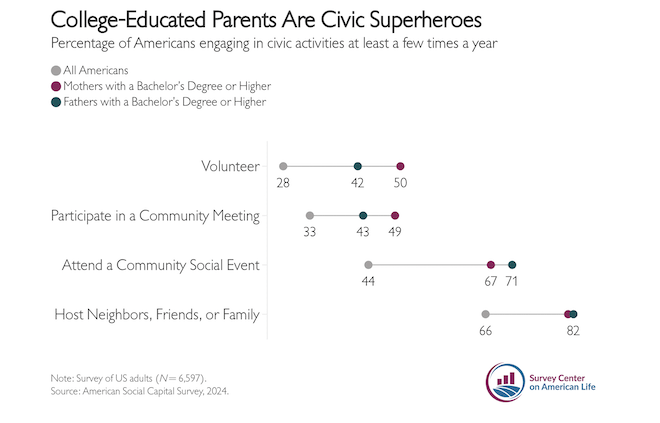

If you use Goldstein’s logic above, parents should have less time to be involved in their communities. But it turns out parents do more for their communities, because perhaps parenting makes people more efficient with their time and more concerned about their communities’ future.
I just don’t buy that parents who spend a lot of time on their kids’ sports are necessarily less involved in their communities than other parents. It’s certainly not been what I’ve witnessed in my own life. The dad who volunteered with me last week on a school project has a daughter in travel baseball, and he and his wife also organize the best block party every summer in my neighborhood. It just seems pretty possible that people who are invested in their kids’ sports are also highly invested in their communities.
Or if they’re uninvested in their communities, they’re no different than most others. Because, if 70 percent of kids drop sports by age 13, then 70 percent of high school parents should be the paragons of community investment and social connection … but where are all those community-oriented parents of older kids? We can see the counterfactual all over the place. People aren’t engaging in community for a bunch of reasons that have nothing to do with being focused on their kids’ sports.
Travel teams do amount to something
Another argument that is used all over the place to criticize travel teams is that most of these kids don’t even go on to play college sports, not to mention in professional sports leagues.
Yglesias writes:
Arguments against the intensity of youth sports come from some of the articles that have exposed the myths that many parents are sold that travel team sports will have some kind of benefit for them.
And Goldstein writes:
Roughly just 0.2 percent of high school athletes receive any amount of college scholarship for their sport.
Minor fact check: if you look at the actual publication, it actually says 2 percent of high school athletes get some amount of funding. But regardless, perhaps Goldstein doesn’t realize that college scholarships aren’t the only big money anymore.
First of all, there’s middle school and high school scholarships that many students pursue. Many of the people who I know who play on travel teams are playing with kids from working class backgrounds who see this as a legitimate pathway to improve their educational opportunities.
But if you’ve followed any of the kids who are at the top of their game, the real money is in NIL. (Name, image and likeness). I went down a kids junior golf Instagram rabbit hole for a few days after those sobering tournaments, and at the absolute minimum, kids who do well in competitions get new gear for free. But many also get sponsorship dollars for promoting gear, even in elementary school.
In other words, certainly many people aren’t going to recoup a fraction of the money invested in these sports leagues. But some do.
But beyond that, the sports industry is huge and growing. At a time when the knowledge economy seems to be on the brink of a slow extinction, investing in sports and other hobbies (as I’ve written before) makes a lot of sense. Many kids may not go on to become professional athletes, but will get a taste for and an intimate understanding of the sports industry.
Lastly, playing sports at a competitive level often correlates with corporate success. In a piece outlining his study on the sports-to-CEO connection, Jonathan Rhodes found that two-thirds of Fortune 500 CEOs played sports at a collegiate level:
Deloitte found that over 70 percent of corporate executives were former college athletes. A 2023 study showed that an astonishing 93 percent of female executives earning over $100K had sporting backgrounds. Cornell University’s research painted a similar picture: 80 percent of Fortune 500 executives and 94 percent of C-suite women were collegiate athletes.
Playing sports at a high level meant these people were capable of “commitment to excellence, the resilience that turns setbacks into comebacks, and the burning passion shaped through experience that propels individuals beyond their perceived limits.”
Sports obsession comes with the territory
I am not writing this defense of highly competitive youth sports because I am happy about the outsized influence that sports have in our world. I live in Philadelphia, perhaps the most sports-obsessed city in the country. Last year when the Eagles won the Super Bowl, a week after the School District made a bad snow day call when it had only rained, I wrote an op-ed about how we should not close down schools for the Eagles parade. Everyone I know told me not to publish it. In Philadelphia, this is how you get canceled: by saying anything negative about the Eagles.
We live in a fallen country that I believe has become more and more sports-obsessed the worse our politics, pop culture, and morale has become. And yet, I can understand why.


When I went to those U.S. Kids Golf events, I saw families that were extremely dedicated to their exceptional children. I saw a world where rules mattered and were followed with absolute precision. I saw a world where inborn talent, money and nepotism can only influence things so much. Yes, they can definitely get you in the door, but they will not keep you in the room. What matters is an ability to weather the highs and lows that come with competition.
We should be learning these lessons in experiences outside of sports. In our lives as students and professionals and family members and friends. And yet, unlike in regular life, in sports, there is no ghosting, no awkward silence, no flaking out. If you quit, you lose. In sports, there are strict schedules and codes of conduct and chants and music at a ballpark that sometimes makes you feel like you’re in a rave. It’s all almost enough to make you forget about everything that isn’t right with the world these days.
What you should focus on instead
But things are pretty bad these days. As I said at the outset of the piece, if you’re going to be mad about highly competitive sports and travel teams, I think you should set your sights higher.
And one of the things I think is really bad with our sport obsessed world is sports betting. As the Washington Post editorial board wrote last year:
The average credit score in states that legalized sports betting decreased by 0.3 percent — and by one percent, three times the average, in states that allow online sports betting … This implies that a relatively small group of intensive users — “problem gamblers” — are suffering major damage to their credit scores, dragging down the overall average … The results were larger for young men from lower-income counties in those states. Meanwhile, states that legalized sports betting saw significant increases in bankruptcy filing rates and debt collections. Debt consolidation loans went up 8 percent by dollar value, and auto loan delinquencies increased 9 percent.
Richard V Reeves from the American Institute for Boys and Men shows that it’s particularly bad for young men from low-income areas.
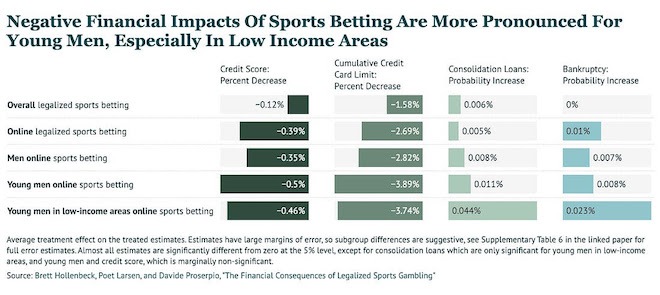

Instead of sticking it to your neighbor, advocate for more regulation on sports betting. Perhaps start in your state by reaching out to your congressperson, senator and governor about this important issue.
And there’s also the other way in which our sports obsession is hindering our cities: Professional sports organizations — the MLB, NFL, MBA, etc. — are seeking subsidies to build or renovate their stadiums. If you live in one of these cities, take a stand against this fiscal mismanagement.
Finally, and perhaps most crucially, you can get involved in making public sports programs better in your local community. In her piece complaining about the cost of youth sports, Jessica Grose gave the examples of Cambridge, Massachusetts, “which reinvigorated its rec soccer league, doubling the number of registered players from 2014 to 2022. The city invested in better uniforms and coaching … The parks and recreation department also tried to make sure that the rec leagues could use the city’s fields at preferred times, rather than travel teams getting those choice slots.”
But as Grose noted, changes like this don’t just happen. It takes “a concerted effort from parents, local governments and, hopefully, private businesses that can contribute to the cause.”
Diana Lind is a writer and urban policy specialist. This article was also published as part of her Substack newsletter, The New Urban Order. Sign up for the newsletter here.


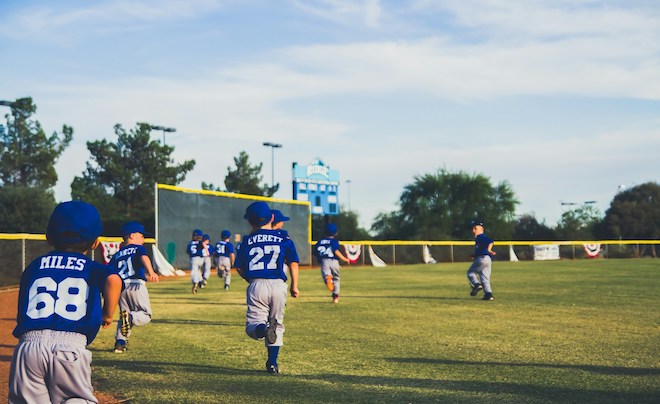
Probably not a travel team, but a photo of kids geared up for a football game by Ben Gorman for Unsplash.