














Speed attends the 40/40 Club Pop-Up during Fanatics Fest at Jacob Javitz Center on August 16, 2024 in New York City.
Arturo Holmes/Getty Images

There has been a spate of contract extensions since March, driven in part by significantly increased arbitration salaries and higher-dollar free-agent contracts.
The Mets pushed to a record $765 million this winter to land Juan Soto, while the Blue Jays stretched to a whopping $500 million this week to extend Vladimir Guerrero Jr. With those deals shaping and reflecting the market, teams realize they now need to lock up their young players earlier in order to control them longer, and more importantly, to save money in an industry where contracts go up year after year.
Advertisement
With so many deals this spring, I decided to rank 11 extensions from the club perspective — the best contracts to the riskiest ones. (Note: Every contract comes with risk and uncertainty on both sides along with its own set of variables the player and team weigh.)
Padres president of baseball operations A.J. Preller deserves high marks for the Merrill deal, which is the most club-friendly extension signed so far this spring.
Merrill, 21, finished second in the National League Rookie of the Year voting last year after slashing .292/.326/.500 with 31 doubles, six triples, 24 home runs, 90 RBIs and 16 stolen bases in 19 attempts. He went on the injured list this week with a hamstring strain after a strong start to the season.
Merrill’s nine-year extension with a club option for a 10th year takes him to age 30 or 31, when he can hit the free-agent market and land another huge deal. How much Merrill makes over this contract will depend heavily on how well he performs, as the deal is loaded with incentives and escalators that could bring the final amount to more than $200 million. However, the Padres bought out four years of arbitration and at least four years of free agency, which could lead to significant savings if Merrill continues to shine.
With Guerrero receiving $500 million and impending free-agent outfielder Kyle Tucker expected to get north of that in the offseason, imagine what deals could look like for elite talent in 2030? A billion dollars is not out of the realm of possibility. Therefore, conservatively speaking, this contract could save the Padres hundreds of millions if Merrill lives up to his potential. He belongs in the same conversation with Guerrero and Tucker in terms of overall talent, ability and potential.

Campbell has incredible bat speed and makes consistent sweet-spot contact. Last season he slashed .330/.439/.558 with 32 doubles, 20 home runs, 77 RBIs and 24 stolen bases in 115 games across three minor-league levels. That success has continued in the majors this season as he posted a 1.079 OPS in his first 11 games.
Advertisement
The Red Sox wasted no time in extending Campbell just a week into his big-league career on a club-favorable eight-year contract that could ultimately cost him tens of millions of dollars or even hundreds of millions. Somehow the Red Sox were able to get two club option years — at $19 million for 2033 and $21 million for ’34. They’ve basically secured a decade of his services at far below today’s market value — let alone what the numbers will look like years from now. Campbell will be paid at or near the top of the arbitration system numbers of the current market, but he also gave up two to four years of free agency, which is significant for a player with this type of talent.
However, from the player’s perspective, how can a 22-year-old turn down $60 million in guaranteed money when they haven’t proven anything at the major-league level and can mitigate the risk of injury or underperformance? Every contract decision is personal. A chance to take care of your family financially is tough to turn down.
I love Campbell’s hit tool, power and athleticism. He has shown a special ability to learn and adjust quickly and should be a star for years to come. He left way too much money on the table, in my opinion, but the Red Sox deserve credit for getting this deal done. Now they should work on Roman Anthony and try to extend the top prospect before he plays a single big-league game.
After Max Fried got an eight-year, $218 million contract from the Yankees and Corbin Burnes signed a six-year, $210 million deal with the Diamondbacks this past offseason, it was incredible to see the Red Sox extend Crochet with this six-year pact considering they were able to secure four of his free-agent years and team control through his age-31 season. (The deal spans the 2026-31 seasons but includes an opt-out after 2030.)
Granted, Fried and Burnes had the advantage of open-market bidding, and both had a more proven track record than Crochet, whom Boston acquired in a blockbuster trade with the White Sox in December. But in reality, when negotiating contracts, teams pay for future performance more than past results, and quite frankly, I’d take Crochet over Fried and Burnes over the next six years. Before this season, I picked Crochet to win this year’s American League Cy Young Award — that’s how much I like him.
 GO DEEPERExtension takeaways: What deals for Garrett Crochet, Cal Raleigh, others mean for the market
The Athletics did an excellent job in extending Butler, buying out all three of his arbitration years and securing two free-agent years as well as a club option for 2032. The deal could be worth up to $87.5 million based on incentives, escalators and the option year. But here’s what’s mind-blowing: In what would have been his free-agent years, Butler will be paid “only” $14 million (2030), $16 million (’31), and $20 million (’32). He projects to be a $30 million per year player by then — and that’s based on today’s prices.
Advertisement
Butler, 24, slashed .262/.317/.490 last season with 24 doubles, 22 home runs and 57 RBIs while swiping 18 bags in 18 attempts. This season, he has a 128 OPS+ entering Wednesday. He ranks in the 83rd percentile in bat speed and in the 70th percentile in barrel rate.
I never like giving pitchers who are under team control long-term extensions because of the risk of injuries or decline. These days, over any five-year period, a Tommy John surgery or another significant setback is always possible, which immediately hurts how the contract plays out for the club. But it’s worth the risk when a pitcher is young, doesn’t have a lot of innings on their arm and has a chance to be a top-of-the-rotation starter.
Bibee fits these criteria after posting 56 starts over 2023 and ’24, going 22-12 with a 3.34 ERA in that span. And the Guardians were able to secure one of his free-agent years, and potentially two with a 2030 club option, making this a club-friendly deal.
After the Bibee extension, the Diamondbacks did the same type of deal with Pfaadt. Although there should have been more separation in value between the pitchers based on their respective early career performances, Pfaadt (4.71 ERA in 32 games last season) has similar upside to Bibee. Also, with starters Zac Gallen and Merrill Kelly eligible for free agency this fall, it was important for the Diamondbacks to extend Pfaadt on an affordable contract to ensure rotation stability in the future.

The Mariners have the only major-league catcher who hit at least 30 home runs in each of the past two seasons, and despite a pedestrian career slash line of .218/.297/.442, Raleigh has finished in the top 18 in AL MVP voting the past two years. So the defense, along with the power, is what the M’s were really paying for. A Gold Glove Award winner in 2024, Raleigh, 28, ranks in the 76th percentile in framing.
The six-year contract takes him to age 34 and ensures the Mariners don’t have to worry about decline after that. The signing also allows them to use their top catching prospect, Harry Ford, as trade bait at some point as they try to improve their offense.
The highest-paid catcher in baseball history was Hall of Famer Joe Mauer, who signed an eight-year, $184 million deal in 2010; the second-highest is future Hall of Famer Buster Posey, who inked a nine-year, $167 million pact in 2013. The Phillies’ J.T. Realmuto is in the final season of a five-year, $115.5 million deal, a $23.1 million average annual value that set a record for a catcher. I understand those are old deals, and this one demonstrates how the market has changed. Raleigh’s new deal, as detailed in this piece by The Athletic’s Ken Rosenthal, covers three arbitration years and three free-agent years and includes a $20 million vesting player option that Raleigh can exercise if he appears in 100 games as a catcher in four of the six seasons. Bottom line: This is a fair market deal for both sides.
Advertisement
With this extension, the Blue Jays did what you’re supposed to do in the stock market: buy low. Kirk was coming off a disappointing season in which his on-base percentage dipped for a third consecutive season and he hit just five home runs, the fewest in a full season. He was an All-Star and Silver Slugger winner in 2022, slashing .285/.372/.415 with 14 home runs and 63 RBIs, but his performance over the past two years didn’t approach that standard.
The Blue Jays believe he can regain his past form now that he’s clearly their No. 1 catcher, but they inked him to a contract that values him more in line with his past two subpar seasons rather than the All-Star year. It’s a market deal, but Kirk has shown he has more upside. I like the gamble by the Jays at this cost point.
At first blush, I didn’t understand why Arizona wanted to sign Martinez long term after just 74 major-league relief appearances (entering this season), despite the 23-year-old’s overpowering stuff. However, looking at this contract from a club perspective, it only guarantees $18 million and secures five years plus three team options, making it a no-brainer for Arizona. (Including options and escalators, the deal could max out at $39 million.) That’s worth the risk even though relievers can come and go in a flash. There’s a good chance this contract works out well enough for the D-Backs.
Marte was the Diamondbacks’ best player last season, batting .292/.372/.560 with 23 doubles, 36 home runs and 95 RBIs. He finished third in the NL MVP voting and won his first Silver Slugger Award. He was already under contract through 2027 with a team option for 2028, taking him through his age-34 season at club-friendly numbers. However, the new deal adds $64 million and takes him through 2031. (It includes a player option in 2031 for $11.5 million.) My question for the D-Backs is, why? You had Marte signed through his prime years and now you’ve added higher-risk years on the back end of the deal? I would have waited another year or two before considering another extension for Marte, who is currently on the IL with a hamstring strain.
At the end of the day, the Blue Jays had no choice but to grossly overpay to sign Guerrero, 26, to what amounts to a lifetime contract as it includes a full no-trade clause. This $500 million deal significantly changes the market for years to come.
Yes, Soto got $765 million from the Mets, but he’s a generational talent. Yes, Shohei Ohtani got a heavily deferred $700 million from the Dodgers two offseasons ago, but he’s the best overall player on the planet and the net present value of his contract is about $460 million. Guerrero’s comparables were more along the lines of players who are paid in the $300 million to $350 million range — Rafael Devers, Corey Seager, Bryce Harper, Fernando Tatis Jr. and Manny Machado — and below the likes of Aaron Judge ($360 million) and Mookie Betts ($365 million). But with the Guerrero deal, the going rate for mid-to-late-20s star players now starts at $500 million, shifting that market by a stunning $150 million. One person who must be thrilled about this is Tucker, who is expected to get more than $500 million, with a chance at $600 million, when he reaches free agency at season’s end.
The Blue Jays could have signed Guerrero to an extension in the $300 million range two years ago, but decided to wait, and it cost them dearly. The good news is they managed to retain the face of their franchise and keep a big bat in the middle of their lineup for years to come. But the bad news is in doing so at $500 million, the club has taken on much more risk, and the marketplace is now changed forever.
 GO DEEPERThree takeaways from MLB’s wave of extensions: How Vladimir Guerrero Jr. reached $500 million
(Top image photos: Jackson Merrill: Orlando Ramirez / Getty Images; Vladimir Guerrero Jr.: Elsa / Getty Images)

In this countdown, we look back at the fastest recorded tennis serves of all time.
Service speed remains a dominant feature in the modern game and can become a player’s trump card out on the court.
With players getting stronger and cutting-edge technology in tennis racquets making leaps and bounds, serves today are faster than ever.
We take a look at the fastest serves ever recorded by men and women out on the tennis court.
Sam Groth – 263.4kph (163.7mph.)
Australian Sam Groth has the honour of having the fastest recorded tennis serve of all time.
The 6ft 4 Australian set the record during an ATP Open Challenger match in Busan, South Korea, in 2012 against Belarusian tennis player Uladzimir Ignatik.
Groths serve clocks in at a staggering 263.4kph (163.7mph).
Albano Olivetti – 257.5 kph (160mph)
Frenchman Albano Olivetti holds the record for the second-fastest serve ever recorded. The French tennis pro also remains the second person to break the 160mph serve speed barrier.
Olivetti’s serve came in 2012 at the challenger level during the Internazionali Trofeo Lame Perrel–Faip.

Albano Olivetti holds the second-fastest record serve on the tour.
John Isner – 253 kph (157.2 mph).
It would be hard not to include the American giant John Isner in this list. The 6ft 10 American is known best for his monster serves, which are delivered consistently throughout.
His monstrous serve is thanks in part to his stature. Isner clocks in as the third-tallest tennis player on the ATP behind the Croatian giant Ivo Karlovic and American young gun Reilly Opelka (both 6ft 11 inches). Ivo Karlovic currently holds the record for the fourth fastest recorded tennis serve.
Isner currently holds the third fastest serve in tennis. The Americans serve, clocking in at 253 kph (157.2 mph) during a 2016 Davis Cup tie against Bernard Tomic.
John Isner also holds the record for playing the longest match in Grand Slam history against Nicolas Mahut. During Wimbledon 2010, Isner beat Mahut in 5 sets: 6–4, 3–6, 6–7, 7–6, 70–68. The match lasted 11 hours and 5 minutes.
Isner’s serve is the fastest recorded serve in tennis, recognised by the ATP.
Georgina García Pérez – 220kph (136.7 mph)
Spaniard Georgina Garcia Perez holds the record for the fastest recorded tennis serve by a woman.
Perez clocked a serve of 200kph (136.7 mph) during the Hungarian Ladies Open in 2018.
Georgina Garcia Perez holds the record for the fastest serve by a female.
A considered calculation of stature, technique, coaching, mechanics and good old practice is said to make the perfect concoction for a fast serve.
A direct correlation has been proven between the height of a player and power during a serve. Therefore, it is no coincidence that the top servers of the game are all giants by nature.
The trajectory of a serve remains ever important. Players who are 6ft 7 or above have the ability to hit the ball with a downward trajectory, whereas those who are under that height are unable to do so.
Modern technology has also greatly aided in the incremental increase of server power over time. The changeover from wooden rackets to today’s modern racket is a huge factor in determining serve power. Advancements in string technology and racket materials also play a huge part in determining a fast serve.
Other mitigating factors include court conditions. Faster serves are much more likely to happen on a hard court and during hotter temperatures, where there is less resistance to air density, translating to faster speeds.
When you compare the fastest tennis serve with other sports, you can see how fast it is.
Fastest Football shot – 114 mph by David Hirst in 1996
Fastest Baseball pitch – 105.1 mph by Aroldis Chapman in 2010
Fastest Cricket Bowling speed – 100.2 mph by Shoaib Akhtar in 2003
The average tennis serve speed differs between both men and women, as well as between pros and amateurs. Data shows us that for professional male tennis players, the average tennis serve speed is approximately 114 mph (on their first serve) and 93 mph (on their second serve).
For women, the average tennis serve speed clocks in at 98 mph (on their first serve) and 82 mph (on their second serve).
This data was recorded between 2002-2013, so bear in mind the average speeds have likely increased by a few miles per hour in the modern era, as racquet technology and athletes continue to evolve and adapt within the sport.
Check out Wired’s video, which covers the topic more in-depth.
Fancy writing for us: Apply to become a Sports Writer at the Sporting Ferret
If you liked this article, then why not check out:


During the Philadelphia stop of IShowSpeed‘s wild Speed Does America Livestream Tour, Meek Mill made waves by gifting the content creator with a dazzling Dreamchasers chain to induct the 20-year-old streamer into his iconic collective.
As the livestream unfolded, the chain’s diamond-encrusted dreamcatcher pendant shimmered in the spotlight, marking a symbolic moment of crossover between rap royalty and internet culture.
“IShowSpeed is officially part of Dreamchasers now,” Meek announced, granting Watkins Jr.—better known as IShowSpeed—an honorary seat at the table.
Speed attends the 40/40 Club Pop-Up during Fanatics Fest at Jacob Javitz Center on August 16, 2024 in New York City.
Arturo Holmes/Getty Images
The moment quickly became a generational handoff. Meek, 38, acknowledged the rise of creators like Speed, saying, “If you under 21, we was the ones that’s out here rocking and rolling chasing dreams. We got to follow y’all now.”
When Meek recalled dropping his hit “I’ma Boss” in 2012, Speed piped in with a humble confession: “I was seven.”
Meek replied, “I got to do my just due to get back to the young bulls.” He added color to the story with a dash of Philly flair. “I just got chased by three helicopters. 13 cop cars to get here. But we here, man.”

Meek Mill at Michael Rubin’s Fanatics Super Bowl Party at The Sugar Mill on February 08, 2025 in New Orleans, Louisiana.
Christopher Polk/Variety via Getty Images
Beyond the music-world handshake, Speed’s Philadelphia adventure played out like an energetic film reel. He demolished cheesesteaks at Pat’s—no onions, American cheese—then snagged a second round with Paul George at Jim’s Steaks.
He sprinted up the Rocky Steps at the Philadelphia Museum of Art (dragging thousands of livestream viewers along for the ascent), visited the Eagles’ NovaCare Complex, chatted with Howie Roseman and Saquon Barkley, played table tennis under LOVE Park, and even tagged along with some of Philly’s “Concrete Cowboys.”

IShowSpeed attends the FIFA Club World Cup 2025 group A match between Al Ahly FC and Internacional CF Miami at Hard Rock Stadium on June 14, 2025 in Miami Gardens, Florida.
Alekandra London/Getty Images
All that—on Day 6 of a nonstop, 35-day, 24/7 streaming marathon that launched on August 28 and spans 25 states, from California to New York to Texas.
See IShowSpeed receiving his Dreamchasers chain from Meek Mill below.


There is one player on this Kentucky basketball team who has the potential to turn himself into a lottery pick this season, and that is Tulane transfer Kam Williams. Last season, as a true freshman playing for the Green Wave, Williams averaged 9.3 points, 4.5 rebounds, 1.4 steals, 1.3 assists, and 1.1 blocks per game.
In 33 games last season at Tulane, he shot 48.5% from the field and 41.2% from three. The impressive part about his percentages from beyond the arc is that he did this on 4.6 attempts per game.
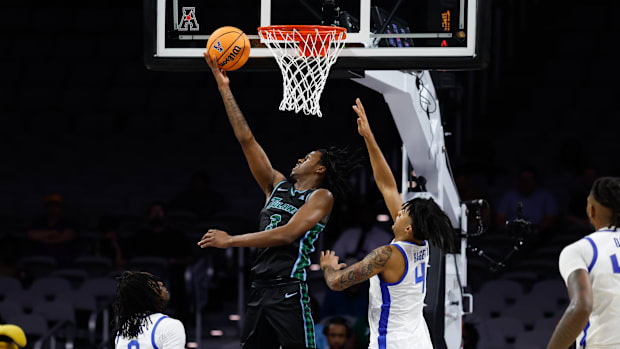
The 6’8 guard is a lights-out shooter and has the potential to be an elite three-and-D player in Mark Pope’s system. Williams talked to the media a few weeks ago, and during this interview, he discussed how he will model his game in the Pope system after what Koby Brea did last season.
If Williams can come anywhere close to Brea as a three-point shooter, this would be incredible for the Wildcats. Williams is already a mile ahead of Brea as a defender, so if he can shoot the three-ball well, he could even be an upgrade over last year’s sharpshooter.
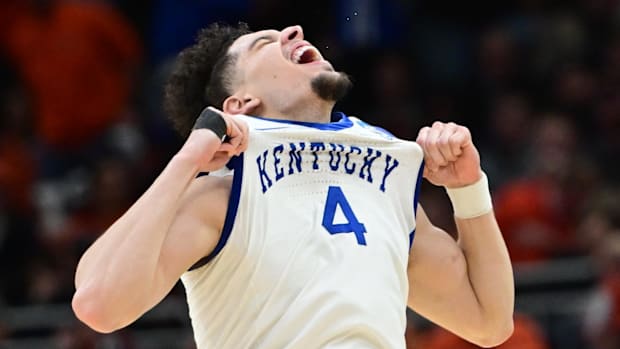
NBA scouts are falling in love with Williams, and some mock drafts even have him going in the first round before even playing a minute in Lexington.
Coach Pope has talked a lot over the last few weeks about how Williams has looked like one of the best defenders on the team. He likely will come off the bench for the Wildcats, but if he is playing at a high level, it will be hard for Coach Pope to keep him on the bench.
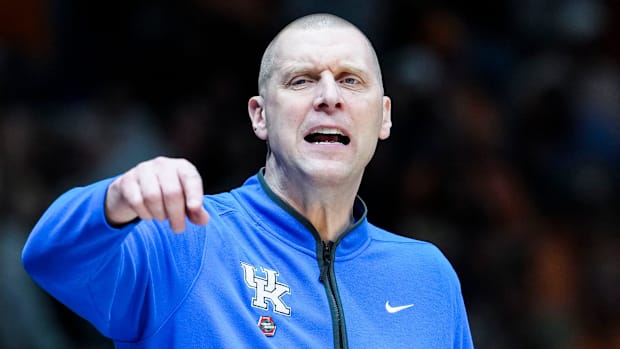
Williams, based on his personality, has the swagger to make shots in big moments like we saw last season with Otega Oweh. A team that has a roster full of players with this type of mentality will lead to a lot of wins, and that is what Pope has.
It will be a special season for Williams, where he will enter as an underrated player in college basketball and leave as a first-round pick. His style of play makes him a perfect fit for what Pope is looking for, and he is going to make a lot of big shots for a basketball team that is capable of winning a national title.
The college basketball world will soon know who Kam Williams is when he is draining shots in Rupp Arena.



The mission of “pickleball diplomacy” continues for Montgomery County Public Schools (MCPS). After students went to China in the spring, Chinese students visited Montgomery County, including a visit to Walt Whitman High School in Bethesda on Tuesday.
46 students and nine adults traveled to the U.S. from the Nanshan school district in Shenzhen, which is one of the cities in China that the MCPS pickleball delegation visited back in April. About 30 MCPS students went overseas in April for a 12-day, 3-city pickleball tour in Shanghai, Shenzhen, and Beijing.
Over Labor Day weekend into Tuesday, MCPS and Chinese students went sightseeing together in Washington, D.C. and Maryland. Earlier in the day on Tuesday, they went on a tour of the U.S. Capitol. After visiting Whitman High School, the students headed to Pike & Rose for dinner and fun at Pinstripes.
“Pickleball diplomacy” mirrors the phrase “ping-pong diplomacy,” which describes the exchange of table tennis players between the U.S. and China in the 1970s.
“And we believe that through those positive relationships we build bonds… and in one little way, build relations between our two countries,” said MCPS Systemwide Athletics Director Dr. Jeffrey Sullivan on Tuesday.


 Why a rising mid-major power with an NCAA Tournament team opted out of revenue-sharing — and advertised it
 NBA Legend Michael Jordan to Join NBC Sports as Special Contributor
 Falcons mailbag
 Portal Update – Basketball and Gymnastics Take Hits
 has always dreamed in Mercurial. Now his initials are on the boots.
The new Kyl…
has always dreamed in Mercurial. Now his initials are on the boots.
The new Kyl…
First Tee Winter Registration is open

Fargo girl, 13, dies after collapsing during school basketball game – Grand Forks Herald

CPG Brands Like Allegra Are Betting on F1 for the First Time
Volleyball Recaps – November 18

F1 Las Vegas: Verstappen win, Norris and Piastri DQ tighten 2025 title fight
Two Pro Volleyball Leagues Serve Up Plans for Minnesota Teams

Utah State Announces 2025-26 Indoor Track & Field Schedule

Sycamores unveil 2026 track and field schedule

Bowl Projections: ESPN predicts 12-team College Football Playoff bracket, full bowl slate after Week 14

Texas volleyball vs Kentucky game score: Live SEC tournament updates
