Cincinnati transfer QB Brendan Sorsby to visit Texas Tech on Friday, report says
2026 NCAA football transfer portal: Tracking moves for Texas Tech, SMU, other area schools

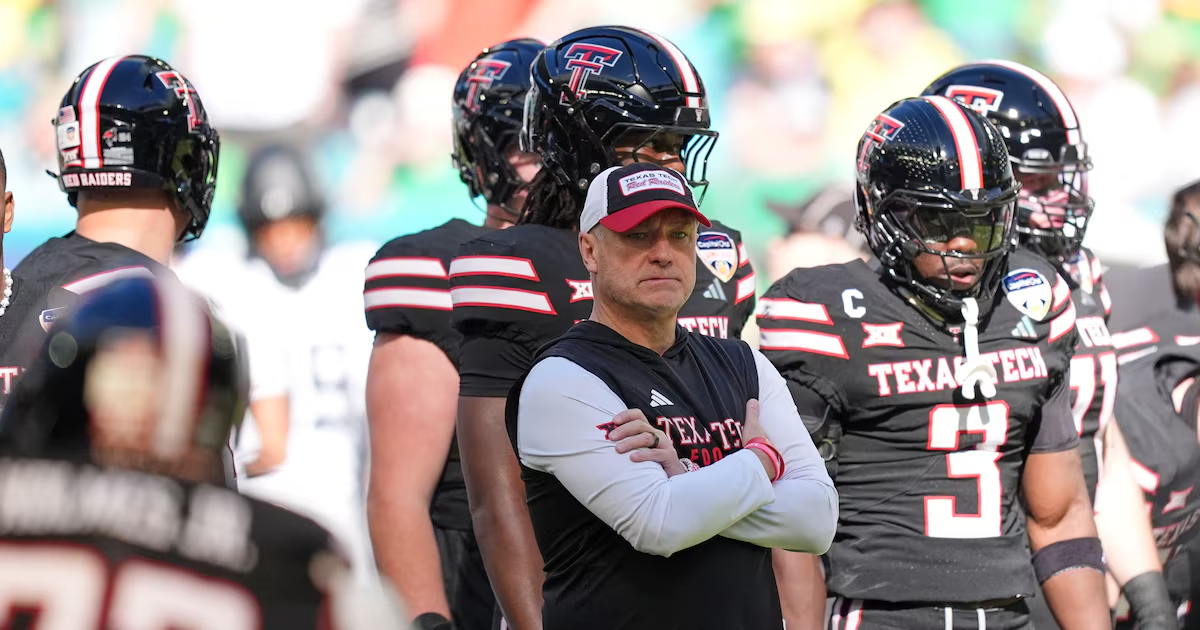
Here are five burning questions for Texas Tech football this offseason…
Texas Tech football outgrew the talent of its quarterback in one offseason. Behren Morton was a perfect fit for the Texas Tech program that existed in his four years prior, but head coach Joey McGuire’s unwavering loyalty to Morton may have cost this year’s team a shot at the national championship.
Morton will be graduating now, so the checkbooks are open for general manager James Blanchard to find a new QB1.
As of Friday, Blanchard and other Texas Tech athletes’ only public interest has been in Cincinnati quarterback Brendan Sorsby. Blanchard reposted Sorsby’s transfer portal announcement, and within an hour, 12 Texas Tech football players had commented on his post.
Sorsby is rated the No. 1 quarterback available in the portal by On3. He is regarded as a potential first-round pick if he enters the NFL draft, but the money college programs are expected to offer will surpass a rookie contract.
Other names to watch are Florida’s DJ Lagway and Arizona State’s Sam Leavitt.
Texas Tech will lose five premier starters on defense to exhausted eligibility: DT Lee Hunter, ILB Jacob Rodriguez, OLB David Bailey, OLB Romello Height and S Cole Wisniewski.
Those five made up 337 total tackles, 29 sacks and 15 forced fumbles in 2025.
Texas Tech will hit the portal to fill a handful of the upcoming defensive holes, but the Red Raiders will retain a handful of players who can step up. Rodriguez’s counterpart, linebacker Ben Roberts, is atop that list.
Between the Big 12 Championship and the Capital One Orange Bowl, Roberts had three interceptions. He also had a career-high 16 tackles in Thursday’s loss.
Roberts and budding linebacker/safety John Curry will man the interior linebacker spots in 2026 alongside at least one portal addition.
USC transfer running back Quinten Joyner tore his ACL on Aug. 18 before taking a regular season snap with Texas Tech. He had not been named the primary back, but his name was circulated in game strategy more frequently than Cameron Dickey and J’Koby Williams.
Dickey and Williams had strong freshman campaigns in their minimal snaps played, but McGuire didn’t know their full capabilities yet. So, before Joyner’s injury, he intended to run a three-headed system with no true starter.
McGuire remained content to run a 1A and 1B system with Dickey and Williams following the injury. It panned out perfectly. Dickey was a 1,000-yard rusher, and Williams thrived as a runner, receiver and kick returner.
Heading into 2025, they were all high-reward, experimental running backs, but one of the three may not be satisfied to play another season as a rotational player. None have entered the transfer portal as of Friday, but Dickey and Williams’ 2025 tape could warrant a payday and a guaranteed starter tag at multiple P4 programs.
The Micah Hudson saga has been nothing short of a rollercoaster. From becoming Texas Tech’s first five-star recruit to being used sparingly as a freshman to then transferring to Texas A&M and back to Lubbock a semester later, Hudson has yet to have his opportunity.
He reportedly struggled to grasp the playbook during his freshman season, which warranted his minimal usage. Then, when he returned to Texas Tech, the talent was too good for him to be anything more than a rotational piece.
Hudson has pledged his loyalty to McGuire and Texas Tech, so his name will be amongst the replacements for starters Caleb Douglas and Reggie Virgil. It’s reasonable to assume Texas Tech grabs one or two receivers from the portal, but Hudson is in a prime position to earn reps over the offseason.
His most recent snaps came against West Virginia in the season finale, when he had two touchdowns in the waning moments of a blowout win.
Texas Tech hung its hat on brotherhood this season. The talent was there at certain positions, but the culture McGuire built was a pillar of Texas Tech’s team-wide success.
However, Height noted in the locker room following Texas Tech’s 23-0 College Football Playoff loss that some players weren’t “locked in.”
No one was named, but there was evident frustration from defensive players with their offensive teammates. All of which is expected in the hour after a season-ending defeat, but if McGuire can’t reroute that energy into pushing for a title next season, it will hinder them.
Texas Tech is no longer the longshot team. There will be a huge shift in how team culture is established, going from the perennial middle-of-the-pack program to a place where the floor is now a playoff win.
Find more Texas Tech coverage from The Dallas Morning News here.

Tickets for the Indiana-Miami College Football Playoff national championship game are available, but they come with a hefty price tag. After Indiana’s win over…
MIAMI GARDENS, Fla.(AP) — The good news: There are tickets out there for the Indiana-Miami matchup in the College Football Playoff national championship game.
The bad news: They’ll cost you. A lot. A whole lot.
In the moments after Indiana finished rolling past Oregon on Friday to win the Peach Bowl 56-22, clinching a spot in the CFP title game on Jan. 19 against Miami — on Miami’s home field, no less — ticket prices for the matchup soared.
The cheapest tickets available entering Friday on the secondary markets were around $2,800. After Friday’s game, those in-the-door prices soared to around $3,800 — and that was for seats in the final rows of the upper deck of Hard Rock Stadium.
By Saturday afternoon, TicketData — which tracks activity across a number of sites — said the lowest get-in price was just under $3,600 per ticket, including fees.
Some seats available on sites like StubHub, TickPick and Ticketmaster were offered for more than $10,000 on Saturday. Numbers like those will fluctuate considerably in the coming days, but it’s already clear that this matchup will be a pricey one. It’s a perfect formula for wild demand: Miami playing a home game and seeking its sixth national title (albeit as the “visiting” team, technically) against an Indiana team on this stage for the first time.
“To see Miami galvanizing like it is right now, it’s awesome,” Hurricanes coach Mario Cristobal said Friday after he and his team arrived home from Thursday night’s win in the Fiesta Bowl over Mississippi. “And we need everybody in that stadium going absolutely bananas.”
Miami sold more than 500,000 tickets this season for its eight home regular-season games, the most in program history. And Indiana fans showed once again in the Peach Bowl that they’ll travel to support their Hoosiers; the stadium in Atlanta was overwhelmingly crimson, swallowing up whatever Oregon green was in the crowd.
“There’s nothing like having a home semifinal game,” Indiana coach Curt Cignetti said in the on-field celebration on Friday night. “There are no fans like Indiana Hoosier fans.”
Not everyone at the game will have to pay the big, big, big prices. Indiana and Miami both receive an allotment of tickets that they can sell — at face value — to season-ticket holders, donors, students and others.
And it appeared Saturday, based on what was showing online, that most of the early sales were for tickets on the “visitor” sideline — because that’s where Miami will be for the game. The CFP predetermined that the Fiesta Bowl winner would be the road team and the Peach Bowl winner would be the home team, meaning Indiana will be on the sideline that the Hurricanes typically occupy.
Get poll alerts and updates on the AP Top 25 throughout the season. Sign up here. AP college football: https://apnews.com/hub/ap-top-25-college-football-poll and https://apnews.com/hub/college-football
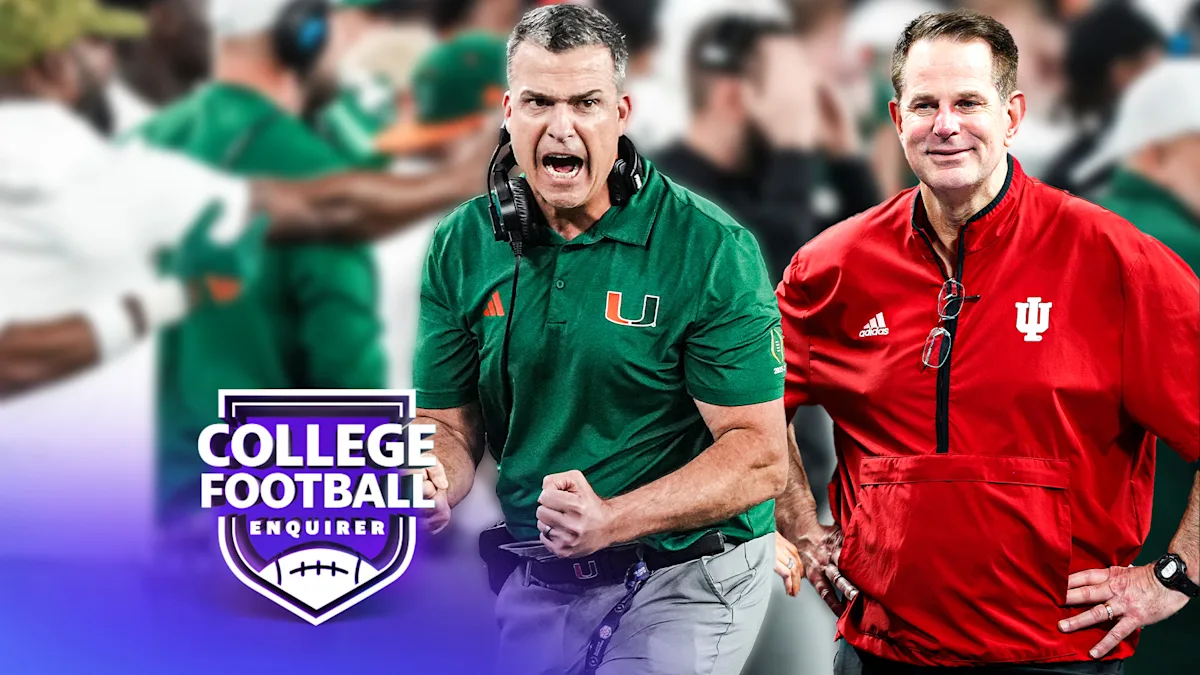
The National Championship Game is set! Andy Staples, Ross Dellenger and Steven Godfrey look ahead to the final matchup of the season by reacting to both semifinal matchups. They first talk about Indiana’s dominating performance over Oregon. Will the Hoosiers’ execution and talent win them a national title? How does Indiana stack up with the historically dominant national champions of the past? Then, they discuss the much more exciting semifinal matchup that saw Miami come out on top. How can Miami upset Indiana? What kind of advantage will playing in their home stadium create for the Hurricanes? Plus, will Oregon ever win a national championship?
Advertisement
Then, the guys look at some things happening off of the field in the college football world. After their loss to Miami, Ole Miss found out that Trinidad Chambliss’ request for another year of eligibility has been denied by the NCAA. However, this is not the end of the story as Chambliss will now sue the NCAA for damages spawning from the money he would make in NIL with that additional season. The guys discuss if Chambliss’ has a chance in this case, or if there is another motive behind the lawsuit.
Finally, the guys look at the madness of the transfer portal. First, they discuss the Demond Williams drama. After trying to enter the transfer portal, and Washington refusing to enter his name due his signed contract, Williams has now returned to the Huskies. Andy, Ross and Godfrey discuss what all happened in Seattle. Then, they look at the College Sports Commission’s investigation into how schools are writing NIL contracts. How will these contracts continue to evolve over time?
Get ready for the Natty with College Football Enquirer.
Miami and Indiana advance to Natty Photo by CFP/Getty Images Photo by Jeff Robinson/Icon Sportswire via Getty Images
(Photo by CFP/Getty Images Photo by Jeff Robinson/Icon Sportswire via Getty Images)
0:00:00 – Indiana dominates Oregon
Advertisement
14:37 – Miami advances over Ole Miss
24:51 – Will Oregon ever win a Natty?
29:46 – Trinidad Chambliss’ fight for a 6th year
40:49 – Demond Williams drama
52:12 – College Sports Commission investigation
Check out all the episodes of the College Football Enquirer and the rest of the Yahoo Sports podcast family at https://apple.co/3zEuTQj or at yahoosports.tv

Missouri finished the 2025 campaign as an interesting mix of promise and turnover under sixth-year head coach Eli Drinkwitz.
The Tigers posted an 8–4 regular-season record, going 4–4 in SEC play, and leaned heavily on a dominant run game led by sophomore running back Ahmad Hardy, who finished with 1,649 rushing yards (second most in college football) and 16 touchdowns on 256 carries (6.4 yards per carry).
However, the quarterback position quickly became a central offseason storyline when starter Beau Pribula re-entered the transfer portal.
On3’s Pete Nakos has tracked Pribula’s early January visit cycle, which included stops at Virginia Tech and Georgia Tech, followed by a visit to Washington as the Huskies navigated uncertainty surrounding Demond Williams.
On Friday, Nakos also reported that Pribula is expected to visit Tennessee, adding another SEC program to his growing list of suitors.
Pribula began his college career at Penn State, where he redshirted and served as a backup from 2022–24 before transferring to Missouri for the 2025 season.
In 2025, he completed 182 of 270 passes (67.4%) for 1,941 yards, 11 passing touchdowns, and nine interceptions across 10 games, while adding 297 rushing yards and six rushing scores on 95 carries, making him one of the more intriguing dual-threat quarterbacks available with both Big Ten and SEC experience.
That experience, paired with his production, has also made Pribula one of the more marketable players in the portal, with an NIL valuation reported in the neighborhood of $1.8 million as he navigates a crowded quarterback market this offseason.
A Central York (PA) product, Pribula was a three-star high school prospect and the No. 27 quarterback in the 2022 class per 247Sports, signing with Penn State over more than a dozen offers, including Nebraska, Northwestern, Rutgers, and Syracuse.

All four programs Pribula has been linked to make sense for different reasons.
Virginia Tech stands out as a logical reunion target, as James Franklin’s staff has been actively pursuing quarterbacks and has prior Penn State ties to Pribula, while Georgia Tech is looking to replace the expiring Haynes King era after losing depth when backup Aaron Philo transferred to Florida.
Washington, meanwhile, has hosted multiple quarterback visitors amid uncertainty surrounding Williams, as the Huskies look to stabilize the position within a program that offers Power-4 exposure and strong NIL opportunities.
At Tennessee, Josh Heupel’s offense has historically prioritized mobile playmakers, and ongoing quarterback turnover makes a veteran option like Pribula appealing, particularly with senior starter Joey Aguilar expected to move on.

Over the past few years, the SEC’s reputation has not matched its on-field results. The conference’s reign atop college football has now officially come to an end. The debate over whether the SEC is still the most dominant conference in college football is over. The SEC’s failure to place a team in the national championship game for a third consecutive year has settled it.
For nearly two decades, the SEC ruled the sport under the conference mantra “It Just Means More.” The mantra was built by the conference’s superior talent and its unmatched level of passion. Their dominance was largely driven by the perceived recruiting advantage resulting from their geographical location. Proximity to recruiting hotspots in the South has enabled programs to consistently accumulate elite talent year after year.
That advantage led to an SEC team being crowned the national champion 13 of the last 19 years. However, the SEC’s dominance has slipped away over recent years. Why? July 1, 2021. The date the back door closed and the front door opened.
The SEC’s biggest advantage was never geographical location or its mantra of just meaning more. It was the SEC acceptance of if you’re not cheating you’re not trying. The understanding within the SEC that bending and sometimes breaking the rules was acceptable allowed the SEC to thrive for two decades. What most programs in other conferences frowned upon was overlooked in the SEC.
The instituting of Name, Image and Likeness (NIL) took away the SEC’s biggest advantage. Every school could now use monetary resources to get top talent to commit to their programs. And with it, the SEC’s ability to stockpile talent evaporated.
How does the SEC dominate for two decades with no end in sight, then tumble back to reality in just three years? Simply, they lost the paid-to-play advantage. There was a belief that the SEC was using NIL before NIL was something you could use. But no one could say for sure, that is, until former LSU coach Ed Orgeron let the cat out of the bag.
More Sports News
On an appearance of “Bussin’ With the Boys,” Taylor Lewan got the dirt from Orgeron.
“We all know that the SEC was NIL before NIL,” Lewan said. “We’re way past it. Can we now just admit it?”
“They say, ‘Hey, coach. You know, you’ve been out of coaching for a while. How are you going to adjust to NIL?’” Orgeron said. “‘Well, it’s a minor adjustment.’ They said, ‘What do you mean?’ I said, ‘Back then, we used to walk through the back door with the cash. Now, we just got to walk through the front door with the cash.’”
You can’t assume that every team was using the back door for recruiting. However, what else in the last four-and-a-half years could have changed the hierarchy of college football?
There is no arguing that the SEC is the deepest conference in college football. But it’s not about being deep when arguing which conference is the best. To be considered the best, it’s putting trophies in the trophy case and playing for national championships. Something the SEC has not done in three years after Ole Miss was eliminated from the College Football Playoff. The only thing that matters is which teams are in the CFP.
Using meaningless losses in bowl games as a talking point that really has little to no impact on being the best conference. Bowl games are nothing more than spring games against other teams. Most teams bear little resemblance to what they were during the regular season. What really matters is how teams perform in the College Football Playoff against programs with equal or superior talent.
In the first nine years of the CFP, the SEC failed to have at least one team in the final. This year’s national championship will be the third straight year the SEC has failed to have a team advance to the final. The Big Ten, on the other hand, has had and will have a team playing in all three. The Big Ten has also won the last two national championships.
The SEC plays semantics in its effort to stay atop of college football. But the “best” means producing elite national championship contenders capable of winning it all and actually doing it. Something the Big Ten has accomplished each of the last two years, Michigan two years ago, Ohio State last season, and now Indiana has a chance to make it three straight for the Big Ten. The SEC is the deepest conference, considering five teams reached the College Football Playoff. What the SEC failed to do was to create a truly elite team that made it.
Moving forward, being a blue blood no longer matters. The only thing that matters now is being a “Green Blood.” A university with ultra-rich alumni willing to invest, with the only reward being wins. The days of “Bob’s Used Cars” putting cash in fast food bags are gone. Now it’s about billionaires and multi-millionaires like Mark Cuban or Nike founder Phil Knight handing over seven-figure checks, and there’s no conference with more than the Big Ten.
And if no rules exist, it is only a matter of time before the Big Ten becomes the deepest conference as well.
College football’s transfer portal season has taken some odd twists and turns this year. Now it’s entering … tax season?
In one of the latest oddities, schools in certain states began trading “no state income tax” social media posts as a way to entice players in the portal. Currently, nine states don’t levy income taxes: Alaska, Florida, Nevada, New Hampshire, South Dakota, Tennessee, Texas, Washington and Wyoming.
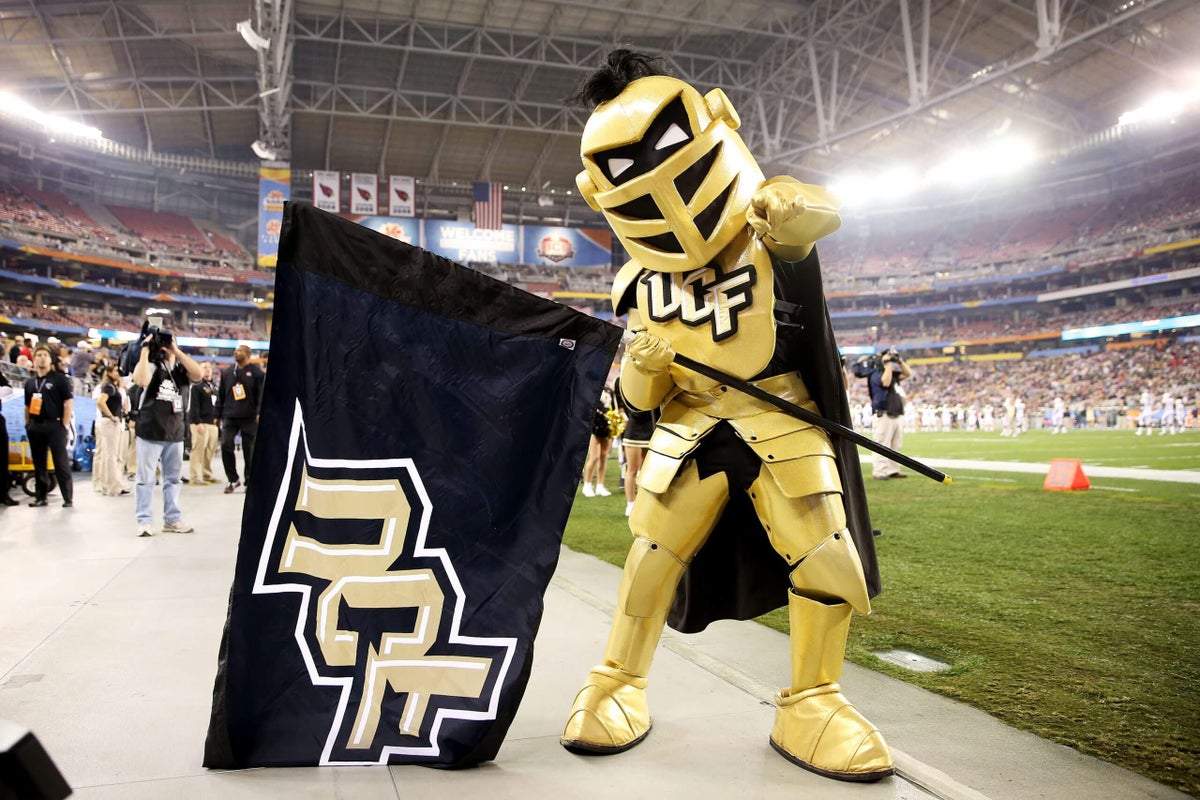
The Houston Cougars, UNLV Rebels and UCF Knights — all universities within one of those nine states — posted about their lack of state income taxes on X on Saturday, featuring an image of either a mascot or cheerleader lifting a comically large bag of cash above their heads.
UCF started the movement with a post on Saturday morning featuring its mascot, Knightro. Houston and UNLV soon followed suit, as did the UTEP Miners, FIU Panthers and North Texas Mean Green.
🤝 https://t.co/rqQdM0cpCQ pic.twitter.com/OgtMjGVhdx
— Houston Football (@UHCougarFB) January 10, 2026
How effective will that pitch be? UCF, Houston and UNLV were all outside the top 40 of 247Sports’ portal rankings as of Saturday night, so any little bit helps. Central Florida was the highest at No. 47 in the 247Sports rankings, followed by Houston at No. 49 and UNLV at No. 86. Texas Tech, Texas A&M and Houston were all in the top 10 of On3’s portal rankings.
College athletes are not only taxed on their NIL earnings, but also on anything they receive of value. If an athlete receives a new car, for example, they have to pay taxes on it in accordance with its value.
Arkansas has tweaked its tax code so that NIL income is tax-exempt as an incentive to induce athletes to sign at the University of Arkansas or other in-state schools.
There was no indication that income taxes were the reason behind another buzzy portal storyline earlier this week: Quarterback Demond Williams changing his mind about entering the portal and deciding to stay with the Washington Huskies. On Tuesday, Williams announced he was entering the portal — four days after signing with the Huskies, a Washington source close to the negotiations told The Athletic’s Bruce Feldman. On Thursday, he said he was “excited to announce that I will continue my football journey at the University of Washington.”
The Huskies were prepared to pursue legal action against Williams to enforce the contract, a source briefed on the situation told Feldman. Williams could have owed the school up to $4 million for transferring, according to Big Ten rules that state that if a player intends to transfer before the end of a payment period, he owes the remaining amount on his contract, unless the school agrees to accept a buyout from the player or the player’s next school.
Williams and his team ultimately decided to stay in Seattle — where he won’t have to pay state income taxes.

Boston College finished the 2025 season 2–10 (1–7 ACC) in what was a down year for the program under former NFL head coach Bill O’Brien.
The Eagles had gone 7–6 in back-to-back seasons, including O’Brien’s first year in 2024 after arriving from Ohio State, where he served as the Buckeyes’ offensive coordinator and quarterbacks coach.
However, the 2025 campaign marked Boston College’s worst season since 2012.
Despite the disappointing results, athletic director Blake James announced that Boston College will retain O’Brien for a third season and increase its financial investment in the football program ahead of 2026.
Still, with both the offense and defense struggling to produce consistent results throughout the year, a wave of players elected to seek new opportunities via the transfer portal, including redshirt-junior wide receiver Ismael Zamor, who announced his decision to enter the portal on January 6.
Zamor, listed at 6-foot, 193 pounds, enrolled at Boston College in 2022 out of Everett (Mass.) High School, where he was rated a three-star prospect and the No. 129 wide receiver nationally in the 247Sports Composite rankings.
He chose the Eagles over nearly a dozen other scholarship offers, including Michigan, Syracuse, Temple, Buffalo, and UMass.
Despite being viewed as an intriguing developmental prospect coming out of high school, Zamor primarily contributed on special teams during his time at Boston College, appearing in limited games and failing to record a reception across four seasons with the program.
He now enters the transfer portal as a redshirt junior.
Aside from Zamor, who saw limited action during his time in Chestnut Hill, Boston College has now seen 29 players depart via the transfer portal, including several notable contributors.
That group includes wide receiver Reed Harris (committed to Arizona State), running back Turbo Richard (committed to Indiana), tight end Ty Lockwood (committed to Arkansas), tight end Stevie Amar Jr. (committed to UCLA), and safety Omarion Davis (committed to Penn State), among others.
Richard was the Eagles’ leading rusher in 2025, totaling 749 rushing yards and nine touchdowns on 145 carries (5.2 yards per carry), while also adding 213 receiving yards and two receiving scores.
Harris, meanwhile, finished as the team’s second-leading receiver, recording 673 yards and a team-high five touchdowns on 39 receptions (17.3 yards per catch).

This level of turnover following a 2–10 season is significant for two primary reasons.
First, it strips Boston College of experienced contributors across multiple position groups, most notably at the skill positions, tight end, and throughout portions of the defensive front seven and secondary.
Second, it signals a program reset of sorts, as more than two dozen players are effectively voting with their feet in search of better fits, greater stability, or clearer paths to playing time.


Badgers news: Wisconsin lands 2nd commitment from transfer portal

Five Youth Sports Trends We’re Watching in 2026

Kentucky VB adds an All-American honorable mention, loses Brooke Bultema to portal


Dr. Patrick Staropoli Lands Full-Time O’Reilly Ride with Big Machine Racing
Fifty years after IU’s undefeated champs … a Rose Bowl


BangShift.com IHRA Acquires Historic Memphis Motorsports Park In Millington Tennessee. Big Race Weekend’s Planned For 2026!

2025 Volleyball Player of the Year: Witherow makes big impact on Central program | Nvdaily

H.S. INDOOR TRACK & FIELD: GLOW region athletes face off at Nazareth University | Sports

Colorado volleyball poised to repeat success


Texas A&M volleyball’s sweep of Kentucky attracts record viewership