
NIL
Sports Business



The headline on CBS Sports website told a depressing story, one that poisons our love of collegiate athletics — “Women’s College World Series 2025: Texas Tech’s historic NIL investment leads to program’s first appearance.” The subhead is even worse. “NiJaree Canady became the first softball player to net a $1 million NIL deal; now, she’s leading the Red Raiders to history.”
Like most of you I hate the “Wild West” we have been relegated to until the adults in the room – athletic directors, commissioners, lawyers, judges and politicians – can agree to set fence lines with the student-athletes. And the longer it takes to get ‘em strung, the more fans collegiate athletics will lose.
These kinds of stories, while true, make me angry because they are dominating the narrative of collegiate athletics. But can two things be true at the same time?
I’ve devoted the better part of my life to college athletics and frankly, the same way you’ve considered giving up your season tickets, I’ve considered pulling the plug on this old keyboard. But that was before I walked into the Friday post-game press conference, where the losing team was understandably emotional after the loss.
But it was as if someone attached me to the business end of a defibrillator as my heart started to beat for college athletics again.
On the same day we saw how money ball can change the destiny of a program with the hiring of a coach and a generational arm talent, FSU catcher Micheala Edenfield and head coach Lonni Alameda’s five-minute post-game conversation reminded us of what we have loved about college athletics, and what makes it so fundamentally different from professional sports.
The patient may be on life support, but as you listened to the interaction between Edenfield, herself an NIL recipient, and Alameda, who is battling cancer, you feel hearts beating, theirs and yours.
“While I was catching, I was looking around, trying to soak in all my surroundings at the Plex, trying to recognize the changes that happened during my time here, the new scoreboard, the speaker system, the plaque with all the All-American pieces behind home plate, taking a look at my family and really soaking that part in,” Edenfield said. “I really couldn’t have asked for anything more than for the team to be present on defense at that point.”
Down 2-0 in the top of the final inning, with a runner on first and no outs, Edenfield came to the plate to face the “Million Dollar Arm” with a chance to extend the series to game three.
“I was still very, very, emotional. It was tough; the acceptance piece,” Edenfield recalled. “I think I was 0-2 and I was breathing some of the biggest breaths of my life. And I told myself the work has been done. You just have to trust it.”
She delivered a double. Runners on second and third. No outs. The crowd was on their feet as a base hit would tie the game against the dominating Canady.
Edenfield gave credit to the mentorship of her college coach for the peace she felt at the plate with her team’s season on the line.
“She told me this past week, ‘It has all been written. It’s just a matter of trusting our process and what that looks like. Control the ‘feelings’ part and come out with the facts,’ ” Edenfield said of the softball coach’s hardball life lesson.
Yes, there were questions about softball but it was the conversations in between those questions that remind us of why college sports, played by 17- to 22-year olds, is foundationally different than adult pro leagues.
“What did this team mean for you?” a reporter asked Alameda, who paused to gather herself before answering what was a question she answered from the heart.
“You talk about adversity,” she began, choking back tears. “It has definitely meant a lot. For me personally, it has been my rock (during cancer treatment). “(I) could come here for four or five hours and not have to think about what is going on.
“(The team) are so good about having love. ‘How you doing?’ Check in. And go from there. So it’s been cool, you know? It’s been part of my process — going every week — and now I’m going to have to call someone for that process to help me out. Yeah, it’s been a lot. It’s been emotional a lot. We’ll see how we move forward. I have a couple more infusions to go.”
Alameda had more to say about the life lessons they experienced together.
“It’s crazy. We talked about adversity in the beginning, not knowing this was going to happen,” she said. “We’ve had so many things hit us left, right and center, and we bounce back. I would just allude to what Michaela said, we’ve been a really tight group, so we’ve been able to handle any kind of adversity. And when I introduced the word adversity, I knew we would be travelling a lot, so the girls would be tired because we would be in a lot of different time zones. I had no idea Kennedy (Harp) would go down, we’d have a (campus) shooting, we would have cancer… I just had no idea all those other things would be coming, and they’ve handled it with great grace and pride and love and I’m just thankful for my situation in particular, too.”
The next question went to Edenfield who had been crying through Alameda’s answer.
“Oh God,” she said, between a sob and a laugh. “I can’t even look over (at Alameda).”
And then she spoke of what I believe is the reason collegiate athletics is so worth fighting for, and that is the personal development that occurs when a program does it right.
“She truly represents what she speaks of,” Edenfield said of her coach and life mentor. “You’ve got to think (about) 17- and 18-year-old girls deciding to commit to Florida State and you think about the word family. A lot of programs talk about family. I always said the reason I came to Florida State was because family was felt, not spoken. And it speaks volumes top down.”
Now looking directly at Coach Alameda, Edenfield said, “She would probably take the selfless route here, but this place would not be anywhere how it is without her. And I hope you know that.”
In athletics we talked about the collegiate years, from 17 to 22, being the most formative of a student-athlete’s life, where everyone in the building and in the community has an impact on the student-athlete, by their walk as much as their talk.
“I can’t tell you how many times life isn’t perfect and for someone to recognize that from a people perspective and from a softball perspective is so special here,” Edenfield said of Alameda, “because it’s about growing the game but it’s also about growing better people at the same time. I’ve just been so grateful for all five years I’ve spent here, not only to become a better softball player than I ever thought I would be but to leave here a better person, to leave here feeling I’m ready for the real world. For all the girls going through committing and deciding where to go, it speaks volumes when family is felt and not told.”
That short five-minute segment brought tears to my eyes and a smile to my face because it reminded me, and I suggest it should remind us all, that even though Edenfield received NIL compensation from FSU, she also earned a degree and it is abundantly clear she is grateful for the rich developmental experience, which again remains the essence of collegiate athletics even in this NIL era.
Not just women’s sports
I know what you are thinking, the cynic in you says FSU’s women’s programs are awesome and have always been about more than just money. And that may be a fair point as a stereotype. Yes, many women do express their feelings better than most men, including gratitude, but I have the benefit of being exposed to enough male athletes who are also earning degrees and are grateful for their collegiate experience, even if they don’t express it as eloquently as Edenfield.
In fact, FSU Athletics set a record for highest GPA on its football team and across all 18 sports, each of which averaged a 3.0 or better GPA. So obviously not every athlete is attending FSU just to collect their NIL paycheck.
Can we find just a little balance in the narrative we choose to write and talk about?
That CBS headline, while true, is one of many that are fueling a not-completely-accurate narrative that is eroding fan support for collegiate athletics. Those of us who love the game and can still see it’s redeeming value, need to balance the narrative by telling the tradional collegiate stories when we see them.
As I write this, the network ran a long, pre-game feature on FSU star pitcher Jamie Arnold who has raised over $11,000 thus far for a young fan, Bradley, who suffers from Cystic Fibrosis. Arnold is donating $25 per strikeout this season and encourages others to help his friend too.
For more information and to donate,
In the coming months I want do more old-school player features, which introduce players to readers in a way that could help to balance the narrative. What are their interests, college major, and life ambitions? Allow the readers to judge for themselves whether the player is appreciative of the opportunity he’s being afforded to develop as a person or playing strictly for the money.
Some thoughts after the game
Canady is the real deal as a pitcher and helped her own cause with a home run in a 3-0 win in game one and its fair to say the 2024 USA Softball Collegiate Player of the Year award winner is also a good interview and ambassador for both Texas Tech and Women’s Collegiate Softball.
But, it’s also objective to note, she didn’t single handedly win the series without help from the Seminoles and her teammates.
Going into the game, you knew FSU’s pitching would have to hold Texas Tech to two earned runs or less per game, which they did. And, the defense would have to play characteristically good defense, which they did not with seven infield errors alone in the second game, which accounted for both unearned runs in the 2-1 loss. That was a surprise.
I think we all thought generating runs would be a challenge. But if FSU could barrel enough balls, you would expect the No. 12 seed to kick the ball around enough for FSU to score more than one run. FSU did barrel some but too frequently they were right at a TT defender who fielded their positions better than expected.
Tip of the cap to Tech; they were a more complete team than expected.
Was it just the million dollars?
Let’s be honest. Canady didn’t transfer from Stanford to Texas Tech for the academics. There are 210 schools ranked between Stanford at No. 4 and Tech at No. 214.
I squirmed when I read this ESPN quote about her decision. “I feel like people thought I heard the number and just came to Texas Tech, which wasn’t the case at all,” she told ESPN. “If I didn’t feel like Coach Glasco was an amazing coach and could lead this program to be where we thought it could be, I wouldn’t have come.”
Don’t miss the relevance of the second part of that quote as not only did Tech invest in an arm, in 2024 they invested in a sport with the hiring of Cary Glasco.
Glasco’s resume lends credence to the back half of that quote. He’s been successful at Georgia, Texas A&M, LSU and Louisiana, as well as at the professional level, so she did have reason to believe he could do what they just did, take TT to the Women’s College World Series.
Glasco has been a part of 12 NCAA Tournament appearances, six NCAA Super Regionals and three Women’s College World Series. Make that four. He also engineered three championships in the National Pro Fastpitch League, and a national championship at the 18U level in travel ball.
Obviously, the relevance of her quote is challenging. Programs with alumni bases with passion for a sport have always been able to invest in that sport by building eye-catching facilities, paying top dollar for coaches, and illegally paying players. Now it’s legal and out in the open.
How did Tech do it?
Do you recognize the name Cody Campbell? He’s the 39-year-old Texas Tech booster who formed the “Matador Club,” Texas Tech’s NIL collective.
A Google search on Campbell tells us his money comes from the sale of his oil company for $4.08 billion in cash and stock, and that he chairs TT’s board of regents.
You may remember when President Donald Trump wanted Nick Saban to co-chair a college athletics review committee? We’ll it was Campbell who was to be Saban’s co-chair. Yeah, that committee – the one Saban says there’s no reason for – and is now “on hold.”
Don’t sleep on programs like the Red Raiders or Lubbock for that matter. Love me some Buddy Holly, so I won’t hate on a town that counts two monuments to Holly among its top five attractions. Hard to believe that beautiful voice was silenced at 22.
Lubbock, a pretty-enough town of 267,000, is what I consider a Texas version of Tallahassee, only without the state Capital or the Gulf of Mexico or however we choose to identify with it. Let’s just say no one has ever woken up in either town wondering how they got there. You must try. Planes, trains and automobiles … and a burro just in case.
Lubbock is 381 miles from Dallas and 591 miles from Houston and there’s nothing but tumbleweeds, longhorn cattle and tiny towns like Spur and Muleshoe in between. Lubbock is 641 miles from Canady’s hometown of Topeka, Kansas, which could help explain her move as well as her friendship with KC Chiefs quarterback Patrick Mahomes.
No, Lubbock is not Palo Alto, where within a short drive you can be watching the Giants in San Fran, the 49ers in San Jose, drive the Monterey Peninsula to Carmel, or spend a day at Half Moon Bay watching big wave surfers wrestle 60-footers at “Maverics.”
If you are going to invest $1 million in one player
More than in any other sport, a great softball pitcher can dominate a series like no other sport. And Canady is one of, if not the hardest throwers ever in the sport, consistently hitting mid-70s. Understand that in softball the pitching rubber is just 43 feet from the plate, where it is 60 feet away in baseball. A 75-mph softball gets to the plate as quick as a 115.5 mph baseball. The fastest pitch in MLB history is 105.8 mph.
While Seminole fans would have rather not have seen Canady, they did get to see one of the best to ever play the game.
“We’re talking about Bo Jackson. We’re talking about Herschel Walker,” Glasco said via ESPN. “We’re talking about a once-in-a-generation player that’s already made a name all over America. She’s a folk hero in our sport and she’s a sophomore.”
While we find collegiate athletics in these troubling times, looking for a lifeline from anyone, let’s try to remind ourselves of those good things about college athletics that are still worth fighting for.


Tickets for the Indiana-Miami College Football Playoff national championship game are available, but they come with a hefty price tag. After Indiana’s win over…
MIAMI GARDENS, Fla.(AP) — The good news: There are tickets out there for the Indiana-Miami matchup in the College Football Playoff national championship game.
The bad news: They’ll cost you. A lot. A whole lot.
In the moments after Indiana finished rolling past Oregon on Friday to win the Peach Bowl 56-22, clinching a spot in the CFP title game on Jan. 19 against Miami — on Miami’s home field, no less — ticket prices for the matchup soared.
The cheapest tickets available entering Friday on the secondary markets were around $2,800. After Friday’s game, those in-the-door prices soared to around $3,800 — and that was for seats in the final rows of the upper deck of Hard Rock Stadium.
By Saturday afternoon, TicketData — which tracks activity across a number of sites — said the lowest get-in price was just under $3,600 per ticket, including fees.
Some seats available on sites like StubHub, TickPick and Ticketmaster were offered for more than $10,000 on Saturday. Numbers like those will fluctuate considerably in the coming days, but it’s already clear that this matchup will be a pricey one. It’s a perfect formula for wild demand: Miami playing a home game and seeking its sixth national title (albeit as the “visiting” team, technically) against an Indiana team on this stage for the first time.
“To see Miami galvanizing like it is right now, it’s awesome,” Hurricanes coach Mario Cristobal said Friday after he and his team arrived home from Thursday night’s win in the Fiesta Bowl over Mississippi. “And we need everybody in that stadium going absolutely bananas.”
Miami sold more than 500,000 tickets this season for its eight home regular-season games, the most in program history. And Indiana fans showed once again in the Peach Bowl that they’ll travel to support their Hoosiers; the stadium in Atlanta was overwhelmingly crimson, swallowing up whatever Oregon green was in the crowd.
“There’s nothing like having a home semifinal game,” Indiana coach Curt Cignetti said in the on-field celebration on Friday night. “There are no fans like Indiana Hoosier fans.”
Not everyone at the game will have to pay the big, big, big prices. Indiana and Miami both receive an allotment of tickets that they can sell — at face value — to season-ticket holders, donors, students and others.
And it appeared Saturday, based on what was showing online, that most of the early sales were for tickets on the “visitor” sideline — because that’s where Miami will be for the game. The CFP predetermined that the Fiesta Bowl winner would be the road team and the Peach Bowl winner would be the home team, meaning Indiana will be on the sideline that the Hurricanes typically occupy.
Get poll alerts and updates on the AP Top 25 throughout the season. Sign up here. AP college football: https://apnews.com/hub/ap-top-25-college-football-poll and https://apnews.com/hub/college-football
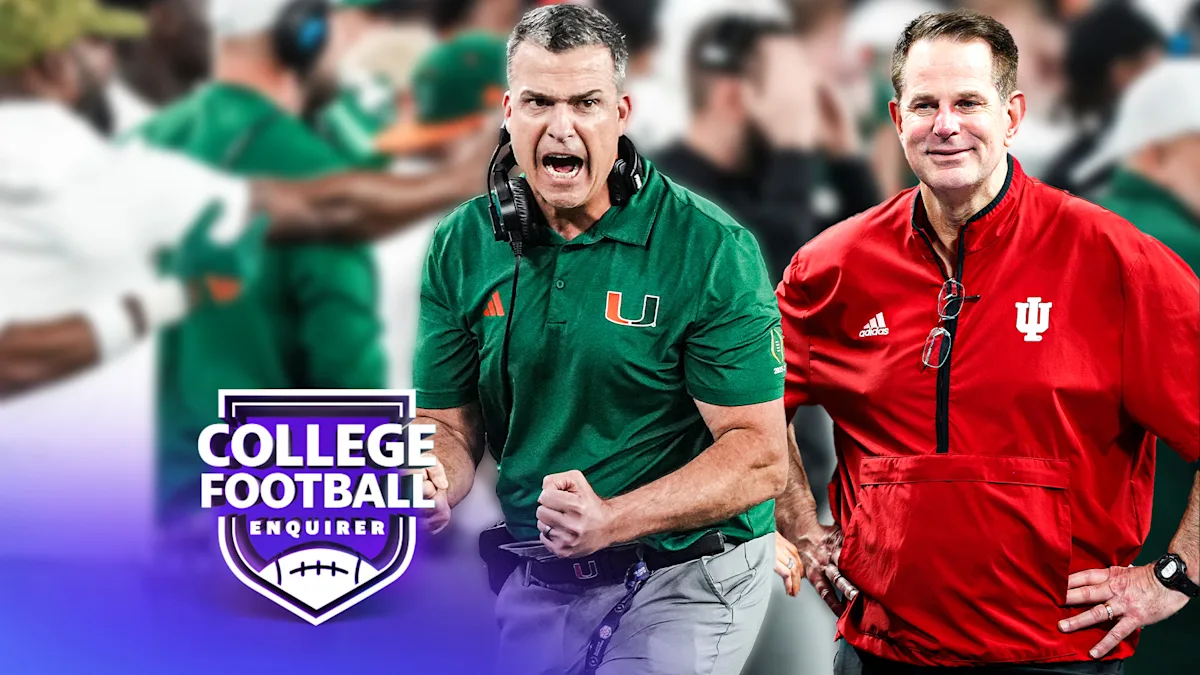
The National Championship Game is set! Andy Staples, Ross Dellenger and Steven Godfrey look ahead to the final matchup of the season by reacting to both semifinal matchups. They first talk about Indiana’s dominating performance over Oregon. Will the Hoosiers’ execution and talent win them a national title? How does Indiana stack up with the historically dominant national champions of the past? Then, they discuss the much more exciting semifinal matchup that saw Miami come out on top. How can Miami upset Indiana? What kind of advantage will playing in their home stadium create for the Hurricanes? Plus, will Oregon ever win a national championship?
Advertisement
Then, the guys look at some things happening off of the field in the college football world. After their loss to Miami, Ole Miss found out that Trinidad Chambliss’ request for another year of eligibility has been denied by the NCAA. However, this is not the end of the story as Chambliss will now sue the NCAA for damages spawning from the money he would make in NIL with that additional season. The guys discuss if Chambliss’ has a chance in this case, or if there is another motive behind the lawsuit.
Finally, the guys look at the madness of the transfer portal. First, they discuss the Demond Williams drama. After trying to enter the transfer portal, and Washington refusing to enter his name due his signed contract, Williams has now returned to the Huskies. Andy, Ross and Godfrey discuss what all happened in Seattle. Then, they look at the College Sports Commission’s investigation into how schools are writing NIL contracts. How will these contracts continue to evolve over time?
Get ready for the Natty with College Football Enquirer.
Miami and Indiana advance to Natty Photo by CFP/Getty Images Photo by Jeff Robinson/Icon Sportswire via Getty Images
(Photo by CFP/Getty Images Photo by Jeff Robinson/Icon Sportswire via Getty Images)
0:00:00 – Indiana dominates Oregon
Advertisement
14:37 – Miami advances over Ole Miss
24:51 – Will Oregon ever win a Natty?
29:46 – Trinidad Chambliss’ fight for a 6th year
40:49 – Demond Williams drama
52:12 – College Sports Commission investigation
Check out all the episodes of the College Football Enquirer and the rest of the Yahoo Sports podcast family at https://apple.co/3zEuTQj or at yahoosports.tv

Missouri finished the 2025 campaign as an interesting mix of promise and turnover under sixth-year head coach Eli Drinkwitz.
The Tigers posted an 8–4 regular-season record, going 4–4 in SEC play, and leaned heavily on a dominant run game led by sophomore running back Ahmad Hardy, who finished with 1,649 rushing yards (second most in college football) and 16 touchdowns on 256 carries (6.4 yards per carry).
However, the quarterback position quickly became a central offseason storyline when starter Beau Pribula re-entered the transfer portal.
On3’s Pete Nakos has tracked Pribula’s early January visit cycle, which included stops at Virginia Tech and Georgia Tech, followed by a visit to Washington as the Huskies navigated uncertainty surrounding Demond Williams.
On Friday, Nakos also reported that Pribula is expected to visit Tennessee, adding another SEC program to his growing list of suitors.
Pribula began his college career at Penn State, where he redshirted and served as a backup from 2022–24 before transferring to Missouri for the 2025 season.
In 2025, he completed 182 of 270 passes (67.4%) for 1,941 yards, 11 passing touchdowns, and nine interceptions across 10 games, while adding 297 rushing yards and six rushing scores on 95 carries, making him one of the more intriguing dual-threat quarterbacks available with both Big Ten and SEC experience.
That experience, paired with his production, has also made Pribula one of the more marketable players in the portal, with an NIL valuation reported in the neighborhood of $1.8 million as he navigates a crowded quarterback market this offseason.
A Central York (PA) product, Pribula was a three-star high school prospect and the No. 27 quarterback in the 2022 class per 247Sports, signing with Penn State over more than a dozen offers, including Nebraska, Northwestern, Rutgers, and Syracuse.

All four programs Pribula has been linked to make sense for different reasons.
Virginia Tech stands out as a logical reunion target, as James Franklin’s staff has been actively pursuing quarterbacks and has prior Penn State ties to Pribula, while Georgia Tech is looking to replace the expiring Haynes King era after losing depth when backup Aaron Philo transferred to Florida.
Washington, meanwhile, has hosted multiple quarterback visitors amid uncertainty surrounding Williams, as the Huskies look to stabilize the position within a program that offers Power-4 exposure and strong NIL opportunities.
At Tennessee, Josh Heupel’s offense has historically prioritized mobile playmakers, and ongoing quarterback turnover makes a veteran option like Pribula appealing, particularly with senior starter Joey Aguilar expected to move on.
Read More at College Football HQ
- Major college football programs lose transfer portal recruitment for $2 million QB
- College football program loses 34 players to transfer portal
- Stephen A. Smith deals $92 million college football coach blunt reality check
- Three major college football programs battling for former 5-star recruit

Over the past few years, the SEC’s reputation has not matched its on-field results. The conference’s reign atop college football has now officially come to an end. The debate over whether the SEC is still the most dominant conference in college football is over. The SEC’s failure to place a team in the national championship game for a third consecutive year has settled it.
For nearly two decades, the SEC ruled the sport under the conference mantra “It Just Means More.” The mantra was built by the conference’s superior talent and its unmatched level of passion. Their dominance was largely driven by the perceived recruiting advantage resulting from their geographical location. Proximity to recruiting hotspots in the South has enabled programs to consistently accumulate elite talent year after year.
That advantage led to an SEC team being crowned the national champion 13 of the last 19 years. However, the SEC’s dominance has slipped away over recent years. Why? July 1, 2021. The date the back door closed and the front door opened.
The SEC’s biggest advantage was never geographical location or its mantra of just meaning more. It was the SEC acceptance of if you’re not cheating you’re not trying. The understanding within the SEC that bending and sometimes breaking the rules was acceptable allowed the SEC to thrive for two decades. What most programs in other conferences frowned upon was overlooked in the SEC.
The instituting of Name, Image and Likeness (NIL) took away the SEC’s biggest advantage. Every school could now use monetary resources to get top talent to commit to their programs. And with it, the SEC’s ability to stockpile talent evaporated.
Recruiting Edge Lost With NIL
How does the SEC dominate for two decades with no end in sight, then tumble back to reality in just three years? Simply, they lost the paid-to-play advantage. There was a belief that the SEC was using NIL before NIL was something you could use. But no one could say for sure, that is, until former LSU coach Ed Orgeron let the cat out of the bag.
More Sports News
On an appearance of “Bussin’ With the Boys,” Taylor Lewan got the dirt from Orgeron.
“We all know that the SEC was NIL before NIL,” Lewan said. “We’re way past it. Can we now just admit it?”
“They say, ‘Hey, coach. You know, you’ve been out of coaching for a while. How are you going to adjust to NIL?’” Orgeron said. “‘Well, it’s a minor adjustment.’ They said, ‘What do you mean?’ I said, ‘Back then, we used to walk through the back door with the cash. Now, we just got to walk through the front door with the cash.’”
You can’t assume that every team was using the back door for recruiting. However, what else in the last four-and-a-half years could have changed the hierarchy of college football?
Trophies Define Conference Supremacy
There is no arguing that the SEC is the deepest conference in college football. But it’s not about being deep when arguing which conference is the best. To be considered the best, it’s putting trophies in the trophy case and playing for national championships. Something the SEC has not done in three years after Ole Miss was eliminated from the College Football Playoff. The only thing that matters is which teams are in the CFP.
Using meaningless losses in bowl games as a talking point that really has little to no impact on being the best conference. Bowl games are nothing more than spring games against other teams. Most teams bear little resemblance to what they were during the regular season. What really matters is how teams perform in the College Football Playoff against programs with equal or superior talent.
In the first nine years of the CFP, the SEC failed to have at least one team in the final. This year’s national championship will be the third straight year the SEC has failed to have a team advance to the final. The Big Ten, on the other hand, has had and will have a team playing in all three. The Big Ten has also won the last two national championships.
The SEC plays semantics in its effort to stay atop of college football. But the “best” means producing elite national championship contenders capable of winning it all and actually doing it. Something the Big Ten has accomplished each of the last two years, Michigan two years ago, Ohio State last season, and now Indiana has a chance to make it three straight for the Big Ten. The SEC is the deepest conference, considering five teams reached the College Football Playoff. What the SEC failed to do was to create a truly elite team that made it.
Moving forward, being a blue blood no longer matters. The only thing that matters now is being a “Green Blood.” A university with ultra-rich alumni willing to invest, with the only reward being wins. The days of “Bob’s Used Cars” putting cash in fast food bags are gone. Now it’s about billionaires and multi-millionaires like Mark Cuban or Nike founder Phil Knight handing over seven-figure checks, and there’s no conference with more than the Big Ten.
And if no rules exist, it is only a matter of time before the Big Ten becomes the deepest conference as well.
College football’s transfer portal season has taken some odd twists and turns this year. Now it’s entering … tax season?
In one of the latest oddities, schools in certain states began trading “no state income tax” social media posts as a way to entice players in the portal. Currently, nine states don’t levy income taxes: Alaska, Florida, Nevada, New Hampshire, South Dakota, Tennessee, Texas, Washington and Wyoming.
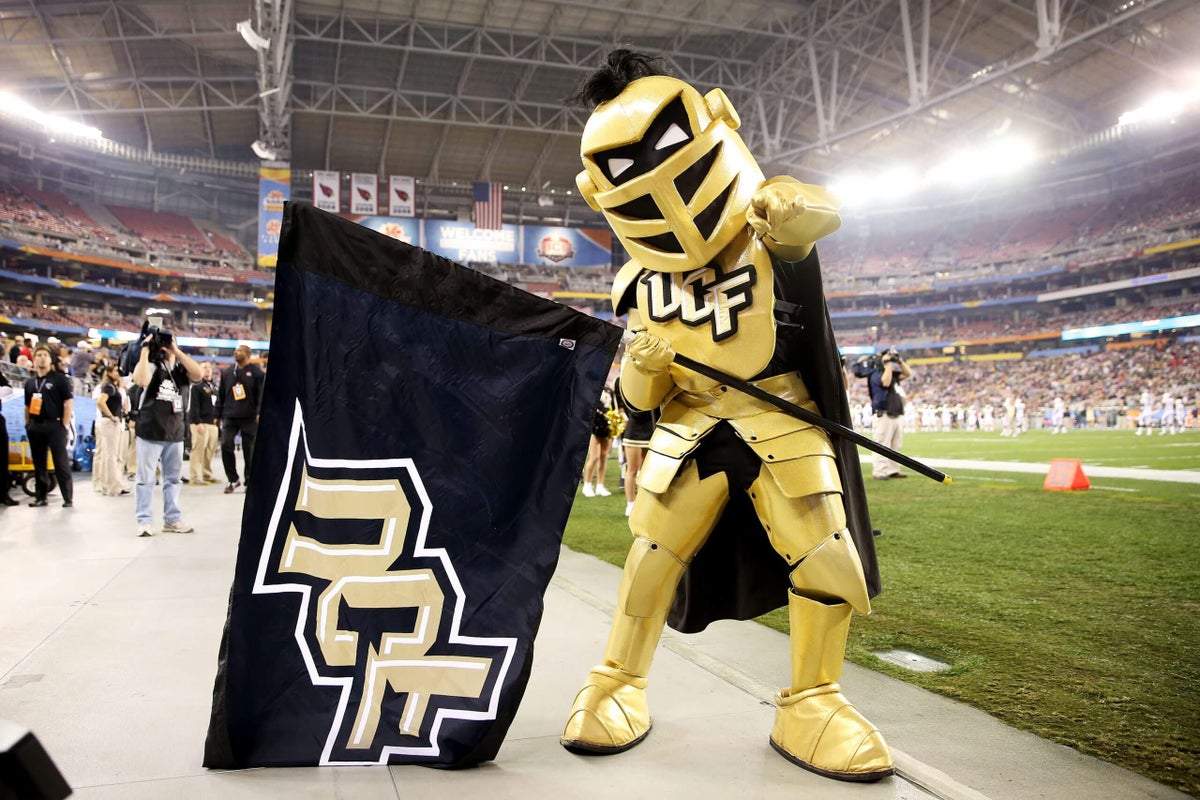
The Houston Cougars, UNLV Rebels and UCF Knights — all universities within one of those nine states — posted about their lack of state income taxes on X on Saturday, featuring an image of either a mascot or cheerleader lifting a comically large bag of cash above their heads.
UCF started the movement with a post on Saturday morning featuring its mascot, Knightro. Houston and UNLV soon followed suit, as did the UTEP Miners, FIU Panthers and North Texas Mean Green.
🤝 https://t.co/rqQdM0cpCQ pic.twitter.com/OgtMjGVhdx
— Houston Football (@UHCougarFB) January 10, 2026
How effective will that pitch be? UCF, Houston and UNLV were all outside the top 40 of 247Sports’ portal rankings as of Saturday night, so any little bit helps. Central Florida was the highest at No. 47 in the 247Sports rankings, followed by Houston at No. 49 and UNLV at No. 86. Texas Tech, Texas A&M and Houston were all in the top 10 of On3’s portal rankings.
College athletes are not only taxed on their NIL earnings, but also on anything they receive of value. If an athlete receives a new car, for example, they have to pay taxes on it in accordance with its value.
Arkansas has tweaked its tax code so that NIL income is tax-exempt as an incentive to induce athletes to sign at the University of Arkansas or other in-state schools.
There was no indication that income taxes were the reason behind another buzzy portal storyline earlier this week: Quarterback Demond Williams changing his mind about entering the portal and deciding to stay with the Washington Huskies. On Tuesday, Williams announced he was entering the portal — four days after signing with the Huskies, a Washington source close to the negotiations told The Athletic’s Bruce Feldman. On Thursday, he said he was “excited to announce that I will continue my football journey at the University of Washington.”
The Huskies were prepared to pursue legal action against Williams to enforce the contract, a source briefed on the situation told Feldman. Williams could have owed the school up to $4 million for transferring, according to Big Ten rules that state that if a player intends to transfer before the end of a payment period, he owes the remaining amount on his contract, unless the school agrees to accept a buyout from the player or the player’s next school.
Williams and his team ultimately decided to stay in Seattle — where he won’t have to pay state income taxes.

Boston College finished the 2025 season 2–10 (1–7 ACC) in what was a down year for the program under former NFL head coach Bill O’Brien.
The Eagles had gone 7–6 in back-to-back seasons, including O’Brien’s first year in 2024 after arriving from Ohio State, where he served as the Buckeyes’ offensive coordinator and quarterbacks coach.
However, the 2025 campaign marked Boston College’s worst season since 2012.
Despite the disappointing results, athletic director Blake James announced that Boston College will retain O’Brien for a third season and increase its financial investment in the football program ahead of 2026.
Still, with both the offense and defense struggling to produce consistent results throughout the year, a wave of players elected to seek new opportunities via the transfer portal, including redshirt-junior wide receiver Ismael Zamor, who announced his decision to enter the portal on January 6.
Zamor, listed at 6-foot, 193 pounds, enrolled at Boston College in 2022 out of Everett (Mass.) High School, where he was rated a three-star prospect and the No. 129 wide receiver nationally in the 247Sports Composite rankings.
He chose the Eagles over nearly a dozen other scholarship offers, including Michigan, Syracuse, Temple, Buffalo, and UMass.
Despite being viewed as an intriguing developmental prospect coming out of high school, Zamor primarily contributed on special teams during his time at Boston College, appearing in limited games and failing to record a reception across four seasons with the program.
He now enters the transfer portal as a redshirt junior.
Aside from Zamor, who saw limited action during his time in Chestnut Hill, Boston College has now seen 29 players depart via the transfer portal, including several notable contributors.
That group includes wide receiver Reed Harris (committed to Arizona State), running back Turbo Richard (committed to Indiana), tight end Ty Lockwood (committed to Arkansas), tight end Stevie Amar Jr. (committed to UCLA), and safety Omarion Davis (committed to Penn State), among others.
Richard was the Eagles’ leading rusher in 2025, totaling 749 rushing yards and nine touchdowns on 145 carries (5.2 yards per carry), while also adding 213 receiving yards and two receiving scores.
Harris, meanwhile, finished as the team’s second-leading receiver, recording 673 yards and a team-high five touchdowns on 39 receptions (17.3 yards per catch).

This level of turnover following a 2–10 season is significant for two primary reasons.
First, it strips Boston College of experienced contributors across multiple position groups, most notably at the skill positions, tight end, and throughout portions of the defensive front seven and secondary.
Second, it signals a program reset of sorts, as more than two dozen players are effectively voting with their feet in search of better fits, greater stability, or clearer paths to playing time.
Read More at College Football HQ
- First-team All-conference player announces transfer portal decision
- No. 1 transfer portal player visits fourth college football program
- Son of NFL Pro Bowl QB announces transfer portal commitment
- $1.8 million QB set to visit fourth college football program in transfer portal

Mountaineers Tally Nine First-Place Finishes at UNC Asheville Collegiate Opener at Tryon International

IMS Museum Names New President – WRBI Radio

Ticket prices soar for Indiana-Miami College Football Playoff national championship game

Track and Field Earns Four Event Wins at Wolverine Invitational

Lang’s Shot Put Win Paces Garnet Chargers at Middlebury

Field Events Power DePaul at Gately Indoor

Lehigh Competes in First Away Meet at Penn Select

Indiana & Miami advance to Natty + QB transfer portal madness

Szepieniec, VanZeeland Secure Individual Victories at Minnesota Open

Panthers Turn In 3 Podium Sweeps at Minnesota Open

Lenes, Kermath take First at Wesleyan Indoor Invite I

$1.8 million QB set to visit fourth college football program in transfer portal

Sullivan Leads Cardinals at Wesleyan Indoor Invite I

Photos: Fort Lewis College women’s and men’s basketball take on Westminster University

Mountain Hawks Produce Top Performances at Penn Select

Stempien to seek opening for Branch County Circuit Court Judge | WTVB | 1590 AM · 95.5 FM

#11 Volleyball Practices, Then Meets Media Prior to #2 Kentucky Match

Ross Brawn to receive Autosport Gold Medal Award at 2026 Autosport Awards, Honouring a Lifetime Shaping Modern F1

Maine wraps up Fall Semester with a win in Black Bear Invitational

Princeton Area Community Foundation awards more than $1.3 million to 40 local nonprofits ⋆ Princeton, NJ local news %

Nascar legal saga ends as 23XI, Front Row secure settlement

Downtown Athletic Club of Hawaiʻi gives $300K to Boost the ’Bows NIL fund

Sunoco to sponsor No. 8 Ganassi Honda IndyCar in multi-year deal

WNBA’s Caitlin Clark, Angel Reese and Paige Bueckers in NC, making debut for national team at USA camp at Duke

Badgers news: Wisconsin lands 2nd commitment from transfer portal

Nike Signs 10 LSU Athletes to NIL deals

Five Youth Sports Trends We’re Watching in 2026

Beach Volleyball Unveils 2026 Spring Schedule – University of South Carolina Athletics

Three Clarkson Volleyball Players Named to CSC Academic All-District List

Kentucky AD explains NIL, JMI partnership and cap rules





-
 Sports3 weeks ago
Badgers news: Wisconsin lands 2nd commitment from transfer portal
-
 Rec Sports1 week ago
Five Youth Sports Trends We’re Watching in 2026
-
 Sports2 weeks ago
Kentucky VB adds an All-American honorable mention, loses Brooke Bultema to portal
-

 Motorsports3 weeks ago
Dr. Patrick Staropoli Lands Full-Time O’Reilly Ride with Big Machine Racing
-
NIL2 weeks ago
Fifty years after IU’s undefeated champs … a Rose Bowl
-

 Motorsports2 weeks ago
BangShift.com IHRA Acquires Historic Memphis Motorsports Park In Millington Tennessee. Big Race Weekend’s Planned For 2026!
-
 Sports2 weeks ago
2025 Volleyball Player of the Year: Witherow makes big impact on Central program | Nvdaily
-
 Sports2 weeks ago
H.S. INDOOR TRACK & FIELD: GLOW region athletes face off at Nazareth University | Sports
-
 Sports2 weeks ago
Colorado volleyball poised to repeat success
-

 Rec Sports3 weeks ago
Tennessee Developments: Rolling on the River