
Rec Sports
Sycamore folk dancers celebrate culture | News, Sports, Jobs


SPIRIT OF POLAND — More than 50 young dancers took to the stage at the Sycamore Youth Center May 6 to perform the “Spirit of Poland” folk dance celebration.
— Contributed
STEUBENVILLE — The Sycamore Youth Center was alive with color, movement and music on the evening of May 6, as more than 50 young dancers took the stage for the highly-anticipated “Spirit of Poland” folk dance celebration.
Hosted by the Sycamore Folk Dancers and led by directors Zac Gordon and Jariel Henthorn, the event drew a packed house of parents, community members and cultural enthusiasts.
The performance began at 7 p.m. and featured traditional Polish folk dancing and singing, showcasing the beauty and vibrancy of Polish culture.
Dressed in festive costumes and dancing with enthusiasm, students brought to life songs and traditions that spanned generations.
“This was truly one of the most moving and joyful events we’ve ever had at the Sycamore Youth Center,” said Bobbyjon Bauman, executive director of the center and president of the Ohio Valley Youth Network. “To see these young people celebrate faith, culture and community with such heart, was nothing short of inspiring.”
The “Spirit of Poland” event was the culmination of months of dedicated rehearsals under the guidance of Gordon and Henthorn, who have poured their time and passion into mentoring the young performers.
The Sycamore Youth Center continues to be a hub for arts, faith and youth development in the Ohio Valley.
The “Spirit of Poland” was just one example of what can happen when tradition meets passion in the hearts of the next generation.

Rec Sports
What if youth sports weren’t about winning? How KidsUnited Frisco | Plano builds confidence 1 kick at a time

Toddlers carefully tap soccer balls with growing coordination, while older children practice focused footwork. Classes move seamlessly from one age group to the next, stretching from morning sessions to evening play, seven days a week. Each one is designed to help children grow not just as athletes, but as confident, capable individuals.
That steady hum of activity reflects the heart of KidsUnited Frisco | Plano: a year-round, indoor early childhood development program that uses soccer as a tool to help children ages one and a half to nine reach critical developmental milestones.
What makes KidsUnited Frisco | Plano unique?
Unlike traditional youth sports programs built around competition and seasonal schedules, KidsUnited Frisco | Plano takes a fundamentally different approach. The program focuses on individual skills development, with small class sizes and personalized coaching that allows each child to progress at their own pace.
“We focus on age-appropriate developmental milestones as the child progresses through our program, and we use soccer as the main tool for reaching those milestones and inspiring a lifelong love for the game,” head coach Bella Lopez said.
For the youngest age groups, there are no more than 10 children in each class, with two coaches on the field to ensure individualized attention. For older kids, class sizes do not exceed 12 children, and the coach to student ratio does not surpass 1:6. This structure allows athletes to get more touches on the ball, more repetition and more feedback, creating an environment where learning feels both supportive and fun.
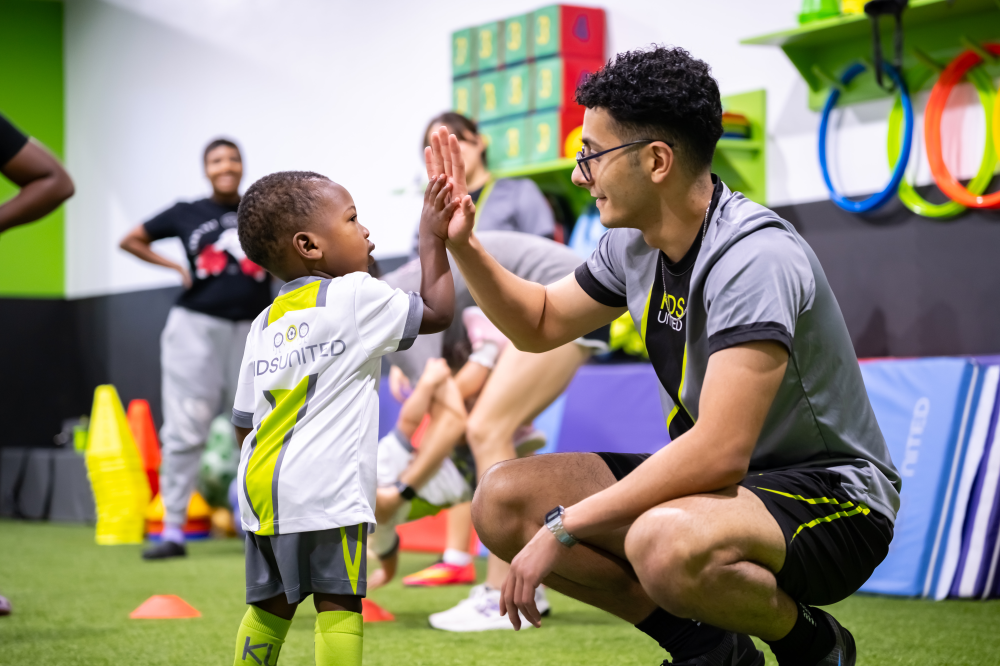
Additionally, all coaches are certified and bring extensive soccer experience. Many have competed at the collegiate, semi-professional or professional level, equipping them to teach proper technique, refine form and build strong fundamentals in every player.
Beyond their expertise, the coaches are the heart of each session, dedicated to helping children grow both on and off the field. They focus on creating classes that are engaging, safe and filled with meaningful moments, encouraging a lasting passion for the game.
A curriculum built for growth
At the core of KidsUnited Frisco | Plano is a structured, 52-week curriculum developed by national KidsUnited head coaches. The curriculum is refreshed continuously throughout the year. While the focus areas remain consistent—body and ball mastery, and life skills—the drills change weekly to keep children engaged and challenged.
Life skills become a more intentional part of the curriculum starting around age three and a half, when children begin working on concepts such as perseverance, teamwork, leadership and decision-making. These lessons are woven directly into drills, as well as one-on-one or two-on-one scrimmages. This helps children learn how to navigate challenges in a low-pressure environment.
“The lesson that’s built into [this program] is that … you’re not going to get [the skill] on day one, … but you can do hard things little by little in a safe, comfortable, smaller type of environment,” Lopez said.

Building confidence early
For many families, one of the most noticeable outcomes of the program is confidence. Younger classes include parent-assisted instruction, helping toddlers feel comfortable as they bond with both caregivers and coaches. As children grow, the emphasis shifts toward independence and problem-solving, without the pressure of winning or losing. Families can also take advantage of a trial option to experience the program firsthand and see if it is a good fit for their family.
Coaches provide individualized feedback after every class, reinforcing progress and helping children recognize their own growth.
Families are incredibly happy with their experience.
“This soccer school has been an amazing experience for our family. The coaches are encouraging, organized and truly care about each player,” one family member said. “My child has grown not only in soccer skills, but also in confidence, teamwork and sportsmanship. Communication with parents is clear, the environment feels safe and welcoming, and practices are always fun and engaging. We’re so glad we signed up.”
Expanding access across North Texas
KidsUnited Frisco | Plano was the first KidsUnited location in Texas. It brought the nationally recognized program from the Northeast to one of the region’s most active youth sports communities, located at the border of Frisco and Plano.
That success is now fueling expansion.
The organization plans to open at least two additional locations in North Texas by early to mid-2025, including clubs in Celina and McKinney. The expansion aims to make the program more accessible for families who currently travel from surrounding cities such as Prosper, Aubrey and Melissa.
As the footprint grows, the mission remains the same: offering consistent, year-round development during the most formative years of childhood.
Frisco | Plano location: 4568 SH 121, Plano. Click here to learn more and try a class today.
Celina | Northwest McKinney location (coming soon): 8176 FM 2478, Bldg. 13, McKinney. Click here to contact the team now and take advantage of Founding Member Rates.
Follow the action @kidsunited_frisco.plano on Instagram and Facebook.

The above story was produced by Multi-Platform Journalist Sydney Heller with Community Impact’s Storytelling team with information solely provided by the local business as part of their “sponsored content” purchase through our advertising team.

There was a time when signing your kid up for soccer or softball didn’t take a big investment. But in recent years, the financial commitment required for some youth sports has grown dramatically.
Parents now regularly spend thousands of dollars each season on registration, travel, equipment and other costs. And the entrance of private equity firms into the industry has helped accelerate the growth in expense.
Todd Frankel, a reporter for the Washington Post, recently wrote about the growing costs of kids’ sports. He spoke to Texas Standard about some of the factors that are driving the trend. Listen to the interview above or read the transcript below.
This transcript has been edited lightly for clarity:
Texas Standard: Give us a sense of how much money some parents are actually paying for their kids to participate in sports. I mean, it’s easy to sort of talk in these broad terms and it might sound like hyperbole, but I was kind of shocked by what you reported here.
Todd Frankel: Yeah, they are eye-popping numbers, but I think any parent who has a kid playing sports these days, they’re sort of the rules of the road. And they are shocking. I mean, folks are being charged just to try out for these teams.
And these, again, as you pointed out, the Pop Warner/Little League stuff that most folks grew up with a generation ago, that’s still around, but it’s been sort of supplanted and also competing against these like travel clubs and these club sport teams that are year-round. You know, they cost $3,000, $4,000 a year easy – $50 to try out, and then there’s fees all along the way.
And, you know, it’s really turning youth sports into a luxury good.
Is this across the board? I mean, are there certain sports or certain leagues that are more affordable? You mentioned the Pop Warner thing’s still out there, but where’s all this money going?
It’s sort of tricky. So those other cheaper options are still out there, but what happens is – and I was speaking to some academics and folks who study this – is starting around second grade, which is pretty young, folks start getting sort of lured into this club sports world, and by fifth grade, there’s fewer and fewer players around to play the lower-end sports. And so everyone sort of feels compelled, “oh well, maybe Johnny down the street’s doing it, my kid should follow him.”
And some sports definitely cost more, like ice skating is a famous example of just incredible investment – ice hockey as well. Soccer’s cheaper, baseball’s a little bit cheaper.
But again, the costs are so much higher than they were a generation ago. And you’re getting more. You’re around practices, three practices a week.
Another big thing that I was sort of even surprised by was this sort of growth in what’s called youth sports tourism, right?
So on the weekend, mom and dad and the family are loading up and driving three, four hours or even hopping on a plane to go play in a weekend youth sports tournament at these new facilities that are just for youths, right? They’re not for adults.
So it’s an entirely different world than what most folks are aware of.
» GET MORE NEWS FROM AROUND THE STATE: Sign up for Texas Standard’s weekly newsletters
It seems like much bigger business, and I say that with intent because you report that private equity firms have taken notice of what’s happening here. What role have they actually played in driving this trend?
Yeah, so, you know, I think they took notice that folks are willing to spend a lot of money.
As someone told me, families will cut back on a lot things before they cut back on spending for their kids. And these private equity and venture capital investors have started getting into this – buying up some of these facilities, wrapping up a bunch of these leagues… Like one group bought up/owns almost 100 different flag football leagues across the country. And they see the profit opportunity there.
And the concern is, what’s driving which? I think this was sort of happening and private equity got into it. But as they are going to do, they’re probably going to push this a little bit further.
But I wonder if they can only push so far, because surely there’s gotta be some sort of backlash. Is there any, as far as you can tell? Are parents looking for alternatives?
Well, yes, there’s definitely backlash. And it’s mostly like that, you know, any parent I talk to about this were just sort of a knowing laugh when I brought this up. Because everyone goes through this at different levels, you know?
Some folks have much worse times. Some of it’s just a little bit of a financial strain. But there was surveys showing that parents are getting second jobs to afford their kids sports. And I was kind of like, that can’t be true. But then, secondhand, I heard from friends that I know of who they’ve done that same thing for their kids.
And so we are probably reaching a tipping point where how much more can you possibly get folks to pay? But even if it just sort of stays where it is, it’s still a really big strain for a lot of families. But no one wants to be the first one to pull out.
And as I said earlier, the problem is, these earlier, cheaper options, they don’t seem as attractive. And they’re, quite frankly, not – especially if you can somehow squeeze out and do the fancy stuff, it’s kind of hard to say no.

The Elite Clubs National League has announced a long-term partnership with the IBERCUP to bring U11 and U12 soccer clubs from around the world to America for an international boys youth tournament for the first time.
IBERCUP x ECNL International – Raleigh, NC USA 2026 will kick off Labor Day Weekend in 2026, bringing players and teams from around the world to North Carolina. Nearly 200 U11 and U12 teams from Europe, South America, Asia and the United States will play in the four-day tournament, which will provide competitive, developmental and cultural opportunities for players, teams, coaches and clubs.
“For nearly two decades the ECNL has brought together the best clubs in America for competition, and we are thrilled to be able to expand that mission to bring some of the best clubs across the globe here to the United States,” said ECNL President Christian Lavers. “The IBERCUP has hosted fantastic events all over the world, featuring household club names with future world stars, and we could not have asked for a better partner to help create what will be the most exciting event on the calendar for U11 and U12 American soccer players.”
“This partnership with ECNL is an important milestone for IBERCUP,” said IBERCUP President Filipe Rodrigues. “Bringing an international IBERCUP tournament to the United States has long been part of our vision.
“Together with ECNL, we will offer young players a competitive environment that reflects the reality of international football, where performance, learning, and cultural exchange go hand in hand. We are confident this event will become a reference point for youth football in the U.S.”
Tournament Format
IBERCUP x ECNL International – Raleigh, NC USA 2026 will provide 7v7 min-game competition at U11 and U12 boys age groups. Teams will be guaranteed six games during the four-day event, with every team competing for the tournament championship in a combination of group and knock-out play.
More information regarding IBERCUP x ECNL International – Raleigh, NC USA 2026, including competing teams and group placements, are set to be announced in due course.

A trial about a dark chapter in basketball history opened Thursday in New York with a former player testifying that the multimillionaire coach of the pioneering Riverside Church youth basketball team regularly molested him as a child, but the program’s prestige and the stigma of speaking out about sexual abuse kept him silent for nearly 50 years.
Daryl Powell, a Marist College star in the early 1980s, is one of 27 men suing Riverside under New York’s 2019 Child Victims Act, and, Rolling Stone reports, the case is among the first in the city to go to trial under the law. As detailed in a joint investigation by Rolling Stone and Sportico, Powell and his fellow plaintiffs claim the church negligently failed to supervise Ernest Lorch, the longtime head of the basketball program and a former church trustee who died in 2012, and should have known of his alleged propensity to prey on kids from New York’s poorest neighborhoods.
Riverside has denied any wrongdoing by the church or its officials, and reiterated that stance Thursday during opening arguments. Attorney Phil Semprevivo told the jury that if there was abuse by Lorch, “that’s essentially on him” and not the church.
Dressed in a sweater vest and donning a headset to aid what he described as severe hearing loss, Powell, who filled the witness stand with his 6-foot-5-inch frame, graphically described how Lorch frequently abused him. Lorch, Powell said, fondled him as a teen during “jockstrap inspections,” rubbed his bare buttocks and told him to be a “good boy” after paddling him with four or five “hard whacks,” and sniffed his genitals after practices to check if he’d showered. “I could feel his breath on them,” Powell testified.
Asked how he felt after Lorch’s abuse and later as an adult, Powell began to cry and answered: “I never thought a man would do something like that to me. I was scared, frightened, angry, lonely and heartbroken.”
Yet he stayed with the program into his early twenties because Riverside also offered him the hope of escape from the grinding poverty his family endured in 1970s Harlem. “I lived in a very deprived neighborhood—the ghetto, very messy with a lot of drug addicts, running numbers, a lot of people on the street, gang-infested,” he testified.
The lure of a coveted Riverside jacket, bag and sneakers enticed Powell to try out for the team. Later, Lorch frequently gave him money for food and took him on team trips across the country and around the world, including the former Yugoslavia, and eventually helped land him junior college and major college scholarships.
Lorch also pulled strings to get him into high school. As a Manhattan native, public school league rules forbade Powell from playing for a school outside the borough. But somehow, he testified, Lorch got him into DeWitt Clinton High School in the Bronx, a powerhouse at the time. “It was like making the NBA,” Powell testified.
In a rare moment of levity, Powell recited names of some Clinton basketball greats: “Tiny Archibald [an NBA Hall of Famer], Butch Lee [a star at Marquette and in the 1976 Olympics] … myself.”
Powell testified that he never felt he could tell anyone about the alleged abuse. Lorch represented “a father figure,” he said, something that was absent in Powell’s home life. The subject was also so taboo in that era that he felt there was no way he could admit to what happened. “We couldn’t disclose that,” he testified, “because at that time, you didn’t want to be a faggot or a homo.”
Powell revealed in a previously undisclosed incident that he once told a Riverside assistant coach, Kenny “Eggman” Williamson, about Lorch’s abuse. Williamson was a prominent figure in New York basketball circles who went on to become a successful college assistant coach, pro scout and NBA front office executive. He died of cancer in 2012 while serving as the assistant general manager of the Memphis Grizzlies.
Powell had previously been asked in his 2023 deposition for the lawsuit whether he had spoken about abuse to Williamson and replied, “No.” But on Thursday, Powell said he remembered the exchange clearly because it happened the day of the infamous New York City blackout of 1977. Powell testified he was at a tournament where Williamson was coaching him, which was canceled because of rioting. Williamson took Powell home with him rather than letting him go back to his unsafe neighborhood.
Semprevivo, Riverside’s attorney, objected to the testimony, pausing the proceedings before Powell could answer fully. Eventually, Judge Alexander Tisch overruled the objection and allowed Powell to continue. “I had a moment now, one on one, with somebody I trust,” Powell testified, referring to a discussion with Williamson that day. “I said, ‘Mr. Lorch is looking down my shorts, hitting me with the paddle.’”
According to Powell, Williamson told him, “If you know what I know, you better not say anything, or you’re not playing for this team anymore.”
Powell continued: “I was devastated. I shut my mouth up. I wanted to stay on the team.”
The trial’s first day also revealed both sides’ strategies, which could have an effect on the 26 other lawsuits. In his opening statement, Powell’s attorney Paul Mones said the plaintiff will prove Riverside allowed Lorch to “operate completely on his own and abuse him” and other players, either because those in the church hierarchy were “incompetent or they just didn’t care.” Either way, Mones said, “The church was negligent.” The attorney called it “a heartbreaking failure on the part of an esteemed institution” to protect a person under their care.
Powell’s side is expected to call two fellow teammates and plaintiffs, Mitchell Shuler and Byron Walker, to the stand during the trial.
In Riverside’s opening statement, Semprevivo reminded the jury, consisting of six jurors and three alternates, that “the burden of proof” belongs to “the plaintiffs, not Riverside.” He told the jury they’d have to ask whether plaintiff witnesses “have an interest in this case.”
The defense also seems keen to claim Powell’s hardships in life aren’t attributable to his time with Riverside, saying there was no current harm “with respect to these allegations.” To that point, Powell at times seemed to struggle to elaborate on specific examples of what damage he suffered as an adult from Lorch’s abuse, though he brought up issues with his marriages and with women generally.
Semprevivo also said the jury should consider why Powell waited so long to bring suit. Throughout his adulthood, Semprevivo said, Powell had “opportunities to be heard” but did not take them.
On Friday morning, Riverside attorneys will cross-examine Powell. The trial is expected to continue into next week.

PARKS AND REC: Happy New Year, Crook County!
Published 5:00 am Friday, January 9, 2026
As we turn the page to a new year, Crook County Parks and Recreation District (CCPRD) wishes you and your family a happy, healthy and active New Year! January is a time for fresh starts, and there’s no better way to kick off the year than by getting involved in our sports, classes and recreation opportunities designed for all ages and abilities.
Registration opens in January
January marks the opening of registration for Gymnastics, Karate, and Dog Obedience. Registration is also open for the 2026 Daddy Daughter Dance. Whether your goal is to stay active, try something new or connect with friends and neighbors, we have something for you. Our programs are built to support wellness, learning and fun throughout the community.
Popular offerings often fill quickly, so we encourage residents to register early. Programs are led by qualified instructors and coaches who focus on skill-building, teamwork and enjoyment in a welcoming environment.
Sports for all ages
Our sports programs provide opportunities to move, compete and grow — whether you’re a beginner or a seasoned player. Youth sports help build confidence and healthy habits, while adult leagues offer a great way to stay active and social during the winter months. Look for registration for Youth Spring Soccer and Adult Basketball to begin this month. CCPRD is also offering Open Gym Adult Basketball on Tuesdays and Thursdays during January and February. Indoor Pickleball is also running through the winter months.
Start the year moving
Parks and recreation play an important role in quality of life, and we’re proud to provide programs and spaces that bring Crook County together. We invite you to make parks and recreation part of your New Year’s routine.
For program details, registration dates and schedules, please visit our website at ccprd.org. We look forward to seeing you on the field, in class and out enjoying all that our community has to offer in 2026.
Here’s to a year of health, connection and recreation — Happy New Year from Crook County Parks and Recreation District!
Steve Waring is the Crook County Parks and Recreation District’s executive director. He can be reached at 541-447-1209.


Most people hear the words Orange Bowl and immediately think of football. They picture the matchup, the crowds, the fireworks, and the national spotlight on South Florida. But the real story of the Orange Bowl is much bigger than a single game. The Orange Bowl is one of the greatest community engines in our region. It is a volunteer powered organization that lifts neighborhoods, builds opportunities for young people, supports schools, transforms parks, and reinvests millions of dollars right back into South Florida families. If you think this organization is only about football, then you are missing the best part.
The Orange Bowl is more than football. It is a force for good in South Florida.
The heart of this mission is Orange Bowl Cares. This is not just a slogan or a feel-good idea. It is the core platform that guides every investment the Orange Bowl makes. Orange Bowl Cares focuses on four pillars. Youth Sports. Education. Community Engagement. Legacy Projects. These pillars stretch across a geographic footprint that runs nearly two hundred forty miles, from the area around Lake Okeechobee all the way down to Key West. It is one of the widest ranging community missions in Florida.
The Orange Bowl Committee is made up of more than four hundred members who volunteer their time to support this mission. The proceeds generated through Orange Bowl games, events, and programs go directly back into the community. Over the past two decades, more than fifty million dollars have been invested into South Florida neighborhoods, schools, parks, and youth programs. In the most recent Community Report, Orange Bowl Cares documented one point seven million dollars in annual community giveback. That is real money making a real difference.
The economic impact goes even further. During the College Football Playoff era, the Orange Bowl has generated more than one billion dollars in total economic impact and added media value for South Florida. When the Orange Bowl comes to town, the benefits reach hotels, restaurants, small businesses, workers, and families throughout the region.
One of the most transformative parts of the Orange Bowl’s work can be found in its Legacy Gift projects. These are not temporary programs. These are permanent, physical assets built within communities that need them most. In Miami Gardens, the Orange Bowl created a brand new four thousand seven hundred square foot STEAM Center at Bunche Park West, located inside the Rev. Dr. Martin Luther King Jr. Recreation Center. This facility is valued at six hundred eighty five thousand dollars and was developed through partnerships with Commissioner Oliver G. Gilbert III, Baptist Health, and Miami-Dade County. Inside this center, students have access to robotics, multimedia labs, hands-on STEAM experiments, and technology that connects directly to future career pathways. It is a place where curiosity becomes opportunity.
Take a short drive through Miami Gardens and you will find the next headline project. The Orange Bowl Field at Walt Frazier Park. This was a two point three million dollar renovation that transformed the entire park. The investment included a brand new football field, a new scoreboard, a press box, shaded seating for families, and improvements to the surrounding buildings. When all legacy projects are added together, the Orange Bowl has delivered more than twenty seven million dollars in park and community facility improvements across South Florida. These are long lasting gifts that will serve generations.
The impact does not stop with buildings and fields. Walk into schools across the region and you will find Media Center Makeovers funded through Orange Bowl Cares. More than thirty media centers have been completely renovated, turning outdated spaces into bright, modern, tech-ready learning hubs. These improvements have directly impacted more than three thousand eight hundred students. The Community Report shows one hundred twenty five thousand dollars invested in these school based upgrades. These centers give students the kind of learning environment they deserve.
Youth sports are another major focus. The Orange Bowl High School Girls Flag Football Showcase, the High School Football Showcase, and the High School Basketball Showcase bring together eligible Florida student-athletes for evaluation, mentoring, and academic support. These events are not just about sports. They are about opening doors. Since 2017, the football showcase alone has generated more than nine million dollars in financial aid and has helped more than four hundred athletes get recruited to colleges and universities. Many of these students would not have had these opportunities without Orange Bowl Cares.
Across all youth sports programming, the Orange Bowl supports more than thirteen thousand football players and cheerleaders through the OBYFA. The international reach is massive as well. More than forty countries participate in events like the Orange Bowl International Tennis Championships and the Orange Bowl International Youth Regatta. These events bring global competition and talent to South Florida, enriching the community while elevating young athletes on an international stage.
Education programs continue beyond the classroom. Orange Bowl Cares has awarded twenty thousand dollars in academic scholarships. More than two thousand five hundred students have submitted entries to the Creative Art Contest. Four hundred fifty students have been impacted by the Leadership Academy. More than one thousand seven hundred educators have benefited from professional and classroom resources provided through Orange Bowl initiatives. These numbers tell a clear story. The Orange Bowl invests in students of every age.
Community engagement is another major part of the mission. Through the Big Buddy Program, more than four thousand tickets have been donated to children and families who might not otherwise attend live sporting events. These are memory-making moments for young people who deserve to feel included. Fundraising efforts have engaged more than three thousand supporters, and community events have positively impacted more than two thousand five hundred families across South Florida.

All of this work thrives under strong leadership. Eric Poms, who serves as Chief Executive Officer of the Orange Bowl Committee, has played a crucial role in expanding the reach and impact of these programs. Through his leadership, the Orange Bowl has strengthened partnerships, elevated community investment, and continued to unite schools, families, and neighborhoods under one shared mission. His guidance has ensured that the Orange Bowl is not only a major sporting institution, but also a major community institution that puts South Florida first.
When you add it all together, the message becomes very clear. The Orange Bowl is one of the greatest forces for community improvement in our region. It builds fields. It revitalizes parks. It strengthens schools. It supports teachers. It lifts families. It connects student-athletes to college opportunities. And it creates permanent, meaningful assets that will serve South Florida for decades.
The Orange Bowl is more than football. It always has been. And our entire community is better for it.
Connect To Your Customers & Grow Your Business
Click Here


IMSA to rule with an iron fist in 2026

The Transfer Portal Era and Pursuit of NIL Money Is Messy. Are There Solutions?

Spire, McDowell Land Daytona Truck Sponsor

What if youth sports weren’t about winning? How KidsUnited Frisco | Plano builds confidence 1 kick at a time

Track and Field Begins New Year at Gately Indoor

Jordan Larson announces retirement from professional volleyball

Signing your kid up for soccer? You might need a second job

Auto Racing News – The Mountain Eagle

UE signee Wren Jones named Gatorade Arkansas Volleyball Player of the Year

Ross Chastain to drive Niece Motorsports truck again

2026 Empire 8 Men’s Volleyball Players to Watch

Front Row Motorsports shuffles personnel, names new crew chief for Gragson

NIL contracts with Bison athletes a comprehensive, binding document – InForum

Costantini Named SLC Volleyball Student-Athlete of the Year; Five Make All-Academic Team

Audi F1 chief Jonathan Wheatley admits team principal role felt “completely unattainable”

SoundGear Named Entitlement Sponsor of Spears CARS Tour Southwest Opener

DeSantis Talks College Football, Calls for Reforms to NIL and Transfer Portal · The Floridian

#11 Volleyball Practices, Then Meets Media Prior to #2 Kentucky Match

Stempien to seek opening for Branch County Circuit Court Judge | WTVB | 1590 AM · 95.5 FM

Ross Brawn to receive Autosport Gold Medal Award at 2026 Autosport Awards, Honouring a Lifetime Shaping Modern F1

Princeton Area Community Foundation awards more than $1.3 million to 40 local nonprofits ⋆ Princeton, NJ local news %

Maine wraps up Fall Semester with a win in Black Bear Invitational

Nascar legal saga ends as 23XI, Front Row secure settlement

Downtown Athletic Club of Hawaiʻi gives $300K to Boost the ’Bows NIL fund

Sunoco to sponsor No. 8 Ganassi Honda IndyCar in multi-year deal

WNBA’s Caitlin Clark, Angel Reese and Paige Bueckers in NC, making debut for national team at USA camp at Duke
NASCAR, 23XI Racing, Front Row Motorsports announce settlement of US monopoly suit | MLex

Hope College Tops MIAA Commissioner’s Cup Fall Update

Woods, Ogunribido Named CCIW Women’s Indoor Track & Field Student-Athletes of the Week

Nike Signs 10 LSU Athletes to NIL deals





-

 Sports2 weeks ago
Badgers news: Wisconsin lands 2nd commitment from transfer portal
-

 Rec Sports7 days ago
Five Youth Sports Trends We’re Watching in 2026
-

 Sports3 weeks ago
Is women’s volleyball the SEC’s next big sport? How Kentucky, Texas A&M broke through
-
 Sports2 weeks ago
Kentucky VB adds an All-American honorable mention, loses Brooke Bultema to portal
-

 Rec Sports3 weeks ago
NBA, Global Basketball Community Unite for World Basketball Day Celebration
-

 Motorsports2 weeks ago
Dr. Patrick Staropoli Lands Full-Time O’Reilly Ride with Big Machine Racing
-
 NIL3 weeks ago
$2.1 million transfer portal QB predicted to join College Football Playoff team
-

 Motorsports2 weeks ago
BangShift.com IHRA Acquires Historic Memphis Motorsports Park In Millington Tennessee. Big Race Weekend’s Planned For 2026!
-

 Motorsports3 weeks ago
NASCAR, IndyCar, and F1 Share These Race Days in 2026
-

 Rec Sports2 weeks ago
Tennessee Developments: Rolling on the River