
NIL
The evolving landscape of college athlete pay


Cat Flood recounted the DM she got from the Pennsylvania Beef Council around two years ago that started her down the road of cashing in on college volleyball stardom. The nonprofit wanted her to promote its mission of “building beef and veal demand with consumers of all ages.”
She recorded a series of videos for her Instagram, one of which got over a million views. In the post, she invited followers along a day in her life — notably, eating jerky for her first snack, steak for lunch and later on, more jerky. The council paid her $1,000.
Deals like this are commonplace in today’s college athletics landscape, where for four years, athletes have been profiting from use of their name, image and likeness [NIL].
“NIL made us all influencers,” Flood said.
As one of the University of Pittsburgh’s most popular athletes, Flood — who recently graduated — benefited from NIL deals, averaging one or two a month, and saw how their introduction changed the nature of college sports.
And more change is on the horizon with the June 6 approval of a landmark NCAA settlement letting colleges pay their athletes that takes effect July 1. Universities in the former Power Five conferences (recently reduced to four), including Pitt and Penn State, will each have to split $20.5 million annually between players for a decade. The yearly amount will increase incrementally.
We are local reporters who tell local stories.
Subscribe now to our free newsletter to get important Pittsburgh stories sent to your inbox three times a week.
While the settlement ushers in more money for athletes, it’s unlikely to be spread evenly, and certain NIL deals will be scrutinized for the first time. Uncertainty about how the millions will be distributed and exactly how the settlement terms will be enforced has rattled college athletes and spurred state lawmakers alike.
PublicSource spoke to several athletes, state representatives and NIL experts about their thoughts on the second big change in compensation in just this decade. Here’s what they had to say.
Antonio Epps, Duquesne University
School division: Division I, outside of Power 4 conferences
Year: Senior
Sport: Football
Recent NIL deal: None
Dream NIL deal: Pizza Hut

Before NIL came into play, Epps said, “there was always talk about how being a college athlete was very similar to working a 9-5, in a sense.”
He was a sophomore when the NCAA allowed athletes to have NIL deals and became a part of Duquesne’s Red and Blue NIL collective. Through this, he’s able to make money from merch and generally feels NIL has been a good thing.
“It can help out a lot of people who didn’t have as much money coming into college,” he said.
Duquesne is one of the schools that can choose to opt into sharing a portion of their athletics department revenue with athletes, but isn’t required to do so.
A university spokesperson confirmed that Duquesne is opting in.
Epps said that although the conversation has been about athletes, they’re being left in the dark when it comes to understanding what impact this will have on them.
“A lot of the conversations that happen, happen around us, but a lot of us are not told the [parameters] of what is being said.”
When the NIL policy first went into effect in 2021, it was expected that money would largely come from endorsement rights opportunities — think brand deals like Flood’s Pennsylvania Beef Council posts. Then collectives emerged, said University of Illinois labor and law professor Michael LeRoy.
Collectives are groups that pool donations to pay athletes for use of their NIL, while facilitating deals for them. While these are usually school-specific, they’re operated independently, though there’s often some level of collaboration with the college.
Once athletes sign contracts with collectives, there’s an expectation that they’ll get paid, but which players are paid and how much is up to the discretion of the collective’s head. Last fall, the founder of Pitt’s collective, Alliance 412, along with the university’s football coach, stopped paying all members of the team, instead compensating only some to incentivize better performance.
The NCAA settlement retains a longstanding ban on compensation solely related to athletic performance or participation. Nonetheless, the NIL system has been called “pay for play,” because it seemingly rewards performance in many cases.
“There’s so much pent-up demand among supporters and the businesses … neither the laws nor the rules have caught up with the market supply of NIL money for athletes,” LeRoy said.
A majority of NIL funds come from collectives, not endorsements, sponsorships or appearances, according to Philadelphia-based NIL agent and attorney Stephen Vanyo. When he’s looking at contracts with collectives for clients, he said a player’s NIL value is being assessed based on what they will bring to a team. This is subjective, but factors include stats and social media following.
None of the athletes PublicSource interviewed disclosed their NIL values. Some of them did not have the figures.
LeRoy, who has researched NIL earnings, said that men outearn women 10:1 in deals, with the most money going to men’s football and basketball players. The settlement is expected to do little to remedy this, opening the doors for lawsuits against schools under Title IX, which requires schools to provide equal financial assistance opportunities to men and women athletes.
With no stipulations on how colleges have to divvy up the $20.5 million, experts have predicted that as much as 70-90% will go to men’s football, men’s basketball and women’s basketball, in that order.
Cat Flood, University of Pittsburgh
School division: Division I, ACC
Year: Graduated in 2025
Sport: Volleyball
Recent NIL deal: Saxbys
Dream NIL deal: World Wildlife Fund or Free People

Last year, Pitt’s volleyball team was ranked third in the country by the NCAA, finishing the 2024-2025 season 33-2.
Flood joined the team in 2020 after one visit to a university volleyball clinic. “I fell in love with it on the spot,” she said.
Recruiting, to her, was all about considering, “Where am I going to have the best four years?” not where she could get the most money in NIL deals. She never joined Alliance 412.
“I didn’t love the idea of NIL, I had seen what it had done to a lot of players,” she said. “They were playing for the money, they were transferring for the money.” She preferred to use NIL to promote local businesses in mutually beneficial, ethical arrangements.
However, after the volleyball team’s continued success, she began to regret not taking NIL more seriously. She saw NIL funds flowing to men’s football and men’s basketball, which she believed was fair due to viewership. But she noted that despite her squad being “the best team at the university … the women’s side was getting nothing.”
With players now getting paid a portion of the revenue that college athletics departments receive, she wants to see women’s volleyball benefit.
“I hope that we bark up some NIL trees.”
In the year it’s taken for the settlement terms to be negotiated and finalized, schools have prepared to start paying athletes. One way was by presenting recruits with NIL contracts that would only become effective after the settlement’s approval.
Alex Guminiski, a Pittsburgh-based NIL agent and attorney, has seen over 20 of these so far — some for Pitt recruits — but due to confidentiality clauses, couldn’t give more details. He stressed, though, that “it’s not pay for play,” but rather “licensing deals.”
“The school is asking the player to grant the school the license to use their NIL in all sorts of media,” Guminiski said.
LeRoy, the professor who obtained similar contracts from schools in the Big Ten and SEC conferences, said players are being asked to give away “an irrevocable right” to their collegiate NIL. These terms aren’t negotiable, he added.
“They are going to be paid for this, and in many cases, paid well. But again, people likely don’t know what they’re signing.”
LeRoy worries about the exploitation of athletes, especially those without an agent. He sees these contracts as a way to sidestep the perennial question of whether college athletes are employees of the schools they play for — another area many experts believe will play out in the courts.
Vanyo called the settlement “another half measure” because of the legal challenges it is likely to ignite. He said the only sustainable solution for stabilizing the industry is to allow athletes to unionize and collectively bargain, as players in professional leagues do. Then, there’d be what he described as a “semblance of fairness.”
“It’s the only thing we’ve seen work in the American sports model,” he said.
Ryan Prather Jr., Robert Morris University
School division: Division I, outside of Power 4 conferences
Year: Junior
Sport: Basketball
Recent NIL deal: C4 Energy
Dream NIL deal: Nike

Ryan Prather Jr. has had a long journey to Pittsburgh. After playing at the University of Akron through his first two years of college, he decided to transfer and commit to RMU in 2024.
“I wanted somewhere I could go and showcase what I could do,” he said.
He changed schools in part to be closer to home and family, but also due to the opportunities he could envision. After transferring, he joined RomoRise, an NIL collective specifically for RMU students, and has taken advantage of the deals presented to him.
As the settlement is sure to prompt changes to deals, Prather said, “It definitely has an effect on anyone who’s trying to play in college … they come in with a certain amount in their head.”
Prather said he understood the benefit of college athletes getting paid to do what they love. “The money helps you out in the long run because if you use up your money and save it up and invest, you can start early rather than waiting until after college for your career to get started.”
The downside: “It’s kind of hard at the same time because no team is going to stick with each other.” With teams changing every year due to players leaving, it can be difficult to produce a cohesive team environment.
“More money doesn’t always mean a better situation.”
The NCAA has been trying to wrangle what it views as an out-of-control stream of money going to athletes via NIL deals over the past few years, in part because athletes are transferring schools at record numbers, which some believe is due to money offered by collectives.
Under the settlement’s rules, third-party NIL deals valued at or above $600 will be reported to a clearinghouse run by consulting firm Deloitte. The goal, LeRoy said, is to regulate the market.
The clearinghouse will determine if deals fall under “pay for play” and evaluate their fair market values. Deals have to be approved before an athlete can receive the funds.
Little is known about the specific criteria needed for compliance, but experts told PublicSource that there isn’t a set fair market value for any NIL deal, and trying to determine one is next to impossible.
Vanyo said fair market value in the industry is simply “what somebody’s willing to pay.”
“In no other industry do we have … a clearinghouse that then says, ‘OK, this is a fair salary,’” he continued.
Some experts describe the clearinghouse as a way to scale back how much some athletes are earning.
“While nobody knows for sure how this is going to come out, the clear implication is that most of the NIL deals, particularly in men’s revenue sports — football and men’s basketball — will not be accepted as fair market value,” LeRoy said. A new College Sports Commission, separate from the NCAA, could then reject such deals.
It’s been reported that Deloitte officials said 70% of past deals from collectives would be rejected under the clearinghouse.
Unsurprisingly, legal challenges by those with rejected deals are expected to follow.
Aurielle Brunner, Chatham University
School division: Division III, Presidents’ Athletic Conference
Year: Graduated in 2025
Sport: Track and field, Soccer, Basketball
Recent NIL deal: P3R, a local event management organization
Dream NIL deal: Nike

Brunner believes college athletes are valued professionals and views the settlement as a “huge step for sports.”
She holds 10 All-American awards for her track and field success. As Chatham University’s most decorated athlete of all time, she quickly stood out in the local college sports scene and became one of the school’s first players to secure an NIL deal.
She’s part of an NIL Athlete program with the Pittsburgh-based sports event planners P3R, which spotlights players in underrepresented sports to advance the company’s mission to “keep Pittsburgh moving.”
Brunner said NIL opportunities are “a great way to get college athletes out there and into the world.”
Her role involves filming a monthly video sharing workouts, answering fan questions and talking about her accomplishments. For this, she receives $500 a year.
“Any amount was great for a college athlete playing three sports,” said Brunner.
She’s very aware of the disparity between athletes’ earnings and isn’t a fan of the clearinghouse and tighter NIL deal regulations introduced by the settlement. While Division III schools aren’t included, she’s confident that some of the funding changes will trickle down.
Several state legislatures have passed bills aimed at making it easier for athletes and schools to navigate the new revenue-sharing model.
Days before the settlement was finalized, three Pennsylvania House representatives introduced legislation targeting NIL earnings. Rep. Aerion Andrew Abney, whose district includes Pitt’s Oakland campus, said his bill would put the state on par with others that have prohibited the NCAA’s compensation limits on money from NIL collectives.
He said the bill would allow schools in the state “to have the same type of, if not more, of a competitive edge” than those in neighboring states by protecting student athletes against exploitation. As a trustee on Pitt’s board, he sent the legislation to the university for review.
Across the aisle, House Republican Leader Rep. Jesse Topper, of Bedford and Fulton counties, and Rep. Perry Stambaugh, R-Juniata and Perry counties, issued a memo highlighting their forthcoming legislation that aims to develop long-term financial security for college athletes. Their bill would require schools to provide financial literacy courses to players and offer them the opportunity to put NIL earnings in trust accounts.
“We do need to bring a little order,” said Topper, to what he called the “Wild, Wild West” of NIL.
“We see what’s going on with the courts. The more that we can as public policymakers set rules and guidelines through policy, the less uncertainty that’s out there,” he said.
When interviewed by PublicSource, neither Topper nor Abney had seen the other’s legislation. Abney said he shared his bill with the Republicans and was positive that there would be something to glean from both, as the legislature also tries to finalize a budget.
“At the end of the day, there’s got to be something in … their legislation and my legislation that we can, during this budget negotiation, find a solution to this topic.”
Maddy Franklin reports on higher ed for PublicSource, in partnership with Open Campus, and can be reached at madison@publicsource.org.
Ayla Saeed is an editorial intern at PublicSource and can be reached at ayla@publicsource.org.
This story was fact-checked by Jake Vasilias.


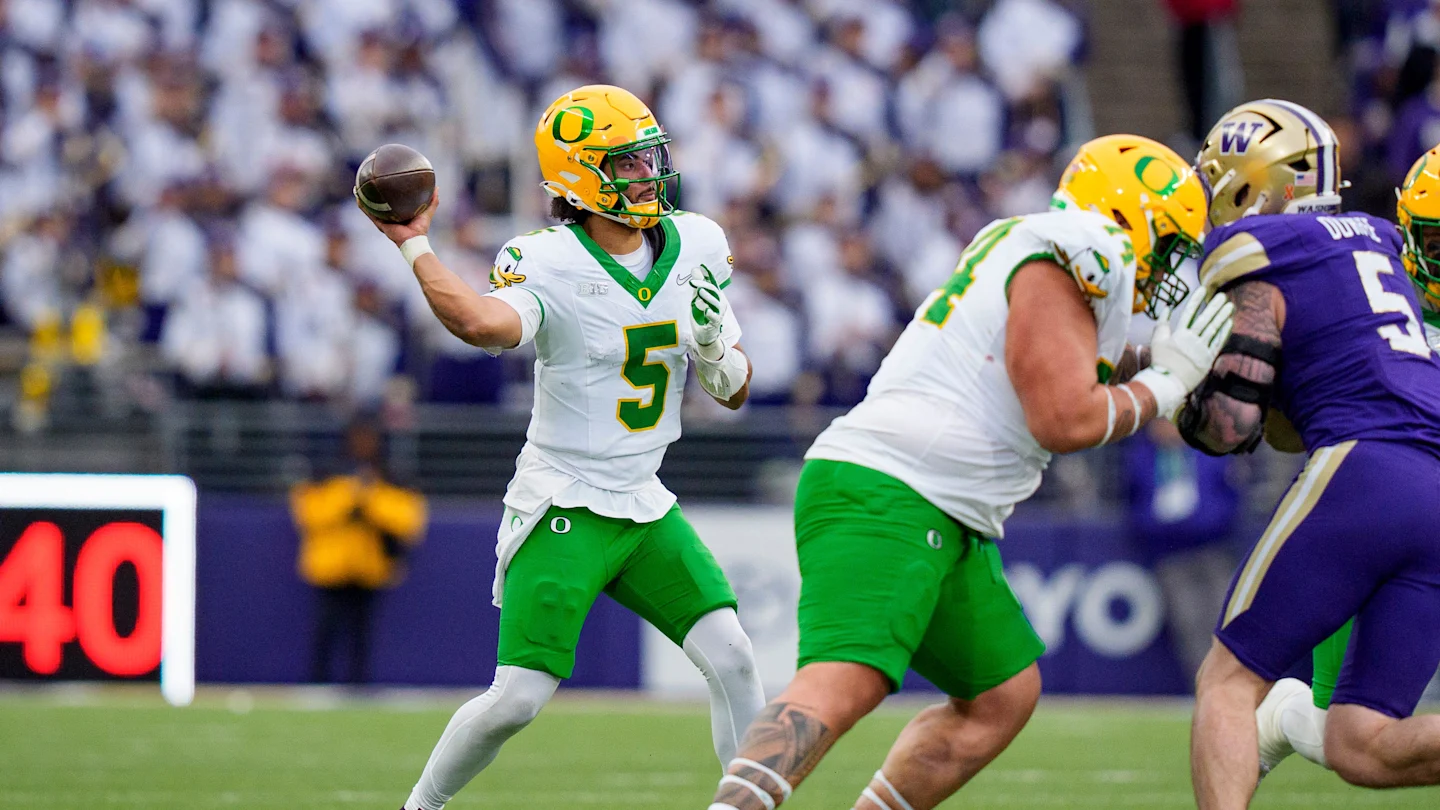
The 2026 NFL draft officially opens on April 23 in the shadows of Acrisure Stadium in Pittsburgh, Pennsylvania.
A prominent discussion around the draft is about the organizations in need of quarterbacks and which quarterbacks are expected to be selected in the first round.
Drafts like 2018 and 2021 have featured five quarterback selections in the first round. The 2022 NFL draft only featured one quarterback (Kenny Pickett) in its first round.
The 2026 NFL draft figures to split the difference. While there are franchises that need new quarterbacks, the number is limited to the ones drafting at the very top of the first round.
As for the quarterbacks who will be selected in the first round, Fernando Mendoza of Indiana and Dante Moore of Oregon are the two who have been connected with the very top of the order. Ty Simpson of Alabama has also been floated as a first-round choice, but his position is less well-known than Mendoza and Moore.
The Athletic compiled a projection of how each NFL team missing the playoffs is expected to approach the draft. The projection linked Moore with the Las Vegas Raiders.

Currently, the Raiders hold the worst record in the NFL at 2-14, putting them in line for the No. 1 overall pick. However, one week remains in the 2025 NFL regular season, and with a handful of teams at 3-13, the draft order can change if the Raiders win their regular-season finale.
Unless the season has produced one of the worst records in the league, a starting quarterback is not a position NFL teams look to draft in the first round.
The last multi-year starting quarterback the Raiders drafted was Derek Carr in the 2014 NFL draft, but that was in the second round. JaMarcus Russell is the last quarterback the Raiders selected in the first round, all the way back in 2007. Before Russell, the last quarterback the Raiders drafted in the first round was Todd Marinovich in 1991.
While the trend of the Raiders drafting first-round quarterbacks is few and far between, Oregon is no stranger to having its quarterbacks selected in the first rounds of NFL drafts. Dating back to 2015, Marcus Mariota, Justin Herbert and Bo Nix have all been selected by NFL franchises in the first round of the NFL draft.
Moore began his college football journey at UCLA in 2023. He played nine games for the Bruins and passed for 1,610 yards, 11 touchdowns and nine interceptions.
When Chip Kelly left UCLA to become Ohio State’s offensive coordinator that offseason, he transferred to Oregon.
After redshirting in 2024, he became the Ducks’ starter in 2025. Ahead of the College Football Playoff quarterfinals, Moore has thrown for 3,046 yards, 28 touchdowns and eight interceptions while rushing for 196 yards and two touchdowns.
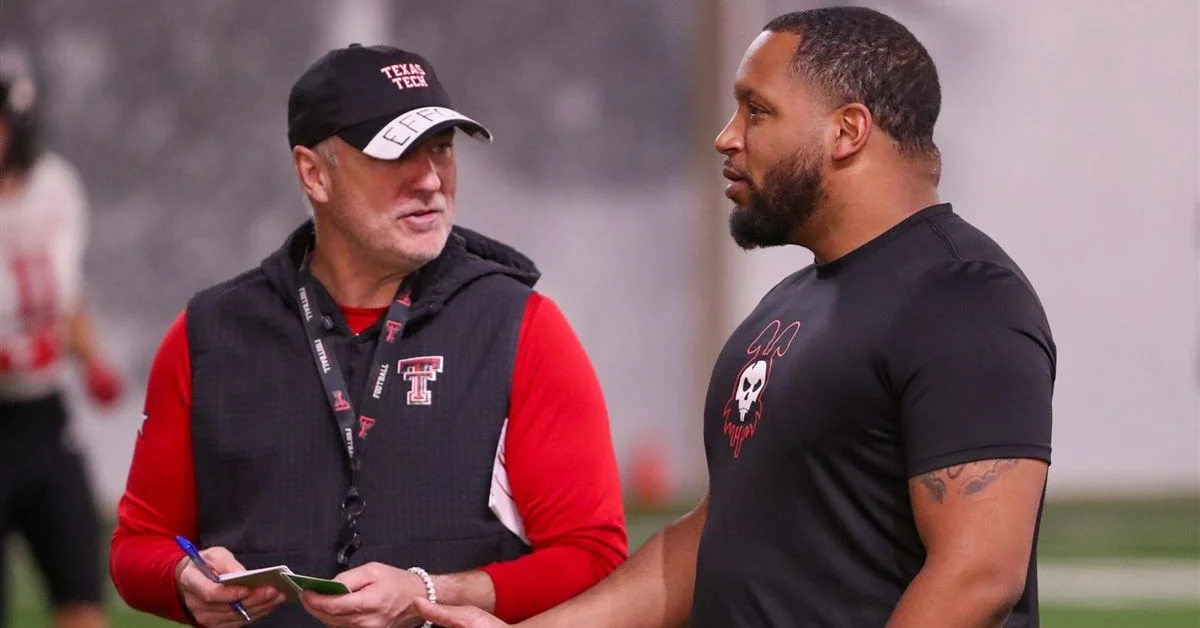
One of the 2025 college football season’s major storylines has been Texas Tech‘s rise to the upper tier. The West Texas program made headlines throughout the year, positioning itself as a power player in the NIL and revenue‑sharing world. The Red Raiders dominated Big 12 play and earned a first‑round bye in the College Football Playoff.
When the Red Raiders take the field on New Year’s Day in the Orange Bowl against Oregon, an experiment four years in the making will play out on the big stage. There has been plenty written this year about Texas Tech’s “Maverick” super donor Cody Campbell, its swashbuckling general manager James Blanchard and fiery head coach Joey McGuire, along with a roster filled with high‑priced talent.
How did the Red Raiders get here?
It has been an intentional build since McGuire was hired Nov. 8, 2021, to save a program that was floundering in West Texas. Having resources is one thing, but executing the plan is another. The current Texas Tech team is an intricate puzzle put together over the span of a presidential term, and every piece matters.


By Ryan Canfield
Published December 31, 2025
Oregon head coach Dan Lanning continued to campaign for the college football season to end on Jan. 1 every year in an effort to fix multiple issues.
Lanning noted the challenges of coordinators who take head coaching jobs being forced to juggle responsibilities and said he prefers to reduce the long layoff between games. The 39-year-old has been talking about ending the college football season sooner since the summer.
“Every playoff game should be played every single weekend until you finish the season,” Lanning said during his press conference Wednesday. “Even if it means we start Week 0 or you eliminate a bye, the season ends Jan. 1. And then the portal opens. Then coaches that have to move on to their next opportunities get to move to their next opportunities.”
CLICK HERE FOR MORE SPORTS COVERAGE ON FOXNEWS.COM
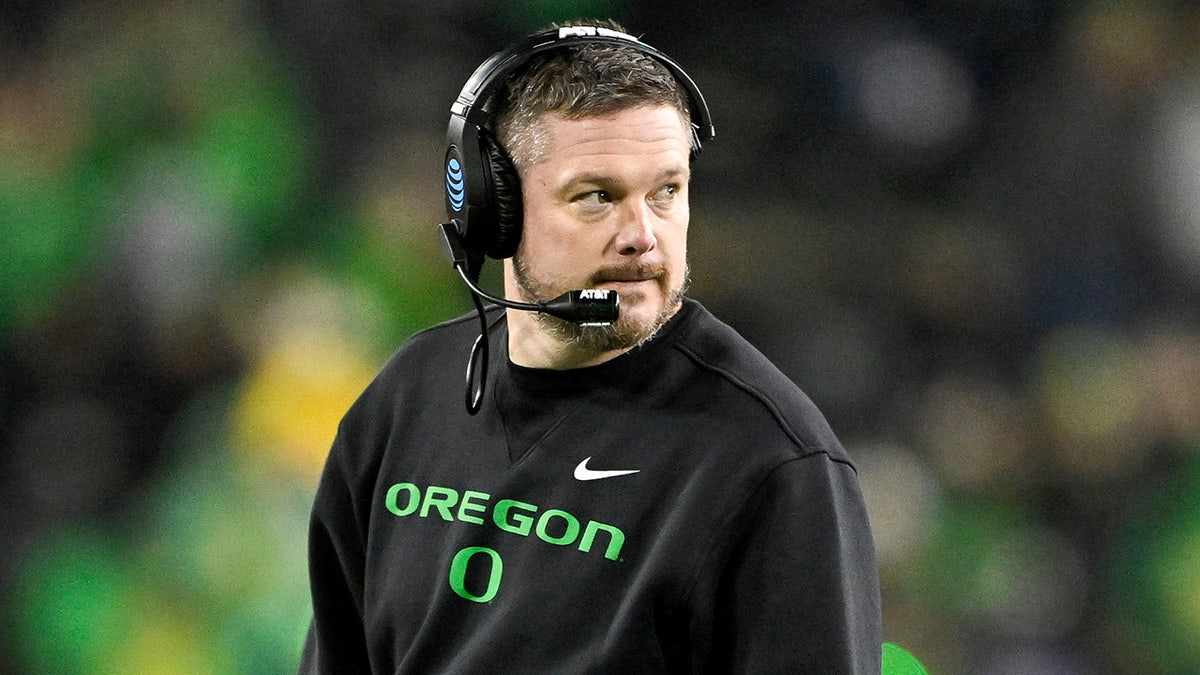
Oregon Ducks head coach Dan Lanning during the fourth quarter against the James Madison Dukes at Autzen Stadium in Eugene, Ore., Dec. 20, 2025. (Craig Strobeck/Imagn Images)
Lanning reiterated throughout his news conference that he thought playing in the first round allowed his team to stay in a rhythm. Last season, Oregon was the No. 1 seed and lost in its first College Football Playoff game to Ohio State.
The NFL plays games on Saturdays throughout the month of December, which Lanning disagrees with. He would rather see Saturdays remain exclusive to college football to quicken the pace of the College Football Playoff to finish the season by Jan 1.
“I’ve got a ton of respect for the NFL, but we’re a prep league for the NFL,” Lanning said. “We do a lot of favors for the NFL. We’re the minor league in a lot of ways, but there’s no money paid from the NFL to take care of college football.
NATIONAL CHAMPION COACH WANTS TRUMP ‘MORE INVOLVED’ IN NIL REGULATION: ‘OUR SPORT IS GETTING KILLED’
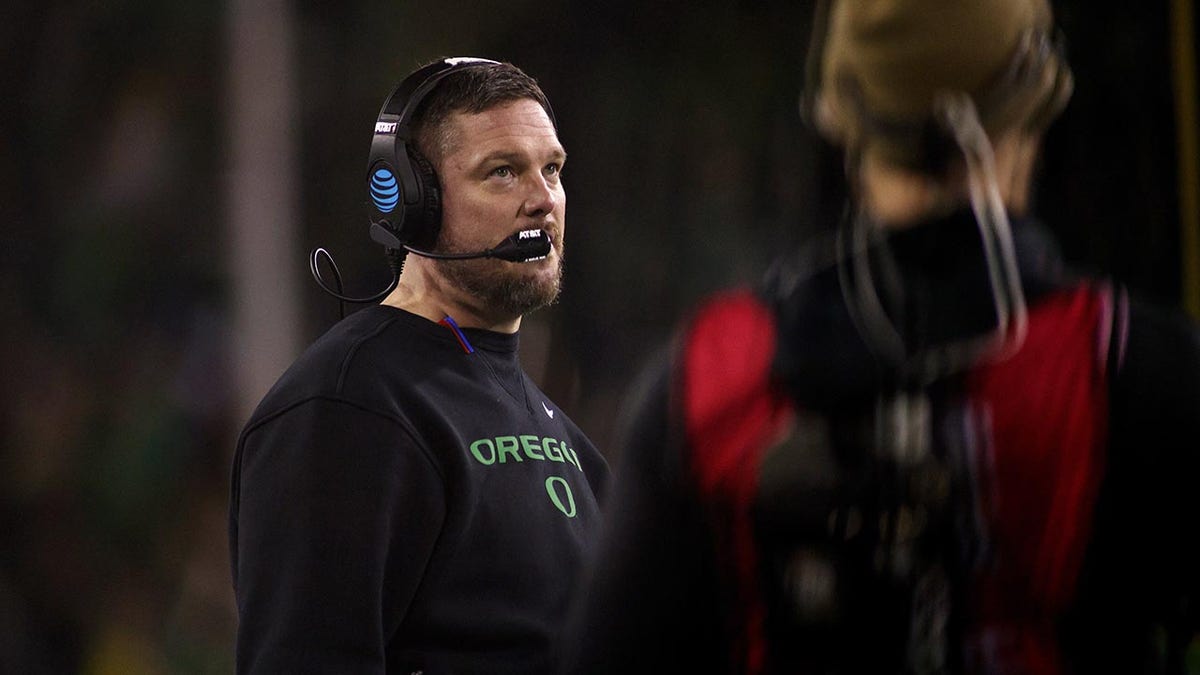
Oregon head coach Dan Lanning looks at the scoreboard during the first half of the first round of the NCAA College Football Playoff against James Madison Dec. 20, 2025, in Eugene, Ore. (AP Photo/Lydia Ely)
“We’ve given up some of our days to the NFL. We said, ‘Oh, you guys get to have this day, you get to have this day, you get to have this day.’ Saturday should be sacred for college football, and every Saturday through the month of December should belong to college football.”
Oregon’s offensive and defensive coordinators are both trying to navigate their dual responsibilities. Offensive coordinator Will Stein took the Kentucky job, while defensive coordinator Tosh Lupoi took the California job.
If Oregon advances beyond the quarterfinals, both coaches will be dealing with navigating the transfer portal, which opens Jan. 2, while also trying to coach the Ducks to a national championship.
CLICK HERE TO DOWNLOAD THE FOX NEWS APP

Bundle FOX One and FOX Nation to stream the entire FOX Nation library, plus live FOX News, Sports and Entertainment at our lowest price of the year. The offer ends on Jan. 4, 2026. (Fox One; Fox Nation)
“Our national championship game this year is Jan. 19, and that’s really hard to envision as a coach that’s going out and trying to join a new program and start a staff,” Lanning said.
“It’s hard for players to understand what continuity looks like and where they’re going to be at and to manage that with visits, the portal, everything else that exists. The clear way to do that is to bump the season up and make sure these playoff games happen a lot faster.”
Oregon will take on Texas Tech in the Orange Bowl Jan. 1 at noon ET.
Follow Fox News Digital’s sports coverage on X, and subscribe to the Fox News Sports Huddle newsletter.
URL
https://www.foxnews.com/sports/oregons-dan-lanning-calls-college-football-season-end-jan-1-every-single-year
It’s a huge week for big-time college sports. We’ve got bowl games every hour, with a national championship at stake. Meanwhile, NCAA basketball repeat violator John Calipari (two Final Four appearances vacated) is delivering lectures about the evils of NIL and the transfer portal. Cal, who has coached for eight NCAA and NBA teams, is shocked, shocked, that college basketball players keep transferring.
The vaunted NCAA — overseer of the once-glorious Pac-10, Big Ten, and Big East — has yielded to a Wild West of “straight cash, homie” and regionally random, power conference monopolies. The system is irreparably broken, yet more popular than ever.
God bless to folks who still love it. I understand the lure of rooting for Old State U, “boola boola” and all that. If you live in a yahoo town with no real professional sports, it’s good to have a legacy college program in your midst. This explains football mania in Columbus, Ohio, State College, Pa., Athens, Ga., and Tuscaloosa, Ala. When March Madness takes hold, it’s the same deal in Lexington, Ky., and Spokane, Wash. All of America loves a nice little 16-seed beating a 1-seed and CBS’s shining moments can make grown men weep.
I get it. I just want no part of it and am proud to work in a region in which big-time college sports don’t move the needle one little bit.
Remember when Boston College had Matt Ryan and the No. 2 football team in the nation for a couple of weeks back in 2007? Of course you don’t. Nobody knew it even then. The Red Sox had just won the World Series, the Patriots were on their way to 18-0, and the Celtics were kicking off the ubuntu championship of 2007-08.
We are a pro sports town. That’s it.
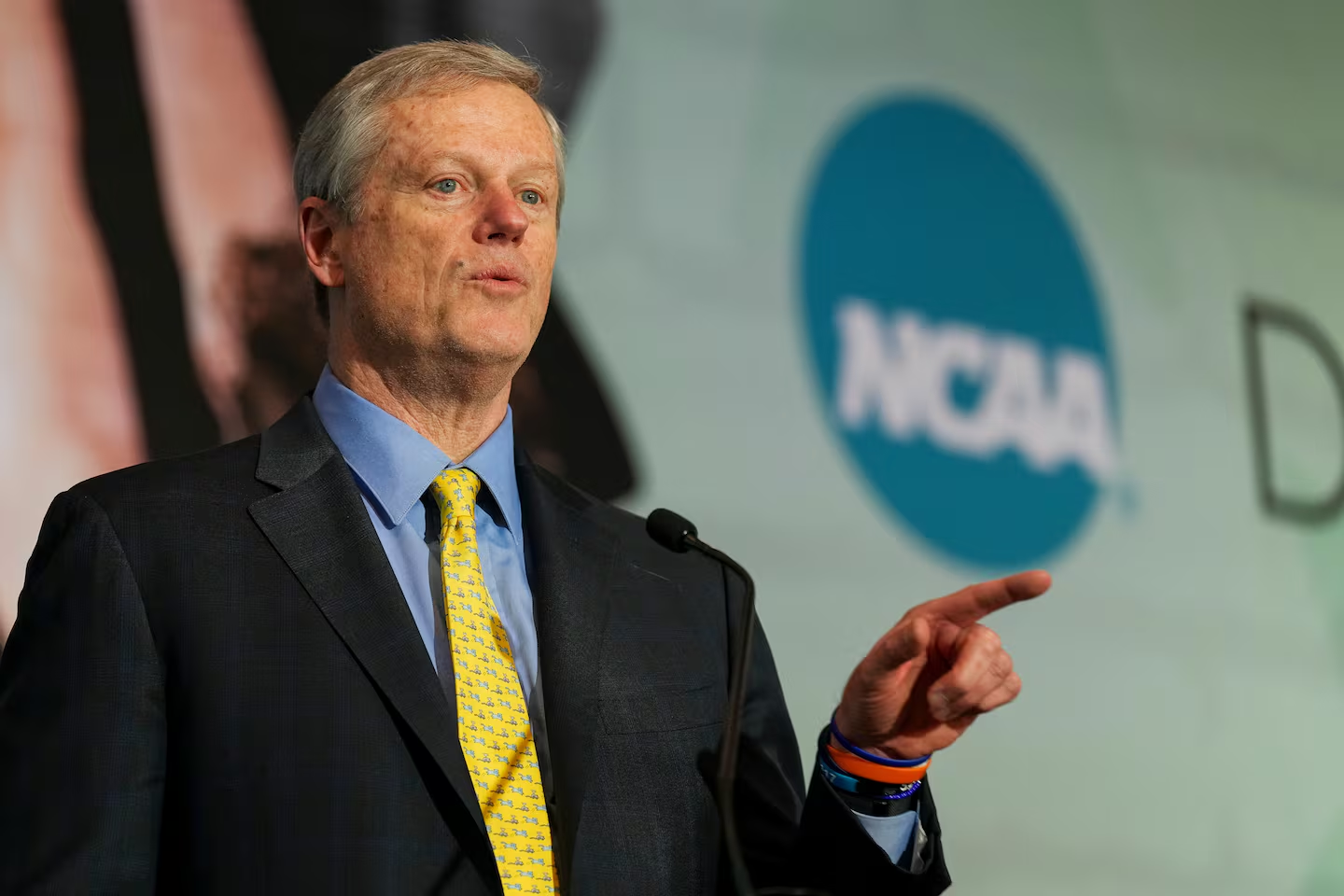
All of which brings me to recent conversations I had with a couple of former Ivy League basketball players: Harvard’s Charlie Baker and Dartmouth’s Peter Roby. They played against one another a half-century ago. Both are tall enough to eat candy off my head. Both graduated in 1979.
Most of you know Baker. He went on to become governor of Massachusetts for eight years, and today he serves as president of the NCAA, a lucrative ($3.15 million per year) yet thankless five-year gig that will take him halfway into 2028.
I told Charlie I wouldn’t take his job for all the money in the world. The NCAA is a hopeless mess and there’s simply no fixing it.
“There’s a lot about it that’s frustrating,” Baker said over lunch last week. “But I spent most of my career in healthcare and government, and those can be frustrating environments, as well. OK?“
Roby knows the college sports landscape as well as anybody. He’s a former athletic director at Northeastern and Dartmouth, was head basketball coach at Harvard, and served a five-year term on the NCAA selection committee for the men’s basketball tournament. He’s an outgoing member of the Knight Commission on Intercollegiate Athletics.
Here’s Roby’s assessment of college sports today:
“No one talks about education or personal development at the highest levels. It’s about transfer portal, NIL revenue sharing, and the need for congressional intervention. Schools continue to complain about rising costs and the need for more revenue, yet they are paying out multimillion-dollar buyouts for fired coaches and hiring coaches at $12 million per year.
“The way things are trending, the NCAA will not exist in its current form in the next few years. It will only manage sports championships. All the legal settlements have resulted in billions of dollars being paid out over the next 10 years, and that money is coming from the NCAA and member schools. This has resulted in less programs being offered to students, coaches, and administrators by the NCAA, while rendering the NCAA powerless to pass overarching legislation or enforce current rules for fear of more litigation. All of this comes as a result of the failure of presidential leadership and overreach by boards of trustees.”

Baker counters: “With all respect to Peter, I don’t think he’s being fair to the power conferences when he puts it that way. For all the talk about the power conferences and the ‘money’ that’s involved in those operations, they are huge investors in women’s sports. I just went to the women’s volleyball championships for the second year in a row. That’s going to be a rocket ship.”
What about NIL?
“In my first year the only people who were allowed to talk to student-athletes about money was everybody but the school,” said Baker. “That’s not good because the school is more likely to have a different point of view than the agents and the collectives. For me, making it possible for the schools to participate in an NIL program so at least they could talk to kids and maybe create a relationship, might help kids stick around. We’re still early in the process.”
We haven’t even gotten into issues of eligibility. Or court rulings. It’s really complicated.
Baker understands the notion that name, image, likeness has, in fact, become “wages.”
“People will call it all kinds of things, and I’m OK with that,“ he said. “Most of these schools, especially the ones that have the biggest school-based NIL programs, those programs are a huge part of these schools’ brand. To say that the Alabama football team doesn’t have a lot to do with the success of the University of Alabama is a misnomer. Same with Ohio State. Michigan. Those schools have benefited in a major way from the success of their sports teams.”
Roby’s position: “It’s time to separate those schools from schools that believe in the primacy of education and the personal development of young people. The NCAA is made up of 1,100 schools in all three divisions and the overwhelming majority of them want to educate young people and prepare them for a life of purpose and impact.
“Let’s create another division within Division 1 to allow like-minded schools to compete on a more level playing field academically, philosophically, and athletically.”
“I think to say that the power conferences don’t care about education is wrong,” argued Baker. “If you look at their graduation rates, they’ve improved dramatically in the last 15 years. I worry a lot about the transfer stuff having an impact on graduate rates, but the transfer rules we had were taken away from us in a court decision in West Virginia a couple of years ago.”
Ah yes, the courts. These days, the NCAA is in court more than the White House. And the law has been friendly to athletes, making the college sports industrial complex ever more complicated and less stable.
“Most of the student-athletes I talk to really want to be students first and want to play sports,” said Baker. “They do not want to be employees. That’s not how they want to roll. Ours is a voluntary membership organization. They can leave any time they want. But the good news is that for 100-plus years, they’ve stayed. But one of the reasons to simplify the Division 1 governing model is that I don’t want schools to leave. I want them to stay. If you leave the NCAA, you give up your chance to win a national championship.
“The thing that people don’t see that I get to see all the time is the kids. They make me glad I am in this role. They are smart, proud, accomplished. The lessons they learn playing sports about teamwork and putting your own interests aside and being able to take constructive criticism and do the grind. They’re applicable everywhere for the rest of their lives.
“I’m too much of an optimist to think anything is hopeless.”
Dan Shaughnessy is a Globe columnist. He can be reached at daniel.shaughnessy@globe.com. Follow him @dan_shaughnessy.

There is no juggernaut. There is no team still standing that will be talked about in the decades to come.
In the absence of one, Ohio State was often treated like one, sporting a historically efficient defense, last season’s national championship rings and the No. 1 ranking for nearly the entire season. But the potentially fatal flaw has been visible since the season opener, when the Buckeyes squeaked by Texas with 14 points. It emerged again in the Big Ten title game, when Ohio State scored 10 points in the loss to Indiana.
The defending champs enter the playoff as the No. 2 seed, but with the 28th-ranked offense, having been limited to less than 20 points per game against the four toughest defenses (Texas, Washington, Michigan, Indiana) it faced, led by a first-year starter (Julian Sayin) who has struggled under pressure, and was sacked five times against the Hoosiers.
Miami’s front is built to create similar havoc — featuring All-American Rueben Bain Jr. and senior Akheem Mesidor — part of a top 10 defense that forces nearly two turnovers per game, shuts down the run and excels in the red zone. The Hurricanes (+9.5) may also struggle to score, but their College Football Playoff first-round upset at Texas A&M will be far more beneficial than the Buckeyes’ 25 days off heading into Wednesday night’s quarterfinal.
Ohio State — still the betting favorite to win the national title — has fallen short of that goal the past three times it spent the majority of the season atop the polls (1998, 2006, 2015). The Buckeyes’ three most recent national championships (2002, 2014, 2024) were all unexpected, including last season’s run as an 8-seed.
Orange Bowl: Texas Tech (+2.5) over Oregon
Texas Tech has exceeded its NIL-fueled hype, winning its first Big 12 title, while going undefeated with Behren Morton under center, as well as 12-0 against the spread with its starting quarterback healthy.
Though Dan Lanning has made the Ducks annual contenders, he has also lost the team’s biggest games every season, most often as the favorite.
Texas Tech’s top-ranked run defense will force Dante Moore to shoulder too much responsibility, having thrown for an average of 149 yards, with one touchdown and three interceptions in his two previous matchups against top 10 defenses (Indiana, Iowa), when the Ducks averaged 19 points.
Rose Bowl: Alabama (+7.5) over Indiana
It was no coincidence that each team that received a bye last year came out flat. The Hoosiers will not be immune to the effects of being off for nearly four weeks, of spending the past month as the top-ranked team in the nation, and no longer able to play the card that no one believes in them.
For once, Alabama carries that chip, in the unthinkable scenario of the most dominant program in the sport’s history playing the role of the underdog against the FBS team with the most all-time losses. The pressure is on the Hoosiers — who have won three games by five points or less — and Heisman winner Fernando Mendoza, whose stock has been inflated by a generationally poor quarterback class.
The Tide won’t lack confidence, coming off an incredible comeback at Oklahoma, and entering with more talent and depth than the nation’s top-ranked team.
Sugar Bowl: Georgia (-6.5) over Ole Miss
The Rebels wouldn’t have signed up for this rematch after surrendering the game’s final 17 points — of a season-worst 43 allowed — against the Bulldogs on Oct. 18, when Georgia controlled possession and Gunnar Stockton had his best performance of the season.
Kirby Smart’s core won’t face-plant in back-to-back playoffs, with his defense peaking — allowing an average of 7.3 points in the past four games — and Lane Kiffin’s absence certain to be felt.
ReliaQuest Bowl: Iowa (+5.5) over Vanderbilt
The Hawkeyes always have hope, suffering their four losses — all against ranked teams — by an average of less than four points. It doesn’t feel good to bet against Diego Pavia, but Iowa’s top 10 defensive ranking is well-earned, having held a pair of top 10 offenses (Indiana, Oregon) to nearly 20 points below their season averages.
Sun Bowl: Duke (-3.5) over Arizona State
The Sun Devils haven’t been the same without starting quarterback Sam Leavitt. Now, Kenny Dillingham will be without his top receiver, running back and pass rusher, as well as both starting tackles.
That is enough to tilt the field in favor of one of the ACC champs, whose opportunistic defense should give extra possessions to Darian Mensah, the nation’s fourth-leading passer.
Citrus Bowl: Michigan (+6.5) over Texas
It’s hard to know which team will show up when so many key players from each side won’t show up. Though Arch Manning will suit up — who knows for how long? — the Longhorns defense and backfield has been decimated, making the Wolverines a live dog after their upset of Alabama in the same bowl last year. New coach Kyle Whittingham will be watching. Will Sherrone Moore?
Las Vegas Bowl: Utah (-14.5) over Nebraska
The Cornhuskers will have plenty of issues putting up points without their star quarterback (Dylan Raiola) and running back (Emmett Johnson), but the defense is a bigger problem, most recently surrendering 40 points to Iowa’s 121st-ranked offense.
Utah’s longtime defensive coordinator turned head coach, Morgan Scalley, knows the path to success comes from pounding the rock. Anything under 200 yards would be a shock.
Armed Forces Bowl: Rice (+14.5) over Texas State
A game that highlights the absurdity of the bloated bowl season features an Owls (5-7) team that has no business being rewarded. But Rice — which was only invited after multiple schools declined — should demonstrate urgency, looking for its first bowl win since 2014 under first-year coach Scott Abell. The Bobcats are 0-2 against the spread this season as favorites of two touchdowns or more.
Liberty Bowl: Navy (-7.5) over Cincinnati
Since 2013, the service academies are 19-3 against the spread in bowl games, being largely shielded from opt-outs and the transfer portal.
Cincy isn’t so lucky, entering this game without standout quarterback Brendan Sorsby — who will soon collect seven figures elsewhere — and at least five other starters. Even at full strength, the Bearcats would’ve struggled to stop Navy’s top-ranked ground game, owning the nation’s 104th-ranked run defense.
Holiday Bowl: Arizona (-2.5) over SMU
The Wildcats will want it more, bouncing back from a 4-8 campaign to potentially finish this season with six straight wins, while the Mustangs — who are 0-3 in the postseason under Rhett Lashlee — may struggle to find motivation, most recently blowing their chance to make the playoff for the second straight year. Arizona hasn’t allowed more than 200 yards passing since September.
Betting on College Football?
Duke’s Mayo Bowl: Mississippi State (-3.5) over Wake Forest
The Bulldogs endured a grueling SEC gauntlet, and are far better than their record (5-7) suggests, having also gone 3-0 against the spread as a favorite. True freshman quarterback Kamario Taylor ran for 173 yards and two touchdowns in his first career start against Ole Miss, while the Demon Deacons’ inconsistent offense will be without leading-rusher Demond Claiborne.
Best bets: Georgia, Navy
This season: 116-131-1 (18-31) (entering Tuesday)
2014-24 record: 1,392-1,309-31
Why Trust New York Post Betting
Howie Kussoy has long been the New York Post’s main handicapper in college basketball (since 2011) and college football (since 2013).
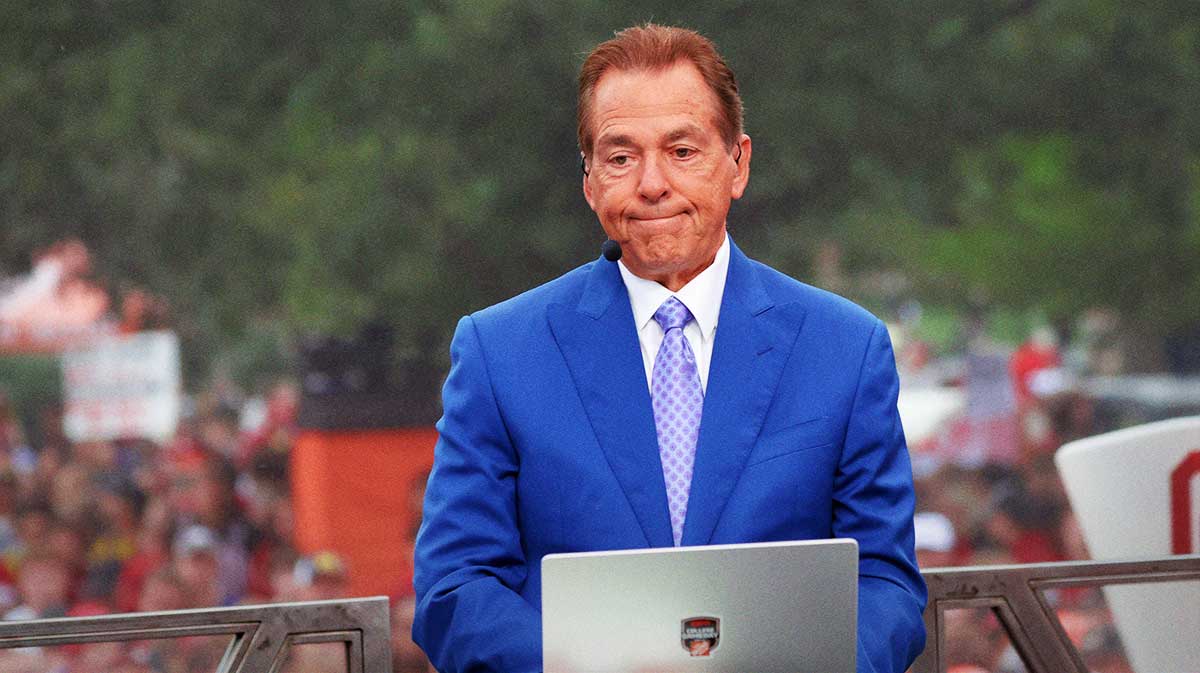
James Nnaji NIL signing with Baylor basketball has Nick Saban up in arms appeared first on ClutchPoints. Add ClutchPoints as a Preferred Source by clicking here.
The 2025 college basketball season has been upended by the fact that a former NBA Draft pick, James Nnaji, joined the Baylor basketball program mid-season. James Nnaji was picked 31st in the 2023 NBA Draft, and after trades, the Knicks currently own his draft rights. The Bears added Nnaji because he has never played college basketball or the NBA, but the move has sent ripples through college basketball.
Advertisement
One of the biggest names in college sports and a legendary college football coach, Nick Saban, addressed the situation with Nnaji on the most recent episode of “The Pat McAfee Show.” Saban made clear that he likes that the players can make money, but he does not like the constant transferring and how muddied the eligibility rules are. He also said that he got a lot of complaints from John Calipari and Tom Izzo despite not being involved in basketball.
Saban said, “I want them to make money. I think they should make money, but there should be some restrictions on how they go about doing it, and the movement is as big an issue to me as the money itself. I mean, everybody being able to transfer at all times. I mean, that’s not a good thing.
“Now we even have a basketball player going to Baylor after he played in the NBA. I mean, you heard me say this before: you want a quarterback drafted by the New York Giants? He’s going to be playing for Penn State. What about that? How crazy it’s got. I got Calipari and Izzo blowing me up. I’m not even a basketball guy. Blowing me up about this kid.”
One massive reason Saban retired in the first place was the issues that have popped up in college football and college sports in general, related to the lack of guardrails on NIL and the excessive emphasis on the transfer portal.
Advertisement
Nick Saban has also been consistently trying to fix college sports. While the NCAA said no one who plays in the NBA will be eligible, Nnaji never played in the NBA, which is a big loophole.
Related: Tiffani-Dawn Sykes gets real on potential Virginia State move to the MEAC
Related: Caleb Wilson accomplishes North Carolina Tar Heels feat not seen in 30 years

H.S. INDOOR TRACK & FIELD: GLOW region athletes shine in RWTL meet at Nazareth University | Sports

LANE ONE: Projecting the top stories of 2026 (10 to 6), with questions about Russia, Israel, esports, doping, college chaos and, of course, track & field

$2.3 million college football QB heavily linked to struggling NFL team

Inside Joey McGuire’s calculated program build

Texas A&M Volleyball makes USA Today’s Top Women’s Moments list

Stockton students making an impact in community with school Police Explorers

2025 Volleyball Year in Review – UCF Athletics
Oregon’s Dan Lanning calls for college football season to end by Jan 1 every year

The 2025 Your Prep Sports Area Volleyball Team

Dan Shaughnessy: Is college sports broken?

2025-26 College Football Playoff quarterfinal, bowl game predictions, picks, odds

James Nnaji NIL signing with Baylor basketball has Nick Saban up in arms

Joey McGuire plays ol’ high school coach as Texas Tech faces pivotal moment vs. Oregon

Fantin’s Late Goal Lifts No. 4 Nittany Lions over No. 10 Cornell – Penn State

2025 All Mountain Volleyball | Sports

SoundGear Named Entitlement Sponsor of Spears CARS Tour Southwest Opener

Donny Schatz finds new home for 2026, inks full-time deal with CJB Motorsports – InForum

Black Bear Revises Recording Policies After Rulebook Language Surfaces via Lever

David Blitzer, Harris Blitzer Sports & Entertainment

How Donald Trump became FIFA’s ‘soccer president’ long before World Cup draw

DeSantis Talks College Football, Calls for Reforms to NIL and Transfer Portal · The Floridian

JR Motorsports Confirms Death Of NASCAR Veteran Michael Annett At Age 39
Elliot and Thuotte Highlight Men’s Indoor Track and Field Season Opener

Rick Ware Racing switching to Chevrolet for 2026

#11 Volleyball Practices, Then Meets Media Prior to #2 Kentucky Match

23 عاما من الفضائح السياسية والجنسية منذ انقلاب حمد بن خليفة.. استغلال الفتيات الصغيرات في الدعارة.. ضبط ابنة رئيس وزراء قطر خلال ممارستها لجنس الجماعي.. ملامح الحكم تتخبط بين المنفي وتدخلات النساء

Colleges ponying up in support of football coaches, programs

Nascar legal saga ends as 23XI, Front Row secure settlement
West Fargo volleyball coach Kelsey Titus resigns after four seasons – InForum

23 عاما من الفضائح السياسية والجنسية منذ انقلاب حمد بن خليفة.. استغلال الفتيات الصغيرات في الدعارة.. ضبط ابنة رئيس وزراء قطر خلال ممارستها لجنس الجماعي.. ملامح الحكم تتخبط بين المنفي وتدخلات النساء





-
 Sports3 weeks ago
#11 Volleyball Practices, Then Meets Media Prior to #2 Kentucky Match
-
 Motorsports3 weeks ago
Nascar legal saga ends as 23XI, Front Row secure settlement
-
 Sports3 weeks ago
Maine wraps up Fall Semester with a win in Black Bear Invitational
-

 Motorsports3 weeks ago
Sunoco to sponsor No. 8 Ganassi Honda IndyCar in multi-year deal
-

 Motorsports2 weeks ago
Ross Brawn to receive Autosport Gold Medal Award at 2026 Autosport Awards, Honouring a Lifetime Shaping Modern F1
-
 Rec Sports3 weeks ago
WNBA’s Caitlin Clark, Angel Reese and Paige Bueckers in NC, making debut for national team at USA camp at Duke
-

 NIL3 weeks ago
Nike Signs 10 LSU Athletes to NIL deals
-

 Rec Sports2 weeks ago
Stempien to seek opening for Branch County Circuit Court Judge | WTVB | 1590 AM · 95.5 FM
-

 Motorsports3 weeks ago
Rick Hendrick comments after the NASCAR lawsuit settlement
-
Sports3 weeks ago
Wisconsin defeats Stanford in NCAA regional semifinals: Updates, recap