
Technology
The fitness tracker most amateur athletes should buy



The Vivoactive 6 is a surprisingly robust fitness smartwatch with advanced training tools and key sport features that make the watch one of Garmin’s best-value offerings. It doesn’t pack a ton of smart features or ECG support, but it nails the basics and packs in many of Garmin’s best features for under $300. That makes it an easy recommendation for most amateur athletes.
After three weeks with Garmin’s newest Vivoactive 6, I’m fairly convinced it’s the fitness tracking watch most amateur athletes should buy. Not because it does everything, but because it does exactly what matters, without overcomplicating your wrist (or torching your wallet). The brand’s higher-end wearables like the Fenix and Epix lines come packed with maps, metrics, and battery stats to withstand a multi-week expedition, but unless you’re training for a back-country sabbatical, the Vivoactive 6 is lighter, more comfortable, and every bit as reliable.
A subtly updated experience
The Vivoactive 5 was a major leap over the 4, introducing an AMOLED display and new health features. The Vivoactive 6 continues that momentum with a more polished interface, expanded workout tools, and thoughtful refinements that make it an even better fit for everyday athletes.
The most immediately apparent change is the device’s completely revamped user interface. Garmin redesigned the settings, controls, and overall navigation system to be more intuitive, giving the Vivoactive line a smoother, more modern feel. If you’re new to Garmin devices, you’ll likely appreciate the layout. However, if you’ve been using Garmin watches for years like I have, you might feel a bit thrown off as your muscle memory adjusts.
A redesigned UI experience may take getting used to for Garmin loyalists, but it’s designed to be intuitive in the long run.
To be honest, I found the changes frustrating at first, and while I’ve mostly adjusted, I still occasionally fumble for old shortcuts that no longer exist. I am only now getting used to a long press not taking me to my settings.

Kaitlyn Cimino / Android Authority
Cosmetically, the Vivoactive 6 stuck to the 5’s single 42mm case size (instead of going back to two options like the 4), which is disappointing. Fortunately, it’s a comfortable middle ground for most wrist sizes; not too oversized or too petite. The build itself is sleek and minimalist, with a tweaked button design I really like. Overall, the device is slightly more casual than the Venu 3’s upscale look without going too cheap. It is available in four colors, including the Jasper Green pictured above, a soft pink, and two neutrals. For all-day wear, I found the watch very comfortable and incredibly lightweight (just 23g) compared to almost every other watch I own, especially during workouts.

Kaitlyn Cimino / Android Authority
On that front, Garmin expanded the device’s sport profile options, adding about 50 new workout types. This gives the Vivoactive family more versatility, even if it isn’t an everything-but-the-kitchen-sink lineup. Garmin also improved the device’s customizable data pages so you can now add up to eight data fields per screen instead of just four. I was personally excited to see animated workouts return to the lineup, which I like to use for HIIT sessions.
The Vivoactive 6 adds a few advanced training tools and customization options, plus animated workout guidance.
Meanwhile, for avid runners, the watch now supports the brand’s PacePro and Running Dynamics (ground contact time, stride length, etc.). These features are readily available on Garmin’s higher-end models, so it’s nice to see them trickle down to the Vivoactive series. I dipped into the device’s added navigation options for following routes (breadcrumb style), which are useful albeit simple. Like the Venu series, there are still no maps here.
For walkers, the watch adds Daily suggested workouts, though I found these often underestimated what I was up for doing each day. Then again, I love to walk excessively and maybe Garmin knows better what is actually a healthy amount. Notably, the watch does not feature a barometric altimeter, so if you want to track altitude on your hikes, you’ll need something higher up in Garmin’s range.
Finally, for sleeping off more grueling workouts I was excited by the addition of Smart Wake Alarm, which is relatively new to the Garmin ecosystem. The watch uses sleep data to wake users during a lighter stage of sleep within a set window (up to 30 minutes before your chosen alarm time). It may sound like a subtle feature, but it can make a real difference in how rested you feel when you wake up. You also can choose to use the feature or not from alarm to alarm. Compared to a regular alarm in your list, one with Smart Wake enabled features a star icon.
For healthier wake ups, Garmin adds Smart Wake alarms.
Unfortunately, I didn’t get many nights of adequate sleep during this review, so Garmin rarely saw fit to wake me earlier than the last possible moment (my set time). Still, I appreciated the personalized approach and look forward to more restful nights ahead. For now, the alarm haptics weren’t too jarring while managing to wake me up without disturbing my partner.
Accuracy where it counts

Kaitlyn Cimino / Android Authority
As always, features are fairly meaningless without accuracy. While some features, like perceived exertion or even sleep stages, are either subjective or hard to verify, others are quite straightforward.
On the heart rate tracking front, I was disappointed to see the watch land without Garmin’s latest Elevated heart rate sensor. This means we don’t get ECG support like on the Venu 3, and also just simply don’t get the most powerful heart rate tracking tech available. That might not matter to most casual users, but if you’re interested in ECG functionality or need more advanced heart metrics for medical or training purposes, this could be a dealbreaker. It also keeps the Vivoactive 6 and 5 more similar than I was hoping.

I tested the device’s heart rate tracking in a variety of conditions including everything from long outdoor runs to high-intensity interval training, and for the most part, it consistently delivered accurate data. However, it did occasionally struggle during weight lifting and rowing, both of which can put more strain on your wrist. You can see in the graph above where the watch dropped off rather than keeping up with my dedicated chest strap. This was surprising to me as I’ve always found Garmin devices largely very reliable. It is possible it could be a fit issue, however, and I’m keen to continue testing.

Likewise, GPS accuracy is another Vivoactive 6 highlight. I tested the watch on a mix of city runs, trail hikes, and suburban loops, and tracking was consistently spot-on. Its signal locked on quickly and without issue. According to its specs, the watch features updated GPS, (adding Beidou & QZSS), but I didn’t notice any significant change.
It still does not feature dual frequency like Garmin’s pricier models, and though it generally performs as well as devices that do, there might be some cases where it won’t. In that map above, for example, the Apple Watch Ultra 2 traced my actual route, a tree-lined neighborhood run, while the Vivoactive 6 recorded me slightly off my route and at one point, on the wrong side of the road.
For better or worse, still not a full-out smartwatch

Kaitlyn Cimino / Android Authority
The Vivoactive 6 excels as a fitness-first device for athletes who want a reliable, comfortable workout companion at a good price. As a smartwatch, the Vivoactive 6 keeps things minimal. You get smart notifications, music storage, and contactless payments, which is enough for me to head out without my phone or wallet. There’s still no speaker or mic onboard for phone calls or voice assistants and certainly no LTE support like I was hoping.
I initially wanted to see more smart features, but in the end enjoy the distraction-free experience.
Yet, call me fickle, but I actually found that to be a plus. The stripped-down approach keeps me focused on what Garmin does best (tracking my fitness) without layering on distractions or features I rarely use. I didn’t miss the temptation to fire off elaborate texts, or the ability to answer calls from my wrist. In fact, I appreciated the sense of separation when heading out for a run.

Kaitlyn Cimino / Android Authority
Additionally, without power-hungry smart features like voice assistants or LTE, battery life holds steady, offering the same 11 days in smartwatch mode and up to 21 hours with GPS as the previous generation. Those are impressive specs when you consider the device’s bright AMOLED display. In testing, the watch averaged closer to five days with always-on mode enabled and daily GPS workouts, putting my Pixel Watch 3 and Apple Watch Series 10 to shame.
Garmin Vivoactive 6 review: The verdict

Kaitlyn Cimino / Android Authority
I started this review stating that the Vivoactive 6 is the Garmin tracker most athletes should buy, and I stand by it. It nails the basics, skips the fluff, and helps me focus on fitness mid-workout. It’s also light, comfortable, and packed with just enough smart features to keep things convenient without draining battery. It’s not a full-on smartwatch, but I didn’t miss silencing phone calls at the gym or getting distracted by apps. What I got instead was a reliable training partner that packs in many of Garmin’s best tools. For $299, that’s not bad.
The Vivoactive 6 is a well-priced, reliable fitness tracker packed with more than enough tools for amateur athletes.
If you’re chasing serious trail maps or want a wrist-based assistant, Garmin’s more full-featured lines will serve you better. The Venu 3 ($449.99 at Amazon) packs in a few more smart features and ECG support. The latest Fenix 8 ($999.99 at Amazon) comes loaded with advanced training features and detailed mapping. There are also a variety of Forerunner models to consider. In other words, Garmin’s stable is a crowded one.
Outside the house of Garmin, the Apple Watch SE ($269.99 at Amazon) is a great pick for iOS users who want a few more smart features while still accessing accurate fitness tracking. Google’s Pixel Watch 3 ($349.99 at Amazon) is a pricier, but equally solid smartwatch option for Android phone users.


Smart technology has quietly reshaped nearly every part of modern life, from how we manage our homes to how we consume entertainment. One area seeing particularly rapid innovation is online gaming. Advances in artificial intelligence, cloud computing, and mobile connectivity are not just improving visuals or speed — they’re fundamentally changing how users interact with digital gaming platforms. For tech-savvy audiences, this evolution represents a fascinating case study in how intelligent systems enhance user experience at scale.
Online gaming platforms today are built on sophisticated technology stacks designed to personalize content, streamline performance, and improve security. This shift is especially visible in online casino gaming, where algorithms analyze player behavior to deliver tailored game recommendations and seamless performance across devices. For example, players looking to explore modern gaming platforms can Experience the thrill of top-rated casino games at Winna while seeing firsthand how smart systems elevate engagement and usability.
As entertainment increasingly converges with technology, the online gaming sector offers valuable insight into how innovation drives adoption, retention, and trust.
AI and Machine Learning Powering Smarter Gameplay
 AI and Machine Learning Powering Smarter GameplayiStock
Artificial intelligence plays a central role in today’s online gaming experiences. Machine learning models continuously analyze gameplay data to understand user preferences, playing patterns, and engagement habits. This allows platforms to create more intuitive interfaces and personalized recommendations without requiring users to manually search for content.
In casino-style gaming, AI helps recommend games based on past behavior, optimize load times, and ensure smooth performance during high-traffic periods. Beyond user experience, AI is also critical for maintaining fair play. Behavioral analysis tools can detect unusual activity, flag potential fraud, and help operators maintain secure, trustworthy environments — an essential factor for platforms handling real-money transactions.
From a broader technology perspective, these systems demonstrate how real-time data processing and adaptive learning models are becoming essential components of modern digital services.
Cloud Computing and the Shift to Device-Agnostic Gaming
 Cloud Computing on the rise iStock
Cloud technology has removed many traditional barriers to entry for online gaming. Instead of relying on powerful local hardware, games can now be rendered and processed remotely, with gameplay streamed directly to users’ devices. This shift allows complex, graphics-rich experiences to run smoothly on smartphones, tablets, and laptops.
For consumers, this means flexibility — gaming is no longer tied to a single device or location. For developers and operators, cloud infrastructure enables faster updates, scalable performance, and reduced downtime. These benefits are especially important for online platforms that must remain accessible around the clock while supporting thousands of simultaneous users.
As cloud adoption accelerates across industries, online gaming stands out as one of the clearest examples of how distributed computing enhances both performance and accessibility.
Mobile Connectivity and Market Growth
Mobile technology has been one of the biggest drivers of growth in the online gaming sector. Improvements in smartphone processing power, combined with faster networks like 5G, have made mobile gaming experiences nearly indistinguishable from desktop or console play.
Industry data highlights just how significant this shift has been. According to Statista’s research on mobile gaming market trends, mobile games account for a substantial share of global gaming revenue, driven by ease of access and growing consumer demand.
For online gaming platforms, optimizing for mobile is no longer optional. Responsive interfaces, fast-loading content, and secure mobile payment systems are now baseline expectations. Platforms that successfully integrate these elements benefit from higher engagement and broader audience reach.
Security Innovations Building User Trust
Security remains a top concern for users engaging with online gaming platforms, particularly those involving financial transactions. Smart technology has enabled several major advancements in this area, helping build confidence and credibility across the industry.
Modern platforms rely on encryption protocols to protect personal and financial data, while AI-powered monitoring systems analyze activity in real time to identify irregular behavior. Some platforms are also experimenting with biometric authentication and blockchain-based transaction verification to further strengthen transparency and security.
These technologies not only protect users but also demonstrate how advanced security solutions can be deployed at scale without sacrificing user convenience — a balance many digital industries continue to pursue.
Social Features and Interactive Experiences
 Social Features and Interactive Experiences iStock
Gaming has evolved from a solitary activity into a highly social experience. Smart technology has enabled real-time chat, live multiplayer interaction, and integrated streaming features that allow users to share gameplay instantly.
Live gaming and streaming platforms have blurred the line between player and audience, creating communities built around shared interests and experiences. As virtual and augmented reality technologies continue to mature, these social elements are expected to become even more immersive, allowing users to interact in fully realized digital environments.
This shift reflects a broader trend in tech-driven entertainment: experiences are no longer just consumed — they’re shared.
What the Future Holds for Smart Gaming
The next wave of innovation in online gaming will likely focus on deeper AI integration, enhanced immersion, and cross-platform compatibility. AI-generated content, adaptive storytelling, and predictive personalization will allow platforms to deliver experiences that evolve with each user.
Virtual reality, augmented reality, and spatial computing are also poised to redefine how players interact with digital worlds. Combined with cloud infrastructure and intelligent analytics, these technologies will continue pushing online gaming toward more immersive, responsive, and inclusive experiences.
Conclusion
Online gaming has become a powerful showcase for how smart technology can transform digital experiences. Through AI-driven personalization, cloud-based performance, mobile optimization, and advanced security, modern platforms are delivering entertainment that is more accessible, engaging, and secure than ever before.
For tech-focused audiences, this evolution highlights the practical impact of intelligent systems operating behind the scenes. As innovation continues, online gaming will remain at the forefront of demonstrating how technology enhances not just how we play — but how we connect, interact, and experience digital entertainment.
From Your Site Articles
Related Articles Around the Web

Launching for the Spring 2026 semester, the TLTC Innovation Hub will expand hands-on discovery, immersive learning and high-quality content creation
for the Seton Hall community. The Hub supports academic inquiry and creative exploration
across disciplines by bringing together fabrication tools, XR and AI technologies
and production studios, plus open collaboration spaces and consultation rooms.
“We built the Innovation Hub so that learning does not stop at the classroom door,”
said Michael Soupios, executive director of the Teaching, Learning and Technology Center. “It is a creative space where students and faculty can experiment with new tools,
turn ideas into prototypes and explore projects beyond traditional assignments. The
Innovation Hub helps transform how we teach and learn by giving our community room
to explore, make and imagine what is possible.”
The Innovation Hub includes an open lounge and collaboration space with comfortable
seating, flexible work areas, ambient lighting and easy power access. The Hub also
features several dedicated studios, each designed for a different kind of making,
creating and problem-solving. Here is what students, faculty and staff can expect
in each area.
Maker Studio
 A hands-on space for designing, prototyping and building. Users can work with 3D printing,
laser engraving and desktop CNC machining, plus sublimation printing, vinyl cutting
and robotics or microcontroller kits. Completed 3D prints can be retrieved through
secure project pickup lockers.
Learn more about the Maker Studio and available equipment.
XR/AI Studio
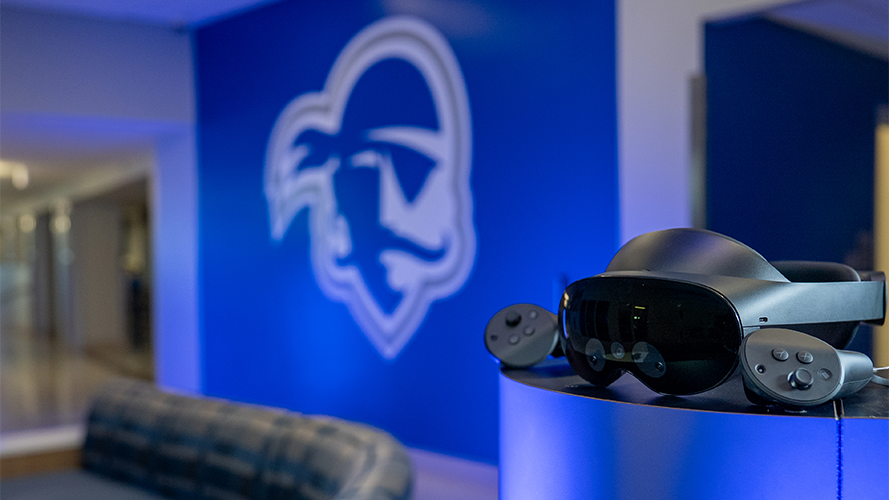 A dedicated space for extended reality, mixed reality and AI exploration. Users can
work with Meta Quest Pro headsets, immersive applications and simulations, along with
workshops and training to support XR integration in courses and projects.
Explore the XR and AI Studio.
Content Creation Studios
 Four spaces for creating high-quality audio and video, including a four-microphone podcast studio, a one-button video studio, a lightboard studio and a production
studio supported by the TLTC’s Digital Media Team.
Learn more about the Content Creation Studios.
Solutions Studio
 The Solutions Studio is the Innovation Hub’s walk-up support desk and first stop for
technology assistance. Beginning in Spring 2026, select Information Technology services
currently located in Corrigan Hall will operate from the Innovation Hub, providing
support for technology questions and laptop or mobile device issues. Located in the
open-style seating area next to the elevator, the Solutions Studio is designed to
be approachable and make it easy to get the help you need.
“By relocating the Solutions Studio to a central location in the Innovation Hub, we
are ensuring that every member of the University community has easy access to the
technology support they need,” said John Fernandes, senior director of IT Service
Management. “From assistance with SHU network login issues such as Wi-Fi and account
access to hardware and software support, our goal is to deliver a premier experience.
Whether you are troubleshooting an issue or learning something new, we invite everyone
to stop by. We are here to help.”
Visit the Solutions Studio.
The Hub will officially open in the Spring 2026 semester, with a grand opening celebration
and a blessing of the new Walsh Library entrance planned later in the semester. The
TLTC Innovation Hub is designed to make innovation more accessible for students, faculty
and staff. Whether you are studying, meeting with classmates, brainstorming a project
or exploring emerging technologies, the Innovation Hub is a place where learning becomes
interactive, content is created and ideas come to life.
Updates on services and access will be shared in the coming weeks. Visit the TLTC Innovation Hub webpage for additional information.
Categories:
Science and Technology
Purely digital games lack tactile, social play, while classic board games can’t adapt probabilities, stream competition, or evolve with live data. Base on Board 2.0 delivers the best of both with dynamic E-ink smart dice that shift probabilities in real time using MLB stats, plus AI commentary and visual effects. Altogether, Base on Board 2.0 delivers authentic baseball drama and supports competitions in a physical-digital gaming hybrid experience.
Gaming PC Market Forecast and Outlook 2026 to 2036
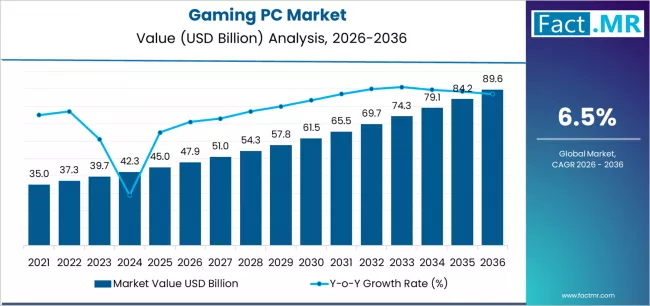
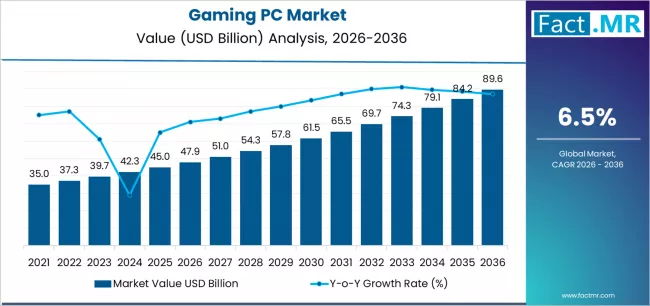
The global gaming PC market is valued at USD 47.9 billion in 2026 and is projected to reach USD 89.6 billion by 2036, reflecting an absolute increase of USD 41.7 billion. This represents total growth of 87.1%, with the market expanding at a CAGR of 6.5% over the forecast period.
Growth is driven by rising demand for high-performance gaming systems, increasing esports participation, and growing requirements for advanced gaming experiences across competitive gaming, content creation, and virtual reality applications.
Quick Stats for Gaming PC Market
- Gaming PC Market Value (2026): USD 47.9 billion
- Gaming PC Market Forecast Value (2036): USD 89.6 billion
- Gaming PC Market Forecast CAGR: 6.5%
- Leading System Type in Gaming PC Market: Desktop Gaming PCs (72.3%)
- Key Growth Regions in Gaming PC Market: Asia Pacific, North America, Europe
- Key Players in Gaming PC Market: Dell Technologies Incorporated, Hewlett-Packard Inc., ASUSTeK Computer Inc., Micro-Star International Co. Ltd., Corsair Gaming Incorporated
Desktop gaming PCs are expected to account for 72.3% of market share in 2026, supported by their superior performance capabilities, upgrade flexibility, and thermal management advantages. Competitive gaming applications are projected to hold 48.7% share, driven by demand for high refresh rates, low-latency processing, and stable performance in professional esports and streaming environments.
Between 2026 and 2030, the market is forecast to grow to USD 65.8 billion, contributing 42.9% of total decade growth, supported by advancing hardware standards and immersive gaming demand. From 2030 to 2036, expansion to USD 89.6 billion will be driven by AI-integrated systems, cloud-gaming hybrids, and expanding virtual reality and content creation ecosystems.
Gaming PC Market Key Takeaways
| Metric | Value |
|---|---|
| Estimated Value in (2026E) | USD 47.9 billion |
| Forecast Value in (2036F) | USD 89.6 billion |
| Forecast CAGR (2026 to 2036) | 6.5% |
Category
| Category | Segments |
|---|---|
| System Type | Desktop Gaming PCs; Gaming Laptops; Mini Gaming PCs; Workstation Gaming Systems; Other System Configurations |
| Application | Competitive Gaming; Content Creation; Virtual Reality Gaming; Casual Gaming; Others |
| End-User | Individual Gamers; Esports Organizations; Content Creators; Gaming Cafes; Others |
| Price Range | Entry-Level Systems; Mid-Range Systems; High-End Systems; Premium Configurations |
| Region | North America; Europe; Asia Pacific; Latin America; Middle East & Africa |
Segmental Analysis
By System Type, Which Segment Holds the Dominant Market Share?

Desktop gaming PCs are projected to account for 72.3% of the gaming PC market in 2026, maintaining clear dominance. This reflects their higher processing capability, graphics performance, and upgrade flexibility compared with portable systems. Compatibility with advanced GPUs, cooling solutions, and peripheral ecosystems continues to support adoption among enthusiasts and competitive players.
By Application, Which Segment Registers the Highest Share?

Competitive gaming applications are projected to represent 48.7% of market demand in 2026, driven by the growth of esports and performance-intensive gaming formats. Professional and semi-professional players require stable frame rates, low latency, and hardware customization, reinforcing demand for high-performance gaming PCs. Ongoing improvements in gaming engines and competitive platforms are expected to sustain this segment’s leading position.
What are the Drivers, Restraints, and Key Trends of the Gaming PC Market?
The gaming PC market is expanding due to rising adoption of competitive gaming, growth of esports ecosystems, and increasing demand for high-performance systems across entertainment and professional use cases. Gamers and content creators require powerful hardware to support high frame rates, advanced graphics, and simultaneous gameplay and streaming. However, market growth is restrained by competition from gaming consoles, price sensitivity among mainstream consumers, and the technical complexity associated with system configuration, upgrades, and maintenance.
A key trend shaping the market is the deeper integration of gaming PCs into esports and content creation workflows. Systems are increasingly optimized for competitive play, live streaming, and video production, supporting stable performance and real-time content delivery. Another major trend is the adoption of ray tracing and AI-enhanced technologies. These innovations improve visual realism, optimize system performance, and enable advanced gaming features, strengthening the appeal of gaming PCs among enthusiasts seeking immersive and high-fidelity gaming experiences.
Analysis of the Gaming PC Market by Key Countries
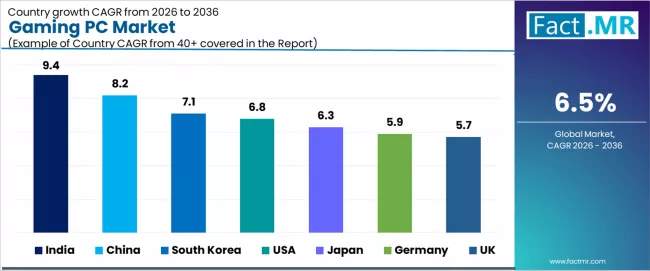
| Country | CAGR (2026-2036) |
|---|---|
| China | 8.2% |
| USA | 6.8% |
| South Korea | 7.1% |
| Germany | 5.9% |
| Japan | 6.3% |
| UK | 5.7% |
| India | 9.4% |
How are E-sports Expansion and Demographic Momentum Driving India’s Market Leadership?
India’s gaming PC market is projected to grow at a CAGR of 9.4% through 2036, supported by a rapidly expanding gaming population, strong youth demographics, and increasing focus on e-sports development. Rising participation in competitive gaming and greater affordability of high-performance hardware are strengthening demand across urban gaming hubs. Manufacturers and distributors are expanding retail, customization, and after-sales capabilities to address growing performance expectations.
- Growth in e-sports participation and gaming communities is accelerating gaming PC adoption across metropolitan regions.
- Demographic advantages and rising technology adoption are supporting demand for premium performance-oriented systems.
Why is E-sports Infrastructure Investment Strengthening China’s Market Potential?
China’s gaming PC market is expanding at a CAGR of 8.2%, driven by sustained investment in e-sports infrastructure, competitive gaming awareness, and high consumer focus on performance hardware. Growth in professional gaming leagues and streaming platforms is reinforcing demand for advanced gaming systems. Suppliers are scaling distribution and service networks to support high-volume demand.
- Expansion of e-sports ecosystems is sustaining demand for high-performance gaming PCs.
- Advancements in gaming hardware technology support adoption among competitive users.
How do Mature E-sports Standards Support Expansion in South Korea?
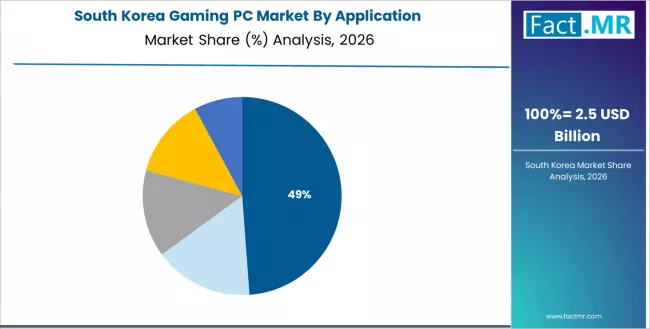
South Korea’s gaming PC market is projected to grow at a CAGR of 7.1% through 2036, supported by its established e-sports culture, structured competitive frameworks, and leadership in gaming technology. Competitive precision and system reliability remain key purchase criteria across professional and enthusiast segments.
- Mature competitive gaming environments drive consistent demand for premium gaming PCs.
- Strong regulatory and performance standards support adoption of advanced gaming systems.
Why is Content Creation Driving Gaming PC Demand in the USA?
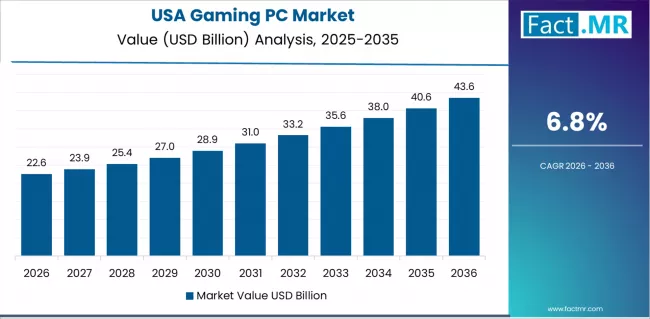
The USA gaming PC market is expected to grow at a CAGR of 6.8%, supported by expansion of content creation, live streaming, and performance-focused gaming applications. Users increasingly seek systems capable of handling gaming, production, and streaming workloads simultaneously.
- Growth in streaming and content creation is increasing demand for high-performance gaming PCs.
- Emphasis on performance efficiency supports adoption of specialized gaming configurations.
How do Performance Optimization Trends Support Germany’s Market Growth?
Germany’s gaming PC market is projected to grow at a CAGR of 5.9%, supported by strong consumer focus on system reliability, performance optimization, and technical quality. Demand remains steady across enthusiast gaming and professional performance segments.
- Preference for technically optimized systems supports consistent gaming PC demand.
- Strong quality standards reinforce adoption of premium gaming hardware.
Why does Market Maturity Sustain Steady Growth in Japan?
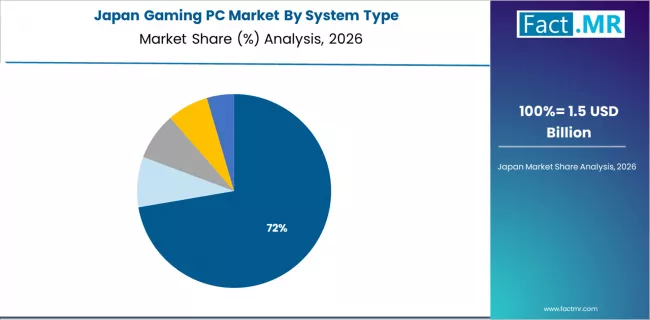
Japan’s gaming PC market is forecast to grow at a CAGR of 6.3%, supported by an established gaming culture, mature technology markets, and steady demand for high-quality systems. Users prioritizing performance consistency and long-term reliability drive adoption.
- Mature gaming markets sustain stable demand for quality gaming PCs.
- Focus on durability and performance supports continued adoption.
How is Competitive Gaming Development Supporting Growth in the UK?
The UK gaming PC market is projected to grow at a CAGR of 5.7%, driven by expanding competitive gaming participation, technology integration, and performance-focused gaming setups. Demand is rising across esports, streaming, and enthusiast gaming segments.
- Expansion of competitive gaming environments is driving demand for advanced gaming PCs.
- Emphasis on technical precision supports adoption of performance-oriented systems.
Competitive Landscape of the Gaming PC Market
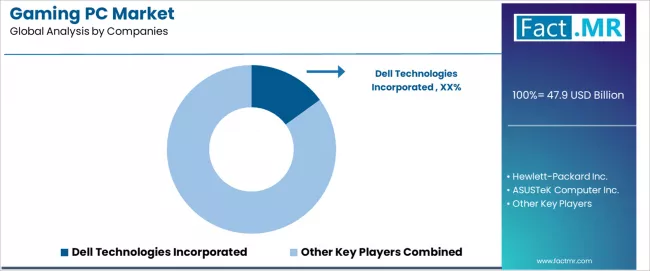
The gaming PC market is characterized by competition among established technology companies, specialized gaming manufacturers, and integrated performance solution providers. Companies are investing in advanced gaming technologies, specialized integration platforms, product innovation capabilities, and comprehensive distribution networks to deliver consistent, high-quality, and reliable gaming PC systems. Innovation in component optimization, thermal management advancement, and performance-focused product development is central to strengthening market position and customer satisfaction.
Dell Technologies Incorporated offers a a strong focus on gaming innovation and comprehensive high-performance solutions, offering premium and enthusiast systems with emphasis on performance excellence and gaming heritage through its Alienware brand. Hewlett-Packard Inc. provides integrated gaming solutions with a focus on mainstream market applications and competitive price networks.
ASUSTeK Computer Inc. delivers comprehensive gaming technology solutions with a focus on enthusiast positioning and performance efficiency. Micro-Star International Co. Ltd. specializes in comprehensive gaming systems with an emphasis on competitive applications. Corsair Gaming Incorporated focuses on comprehensive gaming components with advanced design and premium positioning capabilities.
Key Players in the Gaming PC Market
- Dell Technologies Incorporated
- Hewlett-Packard Inc.
- ASUSTeK Computer Inc.
- Micro-Star International Co. Ltd.
- Corsair Gaming Incorporated
- Razer Incorporated
- Origin PC Corporation
- NZXT Incorporated
- CyberPowerPC Systems USA Incorporated
- iBUYPOWER Computer Corporation
- Falcon Northwest Computer Systems
- Digital Storm LLC
- Maingear Voodoo LLC
- System76 Incorporated
Scope of the Report
| Items | Values |
|---|---|
| Quantitative Units (2026) | USD 47.9 Billion |
| System Type | Desktop Gaming PCs, Gaming Laptops, Mini Gaming PCs, Workstation Gaming Systems, Other System Configurations |
| Application | Competitive Gaming, Content Creation, Virtual Reality Gaming, Casual Gaming, Others |
| End-User | Individual Gamers, Esports Organizations, Content Creators, Gaming Cafes, Others |
| Price Range | Entry-Level Systems, Mid-Range Systems, High-End Systems, Premium Configurations |
| Regions Covered | North America, Europe, Asia Pacific, Latin America, MEA, Other Regions |
| Countries Covered | China, USA, South Korea, Germany, Japan, UK, India, and 40+ countries |
| Key Companies Profiled | Dell Technologies Incorporated, Hewlett-Packard Inc., ASUSTeK Computer Inc., Micro-Star International Co. Ltd., Corsair Gaming Incorporated, and other leading gaming PC companies |
| Additional Attributes | Dollar sales by system type, application, end-user, price range, and region; regional demand trends, competitive landscape, technological advancements in gaming engineering, competitive performance optimization initiatives, system enhancement programs, and premium product development strategies |
Gaming PC Market by Segments
-
System Type :
- Desktop Gaming PCs
- Gaming Laptops
- Mini Gaming PCs
- Workstation Gaming Systems
- Other System Configurations
-
Application :
- Competitive Gaming
- Content Creation
- Virtual Reality Gaming
- Casual Gaming
- Others
-
End-User :
- Individual Gamers
- Esports Organizations
- Content Creators
- Gaming Cafes
- Others
-
Price Range :
- Entry-Level Systems
- Mid-Range Systems
- High-End Systems
- Premium Configurations
-
Region :
-
North America
-
Europe
- Germany
- UK
- France
- Italy
- Spain
- Nordic Countries
- BENELUX
- Rest of Europe
-
Asia Pacific
- China
- India
- Japan
- South Korea
- Australia
- Rest of Asia Pacific
-
Latin America
- Brazil
- Argentina
- Rest of Latin America
-
MEA
- Saudi Arabia
- UAE
- South Africa
- Rest of MEA
-

“Phygital” sports combine traditional athletic competition with its digital counterpart in a unified format that requires competitors to excel in both dimensions. Teams begin the challenge in the digital round before facing off again in the physical arena, with victory determined by the combined results of both performances.
This model reflects the growing convergence of technology and real-world performance, offering a new and immersive form of sporting competition.
More than 850 athletes from 60 countries will participate, representing clubs, emerging talents, and new faces across 11 phygital sports disciplines.
Faisal Al Bannai, Adviser to the UAE President for Strategic Research and Advanced Technology Affairs and Secretary-General of the Advanced Technology Research Council, said:
“Digital sport is not merely a new format; it embodies the mindset of a new generation.
Bridging physical excellence and digital mastery
Abu Dhabi is proud to host this edition of the Games of the Future 2025, providing an environment that brings together physical excellence and digital mastery. Our goal is to empower youth, accelerate innovation, and build communities around the technologies that will shape the future.”
The 2025 edition comes with strong global momentum, bringing together elite athletes from across the phygital sports ecosystem—competitors who demonstrate exceptional physical performance alongside advanced digital skills.
The event will feature professional athletes, esports stars, and rising phygital talents, promising outstanding competitions that showcase the best of both the physical and digital worlds. The championship reflects the rapid transformation of sport in an increasingly interconnected world, positioning the 2025 edition as a pivotal milestone in the global evolution of this growing sector.
Abu Dhabi prepares to deliver an exceptional edition
The draw has determined the opening group-stage matchups across the various disciplines, setting the stage for the first competitive narratives that audiences will follow. As the event progresses, full competitive pathways will unfold, with clubs vying for qualification and top positions in the finals, which will feature a total prize pool of USD 5 million.
In parallel with the tournament, Abu Dhabi will host the Phygital Sports Summit on 17 December 2025. The summit will serve as an intellectual platform bringing together global experts, athletes, innovators, and decision-makers to discuss the evolution of hybrid sports. Its comprehensive program includes keynote addresses, panel sessions, and in-depth discussions on the intersection of sport and technology, human–AI integration, the future of youth engagement, athlete health in hybrid environments, and the sustainable legacy of phygital sports.
Summit sessions will be moderated by Amy Jane Gillingham, Mohamed Al Hosani, and Sabine Sassen, with participation from senior representatives of Phygital International, partners of the Games of the Future, and leading global figures shaping both the digital and physical sports movements.
Distinguished guests expected to attend include H.E. Dr. Ahmad Belhoul Al Falasi, UAE Minister of Sports, and a high-level international delegation featuring H.E. Ilham Aliyev, President of the Republic of Azerbaijan; H.E. Rawan bint Najeeb Tawfiqi, Minister of Youth Affairs of the Kingdom of Bahrain; Sheikha Deena bint Rashid Al Khalifa, Adviser for Planning and Development at Bahrain’s Ministry of Youth Affairs; and Dr. Osman Aşkın Bak, Minister of Youth and Sports of the Republic of Türkiye.
Sport of the next generation

Entertainment has always played a vital role in society, and the ways we access and enjoy it have changed drastically over time. Today, as online platforms, streaming services, and digital applications gain traction, businesses are rethinking their strategies in this evolving landscape.

Innovations in entertainment technology touch everything from live sports to gaming and betting, as seen at bet777, demonstrating how rapidly shifting trends impact the industry as a whole.
From analog to digital: the transformation of entertainment
The transition from analog to digital technology marks one of the most significant changes in entertainment history. In the past, physical media such as vinyl records, VHS tapes, and CDs were the norm. With the rise of digital formats, accessibility and distribution underwent a revolution. Digital streaming made it possible for consumers to access content instantly, eliminating the limitations of geography and physical storage. This convenience not only changed how audiences consume media but also how creators and companies distribute and monetize their content.
As digital solutions expanded, new forms of entertainment began to emerge. Video games, interactive apps, and online casinos grew in popularity, shifting the focus from passive viewing to active participation. The proliferation of high-speed internet and smartphones further fueled this transformation, enabling entertainment anywhere, anytime. Companies operating in this environment had to adapt quickly to user expectations of on-demand, personalized experiences. This ongoing evolution continues to blur the line between creators, distributors, and consumers, changing the entire value chain.
Streaming services and the shift in business models
The introduction of video and music streaming platforms led to fundamental changes in business models across the sector. Subscription services replaced one-time purchases, shifting the focus to long-term customer retention and recurring revenue streams. This not only increased competition among platforms but also gave rise to exclusive content and original productions as key differentiators. The bargaining power shifted to content creators and platforms able to attract large subscriber bases, while traditional broadcasters and physical retailers had to reinvent or risk becoming obsolete.
This transition has also extended to other segments such as live sports, eSports, and iGaming. Businesses are investing in digital infrastructure and user experience, offering everything from artificial intelligence-driven recommendations to interactive live events. The ability to collect and analyze user data allows companies to tailor offerings directly to their audiences, driving engagement and loyalty. Simultaneously, regulatory challenges and data security concerns have emerged, demanding new approaches to compliance and consumer protection in digital entertainment.
Immersive technology and the business of innovation
The latest chapter in entertainment technology is defined by immersive experiences such as virtual reality (VR), augmented reality (AR), and advanced streaming features. As these technologies find mainstream adoption, businesses are leveraging them to create new ways to engage users. For example, VR concerts, AR-enhanced sports statistics, and immersive gaming environments offer fresh revenue opportunities and deepen the user’s connection with content.
To stay competitive, entertainment companies must constantly invest in innovation and understand emerging trends. Cloud gaming and interactive betting platforms exemplify how technology influences entertainment choices and opens up lucrative business channels. The integration of social features, mobile-first strategies, and cross-platform compatibility are now prerequisites for success. As the landscape continues to evolve, keeping pace with technology and user preferences will be crucial for organizations aiming to thrive in the future of entertainment.

Chanticleers Continue Academic Excellence in Fall 2025

Four From Women’s Volleyball Named to College Sports Communicators Academic All-District Team

JMU Coach Bob Chesney Doesn’t Hold Back On Dan Lanning And Dante Moore
Watch Wisconsin volleyball vs Kentucky in Final Four tonight; time, TV
Terrebonne Parish All-Stars youth sports programs to return in 2027

Aggie Volleyball Signs Gianna Bogan Ahead of 2026 Season

What NCAA’s New Wearables and Tracking Guidelines Mean for Youth Sports

NASCAR’s Greg Biffle owner of plane that crashed and erupted into fireball – Motorsport – Sports
Kentucky volleyball game time today, Wisconsin vs UK Final 4 channel

Johansson Earns Big Ten Weekly Honors – University of Nebraska

21 NJAC Women’s Volleyball Players Earn Academic All-District Recognition

College football program set to lose 15 players to NCAA transfer portal

Spring softball sign-ups underway for Newcastle Youth Sports Association

Four Eagles Named To CSC Academic All-District Volleyball Team

Males banned from women’s sports in NDAA

First Tee Winter Registration is open

Fargo girl, 13, dies after collapsing during school basketball game – Grand Forks Herald

CPG Brands Like Allegra Are Betting on F1 for the First Time

F1 Las Vegas: Verstappen win, Norris and Piastri DQ tighten 2025 title fight

Volleyball Recaps – November 18

Sycamores unveil 2026 track and field schedule

Utah State Announces 2025-26 Indoor Track & Field Schedule

Two Pro Volleyball Leagues Serve Up Plans for Minnesota Teams

Redemption Means First Pro Stock World Championship for Dallas Glenn

SoundGear Named Entitlement Sponsor of Spears CARS Tour Southwest Opener

Jo Shimoda Undergoes Back Surgery

Texas volleyball vs Kentucky game score: Live SEC tournament updates

Bowl Projections: ESPN predicts 12-team College Football Playoff bracket, full bowl slate after Week 14

How this startup (and a KC sports icon) turned young players into card-carrying legends overnight

Robert “Bobby” Lewis Hardin, 56






-
 Motorsports1 week ago
SoundGear Named Entitlement Sponsor of Spears CARS Tour Southwest Opener
-
 Motorsports3 weeks ago
Jo Shimoda Undergoes Back Surgery
-
 NIL3 weeks ago
Bowl Projections: ESPN predicts 12-team College Football Playoff bracket, full bowl slate after Week 14
-
 Rec Sports3 weeks ago
How this startup (and a KC sports icon) turned young players into card-carrying legends overnight
-
 Rec Sports3 weeks ago
Robert “Bobby” Lewis Hardin, 56
-
Sports3 weeks ago
Wisconsin volleyball sweeps Minnesota with ease in ranked rivalry win
-

 Motorsports3 weeks ago
Pohlman admits ‘there might be some spats’ as he pushes to get Kyle Busch winning again
-

 Motorsports1 week ago
Donny Schatz finds new home for 2026, inks full-time deal with CJB Motorsports – InForum
-

 Motorsports3 weeks ago
Increased Purses, 19 Different Tracks Highlight 2026 Great Lakes Super Sprints Schedule – Speedway Digest
-

 Rec Sports2 weeks ago
How Donald Trump became FIFA’s ‘soccer president’ long before World Cup draw