Subscribe to The Kicks You Wear with Mike D. Sykes, a drill down on the red hot intersection between sports and fashion.
Good morning, friends! Welcome back to The Kicks You Wear. Thanks so much for reading. Appreciate you spending some time with me this morning. Hope your week was awesome.
It’s Labor Day weekend here in the states! If I’m being honest, it’s a bit of a sad time for me because it basically means summer is over. But, hey. At least it’s college football season, right?
While you’re at it, make sure you subscribe to my friend Marc Bain’s monthly newsletter on tech and fashion.
Let’s jump in.
Taking The Kids Back to School
For years — decades, even — Nike has been the default footwear brand for kids everywhere. We’ve all been there, right? Everyone wants that shiny new pair of Jordans.
Even if you couldn’t get your parents to pony up for the mainline models, you’d be willing to settle for an offshoot of some sort. Even if it was just a regular Nike model, it was fine, so long as it came with a swoosh or a Jumpman.
These days that doesn’t seem to be the case anymore.
What’s new: A new survey from wealth management firm Stifel shows that the kids aren’t as interested in jumping like the Jumpman.
The firm visited and called 110 footwear stores in the US to gather data on the most popular athletic footwear styles for boys and girls during the back-to-school selling season. The stores included Dick’s Sporting Goods, Academy Footwear, Foot Locker, Finish Line and JD Sports, Champs, and Hibbett Sports.
The numbers: The returns showed that Nike was still the leader in the space, but far from the margin it had been.
Only 38.2 percent of retailers referenced Nike as their most popular brand for the 2025 back-to-school season. That’s an all-time low for Nike in the survey, per Stifel. The number was as high as 88.2 percent in 2023.
Challenger brands struggled to establish a decent foothold in 2023. New Balance (7.7 percent) was the closest competitor then.
Two caveats: It’s worth noting that, while this survey indicates a decline in popularity for Nike, the sample size isn’t necessarily the largest. Some of the retailers included have thousands of retail locations.
Plus, this survey strictly measures popularity in the United States. While the US market is a significant one, this is still a global marketplace. This doesn’t represent things on a global scale.
Yet, still: These numbers are notable. They match a broader trend that tells a story of Nike losing the battle for the attention of Gen Z and Gen Alpha.
Piper Sandler’s latest Taking Stock With Teens survey backs this up. Nike held on as the most popular footwear brand for teens surveyed at 49 percent, but that number was down from 60 percent on average.
Why this is happening: The first, and arguably most important, factor here is Nike’s staleness. The brand has been clawing its way out of a rut for almost a year now. Before that, it leaned heavily on retro styles and lacked innovation at a time when most consumers were looking for newness.
But, secondly, teens are just far more willing to try new things these days. People are increasingly willing to experiment with their fashion choices across various categories these days.
Why this matters: While the demographic of kids and young teens doesn’t necessarily come with the cash older generations do, what they think of a brand is essential.
Establishing connections with younger generations now means establishing a connection with the leading consumer of tomorrow. If they buy your brand now, they may buy it in another 10 years when their buying power has grown.
Plus, teens are trendsetters. They’ve always set the tone for contemporary style. And, these days, they plaster it on social platforms like Instagram and TikTok.
Establishing a strong connection with this demographic means creating a brighter future for a brand.
The bottom line: For Nike, regaining the good graces of teens is important. But for companies like New Balance and Adidas, they need to do everything possible to hold the line with new styles and innovation.
Puma May Change Hands Soon
It looks like Puma will be under new ownership soon enough.
The news: The Pinault family, which has owned Puma since 2018 through its holding company, the Artémis Groupe, is meeting with advisors to help it find potential buyers for its 29 percent stake in the company, Bloomberg reports.
Where things are: Puma’s short-term outlook seems pretty bleak.
These setbacks, coupled with headwinds from an increasingly shaky global economy thanks to the United States’ tariff policy, make it easy to see why someone might be searching for a way out of the sportswear business.
The brand has made significant investments in signature basketball athletes like LaMelo Ball, Tyrese Haliburton and Breanna Stewart. It’s poured money into a Formula One partnership with one of the sports’ most popular brands in Ferrari. Despite that, Puma hasn’t found the rising tide to raise its ships.
Don’t get it twisted: Despite the company’s current short-term outlook, there are some positives the brand has going for it.
It may not be showing up in sales data yet, but the Puma Speedcat is growing in popularity.
Puma also recently hired a new CEO, Arthur Hoeld, who is Adidas’ former head of global sales.
The brand has carved out a fashionable niche for itself, working with big names in the space like A$AP Rocky and working with buzzy brands like Collina Strada and showing up on the runway at Paris Fashion Week earlier this year.
The big picture: None of those aforementioned factors will necessarily be game-changing for Puma on their own, but the brand has seemingly built a bit of momentum for itself that shouldn’t be overlooked in any potential sale.
It might be a good time for someone to buy low here.
Arch Manning x Warby Parker
We saw a ton of sports and fashion collaborations come together this week. Breitling and the NFL. Cadillac and Tommy Hilfiger. American Eagle and Travis Kelce. Out of all the deals consummated this week, though, I think Arch Manning and Warby Parker’s partnership might be the most interesting.
What’s happening: The up-and-coming Texas University football star announced a newname, image and likeness (NIL) deal with Warby this week.
As part of the deal, Manning’s partnership will include the introduction of new eyewear collections with him as the centerpiece. He’ll also be introducing local initiatives in Austin, Texas as part of Warby Parker’s Pupils Project — a school-based vision program.
Manning will also star in a new Warby Parker ad featuring him and his father, Cooper, in time for Texas’ first game on August 30.
Why he matters: If you’re not an American college football fan, you probably have no idea who Arch Manning is. The Texas quarterback is the nephew of Hall of Fame NFL QB Peyton Manning and former New York Giants quarterback Eli Manning. He’s a bit of a wunderkind in his sport. Think of him the same way you’d think of, say, Victor Wembanyama in the NBA or Kylian Mbappe in his early days.
The situation: NIL deals in college sports are a bit of a new phenomenon. American collegiate athletes weren’t able to capitalize on their name, image, or likeness until July 2021, meaning they couldn’t sign any brand deals while in school, no matter how popular they were.
The marketplace is the wild, wild west. There are hardly any rules or regulations. Luxury fashion brands have avoided the space so far. That’s why this deal is so striking to me.
Why this matters: Warby Parker isn’t necessarily a luxury brand, but it is luxury adjacent. It’s a premium brand exploring a space where similar brands haven’t. That’s interesting. Especially with a player like Manning, who could have a massive long tail as he advances in his career. There is a chance he doesn’t work out — sometimes, college stars flop. Regardless, it’s beneficial for brands to get on board now.
The big picture: If the NFL’s Breitling deal and this Warby Parker partnership for Arch Manning are any indication, luxury seems to see something in the relatively untapped market of American football. There are opportunities available and interesting athletes to work with.
If that’s the case, then we’ll probably see more deals like this one coming for other players soon.
Caitlin Clark’s Signature Journey Begins
Caitlin Clark and Nike are unveiling her new signature logo, an instantly recognisable combination of interlocking C’s as extraordinary as the athlete they represent. (Nike)
The wait is over. Nike has officially made Caitlin Clark one of its signature athletes. On Monday, the brand unveiled her logo publicly for the first time.
Gotta say, guys. I think this looks great.
My thoughts: There’s a clear luxury inspiration with this. The CC obviously reminds you of Chanel, but I think the clearest inspiration for this one is Gucci’s current interlocking Gs logo. It’s almost identical.
Why this matters: Caitlin Clark is the WNBA’s most popular player. Fans have been clamoring for a signature shoe from Nike from the moment she was drafted by the Indiana Fever. While this isn’t Nike presenting the shoe itself, we do know that the process is at least underway and we’re a step closer.
Nike is set up to dominate women’s basketball. Its roster signature includes Sabrina Ionescu, A’ja Wilson and, now, Caitlin Clark — easily three of the most popular players in the league.
If the brand plays things right, it should run this space for the next decade.
#TheKicksWeWear
This is the section where we share our favorite sneakers and favorite outfits from the week. If you have anything you’d like to send, you can forward it to me at michael.sykes@businessoffashion.com or shoot me something on Instagram, X or BlueSky at @MikeDSykes.
Enjoy!!!
First the homie Yosh got us started with the Shattered Backboards. Love these. Glad everyone is getting pairs.
Then the homie Trudy came through with these Icy AE1s. SOTY 2024.
Then the homie Mark came through with these SICK Salomon x Ama Lou Void XT-Whispers. Get hip to these, guys.
Then Matt took us home with the Chlorine Blue Air Max 97. This is one of my FAVORITE pairs of Maxes. That color is so good.
Greaaaaat stuff, you guys. Bravo.
That’s a wrap, gang. Thanks so much for reading today. Have a fantastic weekend. If you’re reading this from the US, have a great Labor Day weekend. Hope you enjoy some much-deserved time off.
If you have any questions, comments or concerns, feel free to hit me at michael.sykes@businessoffashion.com or tap me on the socials @mikedsykes.
Until next time. Peace and love. Be safe, be easy, be kind. We out.
ABBEVILLE — At an event celebrating the completion of another project by Cajun Broadband, the little internet company that could, there were speeches by local officials, a video message from Gov. Jeff Landry, a ribbon-cutting.
And there was seafood gumbo, cooked the night before by Chris Disher, the company’s co-founder.
His grandmother made her gumbo with tomatoes, but Disher skipped them, knowing the crowd, and used shrimp and oysters harvested from parish waters.
The gathering in Vermilion Parish, like much of what Cajun Broadband does, had a personal feel that belied a bigger truth: The company is among those leading Louisiana’s push to bring speedy internet to the state’s rural reaches.
This fall, it won $18.2 million in federal funding from the Broadband Equity Access and Deployment Program, or BEAD, to connect another 4,000 homes and businesses. This month, they’ll be among the companies breaking ground with that funding: “We’re small, so we can build fast,” Disher said.
Already, the Broussard-based company provides fiber internet across Acadiana, in a doughnut-like shape surrounding Lafayette. In 2023, Inc. Magazine named it among the fastest-growing companies in the U.S. — landing at 603 out of 5,000 and fourth among those based in Louisiana.
“We kept doubling the size every year,” Disher said, “because we didn’t understand just how big this need was in the rural communities.”
Humble beginnings
But it started in 2017 with an antenna in a pine tree.
Disher’s two then-teenage sons had been nagging him for years about the slow, spotty internet. One Sunday before church, they’d hooked up their Xbox for a software update, “and the game wasn’t even 5% done updating after being gone for like three and a half hours,” said his son Matthew.
Meanwhile, Chris Disher’s close friend and now partner Jimmy Lewis, an IT professional struggling with his own internet service, had been driving by an empty tower on his way to work each day.
He wondered: What if we put an antenna on that?
They got the OK, grabbed a chain saw and mounted a dish. “And Chris is hollering up at me, ‘We’ve got 60 megs!” Lewis said, short for 60 megabytes per second. “We’ve got 60 megs!”
They hooked up one neighbor, then another, then 10. They kept their day jobs, at first, working nights and weekends.
Matthew Disher splices fiber in a Cajun Broadband truck for a Maurice home in December.
Jenna Ross
Within two years, they had more than 1,000 customers, said Daniel Romero Jr., operations manager. (Disher declined to give a current count, but the company’s website touts “nearly 10,000 customers across seven Louisiana parishes.”)
“We just kept going and kept building and kept working,” said Lewis, Cajun’s managing director.
When Louisiana’s Granting Underserved Municipalities Broadband Opportunities, or GUMBO, program was announced, Disher bought a nice tie and went door-to-door, parish to parish. In late 2022, with nearly $20 million in GUMBO funding, Cajun Broadband installed some 90,000 feet of fiber in St. Martin Parish.
It was the first completed project in the state under GUMBO, whose mission is in its name. Cajun Broadband competed with and beat bigger companies to nab GUMBO funds, said Veneeth Iyengar, executive director for the Louisiana Office of Broadband Development and Connectivity.
“They bootstrapped this business,” he said. “They saw a need in their community that was not fulfilled, and they decided to bootstrap it through entrepreneurial capitalism and build a business which is now impacting thousands of lives.”
Still, the business has stayed small and nimble. Ask an employee how many of them there are, and they’ll begin ticking off names, counting the number on two hands. It feels like family, said Steven Creduer, field supervisor. “I’m leaving my house to go to my other house.”
Disher’s son, Matthew, works in the field as a splicer now. Romero’s daughter works for the company, too.
Employees exchange “Merry Christmas” texts with customers. Many of them had long struggled to use Zoom, to upload and to stream, and were thrilled to spot Cajun Broadband’s trailer on their rural roads. Technicians see firsthand how people rely on the internet for necessities, from health care to homework.
“People are really happy you’re there,” Disher said.
Company founders and state and local officials hold a ribbon-cutting ceremony for the expansion of Cajun Broadband into Vermilion Parish Tuesday, December 9, 2025, at the LSU AgCenter Cooperative Extension Building in Abbeville, La.
STAFF PHOTO BY LESLIE WESTBROOK
‘Issues on top of issues’
A Louisiana-born-and-educated engineer, Disher hadn’t yearned to be an entrepreneur, the 55-year-old said. “I never wanted to do anything on my own.”
For years, he worked for General Electric in the oil fields of Singapore and Brazil, eventually supporting six regions from Broussard — but traveling often. Then GE downsized, and Disher lost his job.
With his wife’s encouragement, he became Cajun Broadband’s first full-time employee, he said. “She just kept saying, ‘You can do it, you can do it.’”
At first, he felt responsible to his family, his mortgage in mind. Then, he felt responsible for the company’s employees, their families in mind. Now, he feels responsible for the region and its residents.
Several broadband customers were in at the LSU Ag Center office in Abbeville for last month’s ribbon-cutting, which marked the completion of three broadband projects in Vermillion Parish comprising some 500,000 feet of fiber to 1,750 homes and businesses.
Among the beneficiaries: Michelle Romero, a 38-year-old mother, nurse and health coach who can now upload her workout videos in a few minutes, rather than several hours. (Disher used healthier oils in his gumbo, knowing she’d be in the crowd.)
And there’s the North Vermilion Youth Athletic Association, which for years had struggled to make credit card sales in its concession stand using Cox internet.
“We had issues on top of issues,” said Josh Broussard, the nonprofit’s president.
Cajun Broadband offered the athletic association free hookups, Wi-Fi service and boosters in exchange for some publicity. Now, the park has strong enough service to fuel live scoreboards and stream games, Broussard said, which means that they can host regional tournaments.
Broussard, who played sports at the park as a child, said the change is much needed.
“I saw what it was, and I just want to improve it,” Broussard said, “and make it better than what it was when we were there.”
ALMATY – Kazakhstan’s athletes delivered another successful year in the country’s sporting history in 2025, achieving breakthroughs across football, boxing, tennis and winter sports.
Kairat FC team. Photo credit: Kairat FC
From historic firsts to record medal hauls, Kazakhstan’s presence on the world sports map grew stronger than ever.
Football: A breakthrough year and growing international recognition
The defining moment of the year came when FC Kairat qualified for the UEFA Champions League group stage for the first time in its history, defeating Scotland’s Celtic FC in a dramatic penalty shootout in Almaty. The club’s international rise was further reinforced, when FC Kairat was ranked among the 500 best football clubs in the world by the International Federation of Football History and Statistics (IFFHS). Kairat became the only Kazakh club on the list, placing 240th overall with 90.75 points.
FC Kairat’s momentum culminated on Dec. 9 when Anarbekov became the first Kazakh footballer ever to be named UEFA Champions League Player of the Match. His exceptional performance against Olympiacos earned him a 9.2 rating from UEFA, which also included two of his saves among the best of the matchday.
Kazakhstan’s young football talent also gained international visibility, with 17-year-old forward Dastan Satpayev being recognized among the world’s top five young players by Score 90. Meanwhile, Italian giant Inter Milan highlighted Anarbekov’s skills in a dedicated feature. Institutional progress followed as well as the Kazakhstan Football Federation’s national academy received official FIFA Talent Academy status, making Kazakhstan only the ninth country in the world to achieve it.
Boxing: Dominance continues and a new Hall of Fame legend
At the IBA World Championships in Dubai, the Kazakh team finished second overall, collecting six medals – three gold, one silver, and two bronze. Saken Bibossinov (54 kg), Orazbek Asylkulov (57 kg), and Abylaikhan Zhussupov (71 kg) captured world titles.
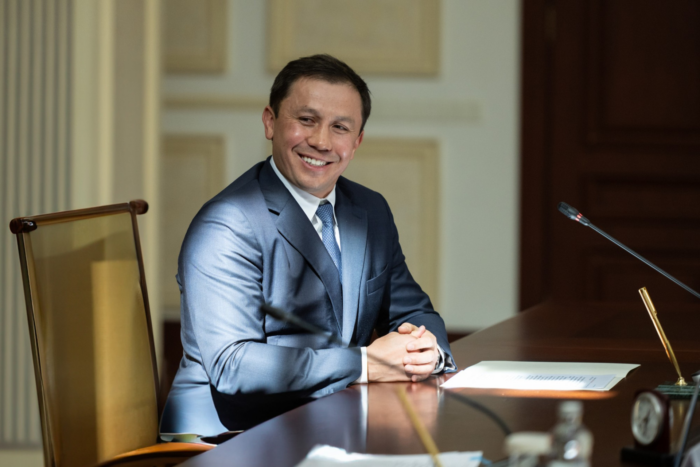
Gennady Golovkin. Photo credit: olympic.kz
The year also brought historic recognition for Kazakhstan with Gennady Golovkin becoming the president of World Boxing Federation and his election to the International Boxing Hall of Fame. Golovkin, selected in the 2025 ballot, became the first Kazakh boxer inducted into the Hall and joined global legends such as Muhammad Ali, Manny Pacquiao, and Mike Tyson.
Kazakhstan further cemented its dominance by topping the medal standings at the World Boxing Championships in Liverpool, where the national team earned seven gold medals.
Tennis: International titles and historic rankings
Kazakhstan strengthened its global presence in tennis with some of the most significant victories to date. Elena Rybakina made history when she became the first Kazakh player to win the WTA Finals, defeating World No. 1 Aryna Sabalenka in straight sets in Riyadh. She finished the year ranked fifth in the WTA standings, while Yulia Putintseva entered the top 20 for the first time in her career.
Elena Rybakina (L) and Yulia Putintseva (R). Photo credit: Kazakhstan Tennis Federation
On the men’s side, Alexander Bublik captured the ATP 500 Terra Wortmann Open in Halle, Germany, securing his fifth career ATP title after defeating a series of top-ranked players, including Daniil Medvedev.
The next generation also delivered promising results as 17-year-old Amir Omarkhanov climbed to No. 4 in the global junior rankings, bolstered by a breakthrough season. Kazakhstan also continued expanding its tennis ecosystem, hosting the ATP 250 Almaty Open.
Chess
Kazakhstan continued its rapid rise in global chess, achieving historic results across elite, youth, and team competitions. A historic moment took place inside the British Parliament when top Kazakh grandmasters played an exhibition match against members of the UK Parliament.
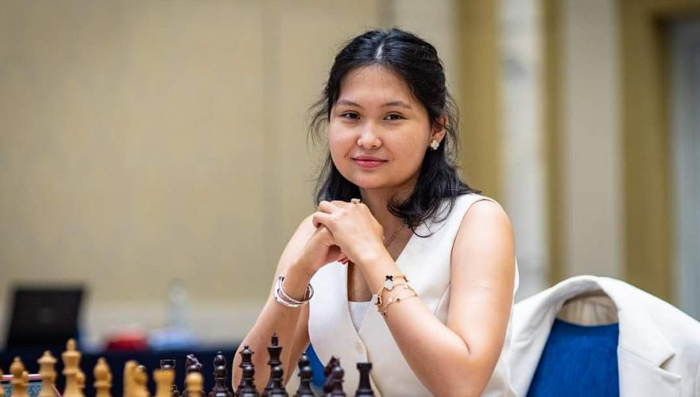
Bibisara Assaubayeva. Photo credit: Ministry of Tourism and Sports of the Republic of Kazakhstan
A major milestone came when FIDE President Arkady Dvorkovich announced that Kazakhstan won the most medals worldwide in all FIDE competitions in 2024. The momentum continued into 2025 with the national women’s team placing fourth at the FIDE World Women’s Team Championship in Linares and earning three individual medals.
Kazakhstan’s rising star Meruert Kamalidenova delivered another impressive result by finishing as women’s vice-champion at the sixth El Llobregat Open in Spain, a major international event featuring participants from 33 countries.
Youth achievements further underscored Kazakhstan’s depth of talent. At the 27th Asian Youth Chess Championship in Bangkok, Kazakh players captured 11 medals, including five gold across classical, rapid, and blitz events.
Bibisara Assaubayeva also achieved the norms required to become Kazakhstan’s second female grandmaster, following Zhansaya Abdumalik, reinforcing the nation’s expanding influence in the chess world.
Winter sports
Kazakhstan’s athletes delivered a series of outstanding results in winter sports, particularly at the 2025 Asian Winter Games in Harbin, where the national team earned 20 medals – four gold, nine silver, and seven bronze. Among the most significant accomplishments were the country’s first-ever victories in short track and freestyle acrobatics.
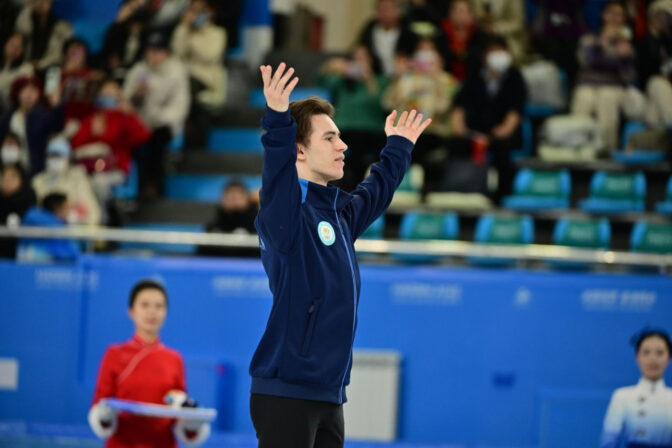
Mikhail Shaidorov. Photo credit: olympic.kz
The men’s 5,000-meter relay team secured Kazakhstan’s inaugural gold in short track, while the freestyle acrobatics duo defeated two leading Chinese teams to win the nation’s first gold in that discipline. Kazakhstan’s men’s hockey team also continued its tradition of excellence by winning the Asian Winter Games title for the fifth time.
Figure skating brought additional triumphs when Mikhail Shaidorov secured silver at the 2025 ISU World Championships in Boston, marking Kazakhstan’s third-ever medal at the event and earning him a place at the 2026 Winter Olympics.
Expanding success beyond traditional arenas
Kazakhstan also reached new heights in sports outside its long-established strengths. In motorsports, Artline Kazakhstan became the world champion in the Lamborghini Super Trofeo series, marking the country’s first world title in the sport.
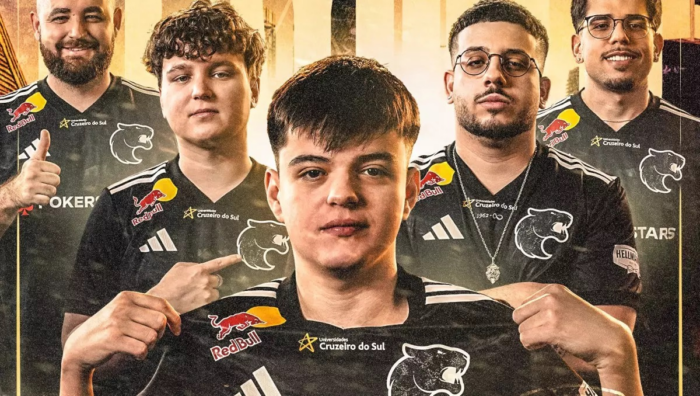
Kazakh player Daniil Golubenko, representing the Brazilian organization FURIA. Photo credit: digitalbusiness.kz
Kazakhstan also saw a breakthrough in eSports when Kazakh Counter-Strike player Daniil Golubenko, representing FURIA, won the Intel Extreme Masters (IEM) Chengdu 2025 tournament with a dominant 3:0 performance and was named MVP.
Meanwhile, Kazakhstan launched its first professional women’s eSports league, the Female Pro League, which aims to promote inclusivity and create new opportunities for female gamers.
Youth and junior success: A foundation for future champions
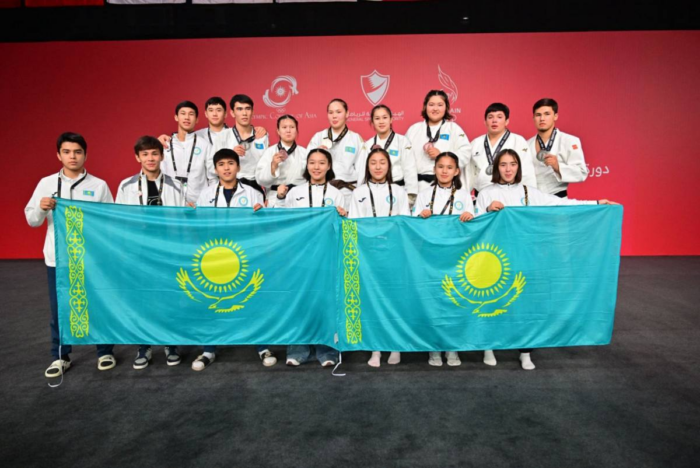
At the Asian Youth Games in Bahrain, Kazakhstan achieved its best-ever result, winning 93 medals and ranking third overall. The country’s next generation of boxers also excelled at the ASBC Asian U22 & Youth Boxing Championships in Colombo, where Kazakh athletes captured 22 gold medals, including sweeping all women’s weight divisions.
Kazakh athletes competed in more than 20 sports. Photo credit: National Olympic Committee’s press service.
Kazakh juniors continued to show promise in tennis, figure skating, and athletics, demonstrating the growing depth of talent across multiple sports.
From Champions League debuts and world titles to Hall of Fame inductions and record-breaking youth performances, 2025 solidified Kazakhstan’s reputation as a rising global sports nation.
The driver of a stolen car crashed into Lightning’s Boxing Club in Oakland early New Year’s Day after colliding with another car — sending two people to the hospital — then fleeing on foot. The estimated repair costs are between $50,000 and $1000,000.
As KTVU reports, a boxing ring used by heavyweight champion George Foreman in the 1980s sustained extensive damage after a car thief crashed into Lightning’s Boxing Club on 5845 MacArthur Boulevard in Oakland at some point in the early hours Thursday morning. Kris Lopez, who co-owns the gym with his wife Denise Lopez, said the impact of the crash was forceful.
“It’s like an earthquake,” Kris Lopez told KTVU. “The force knocked over the ring stairs and pushed the ring out of place.”
Per KRON4, the Lopezes are raising funds for the repairs and staff payroll through GoFundMe, which was close to $10,000 Sunday morning. According to the fundraiser’s page, the boxing ring will need to be replaced.
Per KTVU, the gym has played a crucial role in supporting underserved youth in the community, some of whom have become professional boxers.
“Dear Oakland Community, we have given our all to this city for the better good—mentoring youth, creating positive members of society, and even producing the occasional boxing champion,” the fundraiser’s page states. “Your donation will help us continue this important work and keep our doors open for the next generation. Please give what you can so we can get back to saving the community and inspiring our youth through the sport of boxing!”
Per NBC Bay Area, the boxing club is temporarily relocating to Geoffrey’s Inner Circle, a local nightclub and event space in Oakland’s Black Arts and Business District, but the Lopezes hope to reopen as soon as possible.
“I just want to keep the boxers going,” Kris Lopez told NBC Bay Area. “We have a nationally ranked amateur boxer, and of course my son and all the other kids who need this place to participate in something positive.”
“I’ve had so many people tell me, your husband changed my life,” Denise Lopez told KTVU. “That makes it worth doing.”
Authorities are still searching for the suspect in the crash.
FARGO — A move to take a youth initiative out of the purview of the city of Fargo is expected to expand student civic engagement, the city said.
The City Commission voted Monday, Dec. 22, to give Fargo Public Schools oversight of the Fargo Youth Initiative, an advisory body made up of local high school students.
Commissioners have been discussing over recent weeks whether certain boards are effective or viable. The city’s Planning Department previously coordinated Fargo Youth Initiative events.
“It really did take a village to find a new home for this, but I think it’s the next iteration of greatness,” Commissioner Denise Kolpack said at the meeting.
Isabella Meyer, chair of FYI and a senior at Fargo North High School, told commissioners many decisions are made for youth without involving them.
“The Fargo Youth Initiative has been a great way for us to be able to share our voice and our opinions on what actually works and what we actually need,” Meyer said.
The youth advisory group will now be housed within Fargo Public Schools and will include liaison representatives from the Fargo City Commission, the FPS Board of Education and the Fargo Park Board, with potential for expansion.
The group will meet at and receive administrative support from the Boys & Girls Clubs of the Red River Valley.
Fargo School Board vice president Robin Nelson speaks during a meeting on Tuesday, Nov. 25, 2025.
Chris Flynn / The Forum
Robin Nelson, Boys & Girls Clubs CEO and Fargo School Board vice president, became involved in the Fargo Youth Initiative as it was created in 2013.
She said connecting the high school students with School Board, Park Board and city representatives will provide for even better opportunities.
“Now that they’ve got some more direction, it’s really ignited their excitement,” Nelson said.
Liaisons are expected to be Kolpack from the City Commission, Kristin Nelson from the Fargo School Board and Zoë Absey from the Park Board.
Proposed areas of focus for the Fargo Youth Initiative include education relating to North Dakota Century Code, open meeting regulations and local governance and policies.
Advocacy opportunities include raising the profile of youth public health issues and youth homelessness and speaking out on city, parks and school policies and initiatives.
Community impact ideas could include organizing student-led events or service projects, and regularly attending and participating in local government meetings.
“Youth are a big percentage of our population, so the more they can learn about how our city governments work and serve as a conduit and voice for youth so they are heard at those elected levels, is beneficial,” Robin Nelson said.
A goal is to achieve a total of 15 members on the Fargo Youth Initiative, which plans to continue to meet monthly.
Huebner is a 35+ year veteran of broadcast and print journalism in Fargo-Moorhead.
LIMA, Ohio (WLIO) — Young athletes showed they could perform under pressure as they competed in the Elks Hoop Shoot competition.
The Northwest Ohio District brought winners from 10 different Elks lodge Hoop Shoot competitions to Ohio State Lima for the next step in the national contest.
The Elks have hosted the Hoop Shoot program for 52 years. Boys and girls ages 8 through 13 were divided into three age groups to see who could sink the most baskets.
While organizers hope the event is fun for the participants, they also emphasize the importance of developing skills through practice.
“They’re our future, and you don’t know who’s going to be able to benefit from all the practice that they put in, and further their careers in basketball, not only in the high school level, but in college and perhaps the professionals. We want them to increase their skill level and also show the sportsmanship and the camaraderie with the other shooters and enjoy the time that they have with this program,” says Jean Zink, Northwest Ohio District Elks Hoop Shoot Competition.
The top boys and girls from each age group in the Northwest Ohio District will advance to the state competition in February.
Copyright 2025 by Lima Communications Corporation. All rights reserved.
Since the Vegas Golden Knights arrived in 2017, youth hockey participation in Southern Nevada has more than doubled, according to USA Hockey and local youth programs. While that growth has created new opportunities, it has also strained existing facilities.
Usufzy said programs like learn-to-skate and youth leagues are reaching capacity, and without additional infrastructure, families may be forced to look elsewhere for competitive opportunities.
“We’ve seen incredible growth, but without places to support it, that growth can stall,” she said. “We want kids to be able to play and develop right here in Las Vegas.”
To meet that demand, the foundation has launched a capital campaign to build the Las Vegas Community Sports Complex, the first nonprofit community ice rink and multi-sport facility of its kind in Southern Nevada.
The proposed complex would feature two NHL-sized ice rinks and a versatile indoor turf field designed for sports like soccer and lacrosse, . The goal is to create affordable programming and expand scholarship opportunities for families across the valley.
The Jake Kielb Hockey Foundation’s capital campaign is entirely community-driven. Those interested in learning more or supporting the project can find additional information at HelpVegasPlay.com.
Usufzy hopes the project will ultimately give every child — regardless of background a place to play, grow, and belong.