Motorsports
The Mustang FR500 Proved There Was Life After the Ford 302
The Ford Mustang faced an identity crisis when it made the switch from its time-tested overhead-valve 5.0-liter V-8 to an entirely new DOHC “modular” eight-cylinder engine family in the mid-1990s. While the tried-and-true small block motor enjoyed enormous, and affordable, aftermarket support, the new 4.6-liter unit wasn’t quite as mighty right out of the box, and was dogged by complaints from the pony-loving crowd that modifications were complex and much more expensive than they were for its predecessor.
Ford initially attempted to dispel these negative vibes with the SVT Cobra edition of the car. Arriving in 1996, and outfitted with a 32-valve, all-aluminum version of the 4.6-liter V-8, it claimed 305 horsepower and 300 lb-ft of torque versus the 215 horses and 285 lb-ft that the iron-block, two-valve Mustang GT delivered.
Those are decent numbers, to be sure—but they were no better than the “regular” Chevrolet Camaro SS or the Pontiac Trans Am, which featured LT1 power and weren’t far from the LS1’s 1998 F-Body debut. With the Mustang GT increasingly left behind, and the SVT Cobra barely making the grade, Ford decided to push these modular engines harder for the 1999 model year.
It’s here that disaster struck: despite an advertised 320 horsepower and 317 lb-ft of torque, it turned out that customer cars were actually slower than the weaker SVT Cobras that had preceded them. A quick trip to the dyno easily proved that these ersatz Cobra drivetrains weren’t meeting the performance metrics measured out in the brochure, leading to lawsuits, a stop-sale and recall from Ford, and a frantic re-tuning program to quell the outrage from the Mustang faithful.
At this point, the Blue Oval need a win. The SVT Cobra was canceled for the 2000 model year, and in its place, the automaker rolled out two special projects designed to prove to the public that the Mustang’s modular engines deserved a second chance. Most muscle car fans are familiar with the 2000 Ford Mustang Cobra R, a low-production (just 300 examples) street terror that borrowed a larger 5.4-liter V-8 from Ford’s pickup truck assembly line and milked it for 385 horsepower and 385 lb-ft of torque.

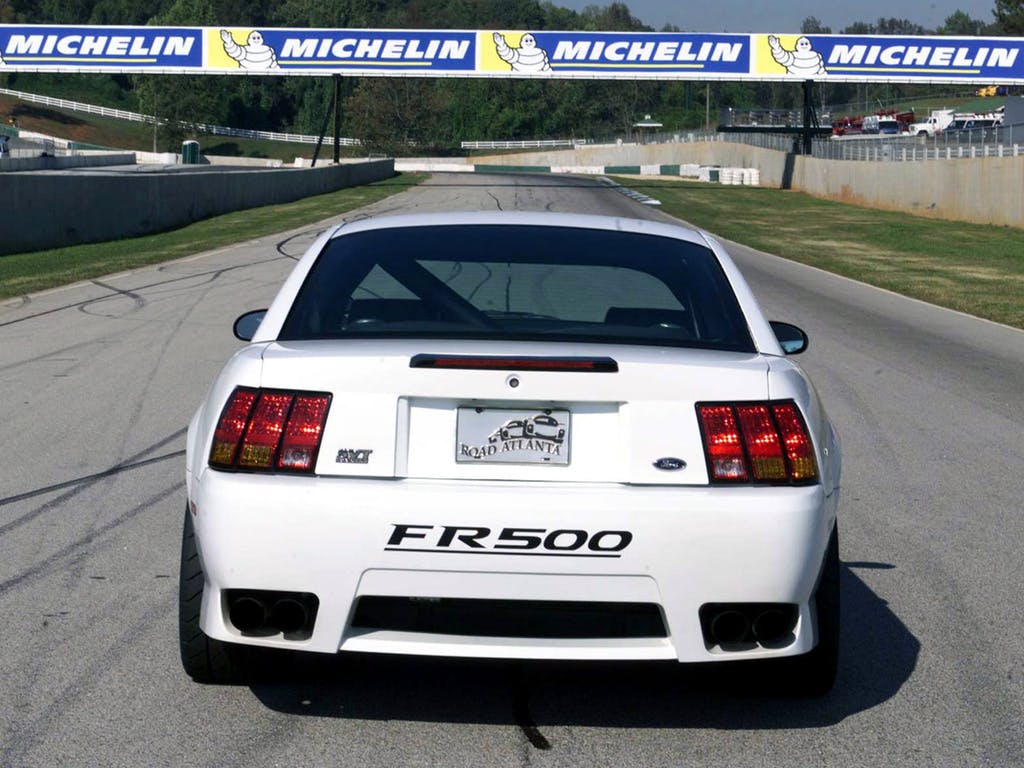
Far fewer, however, have heard of the Ford Mustang FR500. Debuting in 1999 in the midst of the heat surrounding the SVT Cobra debacle, it was aimed exclusively at the track—with the idea that the pony car crowd, after witnessing its high performance extremes, would be able to eventually order specific FR500 parts to hop up their own rides.
That’s not exactly what happened after the FR500 concept rolled out into the auto show spotlight—but this Rad-era racer’s true legacy as the car that proved modern Mustangs could compete on the race track turned out to be an even more important part of pony car history.
The FR500 Concept Showed The Mod Motor’s Potential
When the Special Vehicle Team got to work on the FR500, they weren’t bound by the same street-legal restrictions that kept the Cobra R closer to Earth. In addition to having carte blanche to alter the Mustang’s platform to maximize performance, they were also given a free hand to scour the Ford Racing skunk works for anything that might boost the coupe’s capabilities.


One of the most noticeable changes to the vehicle was its extended wheelbase. The front wheels were pushed nearly five inches towards the front and gained an inch of track width by way of double-A arm suspension that replaced the factory struts, an update that came courtesy of the Lincoln LS sport sedan’s parts bin (and SVT’s own fabrication department). Matched with a unique crossmember up front (and a reconfigured oil pan to get the sump out of the way), the move gave the car better weight distribution across both axles, improving straight-line and high-speed stability.
Also obvious to even casual Mustang fans was the car’s front grille delete (courtesy of a new carbon fiber hood), enormous front bumper air intakes, and carbon fiber fenders. The side scoops were further wiped clean from the body to help further improve slipperiness at speed.
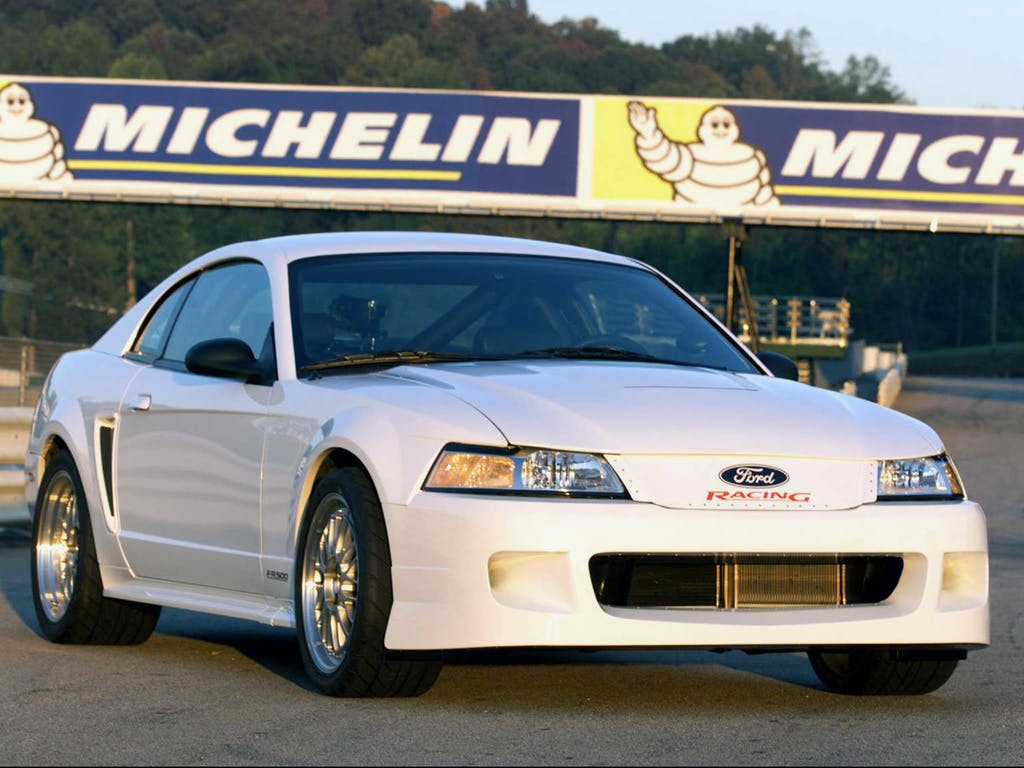
Between the front fenders, the modular V-8 ruled supreme—after it had been bored out to 5.0 liters and assembled by McLaren Engines (at their Livonia, Michigan location). Ford Racing contributed the cylinder heads and a bespoke magnesium intake manifold, while keeping the SVT Cobra’s rods and crank in place. The throttle bodies were borrowed from the same 5.4-liter motor used by the Cobra R, while a set of headers unique to the FR500 helped the engine breathe as deeply as possible.
The end result was 415 horsepower and 365 lb-ft of torque, with the engine’s high-revving nature indicative of its intended competition use. A six-speed T56 transmission sent that output to the Mustang’s rear axle, where a Torsen limited-slip differential managed traction.
A Dream Deferred


The FR500 was a hit with the press and at car shows and events, but the planned parts program roll-out stalled. Estimates at the time placed the full kit at more than $25,000, making the car more expensive than a contemporary C5 Corvette. Enthusiasts who wanted to snag just a few bits of FR500 fun for their own Cobras were eventually denied even that pleasure, as Ford never implemented the implied upgrade path for existing owners, and only built a trio of finished cars.
Hardcore fans willing to scour the Ford Racing parts list could locate a modified version of the FR500 intake, as well as its exhaust system, but that was the extent of what leaked out of Dearborn and onto the streets.
Although the prognosis looked grim from the outside, the Mustang FR500 as a concept was far from dead. Ford had a major redesign of its icon planned for the 2005 model year, and having asserted that the modular engine could hang with some of the most powerful factory power plants out there, it was ready to take the next step.
FR500 Racing Built The Modern Aftermarket For The Mustang Mod Motor


The intent, as before, was to ignore the legalities of emissions and safety regulations and instead build a Mustang for the track—only this time with the full backing of the factory as a turnkey competition car with a fully thought-out parts support program to match. This version of the FR500 went on sale in 2005, the same year as the new S197 platform debuted in showrooms, and it was an instant success among the competition crowd.
There were multiple editions of the FR500 on offer between 2005 and 2008, all based around the modular motor. The “base” FR500S relied on an all-aluminum, 4.6-liter engine, while the top-tier FR500GT3 made use of the hand-built R50 “cammer,” which punched out displacement to 5.0 liters. There were also a number of flavors (FR500GT, FR500GT4) available in between that crested the 400-hp threshold, and even a drag-oriented FR500CJ, featuring a whopping 900 horsepower from a supercharged version of that same 5.0-liter mill.

Initially built to make waves in Grand-Am racing, this version of the Mustang won the GrandSport manufacturer’s championship in its very first year, taking the checkered flag in nearly half of the dozen events in the series. In fact, the FR500 was a little “too” good, with Grand-Am officials hitting it with both weight and gearing penalties before the end of the season to help level the playing field somewhat.
Ford not only offered a complete car to race teams (assembled by Multimatic for between $110,000 and $125,000), but it also made good on the parts promise of the original FR500 by providing a long list of engine, chassis, suspension, and aero components that could be ordered a la carte. This was a boon to privateer teams on more limited budgets seeking to put together their best possible FR500 with the cash they had on hand and incrementally improve a car across multiple seasons.


On top of that, it was a big plus for those campaigning their Mustang on the street, too. More than a little of the parts development prowess Ford Racing poured into the FR500 ended up trickling down to enthusiasts looking for a quicker, better-handling daily driver. This sudden rush of mod motor parts lit a fuse that helped explode the S197 aftermarket, ultimately fulfilling the promise of the ’99 FR500, if only one generation late.
The FR500 Legacy Extends To Today
Today, no one questions the competence of Ford’s modular V-8, which has pulled duty in performance vehicles as diverse as the revived Ford GT, endless variants of the Shelby Cobra, and, of course, the Coyote and Voodoo engine variants that live on with the current edition of the Mustang.


It’s also no longer the case that Mustang owners struggle to find the equipment and expertise necessary to modify whatever engine they have sitting under the hood. The original small block Ford 5.0 remains revered by many, but it’s far from the be-all, end-all for Mustang builders—and certainly not seen as superior to the mod motor within that community.
There’s no question that the Ford FR500—which you can still find competing at tracks across the country on any given weekend—helped turn public perception of the automaker’s modular V-8 around. By acting as the thin end of the development wedge that helped crack open mods for the mod on the street, while regularly finding its way to the grassroots racing winner’s circle, it’s difficult to overstate how important a role it played in modern Mustang history.
