The Ford Mustang faced an identity crisis when it made the switch from its time-tested overhead-valve 5.0-liter V-8 to an entirely new DOHC “modular” eight-cylinder engine family in the mid-1990s. While the tried-and-true small block motor enjoyed enormous, and affordable, aftermarket support, the new 4.6-liter unit wasn’t quite as mighty right out of the box, and was dogged by complaints from the pony-loving crowd that modifications were complex and much more expensive than they were for its predecessor.
Ford initially attempted to dispel these negative vibes with the SVT Cobra edition of the car. Arriving in 1996, and outfitted with a 32-valve, all-aluminum version of the 4.6-liter V-8, it claimed 305 horsepower and 300 lb-ft of torque versus the 215 horses and 285 lb-ft that the iron-block, two-valve Mustang GT delivered.
Those are decent numbers, to be sure—but they were no better than the “regular” Chevrolet Camaro SS or the Pontiac Trans Am, which featured LT1 power and weren’t far from the LS1’s 1998 F-Body debut. With the Mustang GT increasingly left behind, and the SVT Cobra barely making the grade, Ford decided to push these modular engines harder for the 1999 model year.
It’s here that disaster struck: despite an advertised 320 horsepower and 317 lb-ft of torque, it turned out that customer cars were actually slower than the weaker SVT Cobras that had preceded them. A quick trip to the dyno easily proved that these ersatz Cobra drivetrains weren’t meeting the performance metrics measured out in the brochure, leading to lawsuits, a stop-sale and recall from Ford, and a frantic re-tuning program to quell the outrage from the Mustang faithful.
At this point, the Blue Oval need a win. The SVT Cobra was canceled for the 2000 model year, and in its place, the automaker rolled out two special projects designed to prove to the public that the Mustang’s modular engines deserved a second chance. Most muscle car fans are familiar with the 2000 Ford Mustang Cobra R, a low-production (just 300 examples) street terror that borrowed a larger 5.4-liter V-8 from Ford’s pickup truck assembly line and milked it for 385 horsepower and 385 lb-ft of torque.
Ford
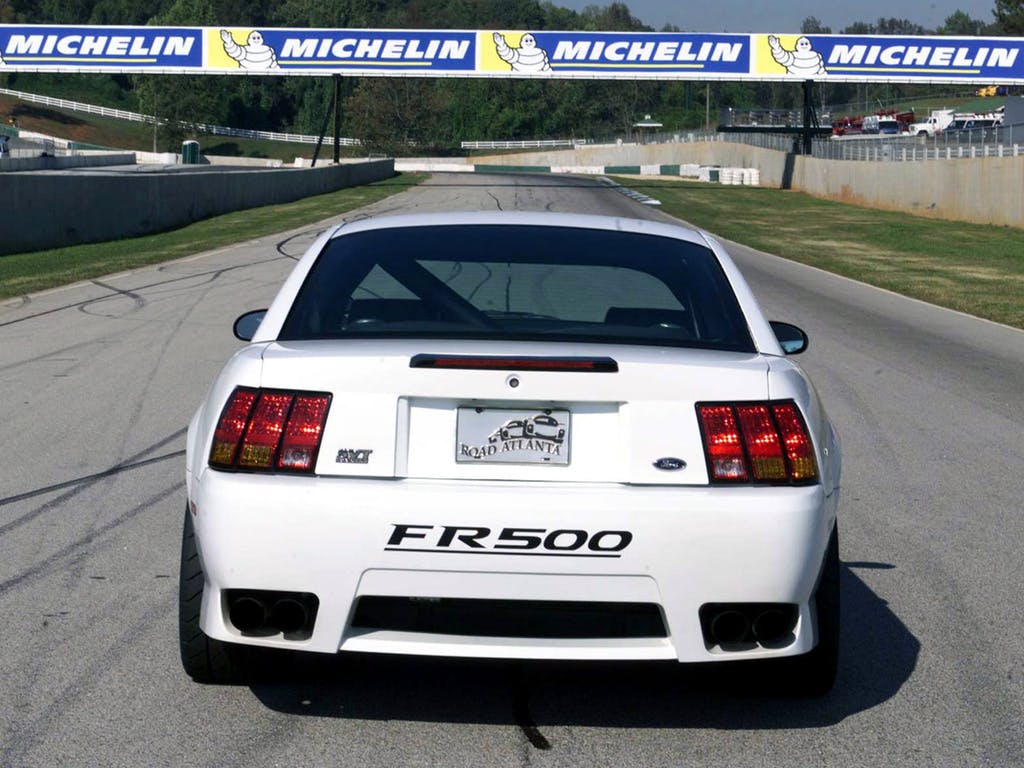
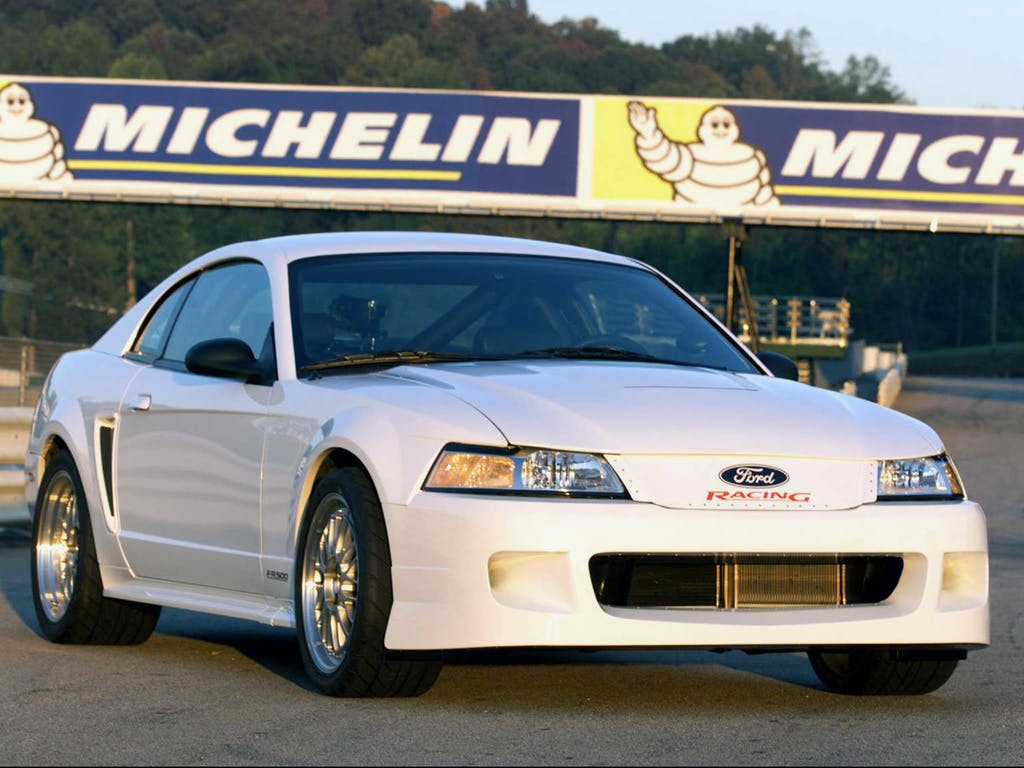
Far fewer, however, have heard of the Ford Mustang FR500. Debuting in 1999 in the midst of the heat surrounding the SVT Cobra debacle, it was aimed exclusively at the track—with the idea that the pony car crowd, after witnessing its high performance extremes, would be able to eventually order specific FR500 parts to hop up their own rides.
That’s not exactly what happened after the FR500 concept rolled out into the auto show spotlight—but this Rad-era racer’s true legacy as the car that proved modern Mustangs could compete on the race track turned out to be an even more important part of pony car history.
The FR500 Concept Showed The Mod Motor’s Potential
When the Special Vehicle Team got to work on the FR500, they weren’t bound by the same street-legal restrictions that kept the Cobra R closer to Earth. In addition to having carte blanche to alter the Mustang’s platform to maximize performance, they were also given a free hand to scour the Ford Racing skunk works for anything that might boost the coupe’s capabilities.
Ford
One of the most noticeable changes to the vehicle was its extended wheelbase. The front wheels were pushed nearly five inches towards the front and gained an inch of track width by way of double-A arm suspension that replaced the factory struts, an update that came courtesy of the Lincoln LS sport sedan’s parts bin (and SVT’s own fabrication department). Matched with a unique crossmember up front (and a reconfigured oil pan to get the sump out of the way), the move gave the car better weight distribution across both axles, improving straight-line and high-speed stability.
Also obvious to even casual Mustang fans was the car’s front grille delete (courtesy of a new carbon fiber hood), enormous front bumper air intakes, and carbon fiber fenders. The side scoops were further wiped clean from the body to help further improve slipperiness at speed.
Ford
Between the front fenders, the modular V-8 ruled supreme—after it had been bored out to 5.0 liters and assembled by McLaren Engines (at their Livonia, Michigan location). Ford Racing contributed the cylinder heads and a bespoke magnesium intake manifold, while keeping the SVT Cobra’s rods and crank in place. The throttle bodies were borrowed from the same 5.4-liter motor used by the Cobra R, while a set of headers unique to the FR500 helped the engine breathe as deeply as possible.
The end result was 415 horsepower and 365 lb-ft of torque, with the engine’s high-revving nature indicative of its intended competition use. A six-speed T56 transmission sent that output to the Mustang’s rear axle, where a Torsen limited-slip differential managed traction.
A Dream Deferred
Ford
The FR500 was a hit with the press and at car shows and events, but the planned parts program roll-out stalled. Estimates at the time placed the full kit at more than $25,000, making the car more expensive than a contemporary C5 Corvette. Enthusiasts who wanted to snag just a few bits of FR500 fun for their own Cobras were eventually denied even that pleasure, as Ford never implemented the implied upgrade path for existing owners, and only built a trio of finished cars.
Hardcore fans willing to scour the Ford Racing parts list could locate a modified version of the FR500 intake, as well as its exhaust system, but that was the extent of what leaked out of Dearborn and onto the streets.
Although the prognosis looked grim from the outside, the Mustang FR500 as a concept was far from dead. Ford had a major redesign of its icon planned for the 2005 model year, and having asserted that the modular engine could hang with some of the most powerful factory power plants out there, it was ready to take the next step.
FR500 Racing Built The Modern Aftermarket For The Mustang Mod Motor
Ford
The intent, as before, was to ignore the legalities of emissions and safety regulations and instead build a Mustang for the track—only this time with the full backing of the factory as a turnkey competition car with a fully thought-out parts support program to match. This version of the FR500 went on sale in 2005, the same year as the new S197 platform debuted in showrooms, and it was an instant success among the competition crowd.
There were multiple editions of the FR500 on offer between 2005 and 2008, all based around the modular motor. The “base” FR500S relied on an all-aluminum, 4.6-liter engine, while the top-tier FR500GT3 made use of the hand-built R50 “cammer,” which punched out displacement to 5.0 liters. There were also a number of flavors (FR500GT, FR500GT4) available in between that crested the 400-hp threshold, and even a drag-oriented FR500CJ, featuring a whopping 900 horsepower from a supercharged version of that same 5.0-liter mill.
Ford
Initially built to make waves in Grand-Am racing, this version of the Mustang won the GrandSport manufacturer’s championship in its very first year, taking the checkered flag in nearly half of the dozen events in the series. In fact, the FR500 was a little “too” good, with Grand-Am officials hitting it with both weight and gearing penalties before the end of the season to help level the playing field somewhat.
Ford not only offered a complete car to race teams (assembled by Multimatic for between $110,000 and $125,000), but it also made good on the parts promise of the original FR500 by providing a long list of engine, chassis, suspension, and aero components that could be ordered a la carte. This was a boon to privateer teams on more limited budgets seeking to put together their best possible FR500 with the cash they had on hand and incrementally improve a car across multiple seasons.
Ford
On top of that, it was a big plus for those campaigning their Mustang on the street, too. More than a little of the parts development prowess Ford Racing poured into the FR500 ended up trickling down to enthusiasts looking for a quicker, better-handling daily driver. This sudden rush of mod motor parts lit a fuse that helped explode the S197 aftermarket, ultimately fulfilling the promise of the ’99 FR500, if only one generation late.
The FR500 Legacy Extends To Today
Today, no one questions the competence of Ford’s modular V-8, which has pulled duty in performance vehicles as diverse as the revived Ford GT, endless variants of the Shelby Cobra, and, of course, the Coyote and Voodoo engine variants that live on with the current edition of the Mustang.
Ford
It’s also no longer the case that Mustang owners struggle to find the equipment and expertise necessary to modify whatever engine they have sitting under the hood. The original small block Ford 5.0 remains revered by many, but it’s far from the be-all, end-all for Mustang builders—and certainly not seen as superior to the mod motor within that community.
There’s no question that the Ford FR500—which you can still find competing at tracks across the country on any given weekend—helped turn public perception of the automaker’s modular V-8 around. By acting as the thin end of the development wedge that helped crack open mods for the mod on the street, while regularly finding its way to the grassroots racing winner’s circle, it’s difficult to overstate how important a role it played in modern Mustang history.
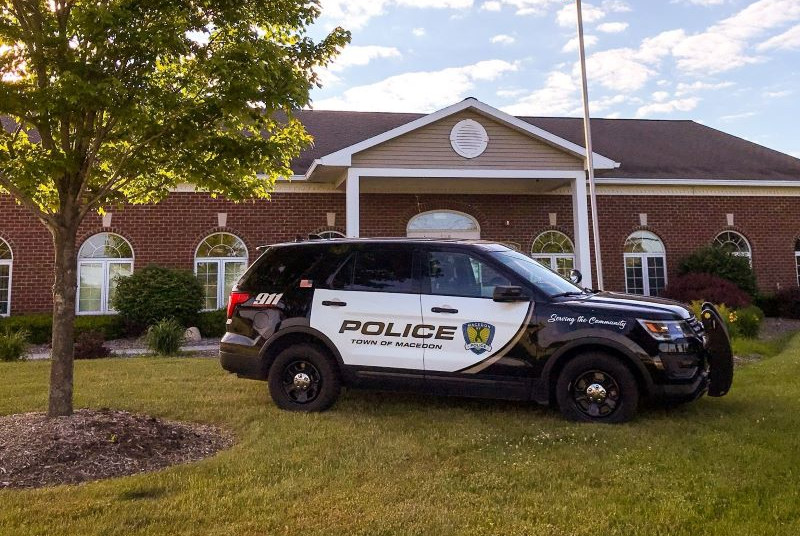
Two additional suspects have been arrested in connection with a 2023 burglary at a Macedon motorsports store that resulted in thousands of dollars in stolen dirt bikes, police said.
The Macedon Police Department announced that Mia Fernandez, a 26-year-old Florida woman, and Cordae Terry, a 28-year-old Rochester man, have been charged in the March 2023 “Smash-and-Grab” burglary at Filer’s PowerSports in Wayne County.
Police said the burglary involved suspects driving a vehicle into a garage door on the side of the building to gain entry. Once inside, investigators said the group stole multiple dirt bikes before leaving the scene and later returning to take additional bikes. Authorities have previously estimated the value of the stolen property at approximately $67,000.
Seven suspects were indicted in Wayne County Court in November 2025. Four of those individuals were taken into custody that month. An initial arrest tied to the burglary was made in March, when a Rochester man was charged with burglary and additional offenses related to the case. The seventh indicted suspect was determined to be deceased.
Fernandez, who had relocated to Bradenton, Florida, was taken into custody at her workplace with assistance from the Manatee County Sheriff’s Office, authorities said. She waived extradition and was returned to New York by Macedon police on Dec. 2. She was arraigned in Wayne County Court, released, and is scheduled to appear at a later date, according to police.
Terry was located while already in the custody of the New York State Department of Corrections and Community Supervision. He was ordered to appear in Wayne County Court on Dec. 18, where he was arraigned before being returned to state custody. Police said he is also scheduled to appear at a later date.
The investigation remains ongoing.
The fact that a defendant has been charged with a crime is merely an accusation and the defendant is presumed innocent until and unless proven guilty.
Have all the Finger Lakes news from Finger Lakes News Radio delivered to your email every morning for FREE! Sign up by clicking here
Get the top stories on your radio 24/7 on Finger Lakes News Radio 96.3 and 1590, WAUB and 106.3 and 1240, WGVA, and on Finger Lakes Country, 96.1/96.9/101.9/1570 WFLR.
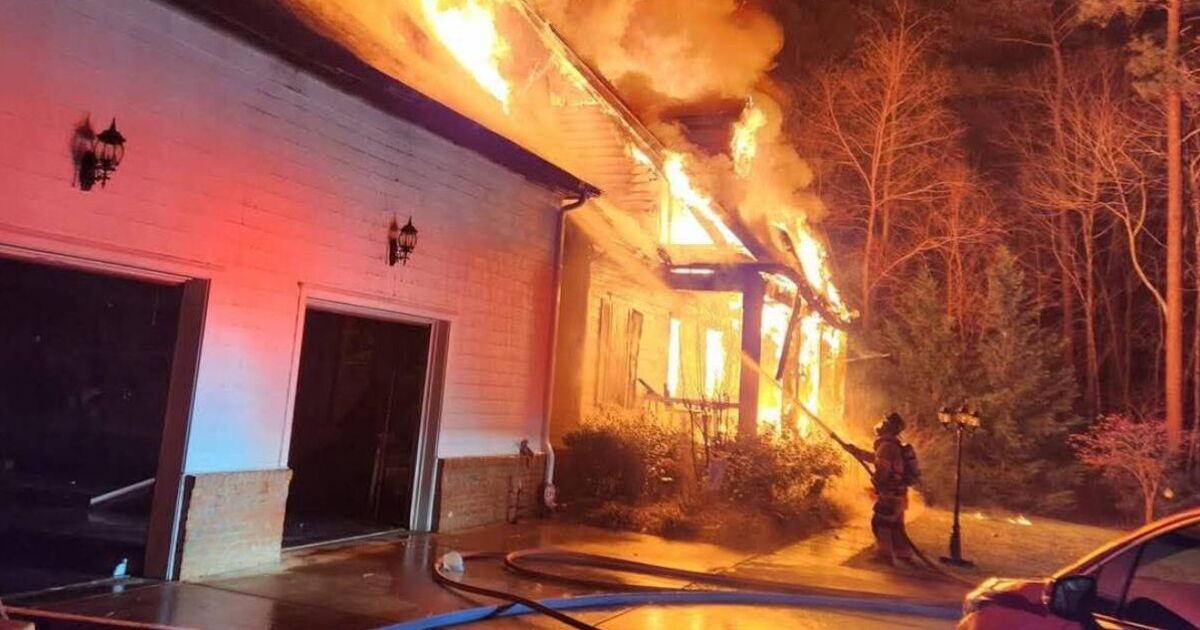
Two people have been hospitalized following a huge fire at a home in North Carolina, which is owned by NASCAR star Denny Hamlin.
On Sunday night, the Lucia-Riverbend Fire Department responded to the scene in Stanley, North Carolina, to extinguish a blaze that had broken out at a property owned by Hamlin’s real estate company, One Real Estate. The property, a four-bedroom, three-bathroom house, sits on 1.76 acres of land and was built in 2015.
Shocking scenes show the house being ravaged by the inferno as firefighters attempted to put out the fire, which also led to two people needing to be taken to the hospital, with the pair unnamed. It comes following a recent announcement involving Jeff Gordon’s family.
“We are starting with some breaking news tonight where you can see some live images of a massive house fire in Gaston County, a house that is reportedly linked to NASCAR driver Denny Hamlin,” said a broadcast from NBC affiliate WCNC.
“We are told this fire started around 6 p.m. Sunday night. … Fire officials also confirming to us that Hamlin’s parents do live in the home … Gaston County officials say two people were taken to the hospital, officials did not share their condition, only to say one person at least had smoke inhalation.”
Sign up to our NASCAR newsletter here
The two individuals were, according to Lucia-Riverbend Fire Department chief David Toomey, outside the property when emergency services arrived to tackle the blaze. It took around five hours for the fire to be put out, with the final fire truck leaving the scene at around midnight on Sunday.
Posting an update on Facebook, the Lucia-Riverbend Fire Department wrote: “Multiple departments throughout Gaston and Lincoln Counties responded tonight to the 1100 block Blacksnake Road.
“Fully involved single family residential home. We are thankful for the multiple agency response and ask that the public be in prayer for the affected family and our first responders in fire, GEMs and police. This remains an active scene.”
Toomey also confirmed that the damage to the house was a total loss and that 40 to 45 percent of its structure was burning by the time they arrived on the scene.
Speaking to the Athletic, Toomey said: “They had some really expensive cars in the garage and some racing memorabilia and stuff, so all that was saved.
“We were able to save all that and get it out so it wasn’t damaged.”
A former NASCAR star once received a presidential pardon that he described as “a tremendous Christmas present.”
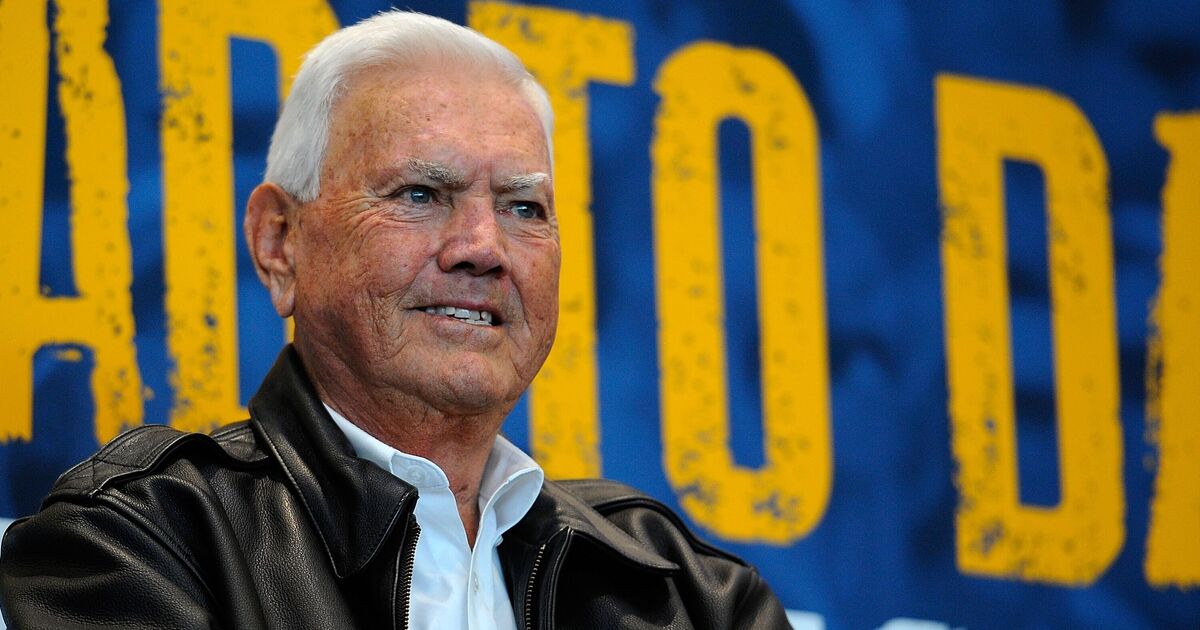
Junior Johnson, a NASCAR Hall of Fame inductee and renowned driver and team owner, once had a pardon signed by United States President Ronald Reagan that vindicated him of a crime he committed 30 years prior.
As a kid growing up in the foothills of western North Carolina, Johnson was born into a family involved in the whiskey business and known as bootleggers, a term used for those who illegally produce and transport alcohol where it is prohibited by law.
Johnson regularly partook in bootlegging as a child and young adult but was never caught or convicted, unlike his father, who spent nearly two decades in prison for his role in operating the family whiskey business.
A 25-year-old who was fresh off his first season as a NASCAR driver at the time of his arrest, Johnson spent one year in an Ohio prison for having an illegal still, an at-home production device for the popular spirit moonshine.
Over the next three decades, Johnson built a Hall of Fame-worthy career as a NASCAR driver and team owner. His resume includes 50 race wins and 148 top 10 finishes as a driver and six drivers’ championships and 132 race victories as team owner of Junior Johnson & Associates.
Johnson’s most decorated drivers include Carl Yarbrough and Darrell Waltrip, each of whom won three NASCAR drivers’ championships in the late 1970s and early 1980s.
All the while, Johnson was ineligible to vote in United States elections due to his status as a criminal.
Reagan’s decision to pardon the NASCAR legend, who was 20 years retired from his driving career at the time, restored that right. Johnson “could not have imagined anything better,” he wrote on Motorsports Unplugged in 2012.
The pardon was signed on December 26, 1985, and was “a tremendous Christmas present for me,” Johnson wrote in 2012.
“Let me tell you that the loss of basic civil rights impacts you in a way you can’t imagine. You come to think of yourself somewhat less than an American citizen. It’s not a good feeling,” Johnson wrote on Motorsports Unplugged.
Johnson’s criminal status also kept him out of the North Carolina Sports Hall of Fame for 10 years, as the man in charge of the induction committee, Dick Herbert, refused to count votes cast for Johnson.
In 1981, votes for Johnson were counted, and the North Carolina native was inducted into his home state’s sports hall of fame.
In 2010, Johnson was inducted into the inaugural class in the NASCAR Hall of Fame and was named one of NASCAR’s 75 greatest drivers in 2023.
Johnson died on December 20, 2019, at the age of 88.
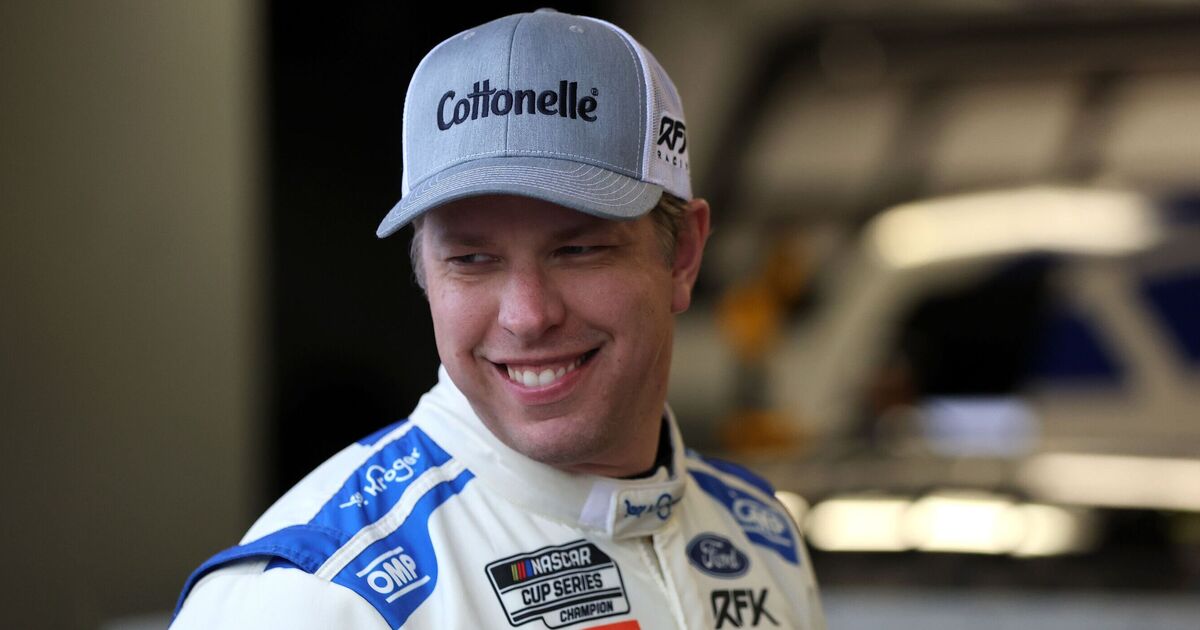
Before becoming an all-time great NASCAR driver and a team owner, Brad Keselowski began his career at the lowest level within his father’s racing organization.
Keselowski’s father, Bob, owned and operated the now-defunct K-Automotive Racing team during Brad’s childhood, and the former ARCA Series racer subjected his son to some less-than-desired manual labor duties around his operation.
In a 2015 interview for USA Today with motorsports journalist Jeff Gluck, Keselowski detailed the specifics of his day-to-day to-do list.
“They let me sweep floors, and I ended up mowing the grass a lot and mopping,” Keselowski said. “I think I made like $20 a day, which was a lot of money when I was 16. I had to work 8 to 5 every day in the summer.”
First as a star for Hendrick Motorsports and Penske Racing, and now the co-owner of his own racing team, RFK Racing, Keselowski, who recently broke his leg in a skiing accident, has been at the top of the totem pole ever since he burst onto the scene in 2009 when he won his first Cup Series race at Talladega.
His foundation as a regular employee in his father’s business laid the groundwork for the success that would soon come for Keselowski, although it didn’t look at all like the path some sons of NASCAR stars, such as Keelan Harvick, are taking to prepare themselves for a career in professional racing.
During the interview with Gluck, Keselowski recalled a specific, objectively gross detail of the everyday grind he faced when working for his father’s team.
Responsible for taking out the trash every day, Keselowski noticed chewing tobacco, which most everyone in the race shop used, spat all alongside the trash can due to poor aim.
He would be forced to touch the sides of the can covered in the substance, and because the trash was only picked up once a month, the dumpster would often overflow, and Keselowski would need to find a way to fit in every last spit-covered piece of trash.
That led him to ask his parents if the trash could be picked up more often, a plea they rejected due to the cost being too expensive.
Years later, as a racing team owner of his own, Keselowski discovered the cost of one more trash pickup per month to be an extra $18, to which the NASCAR star realized his parents were trying to teach him a lesson back in the day, rather than being cheap.
“Are you (freaking) kidding me? I jumped in trash and chewing tobacco and risked losing my foot for two whole summers for like $15?” Keselowski said. “I guess it was good for me. My parents must have known that.”
Kyle Larson stunned fans at Australia’s Perth Motorplex on Sunday when he made a surprise appearance in bold fashion.
The second annual High Limit International event commenced on December 28 and Larson, the defending NASCAR Cup Series champion and a co-founder of the league, opted against a quiet and modest arrival.
The Hendrick Motorsports star instead dramatically descended from the sky in a silver helicopter before the first race of the three-day series began to deliver a briefcase containing $110,000 Australian Dollars, a record prize for an Australian sprint car racing event.
The helicopter landed on the racetrack before Larson emerged wearing a red fire suit, holding a black briefcase containing the winning prize, set to go to the winner of Tuesday’s main event.
The NASCAR star, who won the inaugural High Limit International race one year ago, walked to the infield and delivered the case to Perth Motorplex General Manager Gavin Migro.
“I was actually nervous because of how windy it is,” Larson said as he walked to the infield. “That was probably the smoothest helicopter ride I’ve ever been on.”
The two-time NASCAR Cup Series champion also noted that he’s only accustomed to taking helicopters out of tracks, which he has famously done twice before on ‘Double Duty,’ when he raced in both the Indianapolis 500 IndyCar race and Coca-Cola 600 NASCAR race on the same day.
Then came the race, the first of two prelims leading up to Tuesday’s main event, which pitted big-name drivers from the United States against high profile Australian racers for a $15,000 prize.
Larson’s HMS teammate Corey Day took the checkered flag, fending off Australian Kaiden Manders by a half second. Day, who began the race in fourth position, was briefly overtaken by Manders after Larson caused the lone caution of the race when he suffered a flat right-rear tire on Lap 22.
The defending High Limit champion and co-owner finished 17th on the night, an underwhelming result after his grand entrance.
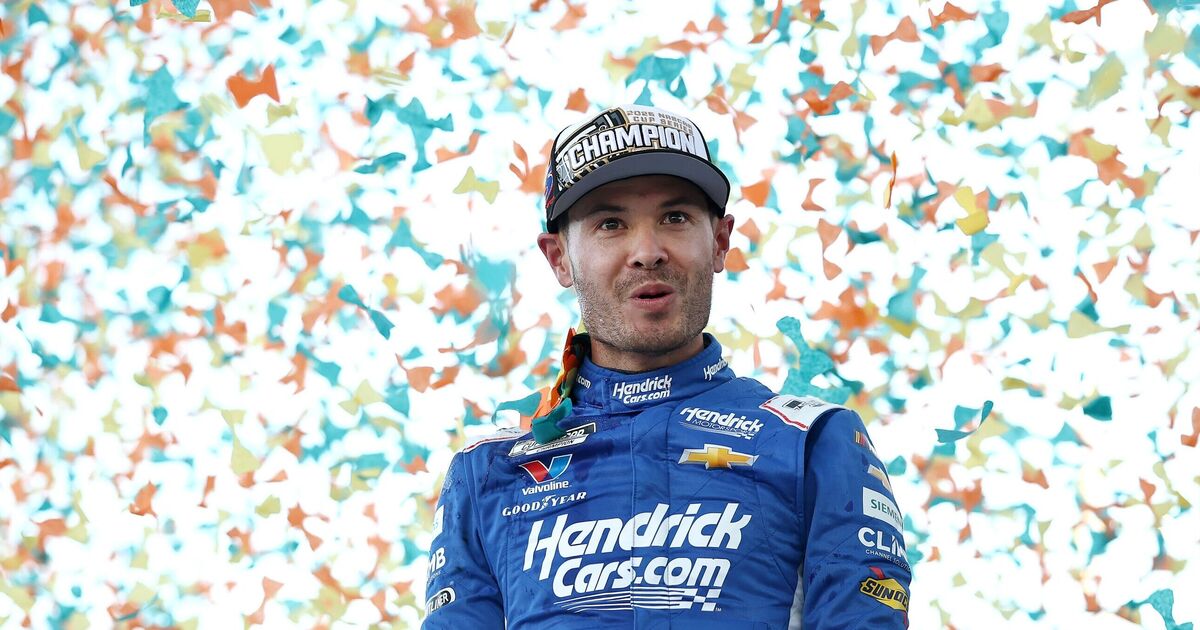
Larson’s cross-globe journey to participate in High Limit comes less than two months after he captured the 2025 NASCAR Cup Series championship.
The 33-year-old won the title without leading a single lap in the championship race at Phoenix, outlasting Denny Hamlin, Chase Briscoe, and William Byron, all of whom suffered tire issues, to finish third.
The former Chip Ganassi Racing driver won three races during the 2025 season and finished atop the points standings thanks to six top-seven finishes in the playoffs.
Unlike in 2021, Larson’s first NASCAR Cup Series title, he did not win a single playoff race en route to claiming the championship.
A sequel to Days of Thunder, titled Days of Thunder 2, has reportedly entered early development. Tom Cruise is expected to return as Cole Trickle in the movie that has a target release window of 2026. While details remain vague, industry chatter has also hinted at possible involvement from NASCAR driver Jeff Gordon.
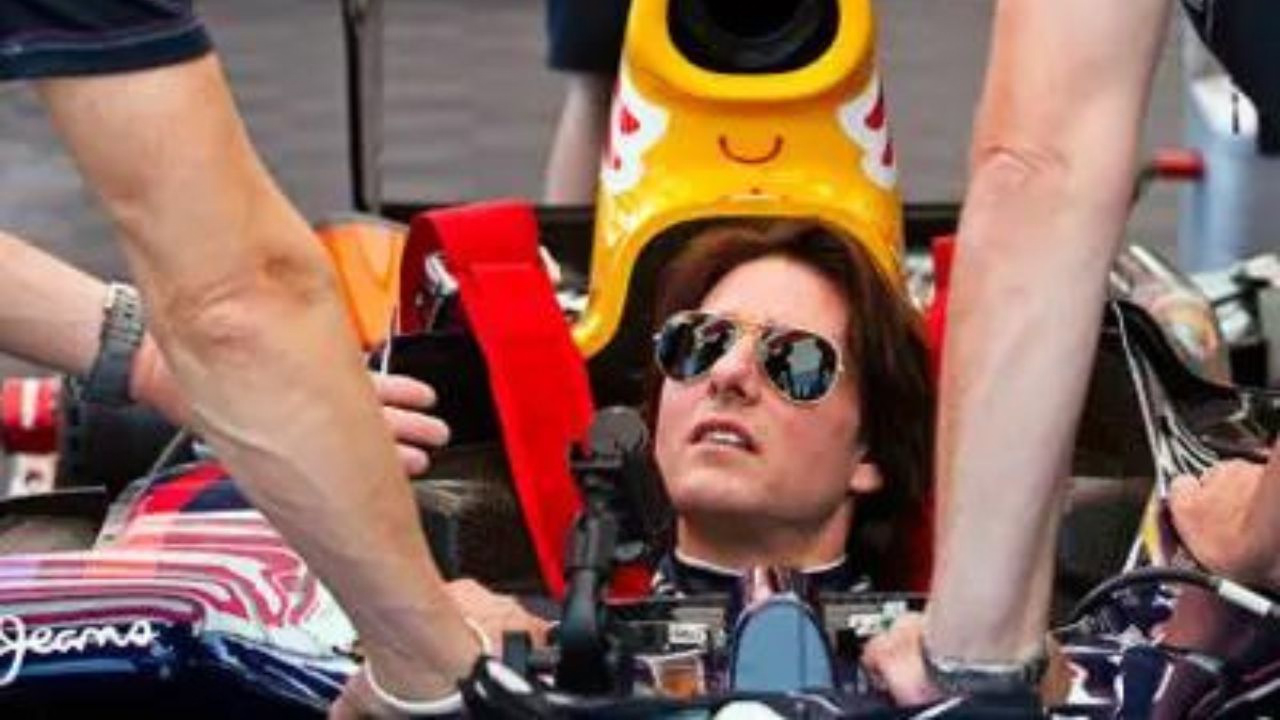
Fueling that speculation, Hendrick Motorsports recently published a set of 23 behind-the-scenes images on its website, offering a glimpse of Cruise during filming. The photographs were of the Hollywood superstar seated in a race car and posing between takes.
The photos have intensified interest. The hype is also fueled by Cruise’s connection to racing extends beyond the silver screen.
Long before portraying a stock car driver in Hollywood, Cruise had some firsthand experience in competitive motorsports. In 1987, he stepped into professional racing by competing in the IMSA Firestone Firehawk Grand Sports endurance race. He also took part in several SCCA events in the 1980s.
That IMSA debut placed him in the deep end, though. The three-hour endurance race at Road Atlanta demanded extreme patience from Cruise, who was sharing the car with Rick Hendrick. His true test of patience came when he encountered a refueling issue that disrupted his run.
The issue ultimately dropped his team to a 14th-place finish in the endurance race at Road Atlanta. Cruise completed 97 laps around the 2.52-mile road course and came away with a clearer understanding of what drivers go through each weekend.
“It was a lot of fun. I got a lot of seat time, and it was fun racing with those guys. The first three laps were like a demolition derby. Guys were bouncing off each other. After that, it settled down, and we had some good racing,” said Cruise, reflecting on the experience.
Cruise had started the Nissan 300 ZX Turbo from 15th on the grid and handled the opening 80 minutes of the three-hour race. He steadily climbed into P9 place before pitting on lap 50. That pit stop, however, proved costly.
A fueling problem stretched the visit to two minutes. They ended falling behind by two laps, undoing the progress. When Hendrick rejoined the race, the team found itself in 19th place, forced to salvage what it could over the remaining distance.
The event also marked Hendrick’s professional racing debut in the street-stock category. That race was won by John Heinricy of Holly, Michigan, and Stuart Hayner of Yorba Linda, California. Cruise and Hendrick focused on finishing the endurance challenge and gaining experience.
Now 63, Cruise appears ready to strap in once more, not to chase trophies, but to return to racing on the silver screen. Reports suggest Days of Thunder 2 will frame him as a mentor confronting modern technology and younger rivals, with themes centered on legacy, redemption, and NASCAR competition.
Speculation has also swirled around Margot Robbie potentially joining the cast as a rising star, alongside possible cameos from the original film’s ensemble.