President Donald Trump‘s reported efforts to reestablish the ground rules of college athletics reflect his long interest in sports and the concern among fans that the NIL changes have gone too far.
While nothing is official, Trump appears to be forming a presidential commission on college sports to establish a new set of guidelines to stabilize what has become a free-for-all model of unlimited player compensation and high roster turnover.
Arguably the most successful coach in college football history, along with a former player involved in a pro-Trump think tank, will lead the commission.
“Alabama has changed college football forever, and inscribed into the history books the names of Bear Bryant, Joe Namath, four Heisman Trophy winners, and, of course, the great Nick Saban,” Trump said in a May 1 commencement speech at the University of Alabama. “This place is truly where legends are made. It really is. It’s a special place.”
Saban, who introduced Trump before the speech and met with him during the visit, won six national championships coaching the Alabama Crimson Tide. Now retired, he wants to add to his legacy by helping reform college athletics.
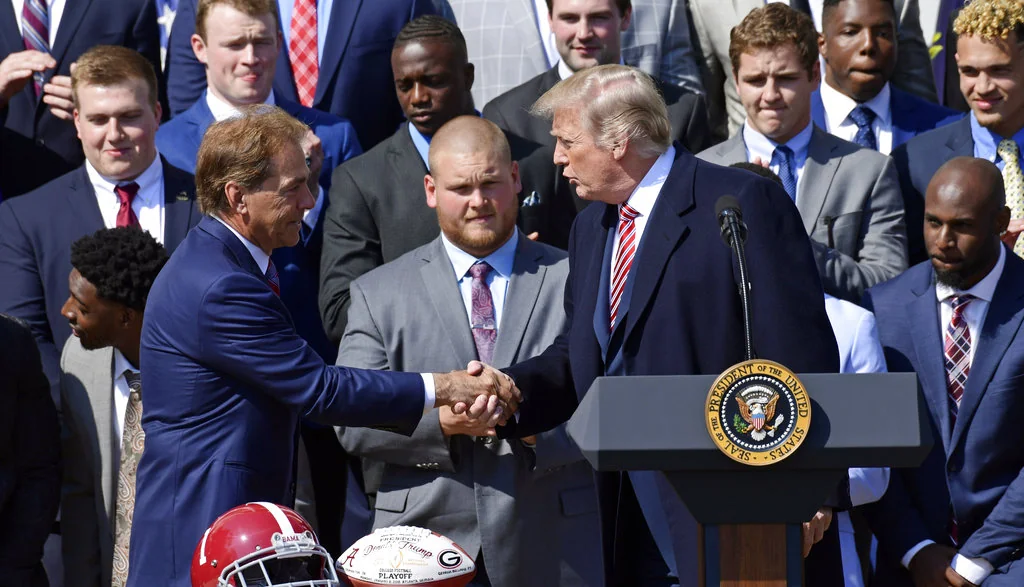
President Donald Trump shakes hands with Alabama head coach Nick Saban during an event for the 2017 NCAA National Champion University of Alabama football team on the South Lawn of the White House in Washington, Tuesday, April 10, 2018. Alabama team captain Bradley Bozeman, center, watches. (AP Photo/Susan Walsh)
According to Yahoo.com, Saban will co-chair the commission along with Cody Campbell, who played football at Texas Tech and is now a member of the school’s board of regents and a distinguished fellow at the pro-Trump America First Policy Institute.
Saban and Campbell each played college football in the era before players got paid. Alabama renamed its home field in Saban’s honor after paying him tens of millions of dollars to coach, and the Texas Tech Red Raiders now play on Cody Campbell Field after Campbell made a $25 million donation to the school.
However, for those who have cheered recent changes in the college sports landscape, what these two men have proposed could represent a regression rather than reform.
“There isn’t a crisis in college sports regarding NIL that needs fixing,” said Andy Schwarz, an economist specializing in antitrust, class actions, and damages analysis. “Schools paying more money for athletes is a sign the market is functioning more accurately than it used to.”
What’s at stake?
Historically, the National Collegiate Athletic Association barred college athletes from being paid beyond the value of a full-ride scholarship, even while their efforts generated billions of dollars in revenue for their schools.
That state of affairs changed in 2021 following the Supreme Court’s NCAA vs. Alston decision. Student-athletes are now allowed to profit from their name, image, and likeness, or NIL, and many college football and men’s basketball players are now paid millions of dollars a year.
Several other factors have also changed over the last few years.
The NCAA relaxed its transfer rules simultaneously, allowing players to switch schools between and sometimes during the athletic season. Some players now spend time at three or even four different schools across their career, and entire rosters can turn over in a single offseason.
Lawsuits have challenged yet another NCAA rule that allowed players five years of eligibility to play four seasons in a given sport, and efforts have emerged arguing that players should be designated as employees who can form labor unions, challenging the NCAA’s amateur model and very idea that players are “student-athletes” seeking a degree from the school they represent.
The NCAA did not respond to a request for comment from the Washington Examiner.
Saban, who retired following the 2023 season, argued that paying players would widen the gap between name-brand schools that can afford top salaries and those that cannot, hurting competition. Concerns have also been raised that schools will have to cut nonrevenue and Olympic sports, including female sports, leaving those athletes out in the cold.
Trump’s commission could not change any rules on its own, and Trump would be limited in what he could do via executive order, but the effort could prove impactful if Congress ratifies its recommendations.
“President Trump obviously has a lot of love and interest in sports in general, and has been involved with sports for many decades,” said John Shu, a constitutional law expert who worked for former Presidents George H.W. Bush and George W. Bush. “These issues are of national importance, and it’s appropriate for President Trump to create a commission to look into it and make suggestions and recommendations.”
Along with Saban, another Alabama-based former football coach, Sen. Tommy Tuberville (R-AL), has his sights set on reforming college sports. Tuberville has tried to get NIL legislation passed before, and flew with Trump on Air Force One to his commencement address in Tuscaloosa.
“College football is the heart and soul of America — but it’s in danger if we don’t level the playing field,” Tuberville, who spent a decade coaching the Auburn Tigers, posted on X.
Had a great conversation with President Trump last night about the importance of establishing national standards for NIL.
College football is the heart and soul of America — but it’s in danger if we don’t level the playing field. pic.twitter.com/GlUycduFxY
— Coach Tommy Tuberville (@SenTuberville) May 2, 2025
A Tuberville spokesperson acknowledged his involvement but provided few details.
“In the ever-changing landscape of college athletics, both President Trump and Sen. Tuberville want to make sure that college athletes continue to get a quality education, women’s sports are protected, and the integrity of college sports remains intact,” the spokesperson said.
A White House spokesperson did not comment on the record when contacted, but according to the Yahoo report, the commission’s framework could include three main components. The first would be a limited antitrust protection for the NCAA to enforce transfer and eligibility rules, the second would be a clause clarifying that players are students and not employees, and the third would be an override of existing state-level NIL laws.
Even with Republican majorities in both chambers, getting a bill through Congress could be difficult. Previous efforts have not been fruitful, and backers of the recent changes have said that athletes are now rightfully empowered to profit off their labor and to leave when they find themselves in a bad situation.
“In the NIL era, the coaches now have to treat their athletes with respect, or they can transfer out to a better offer,” Schwarz said.
Hagens Berman, an attorney leading an NIL-related lawsuit against the NCAA, released a statement criticizing Saban’s reported involvement in the commission.
“Coach Saban and Trump’s eleventh-hour talks of executive orders and other meddling are just more unneeded self-involvement,” Berman said. “College athletes are spearheading historic changes and benefitting massively from NIL deals. They don’t need this unmerited interference from a coach only seeking to protect the system that made him tens of millions.”
Trump the sports fan
This isn’t Trump’s first time trying to shake up the sports world. In the 1980s, he attempted to buy the NFL’s Baltimore Colts. When that failed, Trump bought the USFL’s New Jersey Generals, which featured high-profile players including Heisman Trophy winners Herschel Walker and Doug Flutie.
At Trump’s urging, the USFL filed and won an antitrust lawsuit against the NFL in 1986, but it was famously awarded only $3 in damages, spelling the league’s demise.
Donald Trump shakes hands with Herschel Walker in New York after an agreement on a four-year contract with the New Jersey Generals USFL football team, March 8, 1984. (AP Photo/Dave Pickoff, File)
Trump is also a fan of boxing and mixed martial arts. He has attended several UFC events since last November’s election.
However, college football tends to be popular in red states, and Trump has made a habit of attending games during his political career. He attended the 2018 College Football Playoff Championship in Atlanta, attended Alabama games in Tuscaloosa in 2019 and 2024, and attended the Army-Navy game, the Iowa-Iowa State game, and the South Carolina-Clemson game, among other events.
Whether the reported commission succeeds in reforming college sports, Trump is once again throwing his weight around in matters that stray far from Washington, D.C., politics.
Trump’s austerity argument on tariffs may be ‘dangerous politically’
Tom McMillen, a former Democratic congressman and Maryland Terrapins basketball star, said the commission should have been created long ago.
“Applauding [President] Trump for considering a presidential commission on college sports—something I first called for 11 years ago,” he posted on X. “The conversation is long overdue.”
The annual NHL Winter Classic game is a favorite of hockey fans.
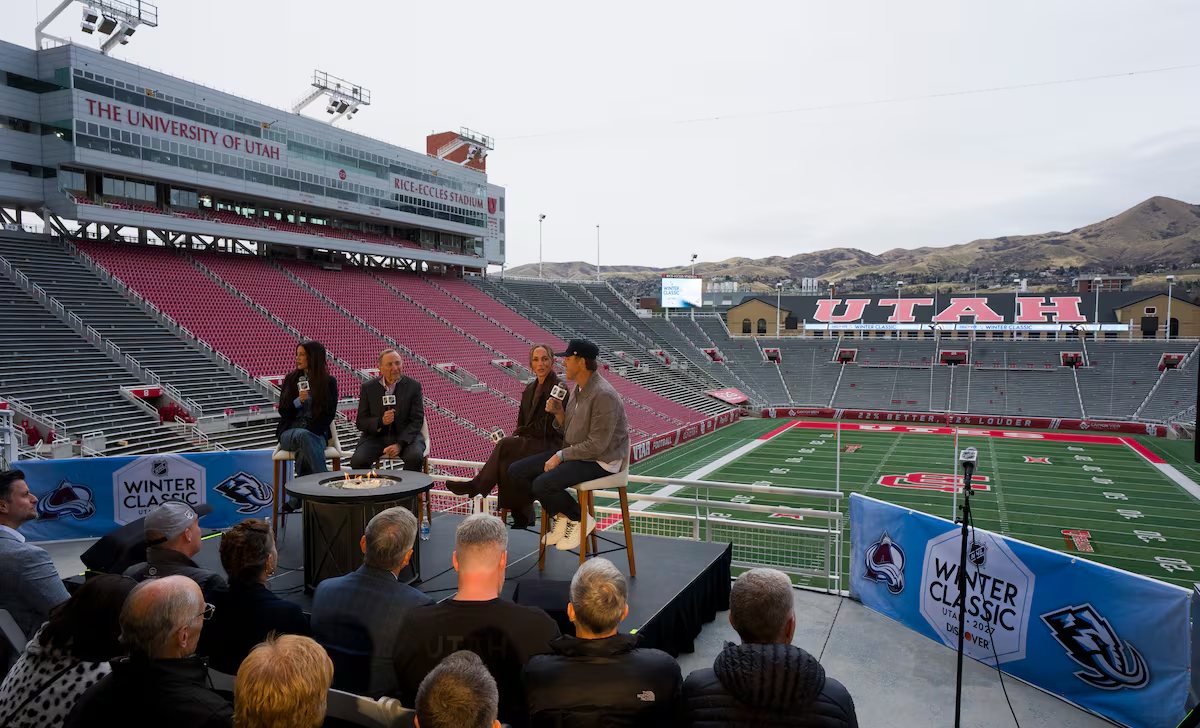
(Bethany Baker | The Salt Lake Tribune) From left, reporter Jackie Redmond, Gary Bettman, the NHL Commissioner, and Ashley and Ryan Smith, both co-founders of Smith Entertainment Group and owners of Utah Mammoth, hold a news conference to announce the location of the 2027 NHL Winter Classic as Rice-Eccles Stadium at the University of Utah in Salt Lake City, seen here on Wednesday, Jan. 7, 2026.
The marquee game of the NHL’s regular season is coming to Salt Lake City next year.
NHL commissioner Gary Bettman joined Utah Mammoth owners Ryan and Ashley Smith on Wednesday in announcing that the 2027 Winter Classic will be held outdoors at Rice-Eccles Stadium. The Mammoth will play the current NHL leaders, the Colorado Avalanche. The game will take place at the beginning of next January.
“I think this venue is going to be incredible,” Ryan Smith said. “This is a dream.”
The NHL selected Rice-Eccles Stadium as the venue over competition from BYU’s Lavell Edwards Stadium in Provo and several other markets around the NHL that wanted to host the event.
“I wanted it here in Salt Lake. This is right,” Smith, a BYU alum, said. “I mean, I do enough down there. This is my NIL donation here. It’s a good one.”
And unlike at University of Utah football games, the stadium will sell alcohol for the event, university director of auxiliary services Collin Simmons told reporters. “We’re able to sell beer and seltzer for all private events,” he explained. “This is a private event.”
(Bethany Baker | The Salt Lake Tribune) Ryan Smith, right, and Ashley Smith, both co-founders of Smith Entertainment Group and owners of Utah Mammoth, answer questions during a news conference to announce the location of the 2027 NHL Winter Classic as Rice-Eccles Stadium at the University of Utah in Salt Lake City, seen here on Wednesday, Jan. 7, 2026.
The exact date for the event has yet to be selected, as the NHL experiments with different dates at the beginning of January that conflict least with the NFL and college football. The game has traditionally taken place on either Jan. 1 or Jan 2.
The Winter Classic began in 2008, as the NHL sought to bring new fans to its games by returning to its roots in outdoor pond hockey. Since then, Winter Classic games have occurred annually with limited exceptions and have proven to be extremely popular with fans and players alike. Fans also enjoy that teams typically wear special-edition uniforms for the event, which Bettman said have not yet been designed.
The 2025 edition of the game took place at Wrigley Field between the Chicago Blackhawks and the St. Louis Blues. This year, the game moved to sunny Miami, Florida, as the Panthers played the Rangers in a matchup that drew significant criticism from hockey fans. Choosing Salt Lake City as the 2027 hosts reflects a league return to a cold-weather site.
League officials toured Rice-Eccles Stadium in recent months to determine its suitability for the game. It will be the fourth time the Winter Classic has been held at a college football stadium, with Michigan Stadium (2014), Notre Dame Stadium (2019), and the Cotton Bowl (2020) the previous three hosts.
(Bethany Baker | The Salt Lake Tribune) Ryan Smith, right, and Ashley Smith, both co-founders of Smith Entertainment Group and owners of Utah Mammoth, sit on stage during a news conference to announce the location of the 2027 NHL Winter Classic as Rice-Eccles Stadium at the University of Utah in Salt Lake City, seen here on Wednesday, Jan. 7, 2026.
“This stadium sets up very well. From a sightline perspective, there’s an intimacy here. We expect to have 50,000 plus here. We’re not anticipating any problems,” NHL commissioner Bettman said. “And the Governor” — Spencer Cox, who attended Wednesday’s announcement — “has promised me that the weather will be perfect.”
The Avalanche should prove formidable opposition to the Mammoth; through 42 games this season, they have suffered just four regulation losses against 31 wins. Team stars Nathan MacKinnon and Cale Makar have pushed the Avs to one of the greatest starts to a regular season in NHL history this season, and should provide additional juice to the matchup.
The Mammoth, meanwhile, are led by team captain Clayton Keller and newly-extended Logan Cooley, who provided a player’s perspective at the announcement.
“Being outside, it’s a whole different experience,” Cooley said, while noting the last time he played outdoors was when he was 4 or 5 years old. “That whole experience will be a challenge. And as players, as competitors, we like those.”
“Just being outside, you see the mountains in the background. As a player, I hope it’s pretty cold and there’s a lot of snow,” he said.
Alabama finished the 2025 season 11–4 (7–1 SEC) under head coach Kalen DeBoer, winning the SEC West, falling to Georgia in the SEC Championship Game, and qualifying for the College Football Playoff.
Despite optimism that the Tide could make a postseason run, Alabama was routed 38–3 by No. 1 Indiana in the CFP quarterfinal at the Rose Bowl, a loss that ended the season and marked the program’s worst-ever playoff defeat.
The lopsided loss triggered immediate offseason fallout, including significant roster turnover and early transfer portal activity.
On Monday, reports emerged that Alabama outside/edge linebacker Qua Russaw had entered the NCAA transfer portal after three seasons with the Crimson Tide, adding an experienced SEC defender to an already active transfer market.
By Wednesday, On3’s Pete Nakos reported that Russaw had scheduled transfer visits, with three programs quickly emerging as leading contenders: Ohio State, LSU, and Tennessee.
Alabama Crimson Tide linebacker Qua Russaw (4) tries to bring down South Carolina Gamecocks quarterback Robby Ashford (1) | Gary Cosby Jr.-Imagn Images
Russaw was a five-star high school recruit in the 2023 cycle, ranked as the No. 3 linebacker prospect and No. 27 overall player nationally by On3, committing to Alabama over more than 20 offers, including Auburn, Georgia, Florida, and Clemson.
He spent three seasons with the Crimson Tide (2023–2025) after redshirting his first year, appearing in 22 career games and totaling 50 combined tackles (21 solo), 3.5 tackles for loss, two sacks, two interceptions, and one forced fumble.
Russaw played in 13 games in 2024, posting 36 tackles, 2.5 TFL, one sack, two interceptions, and a forced fumble, before injuries limited him to nine games and 14 tackles in 2025.
Still, at 6’2″, 243 pounds, the former five-star remains a high-upside, power-athletic edge defender with clear projection in a new system.
All three programs linked to Russaw align with his profile as an experienced SEC defender with pass-rush ability and immediate rotational or starting potential.
LSU is actively retooling its roster under new head coach Lane Kiffin and is seeking defensive reinforcements through the transfer portal after more than two dozen offseason departures.
Tennessee has also experienced roster turnover following the 2025 season, targeting portal additions to bolster linebacker depth and add physical playmakers as part of its defensive reset.
Ohio State’s linebacker room, meanwhile, lacks established FBS starters for 2026, prompting the Buckeyes to prioritize veteran transfers to add proven experience.
Media reports indicate visits are being scheduled immediately, and with the January transfer window underway, a commitment could come within days or a few weeks.
Read More at College Football HQ
$2.1 million QB turns down ‘lucrative NIL packages’ to enter transfer portal
$2.1 million QB reportedly makes NFL decision amid transfer portal rumors
$2 million transfer QB urged to focus on development after entering portal
$5 million transfer QB strongly viewed as ‘game-changer’ after portal frenzy
Indiana defeated Alabama 38–3 in the College Football Playoff quarterfinal at the Rose Bowl, delivering a dominant performance on both sides of the ball.
Indiana’s offense, led by Heisman Trophy winner Fernando Mendoza and an explosive rushing attack headlined by senior running backs Kaelon Black and Roman Hemby, controlled the game throughout, while Alabama managed just a lone field goal.
Alabama quarterback Ty Simpson started and played into the second quarter, completing 12-of-16 passes for 67 yards before sustaining a cracked rib on a hit late in the half.
Simpson attempted to return after halftime but ultimately gave way to backup Austin Mack, who finished 11-of-16 for 103 yards.
Making matters worse for the Tide at quarterback, multiple outlets reported Wednesday that Simpson informed Alabama of his intention to enter the 2026 NFL Draft, opting to turn pro rather than return to Tuscaloosa or explore the transfer portal.
On3’s Pete Nakos also reported that Simpson, along with his family and representatives, evaluated potential NIL opportunities before ultimately deciding to declare.
Across the 2025 season, Simpson totaled 3,567 passing yards, 28 touchdowns, and five interceptions, while adding 92 rushing yards, two rushing scores, and a 145.2 passer rating.
Alabama Crimson Tide quarterback Ty Simpson (15) runs against Indiana Hoosiers defensive lineman Mikail Kamara (6) | Kirby Lee-Imagn Images
In his first year as Alabama’s full-time starting quarterback, Simpson guided the Crimson Tide to an 11–4 record and a berth in the College Football Playoff.
He earned second-team All-SEC honors and capped an Alabama tenure in which Simpson developed from a highly touted five-star recruit with limited early starting experience into a pro-level prospect, pairing mobility with improved pocket play that attracted NFL interest.
Many NFL draft analysts now project Simpson as a top-20 pick and likely first-round selection, generally seen as the No. 3 quarterback in this class behind Indiana’s Fernando Mendoza and Oregon’s Dante Moore.
On3’s NIL valuations placed Simpson at around $2.1 million, ranking him among the higher-valued college players in 2025.
Media reporting also linked Simpson to significant transfer-market interest, with sources naming Miami, Oregon, and Tennessee as potential suitors had he entered the portal.
That interest fueled speculation that Simpson faced a choice between entering the NFL Draft or transferring to pursue a lucrative NIL package.
By contrast, transfer portal quarterback Brendan Sorsby landed a reported NIL package worth roughly $5 million after transferring to Texas Tech.
With Simpson already ranking among the highest-paid college athletes and projected to command even larger offers, alongside Sorsby’s massive NIL deal, this moment underscores the new, multi-path economics of college quarterback careers in the post-NIL era.
Still, while premium portal NIL packages can significantly influence recruitment and roster construction, Simpson’s decision highlights that top quarterbacks continue to prioritize the NFL when their draft stock is strong.
Read More at College Football HQ
$2 million transfer QB urged to focus on development after entering portal
$5 million transfer QB strongly viewed as ‘game-changer’ after portal frenzy
$2 million transfer portal QB strongly linked with two major college football programs
No. 1 college football team soars in transfer portal rankings after ‘swinging wildly’
Thriving in the NIL era, Ole Miss turns into an unlikely college football powerhouse
Well, big games are usually built on two things decision making and nerve. In the Sugar Bowl, the Ole Miss Rebels proved stronger in both. The Rebels didn’t need perfection. They needed poise. And in *** game defined by moments, the Rebels making more of the right ones by taking down *** Georgia team built on pressure and precision. Kind of challenged them at halftime and said, you know, look, we, we were up 9 on these guys going in the 4th quarter last time. I said, let’s play 30 minutes of football and I’ll physical them and execute, and, and they responded like they have all year. Uh, it’s *** super tough group. They got *** lot of grit, and they love playing football, and, and then, you know, they’re not tired of it. So just really, really proud of the group and the effort that took place tonight. Well, with Georgia behind them, the Ole Miss Rebels will now move on to face Miami in the Fiesta Bowl up in Arizona, and the Rebels aren’t just advancing, they’re officially announcing themselves as true, legitimate national contenders. Reporting in the Caesars Superdome, Marissa Stubbs, 16, WAPT News.
Thriving in the NIL era, Ole Miss turns into an unlikely college football powerhouse
Updated: 3:32 PM CST Jan 7, 2026
Editorial Standards ⓘ
Mississippi’s football program is thriving in the NCAA’s pay-for-play era. The sixth-seeded Rebels will face No. 10 Miami in the Fiesta Bowl for a spot in the national championship game. It’s the biggest game for Ole Miss in at least 50 years. It’s also the culmination of a massive fundraising effort athletics director Keith Carter and other behind-the-scenes people that’s helped the Rebels gain an upper hand in the NIL era. Carter said he’s confident Ole Miss can maintain its status in the game’s elite, even as bigger schools start to organize their fundraising efforts to match the Rebels.
OXFORD, Miss. —
Mississippi’s football program is thriving in the NCAA’s pay-for-play era.
The sixth-seeded Rebels will face No. 10 Miami in the Fiesta Bowl for a spot in the national championship game.
It’s the biggest game for Ole Miss in at least 50 years. It’s also the culmination of a massive fundraising effort athletics director Keith Carter and other behind-the-scenes people that’s helped the Rebels gain an upper hand in the NIL era.
Carter said he’s confident Ole Miss can maintain its status in the game’s elite, even as bigger schools start to organize their fundraising efforts to match the Rebels.
Washington quarterback Demond Williams Jr.’s announcement Tuesday night that he plans to enter the NCAA transfer portal sent shockwaves through college sports.
Four days earlier, he’d signed a contract to return to Washington, which was set to pay him in the mid-$4 million range and put him near the top the market for college football. Washington continues to pursue legal action, per sources, to enforce the contract.
Williams’ declaration online that he is leaving quickly became a touchstone for a sport and system where there’s already significant skepticism over the viability of signed contracts.
What happens next with Williams will speak volumes about the future of college football and the enforceability of contracts, providing a bellwether for this new era of college sports.
“This is a very bright line,” a high-ranking college official said. “Are we going to respect each other’s contracts? This is a very simple thing. If we can’t protect this, nothing else matters.”
If Williams follows through on his desire to leave Washington — LSU is the presumptive favorite for his services, but others are expected to be involved as well — his case will be a litmus test for the rules of a new era. And it will likely end up in court.
The situation can be boiled down to a simple point that has been a running issue and an embarrassment for college sports: Can contracts be enforced?
“This situation is a product of 2026 football,” a prominent athletic director told ESPN. “Where the story ends, this is one of the big moments in college football — or really, college sports — and what we do next.”
When initially contacted, Demond Williams Sr. — the quarterback’s father — declined to comment.
If Williams attempts to leave for LSU or another school, it is likely to become a bigger saga than former Tennessee quarterback Nico Iamaleava’s jump from Tennessee to UCLA last year.
It’s also a potentially much higher-profile version of the legal fallout — still unresolved — from the departure last fall of Wisconsin defensive back Xavier Lucas to Miami.
Wisconsin sued Miami claiming the school committed tortious interference by knowingly compelling a player to break the terms of his deal with the Badgers.
Williams is a household name in the Big Ten and among college sports fans, as he threw for 3,065 yards and 25 touchdowns this season. He also ran for 611 yards and six touchdowns. Williams was originally committed to coach Lane Kiffin and Ole Miss in 2023 before flipping to Jedd Fisch and Arizona. He followed Fisch to Washington when Fisch took the head coaching job there in 2024.
“This wouldn’t happen in professional sports,” another high-ranking college official said. “Things like this seem to show that people think that they can do anything.”
The college sports world is watching intently. One general manager at a top program told ESPN on Wednesday: “It’s extremely embarrassing the system allows this. There’s no stability at all. How are people sitting around watching everything crumble? What are the leaders doing? What are the commissioners doing? How do we not get everyone in a room and not leave until there’s a solution.”
One veteran head coach added with a chuckle on the lack of oversight: “I don’t even know who we turn complaints in to.”
Washington sources say the university is prepared to pursue all legal avenues to enforce Williams’ contract. The Big Ten has also been engaged on the issue, and the league has been vocal in the past about how crucial it is that “agreed-to obligations be respected, honored and enforced.” Williams used a traditional agency to complete his deal. Sources said there had been outreach for more than two weeks from people outside the agency to schools. The agency that did his deal was blindsided by Williams’ portal entry.
Per sources, one person who has contacted schools about Williams is Cordell Landers, who generally refers to himself as an adviser and loomed as one of the central figures in Iamaleava’s departure from Tennessee. Landers denied to ESPN that he is involved with Williams.
ESPN obtained some details of Williams’ Washington contract Wednesday. There are two items that loom large. The deal includes a buyout to leave that is at the “sole discretion” of Washington. The contract also states that “the institution is not obligated to enter the Student-Athlete into the transfer portal or otherwise assist or facilitate the Student-Athlete’s transfer to another college or university.”
Lucas’ move to Miami shows that the portal is not a necessity for players to move, but it is another complicating factor.
Williams’ case speaks to a larger issue in which contracts around the sport — binding schools to leagues, coaches to schools and players to programs — are largely being ignored.
The situation illuminates the system’s flaws, including not having any single entity in charge of the inter-workings of contracts in a multibillion-dollar business. The Williams contract issue doesn’t fall under the purview of the new College Sports Commission, which handles third-party name, image and likeness deals to meet legal settlement rules, revenue sharing from schools in relation to the cap and roster limits.
The NCAA deals with tampering, which could be at play. Tampering, however, has become so mainstream in college athletics that it’s nearly impossible to enforce. Modern legalities also complicate oversight, as a federal judge’s ruling in Tennessee in February 2024 made the NCAA’s role in enforcing tampering more challenging.
The cries for new rules are even more complicated. The lawsuit that led to that legal ruling was filed Jan. 31, one day after Tennessee chancellor Donde Plowman revealed in a letter to the NCAA that the school’s athletic department was being investigated.
While there are calls for reform, there is inherent resistance whenever rules land on a school’s doorstep.
Suddenly, Williams’ situation has emerged as a flashpoint for a faulty system.
“This is a very important moment in our space,” one high-ranking official said, “about how we’re going to behave.”