
NIL
Was Jeff Choate’s viral sales pitch good for Nevada football?

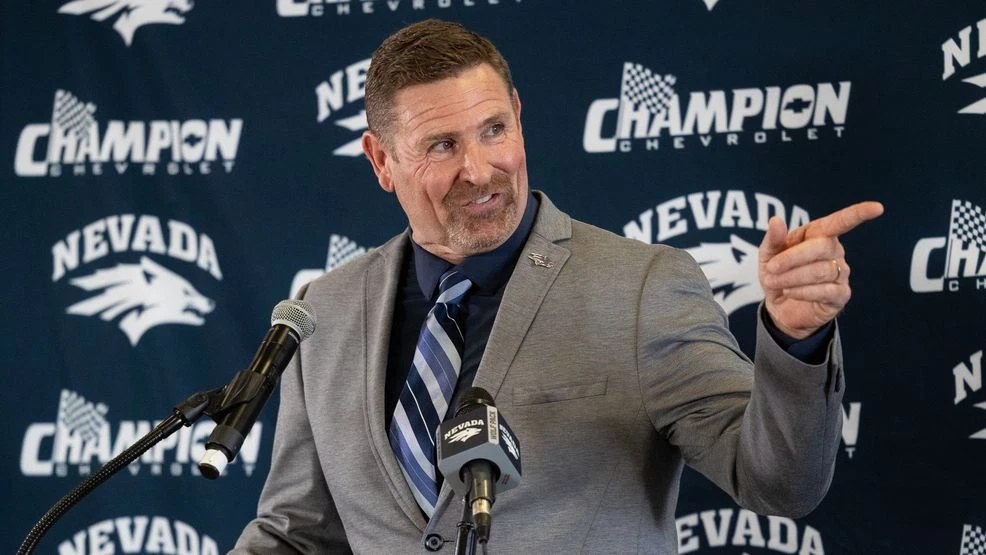
The Nevada men’s basketball team is on a three-game winning streak to improve to 7-3 as non-conference play comes to an end, but we got more questions in this week’s Monday Mailbag about a Jeff Choate press conference than Wolf Pack hoops. And I thought this was a basketball town! Let’s get to the questions. Thanks, as always, for the inquiries.
When Jeff Choate was hired by Nevada in December 2023, we were told by people who previously covered him that Choate would never lose a press conference. Two years into his tenure, that promise has been kept. Choate keeps it real. You ask him a question, and he’ll answer it honestly. That’s rare in college athletics, which can shock some people. But it’s refreshing. And that brings us to last Wednesday when I asked Choate what his sales pitch was to potential recruits. Choate gave a thoughtful answer that lasted more than two minutes, which I posted on our NSN Twitter account. As you can see below, the post went viral with more than 1.2 million views on our post in addition to ESPN, Yahoo! Sports, Sporting News and several other national publications taking the video (ESPN stole it without attribution, whereas most other organizations credited NSN).
The money part of the quote was, “You know what happens when you come to Nevada? You go get $1.4 million to go to Oregon (OT Isaiah World) if you’re developed the right way. A guy that couldn’t play consistently at the University of Texas (DB Kitan Crawford) got drafted when he came here. A guy that was a junior-college walk-on (CB Michael Coats Jr.) ended up becoming a first-team Mountain West player and went and got a bag at West Virginia. A guy that was kind of a sometimes player at Butte College (DE Dylan LaBarbera) comes here, gets developed and becomes a first-team All-Mountain West player. A journeyman safety from the Big Sky Conference (S Murvin Kenion III) comes here and becomes a second-team All-Mountain West player.”
Was that wise? Yes. When all is said and done, Choate’s quote probably got in front of 3 million-plus people, many of whom are potential recruits who had never heard of Nevada before. Now those players not only know of Nevada but know the Wolf Pack has sent players to Oregon and the NFL and turned lightly recruited prospects into all-conference honorees. That honesty got Choate’s sales pitch in front of a ton of eyes (and if we can take a little credit, it doesn’t happen without NSN since that video was only showcased because we put it out first).
Does that soundbite make college athletics feel transactional? Yes. But college athletics is transactional, so why shy away from it? It’s OK to tell recruits to come to Nevada to get playing time and get developed so you can make money elsewhere. In theory, that will help Nevada get more talented players, which should lead to winning, which should lead to more community interest, which should lead to enhanced NIL revenue, which could lead to Nevada having the ability to eventually start keeping some of these players it develops. Does Choate like this system? Hell no. I truly believes he cares more about developing humans than winning games. But it’s the system he’s working with, and he’s been upfront about it. Nothing wrong with that.
In Choate’s first talk to Nevada players in December 2022, he said, “How many of you guys have homeboys and asked them what I’m about? What do they say? I keep it 100, right? ‘This guy’s going to keep it real.'” Well, he’s keeping it real.
As mentioned above, I don’t mind it. But it’s really not about how I absorb what Jeff Choate said. What matters is how the people who help fund Nevada football absorb it. As long as boosters and season-ticket holders and the Wolf Pack’s administration are OK with it, then it’s fine. If a booster or NIL contributor says, “Well, why am I giving the program money to develop players for other schools?” that could be a problem. But I imagine they know how this thing works. It’s not like Choate only talked about developing players for other programs in that viral video. He also talked about the quality of education Nevada offers, how much his players love living in Reno and how hard-working blue-collar players fit within Northern Nevada’s ecosystem. He was very complimentary about Reno, the school and the region while also being honest about how college football works these days with the transfer portal and NIL. If Isaiah World, the left tackle from Nevada who transferred to Oregon, truly made $1.3 million this season with the Ducks, he netted more than the Wolf Pack’s entire 2025 roster (and more than Choate, too). There’s not much Nevada can do about that but find its fit in that system.
Yes. If I’m a lower-level high school recruit and Nevada shows the ability to develop me into a Power 4 player to get paid elsewhere, I’m fine with that. If I’m a transfer who didn’t get much playing time at my first school and Nevada shows it can offer me playing time and potentially a bigger check at another school after a season or two, that’s appealing. Most of these players won’t sniff NFL training camp. If they can make good money in college by using Nevada as a platform, that seems to be mutually beneficial, if not ideal for the Wolf Pack. The alternative is never developing players good enough for the Power 4, which seems like it would lead to a lot of losing.
In 2010, Tulane was in Conference USA and coming off eight straight losing seasons.
In 2010, James Madison was in the FCS playing in the Coastal Athletic Association Football Conference.
In 2010, Nevada was ranked 11th in the nation with a College Football Hall of Fame head coach.
So, I obviously would have picked Nevada to be the first of those three to make a playoff. But it was also clear Nevada was not ready to use that historic 2010 season as a launching point to sustain a regular Top 25 future. The only thing the Wolf Pack really did based off that success was hire two low-level staff positions (director of player personnel; director of operations), which, at the time, it called “critical hires.” It also decided to start the 2011 season with four straight road games, including at top-10 teams Oregon and Boise State and at the Big 12’s Texas Tech. Those games, predictably, went very poorly, and Nevada’s 2010 momentum was killed one month into the 2011 season.
But since 2010, schools like Western Michigan, Liberty, Tulane, James Madison, Boise State, Memphis, Houston and Cincinnati have all played in New Year’s Six/College Football Playoff games. It was possible for Nevada if the Wolf Pack invested at the appropriate time. It did not.
Somebody who can fix the passing game. That has been Nevada’s biggest issue the last four seasons, a period in which it has gone 2-10, 2-10, 3-10 and 3-9. You need to be able to throw the ball to win games. Nevada has had more interceptions than touchdown passes in three of the last four seasons, which is insane. Since 2022, Nevada has thrown 42 touchdown passes and 45 interceptions. The Wolf Pack threw 38 touchdowns in 2021 alone. I don’t have specific offensive coordinator names for you, but top candidates like Nick Rolovich and Bryan Harsin are unlikely to come to Nevada, although Rolovich has history here and Harsin coached with Jeff Choate at Boise State. Either would be great but seem unlikely given Nevada’s pay rate and recent history. What I think would be interesting is getting an offensive coordinator/quarterback combo from a successful FCS school. Look at Western Carolina, whose quarterback, Taron Dickens, passed for 3,508 yards with 38 touchdowns and two interceptions this season and is in the portal. Could you get him and Western Carolina offensive coordinator Rylan Wells in a package deal? That’d be ideal.
If you removed the San Jose State game, Nevada scored five first-half touchdowns in 11 games.
Among Nevada players? No. A quarterback would have to stay at Nevada for all four seasons and average 2,726 yards per season. I don’t see anybody who plays that well for Nevada sticking for four seasons as a starter unless it’s a really unique situation (like a father-son coach-player situation). Nevada couldn’t retain Brendon Lewis after a season in which he passed for 2,290 yards. David Neill’s record is probably safe.
That’s already started to happen. Myles Walker has passed Tyler Rolison for Nevada’s backup point guard job. It was surprising to see Rolison on the floor late in the UC San Diego game, and that almost backfired. Walker has played more minutes (37) than Rolison (29) the last three games and outproduced him thus far with Walker shooting 50 percent from the field and Rolison shooting 26.2 percent. We saw Rolison’s minutes heavily cut last year before he became a key piece late in the season, and that could happen again. It’s a long season. But Walker has outplayed Rolison to date and deserves to back up Tayshawn Comer at this point.
Tyler Rolison’s production hasn’t been strong enough for large minutes, but he’s also one of the team’s leaders, so it looks like Nevada is trying to keep him in the rotation as much as possible to keep the chemistry good. As noted above, it’s a long season and things can change. But Myles Walker has added a spark off the bench at backup point guard and deserves to keep getting some of Rolison’s minutes for now.
Steve Alford said Corey Camper Jr.’s back spasms flared up the practice before Sunday’s Washington State game and he’s optimistic Camper will be available Saturday against Duquesne. If he skipped that game, Camper would have two weeks of rest before Nevada’s Mountain West opener against Boise State, which might not be a bad idea. He was moving very gingerly on the bench against Washington State. It’s hard to tell with back injuries, which are the worst. But Alford didn’t seem overly concerned. We’ll see. K.J. Hymes’ back injury a couple of years ago turned into a season-ending deal and required surgery, which derailed his career. The hope is Camper will be find in a couple of days.
It’s always nice when you have a guy fresh off their playing career on your staff, as Jarod Lucas is. He’s able to relate a little more deeply with the players and knows Steve Alford’s system having played in that scheme for two years. That’s super helpful. When he played for Nevada, Lucas was the Wolf Pack’s most vocal leader, and his dad is a successful high school coach. Add that all up and Lucas was a nice addition to Nevada’s staff. Lucas joined Layup Line with John Ramey and Nick Fazekas this week to discuss re-joining the Wolf Pack (he thought he had a spot with the Lakers until the last minute). You can watch that interview below.
Most Power 4 teams schedule soft in non-league. The Big Ten’s Indiana is the No. 1 seed in the College Football Playoff and played Old Dominion, Kennesaw State and Indiana State out of conference. Not exactly murderer’s row. So, this isn’t unique to the SEC. The bigger issue is why is the SEC champion (Alabama) didn’t get dinged for being blown out in its conference title game when the Big 12 loser (BYU) fell one spot in the CFP rankings, the ACC loser (Virginia) fell two spots, the Big Ten loser (Ohio State) fell one spot and the American Conference loser (North Texas) fell one spot? Alabama didn’t drop a spot after its 28-7 loss to Georgia. This after the Crimson Tide lost by 14 points to a non-bowl Florida State, lost to an Oklahoma team that can’t score and was blown out by Georgia in the conference championship while rushing for negative yards in that game. BYU has a stronger résumé than Alabama but wasn’t even considered for a playoff spot.
Cool story to see Indiana, a basketball school, winning the Big Ten title and getting the top seed in the College Football Playoff. I’m also fine with giving Hoosiers quarterback Fernando Mendoza the Heisman Trophy. But I don’t see the Hoosiers winning the national championship. My (theoretical) money is on Georgia.
It’s terrible. Sacramento State coach Brennan Marion clearly had a deal done to be Colorado’s offensive coordinator but kept that secret until the day after national signing day, at which point the players who signed with the Hornets were bound to the school. That’s why some players wait until the late signing period in February to put pen to paper. But players going to Sac State are unlikely to have that level of leverage and recruiting interest. This is why I don’t put too much energy into players transferring regularly to put themselves in more advantageous positions. They’re just modeling the behavior of the adults running college athletics. Three of the 12 head coaches in the College Football Playoff have already accepted jobs at other schools. That’s how much those coaches care about their universities. It’s all a shell game to advance your career and get more money from somebody else. It’s long been that way with coaches and administrators. Now, players get to participate in that game.
Those numbers are not public, so it’s a guessing game. I wish we had transparency here, but we don’t. Between Nevada football and men’s basketball, you’re probably looking at a cumulative pot of around $2 million to $3 million with hoops getting more than football, which is the reverse of most schools.
Again, unknown, although I get a question like this basically every week. I can get coaching salaries and athletic department budgets through public-record requests. I cannot get NIL and revenue-sharing figures that are trustworthy enough to report. In the new Mountain West (there are eight full members that play football), Nevada will probably be in middle of the pack, but I doubt Wolf Pack football or men’s basketball will rank in the top four in NIL in either sport even in this watered-down MW.
There’s the fact the stadium is named after the Mackay family, which donated the land where the stadium is built to the school, although I do think there is room for a naming-rights sponsor if an interested party stepped forward with the money. To this point, that’s not happened. I’d expect GSR Arena to get a naming-rights sponsor, but truth is, there aren’t a lot of businesses headquartered in Northern Nevada with the kind of cash to make that happen.
UNLV just signed a sponsored jersey patch deal for $11 million over five years. That’s something Nevada should explore.
One of the biggest selling points in promoting Jordan Getzelman from assistant to head coach after Jake McKinley took a job with the Seattle Mariners was player retention. McKinley said the 2026 team was the one he had ben eying since he got Nevada’s job before the 2023 season, and it does seem set up for success. Had Nevada opted for an outside coach, it probably would have had departures. But, as far as I can tell, every player on the Wolf Pack roster was at Getzelman’s introductory press conference and will remain with Nevada for the 2026 season.
“I’ve been invested in this place for years,” Getzelman said at his press conference. “I’m excited and humbled to lead the next chapter. This is a unique moment stepping into this role into the middle of the year. But one of the advantages that we have here is that I’ve been here, I know the players, I know this culture and I know the standards that have been put in place. My priority is to provide confidence and stability. We have a group of players who have worked extremely hard, and they’re deserving of continuity. My job is to keep us moving forward, keep us connected and keep us competing at a very high level.”
Nevada athletic director Stephanie Rempe said you usually take the long-term view when hiring a head coach, but she believed this group of players deserved a short-term perspective, and that played a role in elevating Getzelman, who said his job will be to keep Nevada baseball’s 2026 trajectory on the right course while coming off last year’s Mountain West regular-season title.
“We’re family here, and we’re going to grow closer through this,” Getzelman said. “They know who I am, they know what I expect and I’m excited to continue working with them in this new capacity. My message to them was simple. The ship is on the right track, the coordinates are set, let’s all move over one spot and take this thing where it needs to go, together.”
Nevada athletic director Stephanie Rempe has been getting a little more heat with these Mailbag questions in recent months. Her contract runs through June 30, 2027, and I’d guess she gets extended before that contract is up. From a competitive standpoint, Nevada is still struggling, especially in the fall sports, which have historically struggled. The last fall sport to win a conference title was football in 2010, and those struggles significantly predate. Rempe hired Nevada’s two coaches who won Mountain West championships last year in baseball (Jake McKinley) and softball (Victoria Hayward) with men’s and women’s tennis also doing well during her tenure. Men’s basketball has been solid with two NCAA Tournament berths during her tenure, although she didn’t hire coach Steve Alford. Facility development has improved during her tenure, although a good chunk of that progress has come thanks to university president Brian Sandoval. Rempe did play key roles in the FieldHouse and GSR projects, and deserves some credit there.
Nevada has 14 head coaches (the Wolf Pack no longer counts cross country as having a head coach), and Rempe has hired just six of them (baseball, softball, volleyball, soccer, football and skiing). Baseball and softball have won MW titles; skiing finished 15th in the nation last season; and volleyball, soccer and football have struggled. Obviously football needs to be fixed, although Rempe inherited a new coach (Ken Wilson) on a five-year deal in that sport, so there were limitations on what could be done there immediately. Rempe hired Jeff Choate, which, to date, has not paid dividends. Typically, athletic directors get two shots at football coaches. I honestly don’t think Rempe’s seat is very hot. I imagine she’ll get an extension before her contract is up in June 2027, but getting football to a more respectable place is preeminent. And Nevada should be one of the better departments in the new MW. At least, that should be the expectation.
No reason has been provided, but the women’s soccer head-coaching job at Nevada is the most difficult on campus. There’s almost zero history of success with that team, which has just two winning seasons since the program was started in 2000, and those came in 2005 and 2006. The Wolf Pack plays on FieldTurf in a football stadium, making it the only Mountain West women’s soccer team that doesn’t play on grass. And the job doesn’t even pay six figures. I know there was some friction there behind the scenes, but it’s a low ceiling, lower floor kind of job.
I’m not a fan of the “take my ball and go home” attitude schools like Notre Dame made by not playing in bowl games, but if means there are fewer bowl games in the future, I’d be cool with that. I’ve never liked the fact 6-6 teams (and sometimes 5-7 teams) qualify for bowls. Finishing .500 in not a major accomplishment. Make the requirement seven wins, including at least six against FBS teams, and cutting the number of bowl to 30 would be great. Then you can backfill with 6-6 teams if 7-5 or better teams opt out. Should conferences fine teams that don’t go to bowls? Since leagues have bowl alliances they’re required to fulfill, I don’t have a problem with fines if that leaves the conference financially vulnerable for not fulfilling its bowl obligations.
As soon as the Group of 6 did created its own playoff, the Power 4 would take it as an invitation to remove the G6’s automatic entry into the College Football Playoff. Heck, the Power 4 might do that this offseason anyway since two G6’s (Tulane and James Madison) made this year’s playoff in place of teams like Notre Dame, Texas and BYU. If that were to happen — the removal of the G6’s auto spot — you could see the G6 shift to its own playoff system. Until then, it’s not happening. I would love to see a G6 playoff, perhaps in the place of these lower-level bowls the Power 4 schools are now snubbing.
The only thing that is clear is that no matter how many teams you add to the College Football Playoff, the first team left out of the field will bitch about it. Honestly, we should go back to a smaller field. Eight teams are fine. If Notre Dame wanted to be in the College Football Playoff, maybe it should have beaten a good team. Notre Dame played 10 Power 4 teams, going 8-2 in those games. Of the eight wins, only three were over teams with winning records. Those wins were against USC (9-3), Pitt (8-4) and NC State (7-5). That’s not enough for a playoff berth. What the Power 4s will do, however, is punish the Group of 6 by taking away their spot in the field. They can’t have Tulane and James Madison in the field over bigger brands. The SEC’s five playoff teams are simply not enough. Also, the Power 4s should go back to divisions if they’re going to keep conference title games because their tiebreakers were the biggest issue and led to Duke winning the ACC, which screwed up everything. It’s not the Group of 6’s fault that the Sun Belt and American Conference winners were better than the ACC’s winner. This is all a result of Power 4 conferences having too many schools. They should have left the Pac-12 alone.
I have a long-standing rule that I don’t care about uniforms.
The Tulane Greenwave was wearing blue and the North Texas Mean Green were wearing white. So, two teams with “green” in their name, and neither team was wearing green. Amazing.
See y’all next week!
Sports columnist Chris Murray provides insight on Northern Nevada sports. He writes a weekly Monday Mailbag despite it giving him a headache and it taking several hours to write. But people seem to like it, so he does it anyway. Contact him at crmurray@sbgtv.com or follow him on Twitter @ByChrisMurray.


Notre Dame has seen its College Football Playoff hopes dismantled, has declined its bowl game, and watched its relationship with the ACC deteriorate, all in the last few days.
And now, the man in charge of Notre Dame athletics has revealed he had a conversation with the commissioner of the SEC.
“The only commissioner I’ve spoken to, and I’ve had a couple of great conversations with him, is Greg Sankey,” Bevacqua said of the SEC commissioner.
He added: “Greg and I talk all the time. I can’t tell you how much I admire Greg and his leadership.”
What Notre Dame is interested in
Before you start thinking that Notre Dame is about to join a conference, think again.
Bevacqua said his conversation with Sankey had nothing to do with the Irish finally forsaking its independence, but about the structure and format of the College Football Playoff in the years to come.
Being left out of the playoff tends to inspire teams to re-think what the playoff should look like.
“Gave him my viewpoint on the process. He shared some thoughts that he had with me that, obviously, are between Greg and me,” Bevacqua said.
“Format? Greg knows. They all know how I feel about the format. Put the process aside. The format, being, you know, four teams, twelve teams, fourteen teams, sixteen teams, a thousand teams?”
What should the playoff look like
Okay, maybe not a thousand. How about sixteen? That seems to be the new sweet spot from Notre Dame’s perspective. And it could be for others, too.
“It should be sixteen teams, in my opinion, with five automatic qualifiers and eleven at-larges,” he said.
“Think about this year. If we had four teams, it would have been perfect. I don’t think anybody would argue that those aren’t the right four teams that are one through four, right, the way they’re playing. Texas Tech, Ohio State, Indiana, and Georgia… Sixteen would have been perfect. Notre Dame, Texas, Vanderbilt, you know, who else is in there.”
Expansion would cover all the problems
Bevacqua said that the particular metrics the playoff selectors use will necessarily change as each season brings its own unique situations.
The answer to compensating for those year-by-year situations is to simply expand the format and allow for more teams to have a chance.
“You know, year by year, you’re never going to have the same data points each year. It’s never going to work out perfectly, whether you have four teams, twelve, fourteen, or sixteen,” he said.
“What I like about sixteen is it does create more opportunity, it does create more narratives around more schools and yet preserves the integrity and importance of the regular season, and I think that’s one of the greatest things college football has going for it.”
What about the regular season?
Notre Dame’s head man doesn’t think expanding the playoff will have a negative impact on the regular season.
“The regular season is more important in college football than it is in any other sport by a mile…College football? I mean, hey we see it,” he said.
“We saw it last year. We saw it this year. We knew last year, when we lost to NIU? We had no wiggle room. Every game was a bowl game. Every game was a CFP game. This year, after we lost in the last second to A&M? Zero room for error.
“Turns out, we didn’t even have zero room for error. But, I think sixteen teams, with that five and eleven breakdown, is the way to go. And I think a vast, vast majority of people in the CFP management room feel the same way.”
Read more from College Football HQ
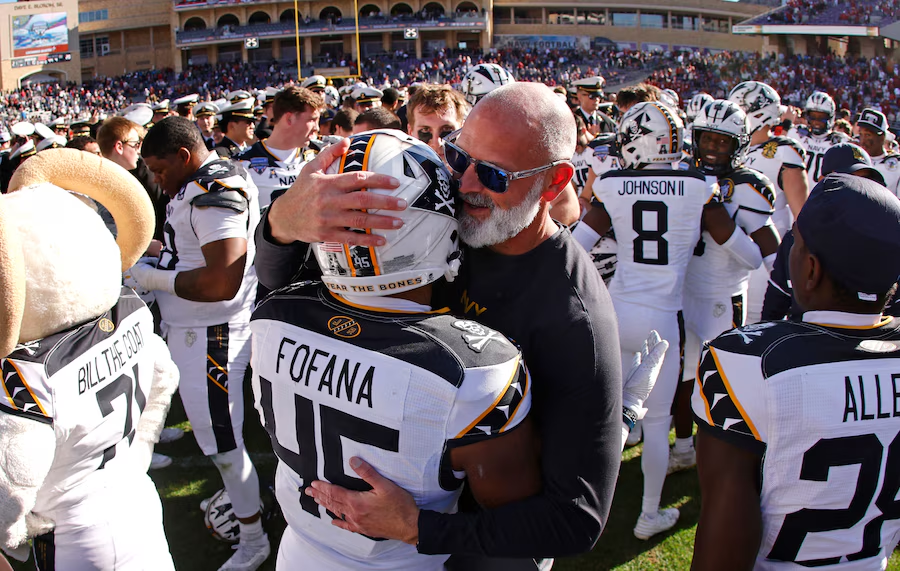
A month after Brian Newberry arrived at the Naval Academy in 2019 to begin his tenure as defensive coordinator, his wife, Kate, gave birth to their first child. A second one followed. The Newberry family has grown in Annapolis, and Newberry’s career has grown with it.
Newberry, in his third year at the helm of Navy, is on the verge of becoming the first coach to lead the Midshipmen to consecutive 10-win seasons in their history.
“That says it all in terms of his leadership and the culture he’s developed,” Navy athletic director Michael Kelly said.
Newberry and Kelly emphasized that the eyes of America will be on the players on the field for the 126th Army-Navy game Saturday at M&T Bank Stadium. But there may be a few athletic departments looking toward the sideline at the 51-year-old head coach who has orchestrated Navy’s return to prominence.
Not that Newberry plans to go anywhere.
Annapolis, Newberry said, feels like home, even though it’s far from his native Oklahoma. And, given the shifting nature of the sport, the sure-footedness offered at Navy — a program intent on developing leaders internally, without the free-for-all transfers that have gripped other schools — makes it an ideal spot for Newberry.
Where else would he rather be?
“It’s a special place and it’s one of the best jobs in the country, because of the kind of young men we have, because it still is, truly, a developmental program,” Newberry said. “Annapolis is a great place to live. You feel like you’re somewhere important. And you get into coaching to make an impact and a difference.
“Understanding that you’re impacting young men who are going to be officers and go serve our country, that gives you a little more meaning and responsibility as a coach. It really is important to me.”
There are few places that can offer Newberry such an existence.
As change buffets college football, Army, Air Force and Navy stand in the eye of the storm, untouched by the gales of the new world. There are no name, image and likeness sponsorships for service academy athletes.

While many programs rely on the transfer portal to inject talent into the roster — adding as many “free agents” as they lose each offseason — Navy builds from the ground up.
“We’re unicorns in college football today,” Newberry said.
Added Army coach Jeff Monken: “We just are who we are. Nothing’s really changed for us. It’s business as usual.”
This is part of the allure for Newberry at Navy. He has coached across the college football landscape, from Division III Washington & Lee to Division I minnow Kennesaw State. Now he leads Navy, a position he has held since Ken Niumatalolo was fired at the end of the 2022 season, and there’s no reason in his mind to move.
Newberry has friends at Power 4 schools. They have the supposed benefits of large NIL coffers and the transfer portal. And yet “there’s a great sense of frustration that has come” at those programs for coaches, Newberry said.
“It should be transformational, right? It’s become a lot more transactional at that level,” Newberry said. “We don’t have that at the Naval Academy.”

The players aren’t the only ones to participate in the merry-go-round of college football, of course. They’re just the newest to benefit from it. Coaches have jumped between programs for decades, going back to when advertising the size of a weight room was the primary recruiting tool for players rather than which school had the most money to offer. The coaching sagas are ongoing, as seen by LSU’s high-stakes pursuit of Lane Kiffin.
Newberry says he is not eying such a move, even though his considerable success at Navy could draw suitors and a significant raise; according to USA Today he made $1.8 million last season, ranking in the middle of the American Athletic Conference but lower than any Power 4 coach.
“I’ve never been a guy who chases jobs, necessarily,” Newberry said. “I’ve always tried to be where my feet are and make the best of a situation and enjoy the people I work with and enjoy the young men I get to coach and build relationships and all those things. That’s what’s important to me. And I’ve been beyond fortunate to be at the Naval Academy.”
Newberry’s first year, replacing the winningest coach in program history in Niumatalolo, was middling. The Midshipmen finished 2023 with a 5-7 record, their fourth straight losing season. That, some came to expect, was as good as things would be in the new world order following the NCAA’s 2021 decision to change its rules to allow athletes to make NIL money.
With it came questions regarding how the service academies might keep up.
The answer: Newberry led Navy to a 10-2 record in 2024, capped by a win over Oklahoma in the Armed Forces Bowl. Entering the Army-Navy game, Navy holds a 9-2 mark. Army has prospered, as well; the Black Knights posted a 12-2 record last year and are 6-5 in 2025.
Kelly believes Army and Navy are thriving because they are outliers.
“But for us it’s not so much the benefit aspect of it; it’s the player stability and lack of player movement, the fact we can be a true player development program, build year to year to year, and build that sort of team unity,” he said. “I can’t believe it’s coincidence that both Navy and West Point have had such great success these last few years.”
Blake Horvath, who has established himself as one of the greatest quarterbacks in Navy history, knows the recruiting rankings won’t flash high grades for players who sign with the service academies. The difference, however, is the longevity — the culture built with players who are there for the long haul.
“I think the biggest thing is, when this was all coming around, the first few years it was like, ‘Oh, it’s passed the academies by. The academies will never be good again because of this,’” Horvath said. “And I think we’ve all proven that wrong, just because, if anything, it makes us stronger. We develop, we have better bonds, we know each other better, we have a culture that is continuous and doesn’t get lost in different transfer portals and other things.”
Newberry thinks, in a sense, the transfer portal is helping Navy’s recruiting. There are schools that seek out the experience of transfer players to maintain a high level of performance, but that focus limits opportunities for high school players on the fringes of big-time college consideration.
“What that’s allowed us to do is recruit a little higher-caliber player than we have in the past,” Newberry said. “We can be a little bit more selective. It’s still difficult to recruit at the Naval Academy. We’re still competing against Army and Air Force for the majority of our recruits. I think that pull is stronger now than it ever has been, and we’re starting to look a little different.”
A few years ago, becoming the head coach of a program was far from Newberry’s mind. He enjoyed calling defensive plays at Navy, and as he watched all that was required of Niumatalolo, he wondered if he even wanted the added responsibility.
He had two young kids; did he really want 100 more under his direct purview?
“I didn’t know if I wanted the responsibility of it all,” Newberry said. “If I could manage juggling a family with being a head coach and all that entails, and work-life balance.”
But watching Niumatalolo and Brian Bohannon before him at Kennesaw State showed Newberry he could have that and “still do things the right way.”
And he feels that Navy, too, does things the right way.
“This institution really speaks for itself in a lot of ways,” Horvath said. “And I think he’s in the perfect place for him and what he tries to do for our team. And the bigger thing is building a staff that really preaches a program that he wants to build, it’s the same thing. So I think what he’s been able to do and what we’ve been able to do for our program is immeasurable.”
Except, perhaps, it’s measured most heavily on one game per year. The eyes of the country will be on Army and Navy. And they’ll be on a head coach who “never in my wildest dreams” thought he’d be here.
NIL
Diego Pavia promises to donate all his NIL money to a G5 team if it wins the national championship

Vanderbilt quarterback Diego Pavia has never lacked confidence or conviction. He proved it again this week with one of the boldest statements of the college football season.
Appearing on The Pivot Podcast, Pavia argued that the College Football Playoff should truly consist of the 12 best teams in America. He doesn’t believe this year’s Group of Five participants, Tulane and James Madison, have any real shot at winning it all. Then, he took it a step further.
SUBSCRIBE to the On3 NIL and Sports Business Newsletter
“It’s a 12-team Playoff. Put every team that’s good,” Pavia said. “If a G5 team wins it, I would donate whatever I got in NIL back to that team. I would do that, if a G5 team ever wins it.”
Alas, Pavia’s frustration is rooted in Vanderbilt’s narrow miss of the postseason despite a historic 10–2 season. The Commodores finished at No. 13, falling outside the field of 12 and behind programs like Notre Dame, BYU and Texas.
The irony is that those teams would’ve kept Vanderbilt out, even automatic bids did not exist. Still, for a program that just delivered its first-ever 10-win regular season, being left out stings. And Pavia, one of the nation’s most electric players, has not been shy about voicing that disappointment.
His appearance on The Pivot was part of a whirlwind week as the elder quarterback continues his media tour ahead of Saturday’s Heisman Trophy ceremony. Pavia was named one of four 2025 finalists, joining Indiana’s Fernando Mendoza, Ohio State’s Julian Sayin and Notre Dame running back Jeremiyah Love in New York City.
No national title, but can Diego Pavia win the Heisman?
During the interview, Pavia also opened up about what the Heisman moment means to him. It’s something he has dreamed about since childhood.
“I still remember Johnny winning it,” he said, recalling Johnny Manziel’s iconic Heisman victory. “I used to watch Johnny’s tape. … I want that to be me one day. Now, it’s coming full circle.”
All told, Pavia’s rise has been nothing short of remarkable. He led the SEC in total offense with 4,018 yards and accounted for 36 touchdowns while carrying Vanderbilt to the brink of the Playoff.
He also became just the fourth SEC player in the last 30 years to top 250 passing yards and 150 rushing yards in a single game. That put him in a group headlined by Manziel, Jayden Daniels and Tim Tebow.
Whether Pavia wins the Heisman or not, he has already cemented his place as one of the most compelling characters in college football. He’s fiery, fearless and unapologetically competitive, and now he’s willing to put his NIL on the line to prove a point.
— On3’s Alex Byington contributed to this article.

The Penn State coaching search didn’t go exactly as planned, but the Nittany Lions ultimately landed a potential strong hire in 46-year-old Matt Campbell, luring him away from Iowa State.
Campbell delivered Iowa State’s most successful stretch in program history over the last decade, winning seven games in eight of his 10 seasons in Ames, Iowa, including four of the Cyclones’ 12 eight-win seasons all-time and their first 10-win campaign, an 11-3 finish in 2024.
Still, questions linger about whether Campbell can compete with Big Ten elites like Ohio State, Michigan, Oregon and Indiana on the recruiting trail.
Iowa State posted high school finishes of Nos. 55, 55, 42, 39, and 59 over the last five cycles. It signed just one top 75 transfer class during his tenure (No. 59 in 2025).
CBS Sports‘ College Football Insiders weigh in on whether Campbell can elevate his game with Penn State’s resources, or if the Nittany Lions should brace for more tough sledding against the Big Ten’s best.
“Not long after the Penn State job opened, we talked to someone close to Matt about whether he’d be a fit,” said John Talty on Tuesday’s episode. “That person mentioned him not really having to mess with NIL and the transfer portal that much at Iowa State.

Last night, Slaton and 15 others were inducted into the College Football Hall of Fame during the 67th National Football Foundation (NFF) Annual Awards Dinner at the Bellagio Resort & Casino in Las Vegas.
According to the NFF release, more than 1,800 people were in attendance and the event was also streamed on ESPN+.
Slaton broke onto the scene during his freshman year in 2005 when he went from fourth on the team’s depth chart to scoring a school-record six touchdowns in West Virginia’s five-overtime 46-44 victory over Louisville and later setting a Sugar Bowl rushing record with 204 yards in the Mountaineers’ stunning 38-35 victory over Georgia.
He was named the game’s offensive MVP.
Slaton’s record lasted nine years before being topped by Ohio State’s Ezekiel Elliott in 2015 against Alabama when he ran for 230 yards.
His best season at West Virginia came in 2006 when he rushed for a career-high 1,744 yards with 16 touchdowns, while also catching 27 passes for 360 yards and two scores to earn unanimous consensus All-America honors. He was second in the nation in all-purpose yardage, fourth in rushing yards per game and tied for 12th in scoring.
His best single-game performance was his 215 yards rushing and 130 yards receiving in the Mountaineers’ 45-27 victory over Pitt in 2006.
Slaton’s junior year in 2007 saw him eclipse 100 yards in a game six times and finish with another 1,000-yard rushing season, his third at WVU.
In 36 career games, the Levittown, Pennsylvania, resident rushed for 3,923 yards and a school-best 50 touchdowns. His rushing yardage total ranks fifth in school history despite skipping his senior year to enter the NFL Draft.
“When the dust settles, all of the hard work you put in will show off,” Slaton said during Tuesday afternoon’s press conference. “Everybody from that 2005 season on the team and the people of the state, they surround you and help make you become a better player for them.”
West Virginia won the 2006 Sugar, 2007 Gator and 2008 Fiesta Bowls and produced an impressive 33-5 record during Slaton’s three seasons in Morgantown.
“I’m most proud that all of the guys are still friends,” he said. “We’re still a family and I think that’s why football is one of the best team sports that you can play. I’m proud that the guys I grinded with have remained great men, great human beings and great fathers. I appreciate that.”
Slaton played five NFL seasons with the Houston Texas and Miami Dolphins, rushing for 1,282 yards and scoring nine touchdowns during his rookie season in 2008, but a severe nerve injury affecting his right arm and causing numbness curtailed his professional career.
Today, he lives in Houston, Texas, with his wife Kimberly and their two sons.
Slaton now becomes the 14th player with West Virginia University ties inducted into the College Football Hall of Fame. Linebacker Darryl Talley was the most recent inductee in 2011.
Among those in Las Vegas representing West Virginia University in support of Slaton were coach Rich Rodriguez, athletics director Wren Baker and president Michael T. Benson.
The first two years of the College Football Playoff’s 12-team era painted a clear picture of today’s NIL realities. That is, while programs can still compete at the highest level with modest budgets, the most surefire path to a prominent seed and national championship contention is to invest an extreme load of money into a star-studded roster. Some of the biggest spenders from the 2025 offseason find themselves, to no surprise, at the top of this year’s bracket.
Overachievers prove every year that money is not always everything. They require a special blend of coaching acumen and talented players who, in many cases, earn paychecks at wealthier programs at season’s end. Doing more with less can result in a CFP berth, but time and time again, the playoff process separates the haves from the have-nots by the end of the national championship game.
Programs over the last five years displayed their NIL capabilities on the recruiting trail and with their player retention efforts, providing evidence of where they stand in the national pecking order.
Here are the 2025 CFP participants grouped into NIL spending power tiers.
Elite spenders
Ohio State
The Buckeyes were not shy about the $20 million price tag associated with their roster a year ago. That investment put Ohio State effectively in its own universe, and while other programs will catch up, it will always have an advantage in the revenue-sharing era as perhaps the most valuable and recognizable brand in the sport. Acquiring and retaining an inordinate amount of college football’s biggest stars — Julian Sayin, Jeremiah Smith and Caleb Downs chief among them this year — comes with an astronomical financial burden that Ohio State has proven more than willing to tackle.
Oregon
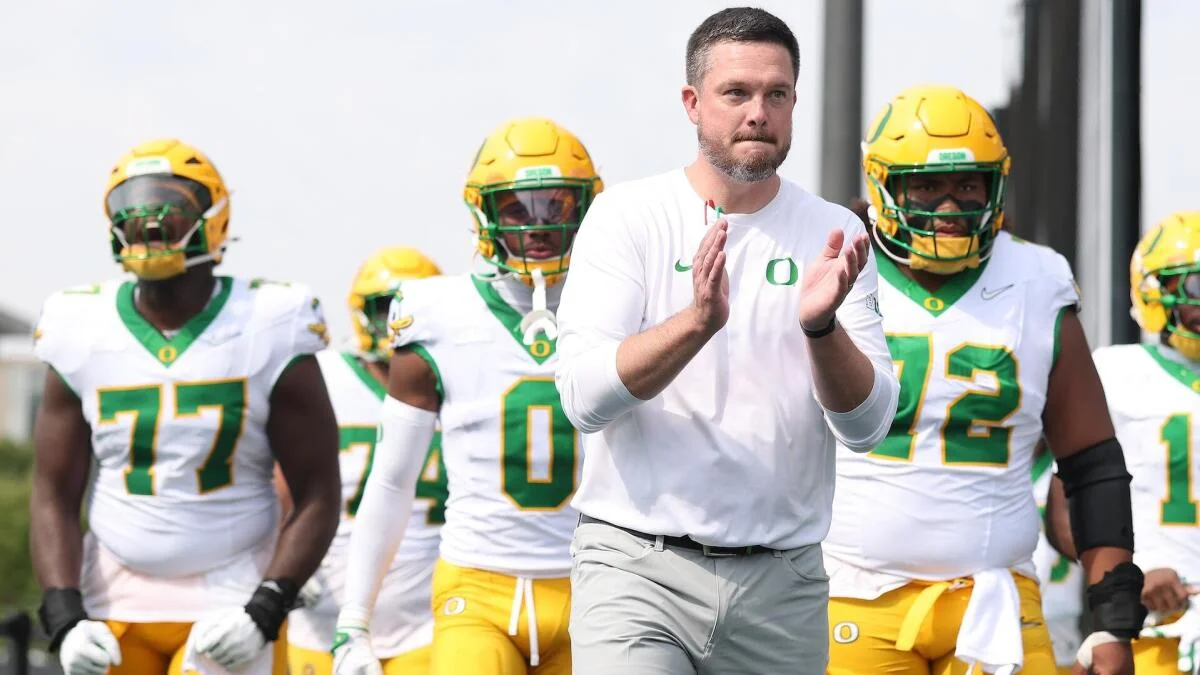
Oregon’s relationship with Phil Knight has made playing for the Ducks a lucrative opportunity. With the Nike co-founder committed to doing what it takes to win a national championship, Oregon continues to inch closer to a full breakthrough. That could come as soon as this season, but if not, it is probably only a matter of time. Dan Lanning stacked the most loaded recruiting classes in program history on top of each other and has the No. 3-ranked haul in the 2026 cycle, per 247Sports. The aggressive NIL operation makes his elite talent acquisition both possible and sustainable.
Texas Tech
There is a new player in the college football arms race, and it resides in West Texas. Billionaire booster Cody Campbell made a bold investment into Texas Tech football ahead of last offseason’s transfer portal cycle, paving the way for the Red Raiders to acquire game-changing newcomers like David Bailey, Lee Hunter and other immediate contributors responsible for delivering the best season in program history. Campbell’s financial backing sets Texas Tech up to compete perennially at the top of the Big 12 and perhaps stockpile enough talent to contend for national championships.
Miami
Miami has been at the forefront of the NIL picture since Mario Cristobal took the head coaching job in 2022. The Hurricanes’ efforts reached a new level last offseason when they went all-in on acquiring top transfer Carson Beck on a $4 million deal and turned heads with a $2 million annual commitment to five-star offensive line recruit Jackson Cantwell. Cristobal has long been one of the sport’s most talented recruiters. He will only become more dominant if the Hurricanes continue to spend like an upper-class program.
Texas A&M
Texas A&M athletes across all sports received $51.4 million in NIL revenue from July 2024 to June 2025 with an extreme majority of that distributed across men’s sports. The most telling part of that number is that the Aggies nearly tripled their war chest from the year prior. Is it a coincidence that the surge in NIL spending came in conjunction with Texas A&M’s best season on the football field since 2012? Probably not, considering prized transfer pickups KC Concepcion and Mario Craver were two of the SEC’s most productive wide receivers and proved instrumental in elevating the offense to a playoff-caliber level.
Big spender
Ole Miss
Before he departed for LSU, Lane Kiffin became almost synonymous with NIL and the transfer portal at Ole Miss. It was his aggressive approach in those regards that helped the Rebels gain a first-mover advantage, string together the best seasons in program history and emerge this season as a true contender for championships at the conference and national levels. The question now is whether Ole Miss will sustain that willingness and ability to spend at such a competitive rate.
Good, but maybe not as elite as you think
Alabama
Not all that dissimilar to professional stars leaving money on the table to allocate to their supporting casts, Alabama players at the start of the NIL era in many cases were willing to take a discount to play for Nick Saban. While that allowed the Crimson Tide to spread its wealth and build deep, immensely talented rosters, it also meant the program would have to play catch-up after Saban’s retirement. To be clear, Alabama is doing just fine on the recruiting trail (Kalen DeBoer just signed the nation’s No. 2-ranked class), but its payroll is a hint more modest than some of the other programs in its realm.

Georgia
As a recent two-time national champion with arguably the top active coach in college football, Georgia can afford to be a bit more selective with how it allocates its NIL dollars. Playing for the Bulldogs is such an immense draw that Kirby Smart can outrecruit his competitors with less reliance on paychecks and more emphasis on the potential to win titles and find success down the line in the NFL. Still, Georgia spends handsomely where it needs to, and it hit a home run last offseason in acquiring SEC receiving leader Zachariah Branch through the portal.
Oklahoma
Brent Venables was among the coaches this year who took a pay cut and gave part of his salary back for NIL and revenue-sharing purposes. While the $1 million he agreed to forgo is only slightly more than a drop in the bucket, it showed that Oklahoma recognizes its needs and is willing to be creative in how it funds its roster. The Sooners may not be at the top of the spending ladder, but it is not far off and proved its competitiveness in that space when it went big in the transfer portal and made splashes like landing John Mateer and then-highly regarded running back Jaydn Ott.
Solid spender
Indiana
The Curt Cignetti hire and immediate success that came with it invoked a jolt of energy into the Indiana football program and, with it, a surge in investment. The Hoosiers flexed their financial muscles when they paid up to secure Cignetti with a long-term contract. They spent significantly in the transfer portal to fill roster holes and, most notably, acquired a Heisman Trophy finalist in Fernando Mendoza. And with contributions from Mark Cuban and ideal alignment inside the athletic department, the Hoosiers appear to have staying power as a college football new blood.
Great for a Group of Five school
Tulane
The transfer portal displayed last winter the chasm between the Group of Five and Power Four levels. That reality hit Tulane hard. Quarterback Darian Mensah left to become the highest-paid known player in college football history at Duke, and he was just one of the standouts from the 2024 Green Wave roster that earned paydays at other schools. But while Tulane operates on a lower NIL tier than its power conference counterparts, it is in a strong position by Group of Five standards. Less than a handful of programs at this level have more spending power than the Green Wave.
Okay for a Group of Five school
James Madison
An excellent string of coaches helped James Madison transition smoothly into the FBS, but even while the Dukes cemented themselves as perennial Sun Belt championship contenders in short order, they have some catching up to do with Group of Five frontrunners in the NIL space. Unless James Madison continues to hit home runs with its coaching hires, it may not have a distinct edge over the other programs contending for the fifth College Football Playoff automatic bid. For a school just four years into its FBS existence, though, its immediate success gives a high floor and ample momentum.

Asunción Paraguay; Bangkok, Thailand; and Santiago, Chile invited into a Targeted Dialogue for the Youth Olympic Games in 2030

Mason Athletics to Host National Girls and Women in Sports Celebration with Carnival on Jan. 31

Wright Steps Down As Head Beach Volleyball Coach

JJ Gabriel, the 15-year-old Manchester United forward breaking records and creating a buzz

PRI Show races to Indy

SoundGear Named Entitlement Sponsor of Spears CARS Tour Southwest Opener

Major college football program reveals talks with SEC amid expansion speculation

Colonels Claim Four ASUN Performer of the Week Honors

Katelynn Oxley to Join Women’s Basketball Roster for Remainder of 2025-26 Season

Nabwe Wins Seventh Career Big Ten Weekly Honor

Kimm, LaPlant and Thompson Earn AVCA All-America Honors

Blinn makes Bentley history with All-American nod

Nwachukwu, Walker Tabbed B1G Athletes to Watch – Iowa Hawkeyes Athletics

Cal Volleyball Adds Siena MacCudden

Navy’s Brian Newberry can still build his program from the ground up

First Tee Winter Registration is open

Fargo girl, 13, dies after collapsing during school basketball game – Grand Forks Herald

CPG Brands Like Allegra Are Betting on F1 for the First Time

Volleyball Recaps – November 18

F1 Las Vegas: Verstappen win, Norris and Piastri DQ tighten 2025 title fight

Two Pro Volleyball Leagues Serve Up Plans for Minnesota Teams

Sycamores unveil 2026 track and field schedule

Utah State Announces 2025-26 Indoor Track & Field Schedule

Redemption Means First Pro Stock World Championship for Dallas Glenn

Texas volleyball vs Kentucky game score: Live SEC tournament updates

Bowl Projections: ESPN predicts 12-team College Football Playoff bracket, full bowl slate after Week 14

How this startup (and a KC sports icon) turned young players into card-carrying legends overnight

Jo Shimoda Undergoes Back Surgery

Indiana’s rapid ascent and its impact across college football

Robert “Bobby” Lewis Hardin, 56

 Why a rising mid-major power with an NCAA Tournament team opted out of revenue-sharing — and advertised it
 NBA Legend Michael Jordan to Join NBC Sports as Special Contributor
 Falcons mailbag
 Portal Update – Basketball and Gymnastics Take Hits
 has always dreamed in Mercurial. Now his initials are on the boots.
The new Kyl…
has always dreamed in Mercurial. Now his initials are on the boots.
The new Kyl…
-
 Rec Sports2 weeks ago
First Tee Winter Registration is open
-
 Rec Sports2 weeks ago
Fargo girl, 13, dies after collapsing during school basketball game – Grand Forks Herald
-
 Motorsports2 weeks ago
CPG Brands Like Allegra Are Betting on F1 for the First Time
-
 Motorsports2 weeks ago
F1 Las Vegas: Verstappen win, Norris and Piastri DQ tighten 2025 title fight
-
 Sports2 weeks ago
Two Pro Volleyball Leagues Serve Up Plans for Minnesota Teams
-
 Sports2 weeks ago
Sycamores unveil 2026 track and field schedule
-
 Sports2 weeks ago
Utah State Announces 2025-26 Indoor Track & Field Schedule
-
 Motorsports2 weeks ago
Redemption Means First Pro Stock World Championship for Dallas Glenn
-
 Sports2 weeks ago
Texas volleyball vs Kentucky game score: Live SEC tournament updates
-
 NIL1 week ago
Bowl Projections: ESPN predicts 12-team College Football Playoff bracket, full bowl slate after Week 14