
Sports
What did the sale of the Lake Monsters mean for Vermont baseball? (Encore)


Brave Little State is Vermont Public’s listener-powered journalism show. In each episode, we answer a question about Vermont that’s been asked — and voted on — by you, our audience. Today, we’re revisiting a question from Emma Ramirez-Richer of Burlington:
“What does the sale of the Vermont Lake Monsters mean for the team, and what does minor league baseball mean to Vermonters?”
A few summers ago, reporter Liam Elder-Connors joined Emma in the stands at Centennial Field to share some Dippin’ Dots, root for the Lake Monsters and chat with fans about Emma’s question. Liam walks us through the changes to the team since its sale in 2021, and the traditions that have stayed the same.
We originally reported this episode in 2022. Stay tuned at the end for a few updates, and find the original episode here.
Note: Our show is made for the ear. We highly recommend listening to the audio. We’ve also provided a transcript. Transcripts are generated using a combination of robots and human transcribers, and they may contain errors.
Loading…
It’s Aug. 20, 2021. A crowd of 2,600 fills the stands at Centennial Field, one of the oldest baseball parks in the country.
It’s the top of the ninth inning. The team that plays here, Vermont Lake Monsters, are poised to do something they haven’t done in more than two decades: win a championship.
They’ve been leading the game, 3-0. But the Massachusetts-based Pittsfield Suns are making a comeback. The Suns have scored two runs here in the ninth inning.
That puts the Lake Monsters’ pitcher Chris Clark in a very tense spot. There are two outs. If he can get one more, then the game is over, and the Lake Monsters win. But there’s a runner on first and second base. One good hit could tie the game — or worse.
Clark looks at the batter. He steadies himself on the pitcher’s mound and throws. The crowd roars.
Strike one. The catcher throws Clark the ball. He walks back to the mound, sets his feet in the dirt, and throws again.
Strike two. The Lake Monsters are a strike away from the championship. Clark takes the ball. He holds it behind his back, spinning it, positioning the ball in his hand. He brings the ball to the center of his body. Clark puffs his cheeks out and exhales. He turns his head once, twice — and throws. The batter swings. Strike three.
The entire Lake Monsters team pours out of the dugout onto the field, throwing themselves around Clark. They’re jumping, a frenzied mass that falls onto the ground, too excited to stand upright.
It’s a big night. This is the first time the Lake Monsters have won a championship since 1996. And it’s an even bigger deal because at the beginning of the year, it wasn’t clear that the team would even exist.
Meet our question-asker: Emma Ramirez-Richer
Emma Ramirez-Richer is today’s question-asker. Emma grew up in Shelburne. She recently graduated from Middlebury College, and now, she lives in Burlington.

Courtesy
/
Vermont Public
Emma’s question about the Vermont Lake Monsters goes back to last summer, when some news broke that the Lake Monsters were changing owners and changing leagues.
“They were on my radar, because of the selling of the team last year, the news that came out. I was like, oh, man, I haven’t seen one of those games for a long time, I wonder what they’re all about,” Emma says. “Because that was definitely a part of my childhood.”
Until the Lake Monsters were sold in 2021, they’d been a professional Minor League team, and the sale would bring lots of changes. We’ll get to those changes. But Emma’s curiosity goes back to her memories of going to games as a kid.
“When I was little, I just assumed that the Lake Monsters were a way bigger deal than they were, because they were like, the team that my dad would go take me to see, and we’d root for them,” Emma recalls. “And we’d wear the baseball cap. And … [I] never really understood baseball, but I found it to be, like, a duty. I had to go watch them, root for them, and eat Dippin’ Dots.”

Emma Ramirez-Richer
/
Courtesy
Emma has more general questions. Like: Is the team less relevant in Vermont? And what does the sale mean for the fans?
We decide to do a little investigating together. Naturally, we begin with a game.
The Game, Part 1: The fans
Emma and I meet up on a Saturday night at Centennial Field, to see the Lake Monsters’ final home game of the regular season. It’s really hot and muggy, and rain has just come through. The team has dominated this year, winning more than 40 games. Tonight, they’re playing the Brockton Rox out of Massachusetts,
“It looks like no one expected it to be canceled,” Emma says. “Even though we just had a torrential downpour, everyone showed up.”
It’s about an hour before the opening pitch. Emma and I wander back and forth on the pavement behind the stadium, past the beer tent and an old shipping container that’s been converted into a wood-fired pizza joint.
We’re looking for some people who can help answer Emma’s question about what the sale of this team means for fans. The first fan we meet is Dan Gillen.
“It’s a great fun for the families,” he says. “And it’s rather comfortable, price-wise. Plus you get to meet the people from the local community.”
Single game tickets cost $9. Dan’s got season tickets, which range from $125 to about $400, depending on where you sit and how early you buy your pass. Dan is a regular at Centennial Field. He’s been coming since the 1980s. I asked him what he likes most about coming to the games.
“Well, just seeing up-and-coming individuals. I enjoy watching pitching, hitting, who appears to have what it takes to move on,” Dan says. “And over the years seeing Ken Griffey here and stuff, I think he was here three games, four games. We both looked and said, ‘This guy’s not going to be around here too long,’ just the way he caught the ball in the outfield, ran, hit. It was an amazing thing.”
Dan is referring to Ken Griffey, Jr. You might have heard of him. He’s one of the best home run hitters in Major League Baseball and an excellent defensive player. At the start of his career, he briefly played in Vermont on a team that was a precursor to the Lake Monsters.
Dan says one difference he sees now with the new Lake Monsters team is that the players appear more supportive of each other.
“…If somebody makes a bad play, good play, they come out and reassure,” Dan says. “It’s not ‘Oh, look what you did. You struck out with the bases loaded.’ They kind of support each other. We like that. It’s more like a caring situation.”
Not everyone at the ballpark tonight is as devout a fan. Some people, like Blake and Stephanie Kruger, are just here to hang out — and see a little bit of baseball.
“I like that the beers are cheap and the food’s cheap and the tickets are free [for] health care professionals tonight,” Blake says.
I asked him straight up if he likes baseball.
“God it’s boring — ha, cut that!” Blake jokes. “I don’t know. I like supporting a local team, right? It’s fun to do that. I got the shirt.”
“I really don’t have much to add,” Stephanie says. “I am incredibly warm without the canopy, but excited to watch the game and get these drinks down.”
And then, sort of in between the hard-core fans and the recreationalists, you’ve got people like Jordan Litner and Alexa Ing Litner.
They come to a few games a year — enough games to have their own secret parking spot.
“We go to a side street parking spot we always take,” Jordan says.
“We’ve said too much!” Alexa jokes.
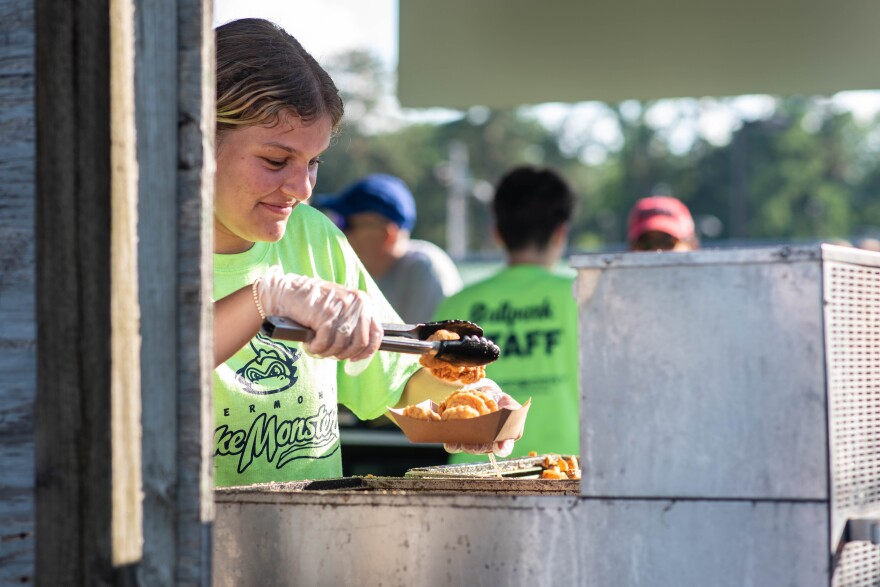
When Jordan and Alexa come see the Lake Monsters, they’re here for the whole experience. From the food (“The Lake Monsters pizza is the best tasting pizza around,” Jordan says) to the entertainment (“The hot dog and ketchup race, because they do a very good job pretending to like fall down and stuff,” Alexa adds).
Kevin Trevellyan
/
Vermont Public
And of course, actually watching the game.
“Last year and this year, they’re actually really good. It’s fun to watch them win again,” Alexa says.
“Yeah they just totally dominated the last two seasons,” Jordan adds.
Jordan and Alexa moved to Vermont from Manhattan, shortly before the pandemic. And Jordan says having a team like the Lake Monsters adds some vibrancy to Vermont.
“I’m just very grateful the Lake Monsters were bought and, you know, survived through the minor league cuts, and we have baseball in Vermont.”
How we got here:
What Jordan is talking about — the Lake Monsters surviving the minor league cuts — is an important part of this story. It’s actually how the team ended up getting sold in the first place. But to understand that part of the story, we need to get into some history.
Baseball has been played professionally in Vermont for a long time. There’s a league that dates back to the early 1900s. The Lake Monsters started in 1994, though at the time, they were the Vermont Expos.
Now, we can’t tell this story without getting a little into the weeds about how professional baseball is organized.
The highest level of professional baseball is Major League Baseball, known as the MLB. That’s teams like the Boston Red Sox, New York Yankees and Los Angeles Dodgers. Then, below those teams you have Minor League Baseball, and each MLB team has minor league teams that are part of their franchise. Those minor league teams, sometimes called farm teams, are where they develop young players or where players rehab after an injury.
In 1994, the Vermont Expos were a minor league team that was affiliated with the Montreal Expos. And at first, the Vermont Expos were pretty good.
“The Expos franchise started in 1994. [In] 1994, 1995, 1996 they made the playoffs. [In] 1996, they won the championship of the league,” says Rich Haskell. He’s the announcer at the Lake Monsters games, a job he’s had since the franchise started in 1994.
“And everybody for three years just basked in nothing but winning all the time. And they just assumed it would continue.
“Well, for the next 20 plus years, that franchise for the most part was a disaster. As far as winning and losing, crowds still showed up. Everybody loved the team, everybody loved Champ, but there was a lot of losing,” Haskell says.
In 2003, the Vermont Expos had a terrible season — they only won 19 out of 75 games. C.J. Knudsen, the current vice president of the Lake Monsters, was the general manager of the team at the time. In an attempt to inspire the slumping team, Knudsen vowed to sleep in the home dugout until the team won a game.
“The first night of my slumber, I was getting ready to fall asleep and all of a sudden a big skunk ran into the dugout. And so I didn’t get any sleep at all that night,” he says. ”And seagulls start waking up around four in the morning, and the light towers are blowing in the wind, and you have a cemetery [near] right field. So lots of lots of eerie random stuff.”
Knudsen slept in the dugout for seven nights until the team finally won a game.

Kevin Trevellyan
/
Vermont Public
In late 2004, the Montreal Expos moved to Washington, D.C., where they were renamed the Nationals. That meant the Vermont Expos needed to change its name, and they asked the fans to help. The New York Times reported that contenders included the Maplebombers, the Green Mountain Boys — and my favorite, the Howlin’ Howards — a nod to Gov. Howard Dean’s infamous shout during his 2004 presidential bid.
Ultimately, the team went with the name they have today: The Lake Monsters. And for the next 13 years things didn’t change much. The team did switch their affiliation from the Washington Nationals to the Oakland Athletics, but every summer fans could count on baseball at Centennial Field.
Then, in 2019, trouble started brewing.
“Basically, for a really long time, more than 100 years, you’d had this system where Minor League Baseball was independently operated as its own entity.”
Says another Emma — Emma Baccellieri. She covers baseball for Sports Illustrated. She says there was a longstanding agreement between Minor League Baseball and Major League Baseball, and it was basically a deal that laid out how the two leagues were connected to one another. But it “kept them as separate groups that operated independently.”
Baccellieri says that in 2019, when that agreement was up for renewal, the MLB decided it was time to end the deal.
“Instead, it kind of wanted to just let the agreement lapse and then have Major League Baseball take over the operations of Minor League Baseball,” she says.
Baccellieri says MLB made several arguments for consolidation. The organization said it would be more cost efficient, that things would be streamlined and it would be a better experience for players, including boosting pay for minor league players — a long standing issue.
“But part of what they had signaled at the end of 2019, going into 2020, was, if we do this, also, a lot of teams will disappear … At least 40 teams will be cut as part of this streamlining, cost-cutting process.”
The Lake Monsters were one of those teams. In December 2020, it was official: The Lake Monsters got dropped from the Minor Leagues.
The sale
For a few months, the future of the Lake Monsters was not looking good. But then, as you may have guessed, the team did not disappear. Instead, they were bought by a businessman named Chris English.
“It’s sort of been a passion of mine to use, sort of, resources that I get in my sort of day job, and invest in communities that, where, baseball can be, you know, fun, or where it needs to be, you know, revived,” English says.
English also works in finance, including founding a company called RockFence Capital. According to an article in Sportico, RockFence provides loans to baseball players. The players then pay back the loan, plus interest, to the company using their future earnings. If they leave baseball they don’t pay back the loan.
Similar companies have been criticized for taking advantage of financially desperate players. There are no specific allegations like that about RockFence — in fact, there’s little public information about the company.
English, citing non-disclosure agreements, won’t say much about it.
“We work with elite Major League Baseball players on their, you know, helping them with their on- and off-field, you know, financial performance,” English says.
The Lake Monsters are not the first team that English has owned. Most recently, he owned the Massachusetts-based Brockton Rox, who the Lake Monsters now play against.
English no longer owns the Brockton Rox. He sold them after he bought the Lake Monsters. According to ESPN, English bought the Lake Monsters franchise from Ray Pecor, their original owner, for $1 million — far lower than what similar teams have sold for. For example, in 2011, the Staten Island Yankees, who played in the Lake Monsters’ old league, sold for $8 million, according to court records.

Kevin Trevellyan
/
Vermont Public
English is originally from Montreal, but he has ties to Vermont. He has family in Shelburne and he owns a house in South Woodstock. He’s also been interested in the Lake Monsters for a while.
“For years, I had asked people in the Burlington area whether Ray would ever consider selling the team. And the answer was always no, no, no, no, that’s just Ray’s thing. He loves it,” English says.
I asked him what vision he pitched that got Ray Pecor to sell.
“I think, number one, that we would be as committed to investing in the community and investing in the ballpark, and keeping the traditions the same — keeping the culture what it is,” English says. “It’s still small-town community baseball, but having the financial resources to make sure that it is going to be here for 10 or 20 years.”
Meet the Monsters
When Chris English bought the Lake Monsters, he basically had to rebuild the team from scratch.
“We started March 15, with no staff, no roster, no nothing.” English says.
English started to hire people to manage the team, including C.J. Knudsen.
Then, of course, they needed players. And here is where the new Lake Monsters are different. Before, when the Lake Monsters were a minor league team, they had no control over who played for them – the major league affiliates just sent them players. Now, Knudsen says, the Lake Monsters’ front office gets to pick their team:
“Yeah, we actually scout and recruit the players.”
All the players are all college students — that’s another difference. When the Lake Monsters were bought they joined a new league called the Futures League. There are eight teams in the league, all based in New England, and everyone on the teams must be a college player.
“It allows them to maintain their skills, or even improve their skills during the summer as opposed to taking the summer off,” Knudsen says. “It allows them to get seen by a lot of professional scouts.”
More than 150 Futures League players and alumni have been drafted by major league teams, according to the league’s website.
And here’s a big part of the answer to Emma’s question about what changed when the team sold: Money.

Kevin Trevellyan
/
Vermont Public
Players pay $1,000 a season to play on the team. More than half of the fee covers housing, which includes paying local families who host out-of-state players. The rest of the money covers food.
English, the team’s owner, says there are scholarships for players if they can’t afford the team fees.
“No player who wants to play and has the skill to play would not be able to afford playing here,” English says. “To answer your question — yes, we have scholarships.”
English says the team also plans to develop relationships with historically Black colleges around the county. He says it’s part of an effort to make the Lake Monsters a more diverse team.
Major change number two: There are actually players from Vermont on the Lake Monsters.
“To be here — now it’s, looking back on it — it’s kind of just, it’s surreal,” says Wyatt Cameron, a pitcher on the Lake Monsters. “Honestly, like, I … wouldn’t have never imagined it. [It’s] unbelievable, the best thing, probably, baseball-wise, that’s ever happened to me.”
Wyatt grew up in Salisbury and his grandparents took him to Lake Monsters games as a kid. He says he never imagined that one day he’d be playing on Centennial Field — so he says to be here, as a pitcher for the Lake Monsters — it’s a big deal for him.
“Just as many years as I can play here in front of the crowd, be in the hometown, you know, just the home state. Just something about it, just, it’s different. There’s nothing better than it.”
The Futures League, where the Lake Monsters play, requires all its teams to have a certain number of players from New England or New England colleges. That means Vermonters have a pretty good chance of getting on the team.
“There is opportunity now … because being from Vermont, you’re always looked at as, like, ‘Oh, you’re just from Vermont, like, you probably can’t really play baseball that well, ‘“ Wyatt says. “ Like, you don’t have the experience that a lot of these other guys have. But now we’ve got that experience. We’ve got that opportunity and you just got to use it.”
Wyatt isn’t the only Vermonter on the team this year who dreamed about playing for the Lake Monsters. Tanner Wolpert, also a pitcher, is from Williston. He says he never thought he’d get to put on the Lake Monsters uniform.
“For me, like, the little kids running up to you, it’s hard to, like, wrap your head around that, because you used to be those little kids.
“But then you sort of started just like gaining respect for that. And, it’s more like playing for the state instead of playing for your team. I guess, like, you’re representing Vermont.”
Tanner says sometimes kids ask for shin guards, bats and gloves from the players. And that when they do — it’s “pretty cute.”
Does he really give them his shin guards?
“No, unfortunately not,” he says. “But it’s always really hard to turn down the kids because, you know, they look up to us like we’re still minor leaguers — like professional athletes. So it’s definitely hard to say no, sometimes.”
Something else that’s different about the new Lake Monsters: They’re winning, and winning a lot. During their first season in the Futures League they won 42 games, and were the league champions. This year, during the regular season, they won 44 games, nearly 70 percent of their games. And they made it to the league championship for the second year in a row – but lost the final game.

Kevin Trevellyan
/
Vermont Public
The team has also upgraded the ballpark, including new 16-seat box suites that cost $1,600. English, the owner, says most of the stadium upgrades are done, though he says they’re hoping to add a few “tiny-house” style concession stands.
“It’ll be a cute little area, like a little village, English says. “But other than that the ballpark in great shape we’re drawing now almost as much as per game as the Lake Monsters did in their heyday.”
So, those are some of the things that changed since the sale of the Lake Monsters. But for all that’s different, there are lots of things that have stayed the same: the uniforms, 25-cent hot dog night — and, of course, the mascot.
“I say the exact same thing for 27 years, you know, ‘Up from the depths of Lake Champlain, there he is, it’s Champ!’” says Lake Monsters announcer Rich Haskell. “‘Bad to the Bone’ plays, Champ comes out, we put the hex on the other team’s dugout. Every night for 28 years has been the exact same process.
“Every year, we kind of look at each other in the press box and I say to the sound guy, Jim, ‘Should we maybe play something other than ‘Bad to the bone’? You know what would happen if we didn’t play ‘Bad to the bone’? We’d have 10 people in that press box within five seconds.”

Kevin Trevellyan
/
Vermont Public
The Game, Part 2: ‘I still feel that pride’
Back at the game, our winning question-asker Emma and I indulge in some nostalgia: Dippin’ Dots, one of Emma’s favorite ballpark snacks from her childhood. I’ve never had them.
“They’re an experience,” Emma says. “Like — don’t expect ice cream.”
We get to the cart and order two cups of Rainbow flavored Dippin’ Dots, which look like multi-colored frozen pebbles. I’ll admit, I found Dippin’ Dots to be a little weird – both in taste and texture. They were also incredibly cold – that trait is probably due to how Dippin’ Dots are made: freezing ice cream mix in liquid nitrogen.
Anyway, Emma and I finish our frozen snack as the game gets underway.
“I don’t get it, because it’s just, like, people throwing balls around and running around, and I never caught on,” Emma says. “So, I like this part, which is the walking around and seeing people you know, and eating good food.
“I like to not feel alone in that, I’m not the only one who doesn’t get baseball,” she says. “But I feel like I still feel that pride, and I wear my hat with pride.”
With that, Emma joins her friends to watch the Lake Monsters. Tonight’s game is a close one. At the bottom of the ninth inning the score is tied 4-4 until Brian Schuab comes to bat. You can feel the crowd in those moments, hanging on to each pitch, waiting and trying to will Schuab to hit the ball out of the park.
And tonight — he does.
The Lake Monsters, today
Since we originally published this episode, some things have changed. Wyatt Cameron and Tanner Wolpert, who we met in this story, are not with the Lake Monsters this season. Wyatt plays for the Great Falls Voyagers and Tanner is at Franklin and Marshall College.
Last November, Lake Monsters announcer Rich Haskell was inducted into the Vermont Association of Broadcasters Hall of Fame.
As for Emma, our winning question-asker — she reports that she still enjoys hanging out with friends at Lake Monsters games. This summer she visited the ballpark for “Hot Dog Hysteria” night. She says she consumed a “respectable” four dogs.
Loading…
Credits
Thanks to Emma Ramirez-Richer for the great question.
This episode was reported by Liam Elder-Connors and produced by Angela Evancie. Editing and additional production from Myra Flynn and Josh Crane. Engineering support from Peter Engisch. The encore was produced by Burgess Brown. Angela Evancie is Brave Little State’s executive producer. Our theme music is by Ty Gibbons; other music by Blue Dot Sessions.
Special thanks to Kate Phillips and Kevin Trevellan.
As always, our journalism is better when you’re a part of it.
Brave Little State is a production of Vermont Public.

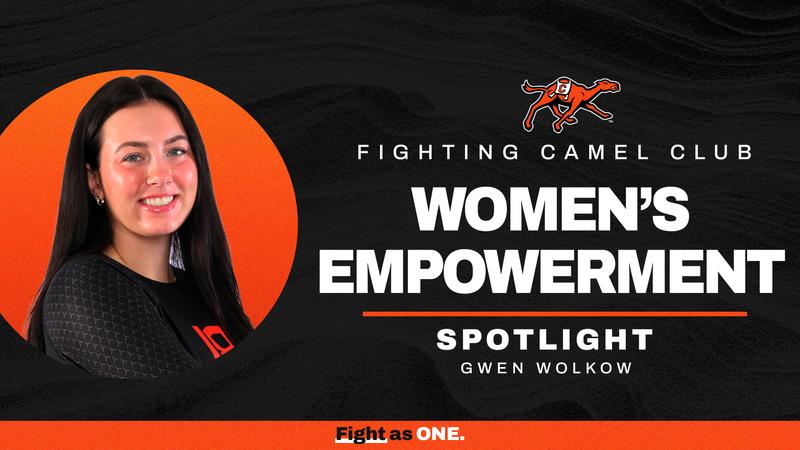
BUIES CREEK, N.C. – Gwen Wolkow’s journey to Campbell University certainly was a family affair. The daughter of two collegiate athletes and oldest of three athletic siblings, Campbell’s All-CAA outside hitter understood from an early age the sacrifices required not only to earn a college scholarship, but to also thrive once she arrived in Buies Creek.
Oh, and how did she thrive!
After earning Big South all-freshman team honors and helping lead her team to a regular season title, she was a mainstay on the roster that three years later captured its first CAA tournament championship.
Wolkow was a first-team All-CAA selection last fall when the Camels reeled off a 23-7 overall record and a 13-3 mark in league play before winning the conference title. Campbell made its second trip to the NCAA volleyball championship in five years and squared off against eventual national champion Texas A&M in the first round.
In the classroom, Gwen is a four-time CAA Commissioner’s honor roll student while preparing for a career in law enforcement as a criminal justice/pre-law major.
“I’m really grateful for my scholarship,” said Wolkow. “Not a lot of people have that opportunity of being able to play at the Division I level like I wanted to. It also helps my family a lot because college is expensive.”
The generosity of Fighting Camel fans, alumni, family, and friends truly makes a difference in the lives of student-athletes at Campbell University. Through the Women’s Empowerment Fund, the Fighting Camel Club’s goal is to make that experience even better, specifically for our female student-athletes. To join the Fighting Camel Club, click here.
A family of athletes
Gwen’s parents are graduates of Western Michigan University, where her father Nathan (Nate) was a defensive lineman on the football team and mother Kate competed for the Broncos volleyball team.
Growing up in suburban Chicago (Downers Grove), Gwen started playing volleyball while she was in the third grade. By the time she reached high school, she knew she wanted to compete on the collegiate level. Having parents who had competed at the highest level of collegiate athletics provided an insight into what was required of an aspiring Division I athlete.
“We had conversations and my parents asked, ‘is this something you really want to do? We’re going to put all this money into training and traveling to tournaments, is it something that you want to put yourself through seven days a week?'” Gwen recalled.
She joined the Sports Performance volleyball club and helped her team win an AAU U15 national championship in 2019 and finish as U17 national runner-up two years later.
“With my club, we played basically every day of the week,” said Gwen. “My club was all about discipline, following the rules and (the commitment) can be really tough on you. But it makes you into the player you’re going to be in the future. If you want to (play) volleyball in college, it really helps.”
Traveling to Wisconsin, Kentucky, Florida and the Dominican Republic with Sports Performance helped prepare Gwen for a collegiate travel schedule against CAA opponents located from Boston, Mass., to Charleston, S.C.
In addition to Gwen’s commitments with Downers Grove North High School and Sports Performance, the Wolkow family also juggled the schedules of her younger brother George, who was pursuing a baseball career and younger sister Grace, who also competes in volleyball.
“On Sunday nights, we’d sit down for dinner at home, talk about what we’re doing throughout the week, where we’re going,” Gwen recalled. “My parents would switch off who they were going with, especially since my younger sister got into sports. They did everything they could to support us in everything we wanted to do. They put us in the highest level we could go and let us run with it.”
George grew to be a 6-foot-7, 240-pound outfielder and was selected by the Chicago White Sox in the seventh round of the 2023 Major League Baseball amateur draft. Gwen was able to see him play during the 2025 season with the Kannapolis Cannon Ballers and on the road against the Fayetteville Woodpeckers.
Grace is in her freshman year of high school with a goal of a career in medicine.
“All of us from a young age knew what we wanted to do,” said Gwen. “My brother from middle school knew that he wanted to play major league baseball. My sister talks about Stanford because she wants a medical degree. We all have big dreams, big goals.”
As the oldest child in the Wolkow family, Gwen has enjoyed watching her siblings grow into the persons they’ve become.
“My brother graduated high school a year early, and not many people have the opportunity to be drafted and do what he’s doing,” said Gwen. “I’m really proud of him. He’s always working. When (the family traveled) to the NCAA tournament, he was working out in the hotel gym. He doesn’t take any days off.”
Gwen has been away from home for much of the last four years competing and pursuing her degree at Campbell and has been impressed by Grace’s improvement.
“It’s crazy to see that growth in my younger sister, she’s six years younger than me, and she gets better every year,” said Gwen. “When we were at my last game, she looked at me, started crying and said, ‘I’m never going to see you play again.’ From a big sister point of view, you really have that effect on your younger siblings.”
Why Campbell?
Like many students who choose to attend Campbell, Wolkow was attracted to a smaller campus with smaller classes that provided more individual attention. She also knew that she wanted to go to a school that was in a place that did not have to endure the bitter cold winter of her hometown in the Great Lakes region.
While attending Campbell’s volleyball camp the summer after her freshman year of high school, Gwen met future teammates Melody Paige and Claranne Fechter.
“At camp, I really enjoyed the girls on the team; it really matters how well you get along with the people there,” said Gwen. “I like the smaller school aspect, smaller classes, I can walk from my apartment to class.”
The turnaround
After a four-year build to becoming one of the best volleyball programs in the Big South, then the CAA, graduation losses and injuries played a large part in Campbell struggling to an uncharacteristic losing season (6-22 overall, 4-14 CAA) in 2024.
Wolkow and her teammates were determined that 2025 would be different. Despite being picked 10th in the preseason CAA poll, Campbell posted a 23-7 overall record, 13-3 mark in the CAA. The 17-win improvement from the previous year was tops among all Division I volleyball programs. All four losses outside of conference play came at the hands of “Power 4” members.
“We just thought, it’s not going to happen again,” said Gwen. “We focused on team chemistry and building our culture back up. A lot of people worked really hard, and that hard work paid off. After being picked second to last in the preseason poll we were definitely angry and then losing two games to Charleston (Oct. 3-4), we really wanted to prove ourselves.”
In the CAA Championship at Towson, Md., Campbell rallied from 2-1 set deficits against Stony Brook in the semifinals and Hofstra in the final to claim the title. In fact, Campbell held off three match points against the Pride, recovering from a 24-21 deficit in the fourth set, to win 26-24. The Camels then won the fifth set 15-12 to punch their ticket to the NCAAs.
“It was a great way to end your college career,” said Wolkow. “Yes, we lost to Texas A&M but being in that environment and around those fans is something that a lot of people don’t get to do. We’re all really grateful for that experience.”
Off the court
Despite a demanding athletic and academic schedule, Gwen found the time to enjoy her collegiate experience in a number of ways – including one that is certainly uncommon for many students.
During breaks in her freshman and sophomore year, she attended Maui Surfer Girls – a camp in Hawaii for adult women who want to learn to surf.
“I had never surfed before, but I loved it,” she said. “Everyone was so involved and included. It was about opening up, getting to know each other, building relationships. A lot of people there were beginners. As an athlete, it was nice because I caught on really fast. Being able to stand up on a surfboard and ride a wave is really exhilarating.”
Last summer, Wolkow completed an internship with her local police department. That experience helped her decide on a career in law enforcement rather than pursuing law school.
“In high school, I thought I’d go to law school, but I became more intrigued about the law enforcement aspect. My internship confirmed that.”
After graduating in May, Wolkow plans to join a police department, work for two years then apply to the FBI or stay in the force and eventually join a SWAT unit.
“I definitely don’t want to work at a desk, I want to be out and about,” said Wolkow. “My grandpa was in the Army. It’s in my blood, I guess.”
Gwen Wolkow’s collegiate experience has provided her with lifelong friendships and memories, not to mention athletic and academic honors, plus three team trophies and a trip to the postseason.
Her advice to someone just starting their college experience?
“The hard days building up to finding out where you want to go to college are worth it. You have those hardships, but if you can get through them, you’re on your way to success in anything,” she said. “Be open to change. Coming to college there’s a lot of changes you have to get used to. Every year the seniors on this team have done a good job involving the freshmen, including them, getting to know them. Each of the seniors is really close with at least one of the freshmen. To have that kind of relationship, once that freshman experiences it, then they can do it when they are seniors.”
Jan. 8, 2026, 5:22 a.m. CT
MADISON – The whiteboard in Kelly Sheffield’s office in Kellner Hall had 14 names on it.
Seven of the names in the upper-left corner were returning players from the 2025 Final Four team. The other seven are newcomers in 2026.
They add up to form a group that still has some remaining positional needs going into the spring semester, but it’s also a group that has Sheffield excited as he looks ahead to his 14th season as Wisconsin volleyball coach in 2026.

COLUMBIA, S.C. (Jan. 8, 2026) – South Carolina Track & Field is set to host the first meet of the 2026 calendar year with the Gamecock Opener on Saturday at the Carolina Indoor Track & Field Complex.
Follow the Meet
Live results for the 2026 Gamecock Opener can be found by clicking here. Fans can also follow along with updates on X (Twitter) by following @GamecockTrack.
Know Before You Go
Carolina Indoor Track & Field Complex does have a CLEAR BAG POLICY that will be in effect. Learn everything you need to know about the Clear Bag Policy by clicking here. There is also a WATER BOTTLE POLICY for all patrons and that is: one clear, plastic disposable water bottle is permitted. No hard, non-clear refillable bottles are allowed inside the facility.
Parking
For the 2026 Gamecock Opener, spectators will be able to utilize the Athletics Village Parking Garage for $10 per car, with no re-entry. There will also be city metered parking surrounding the complex that will also be made available through the ParkMobile app.
Ticket Information
There is a $10 fee for any adults wishing to attend the meet. Children that are 17 and under gain entry for $5, while kids 2 and under are free. Students/faculty/staff get in free with their valid Carolina Card identification. Please note that the Carolina Indoor Track & Field Complex is a CASH ONLY facility.
Meet Information
The Gamecock Opener will kick off at 10 a.m. with the men’s high jump, while the first track event will be the men’s 60 meter prelims at 11:35 a.m. There is a full slate of events scheduled, with the final event being the 4x400m relay for the women at 5:05 p.m. Doors are set to open at 9 a.m. A total of 12 teams will compete in this weekend’s home opener, including in-state opponents South Carolina State and Winthrop.
Gamecocks at Home
South Carolina has 44 athletes competing in the home opener, spread out among 28 potential events. The Gamecocks last competed at Dec. 5 and Dec. 6, 2025 at both the Clemson Opener and the Sharon Colyear-Danville Opener. At Clemson, South Carolina secured 11 wins and took down two program records. Meanwhile in Boston, the Gamecocks dropped two more program records to kick start the season.
There will be 18 Gamecocks making their season debuts on Saturday, including eight who will be making their Gamecock debuts. On the men’s side, Robert Stitts Jr. will lace up the spikes for the first time for Carolina on Saturday. For the women, Jalee Brown, Jasmine Cook, Cohren Corbin, Akala Garrett, Bella Leonard, Jathiyah Muhammad and Kymora-Lee Williams will don the Garnet & Black for the first time this weekend.
The NCAA women’s volleyball rules committees recommended a player’s foot completely crossing the center line be ruled a fault, beginning with the 2026 season.
Additionally, coaches could challenge whether an opponent’s foot completely crossed the center line. Officials would also be able to look at possible net faults while reviewing a challenge as to whether a player’s foot completely crossed the center line.
The Division I Women’s Volleyball Playing Rules Subcommittee and the Division II and Division III Women’s Volleyball Rules Committee met in Indianapolis this week to propose rules changes in the sport.
All rule recommendations must be approved through the governance structure before becoming official. The Division II and Division III Playing Rules Oversight Panel will discuss women’s volleyball rules recommendations Feb. 12. The Division I Women’s Volleyball Oversight Committee will review proposals during a meeting Feb. 16-18.
Both committees wanted to bring NCAA volleyball more in line with the international center line rule.
Currently, it is not a fault for a player’s foot to completely cross the center line unless the player causes interference or creates a safety hazard. Center line faults currently may not be challenged.
“It’s always about safety when you talk about the center line,” said Keylor Chan, chair of the Division I rules subcommittee and women’s volleyball coach at Samford. “I think, through the course of modern volleyball, this rule has gone back and forth through the years. The hardest part was there was some subjectivity to it. We are trying to take the subjectivity out for the referees and for the safety of our athletes.”
Bench protocols
Both rules groups proposed that teams switch benches after the completion of the second set. Also, the rules committees are recommending that after the coin flip for the fifth set – where a team can choose to serve, receive or which side to compete on – the teams remain on their sides of the net the entire set.
Rationale for making the change is to aid pace of play and limit the delays of teams changing benches.
Currently, teams switch benches after each set, and the teams also switch benches in the fifth set when the first team reaches 8 points.
“The time it takes to play a match is something that we are conscious of,” Chan said. “This helps with moving the sport forward in a positive direction.”
DII/III substitutions
The Division II and Division III Women’s Volleyball Rules Committee proposed increasing the substitutions allowed per set to 18. Currently, teams can make 15 substitutions per set.
“With the rosters increasing over the past few years, we felt like this was a good move to give our student-athletes more opportunities to participate,” said Julia Rowland, chair of the committee and deputy director of athletics and senior woman administrator at Coker. “It gives our coaches more opportunities to get creative with their lineups. The committee felt we should keep these two divisions aligned on the number of substitutions.”
Experimental rule
Both committees approved an experimental rule for conference games to allow the electronic transmission of live video to the bench area for coaching purposes only.
Other rules recommendations approved by both committees:
- Players on the serving team would not be allowed to raise their hands above their heads during the serve until the ball crosses the net.
- Challenges would not be permitted once a timeout is initiated.
- When making a video review challenge, coaches would form a “C” with their hands instead of presenting a card to indicate requesting a review.
- Jewelry could be worn above the chin only. There would not be limitations on the size of the jewelry.
- Misconduct sanctions would remain for the entire match and not reset after a set is completed. Sanctions for procedural reasons (delays) would reset each set.
- Players could go around the net pole to pursue a ball and play it back to their side. This action would be allowed for a ball that has crossed the net plane to the opponent’s free zone over or outside the antenna. There would need to be at least 2 meters of space behind the referee’s pole to use this rule. Television cameras also could not be placed between the attack lines on the side where the referee’s stand is located. Players could not go under the net to pursue the ball.
- Officials could go to the statistics crew or use the Challenge Review System to address a scoring discrepancy. Coaches would not have to make a formal protest in these instances.
- Another optional timeout format would be added in which technical/media timeouts occur when a team reaches 15 points for sets 1-4, regardless of whether a team has already taken a timeout. The technical/media timeout will be a maximum of 90 seconds. A team timeout maximum time would be 75 seconds. There would not be a technical/media timeout in the fifth set.
- If a disqualified player doesn’t sit out the next match as required, the head coach and player would be required to serve a two-game suspension. If a coach who is disqualified doesn’t sit out the next match as required, the head coach would be required to serve a two-game suspension.
- Two commercial logos would be permitted on the playing surface that would be no larger than 10 feet by 10 feet. One logo could be placed at each end of the playing court located between the attack line and end line. The logos should not interfere with any court marking or boundary lines.
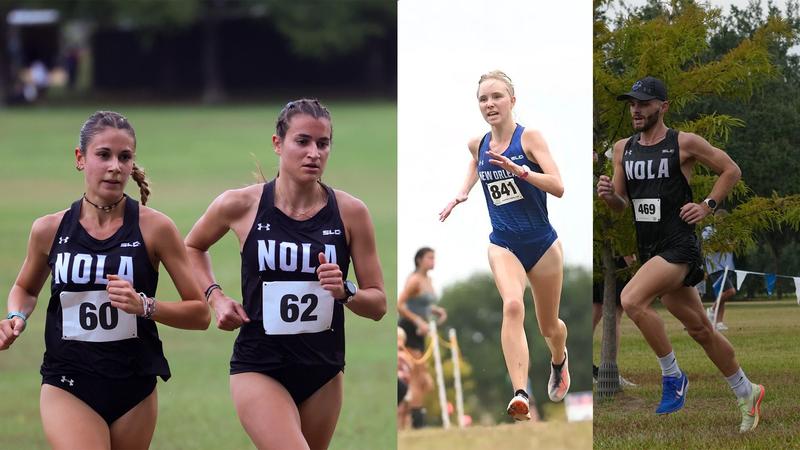
NEW ORLEANS – Four Privateers were named to the Southland Cross Country All-Academic Team which was released by the conference office on Thursday.
Mason Appleton becomes the tenth men’s selection to the Southland All-Academic Team since 2016 and earns his first nod. The senior currently holds a 3.88 GPA as a Biological Sciences major. He competed in all four meets and set three personal bests in the fall.
Appleton also went to the NCAA Regionals for the second consecutive season. He also won the Azalea City Classic in the fall.
Three women also made the All-Academic Team in Anais Sulpice, Petra Imre and Michela Papalia.
Sulpice carries a perfect 4.0 GPA while currently obtaining her Master’s in Finance. A native of France, Sulpice had a top five finish in the Azalea City Classic and finished 21st in the Southland Championships last fall.
Imre currently holds a 3.87 GPA as a Film and Theatre Arts major. The sophomore from Hungary also had a top five finish at the Azalea City Classic and finished 27th at the Southland Championships.
Papalia also finished in the top five at the Azalea City Classic. The sophomore from Italy currently holds a 3.92 GPA as a Human Performance and Health Promotion major. Papalia finished 32nd at the Southland Championships.
The trio of women boost the number of Southland All-Academic selections to 11 since 2019. The Privateers also had four members make the team in 2023, the most since joining the conference.
BLUES ON TUES. NEWSLETTER
To keep up with all athletics news at the University of New Orleans, subscribe here for our weekly newsletter.
FOLLOW US ON SOCIAL
Keep up to date with everything New Orleans Cross Country and Track & Field. Follow @PrivateersTFXC on Twitter/X, @PrivateersTFXC on Instagram, like /PrivateersTFXC on Facebook and subscribe to the UNOPrivateers YouTube channel.
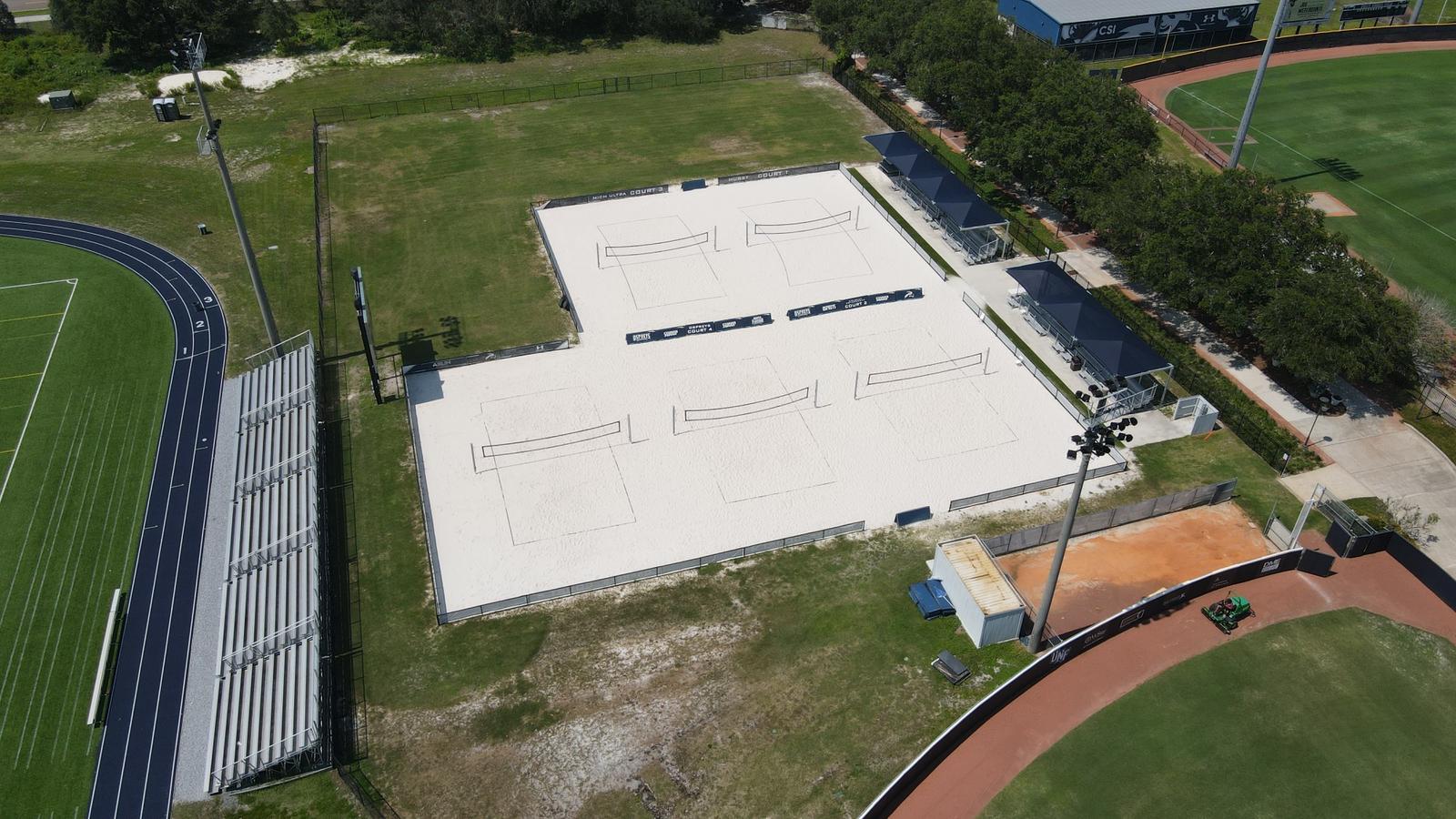
JACKSONVILLE, Fla. – North Florida Beach Volleyball unveiled its 2026 schedule on Thursday.
The slate is highlighted by a pair of home tournaments at The Cooper Beach Volleyball Complex, “The Coop”, with the DUUUVAL Duals on March 6-7 and North Florida Invite on March 20-21.
North Florida totaled a program-record 26 wins in 2025 that culminated in the program’s second-straight and second-ever appearance in the NCAA Championship after it added its second-straight and sixth total ASUN Championship title. North Florida earned a program-best No. 12 seed in the NCAA Championship after it secured the No. 16 seed in 2024.
North Florida has won 24 or more matches in each of its last five seasons.
In addition to a program-record win total, North Florida earned its highest ranking in program history at No. 14 in the final AVCA Collegiate Beach Coaches Poll in 2025. The Ospreys were ranked in each installment of the poll in 2025 for the first time in program history.
Four of North Florida’s five tournaments will be in-state. North Florida opens its season across town at the Dolphin Duals, hosted by Jacksonville, at Payne Sand Volleyball Courts at Dolphin Beach on Feb. 20-21. North Florida then heads to Tallahassee, Fla. for Florida State’s Seminole Beach Bash at the Seminole Beach Volleyball Courts on Feb. 27-28.
North Florida travels to Stanford, Calif. to compete in the Stanford Invitational at the Stanford Beach Volleyball Stadium on March 13-14.
In between home tournaments, North Florida makes the trip to Austin, Texas to compete in the Texas Invitational at Wright-Whitaker Sports Complex on March 27-28. North Florida heads Boca Raton, Fla. for the FAU Beach Invitational on April 10-11.
North Florida closes the regular season at TCU”s Fight In The Fort at the TCU Beach Volleyball Courts on April 17-18.
North Florida looks to defend its back-to-back ASUN Championship titles at the 2026 ASUN Championship at John Hunt Park on April 22-24 and return to the 2026 NCAA Championships at Alabama’s Beach Sports & Events in Gulf Shores, Ala. on May 1-3.

Women’s Empowerment Spotlight | Gwen Wolkow

National Fire Protection Association and Martinsville Speedway Join Forces for the NASCAR O’Reilly Auto Parts Series Spring Race – Speedway Digest

Lakers’ JJ Redick reflects on ‘resilience’ and loss a year after Los Angeles wildfires
Where Wisconsin Badgers volleyball stands after winter transfer window

UW-La Crosse aims to break attendance record Saturday during Bubba’s Youth Day honoring coach Moran Lonning’s son

Winners and losers in the 2026 college football transfer portal

Track & Field Opens Home Slate with Gamecock Opener – University of South Carolina Athletics

Women’s volleyball rules committees propose changes to center line faults

Vice Mayor Campbell welcomes world-class youth soccer to Lauderhill in 2026

Four Privateers Earn Southland Cross Country All-Academic Honors

Beach Volleyball Unveils 2026 Schedule

Midway through the school year, an important reminder for parents and coaches

Mando To Back Bilicki’s O’Reilly Series Effort

NaVorro Bowman Jr. is forging a separate path from his NFL dad

Volleyball Has Two Named CSC Academic All-Region

SoundGear Named Entitlement Sponsor of Spears CARS Tour Southwest Opener

DeSantis Talks College Football, Calls for Reforms to NIL and Transfer Portal · The Floridian

#11 Volleyball Practices, Then Meets Media Prior to #2 Kentucky Match

Stempien to seek opening for Branch County Circuit Court Judge | WTVB | 1590 AM · 95.5 FM

Nascar legal saga ends as 23XI, Front Row secure settlement

Maine wraps up Fall Semester with a win in Black Bear Invitational

Ross Brawn to receive Autosport Gold Medal Award at 2026 Autosport Awards, Honouring a Lifetime Shaping Modern F1

Princeton Area Community Foundation awards more than $1.3 million to 40 local nonprofits ⋆ Princeton, NJ local news %

Downtown Athletic Club of Hawaiʻi gives $300K to Boost the ’Bows NIL fund

Sunoco to sponsor No. 8 Ganassi Honda IndyCar in multi-year deal

WNBA’s Caitlin Clark, Angel Reese and Paige Bueckers in NC, making debut for national team at USA camp at Duke

North Florida Motorsports Park led by Indy 500 Champion and motorsports legend Bobby Rahal Nassau County, FL
NASCAR, 23XI Racing, Front Row Motorsports announce settlement of US monopoly suit | MLex

Woods, Ogunribido Named CCIW Women’s Indoor Track & Field Student-Athletes of the Week

Beach Volleyball Unveils 2026 Spring Schedule – University of South Carolina Athletics





-
 Rec Sports3 weeks ago
Princeton Area Community Foundation awards more than $1.3 million to 40 local nonprofits ⋆ Princeton, NJ local news %
-

 Sports2 weeks ago
Badgers news: Wisconsin lands 2nd commitment from transfer portal
-

 Rec Sports6 days ago
Five Youth Sports Trends We’re Watching in 2026
-

 Sports3 weeks ago
Is women’s volleyball the SEC’s next big sport? How Kentucky, Texas A&M broke through
-

 Rec Sports3 weeks ago
NBA, Global Basketball Community Unite for World Basketball Day Celebration
-
 Sports2 weeks ago
Kentucky VB adds an All-American honorable mention, loses Brooke Bultema to portal
-
Rec Sports3 weeks ago
Inside the NWSL’s first combine: Can the league create a more robust pathway for American talent development?
-
 NIL3 weeks ago
$2.1 million transfer portal QB predicted to join College Football Playoff team
-

 Motorsports2 weeks ago
Dr. Patrick Staropoli Lands Full-Time O’Reilly Ride with Big Machine Racing
-

 Motorsports2 weeks ago
BangShift.com IHRA Acquires Historic Memphis Motorsports Park In Millington Tennessee. Big Race Weekend’s Planned For 2026!