

By Hayley Fowler ( December 22, 2025, 3:36 PM EST) — A trio of nonprofits that advocate against gambling are fighting betting company Kalshi’s efforts to curb Maryland gaming regulators’ oversight, telling the Fourth Circuit that health consequences and threats to elections and youth sports would be significant if Kalshi succeeds….
Rec Sports
What football helmet should you buy? It’s not as simple as you think.


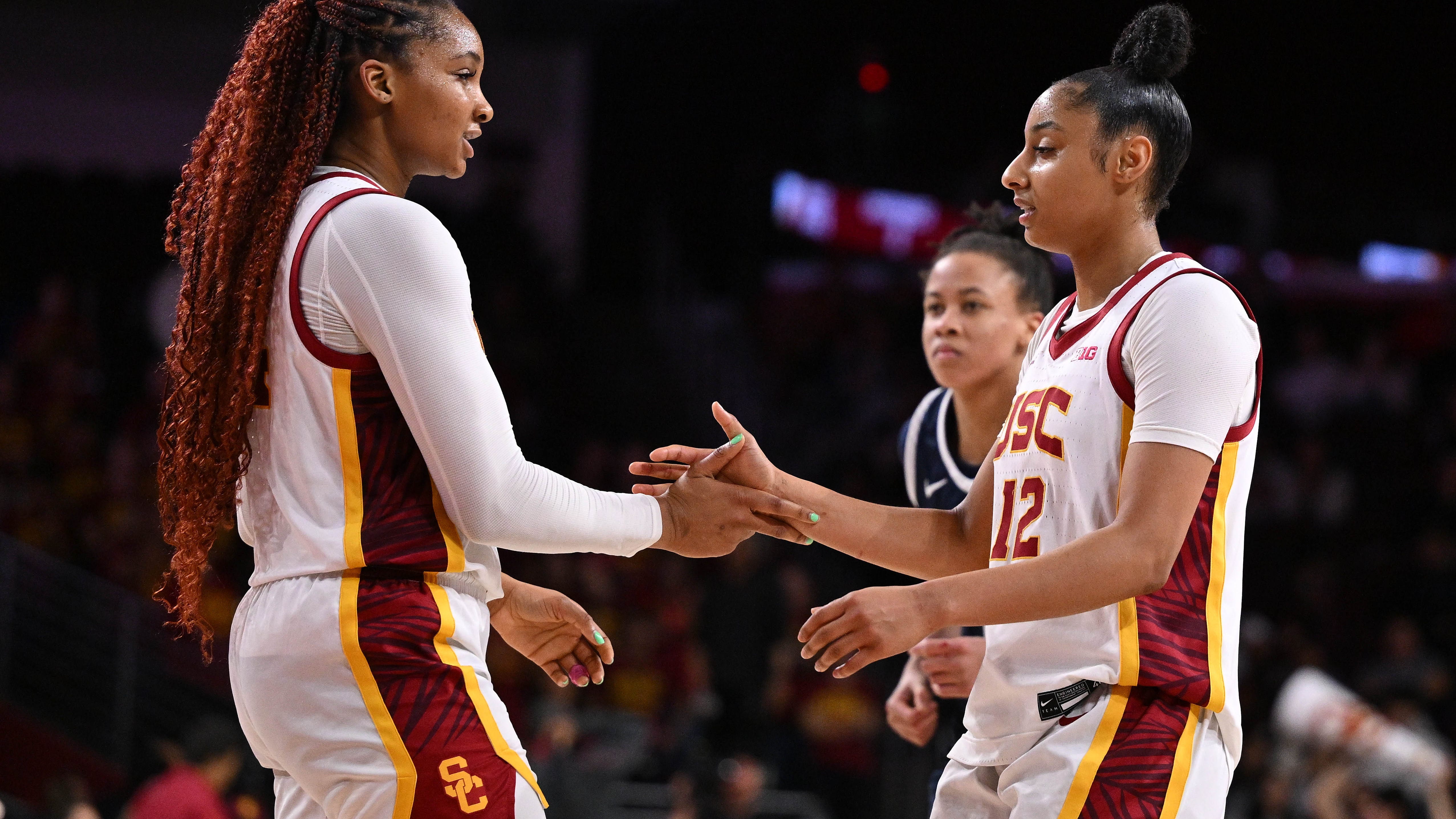

Kiki Iriafen believes in USC basketball and JuJu Watkins next season
Former Trojan Kiki Iriafen believes in her former collegiate team to dominate next season with star JuJu Watkins coming off an injury.
Sports Seriously
Which football helmets should I buy?
It’s what a Virginia Tech athletics equipment manager asked Stefan Duma, a faculty member at the university’s department of Biomedical Engineering and Mechanics, in 2009.
Duma’s team had been working to better understand what causes brain injury. It had placed sensors in Hokies players helmets. It had simulated car crashes.
The question seemed simple enough, until Duma and his colleagues delved deeper into it.
“We said, ‘We don’t know.’ We can buy helmets and test because there’s really no information available in what was good and what wasn’t,” says Steve Rowson, who, as a graduate student, joined this little-known football helmet project that was about to take off.
Duma’s group simulated hits with a guillotine-like device that plunged a dummy headform down cables onto an anvil.
“We bought the helmets, and we saw huge differences,” Rowson tells USA TODAY Sports. “But we also felt like everyone should have that information, so we developed the Virginia Tech helmet ratings based on that. And it was like the first independent, objective way of evaluating helmets.”
The investigation that started in Duma’s basement lab sparked a wave of discussion that would define standards used by youth, high school and college teams and expand to other sports.
“It wasn’t like a pass/fail scale,” Rowson tells USA TODAY Sports. “It was, ‘Here are the best performers. Here are the next best. Here are the not so good performers,’ and that really resonated with consumers. It was a little disruptive to the football helmet manufacturing industry.”
Rowson is now director of Virginia Tech’s Helmet Lab that has reached national acclaim for its testing and studies. It published the first independent safety ratings for varsity football helmets in 2011 and continues to ramp up the standard for what constitutes a five-star helmet.
Just recently, it updated its rating system with new thresholds for those used in varsity and youth football and by bicyclists.
“The best helmets back in 2011 would be the very worst helmets today,” Rowson says.
Have you ever wondered about the force of a hit to the head your kid sees in practice and in games, and how their helmets are tested to protect from them?
Or how helmet recommendations are determined for various sports and age groups?
We spoke with Rowson about the history of his lab, the methods and evolution behind Virginia Tech’s STAR testing system and how it can help keep your athlete safe.
What is the Virginia Tech Helmet Lab and how does it replicate impact?
The lab is a collection of about 25 Virginia Tech faculty, staff, graduate and undergraduate students who study the forces that cause injuries all over the body and look for ways to prevent them from occurring.
They consider over a million head impacts to develop football readings. As they learn more, they add test conditions or change methods.
Sometimes, it’s a complete overhaul.
Their first varsity football helmet ratings were based on Duma’s drop test.
“We were only considering linear acceleration in the head, and it’s because there weren’t really good methods to evaluate rotation of the head,” Rowson says. “We didn’t know how rotational acceleration related to brain injury really well at the time, but we knew enough about linear acceleration that it had a correlation to concussion risk.
“However, a few years later, we had new data to tell us how rotational acceleration related to brain injury, and we upgraded the football method to include both linear and rotational acceleration. We have a pendulum impactor, which pretty much looks like a big upside down hammer that swings down and then it hits a dummy headform that has a helmet on it. Think of a crash test dummy. That dummy headform has sensors inside it.”
Helmet manufacturing has advanced, Rowson says, as the lab has.
“The amount of change that we’ve seen in helmet design over the last decade is probably more than we saw in the previous 30 years combined,” he says.
Understanding the impact and distribution of hits
I asked Rowson, who has a master’s and Ph. D in Biomedical Engineering from Virginia Tech, if he could come up with an analogy for the greatest impact a helmet sustains on a field. He did some math and got back to me with the following scenario:
Head accelerations associated with concussion are comparable in magnitude to those experienced in unbelted car crashes at approximately 17 mph for college-level players and 10 mph for youth-level players.
However, damage from concussions can be cumulative. The lab tests helmets with the hardest hits as well as what Rowson calls “everyday impact” players see on the field.
“They probably see that impact multiple times, and then, with our highest impact condition, not every player might see it,” he says. “The ones who do are at risk of injury. The helmet influences how much force is transferred to the head during all those impacts. So if a helmet’s too soft and too thin, it might not do great under higher impact energy or if it’s optimized for high energy hits, it might do poorly at the low energy hits. So we have a comprehensive evaluation of it where you can’t overdesign for really hard hit impacts or everyday impact.”
No helmet is concussion-proof, the lab states on its website, and any athlete can sustain a head injury. It identifies the helmets that best reduce your chances.
The Summation of Tests for the Analysis of Risk (STAR) score is calculated based on a helmet’s performance in a series of impact tests that are sports-specific. Tests are weighted based on how often people experience similar impacts.
The lower the score, the better the protection. Scores are assigned a number of stars between 1-5, with 5 stars being the best.
“Our ratings are representative of the average,” Rowson says. “There is gonna be some in that (data) distribution who get hurt at really low head accelerations, and there’s gonna be other people who don’t seem to ever get hurt, even at high head accelerations, and that comes down to biological variance. Everyone has their own tolerance to head impact, everyone’s material properties and their brain tissue’s different.
“So it’s kind of a predicted number of injuries for a given number of head impacts that we would expect to see on average, amongst a lot of people. We identify helmets that systematically reduce head acceleration and thus risk.”
Coach Steve: Lessons to learn after suffering a concussion
What’s the difference between a four-and five star helmet? (Hint: They’re both good.)
Rowson says just about every varsity and youth football helmet they recently rated earned five stars.
“But that starts to dilute what a five star meaning is,” he says. “The five star rating is intended to identify what the very best available protection is. And if every helmet that’s being rated is five stars, it takes a little meaning away from that.”
The ratings update rescales those areas to make the five-star winners truly standout performers. The new thresholds reduced the number of five-star helmets from 167 to 38 (bicycle), 33 to 11 (varsity football) and youth football (26 to 6).
The lab still recommends any four or five star helmets.
“It’s not just like everything got good,” Rowson says, “it’s they got good, but to different extents where we could identify meaningful differences.”
Watch contact in practice: Understanding helmet differences and unique risks
According to Virginia Tech, varsity football helmets used to have corresponding youth versions, but there were often few differences between them. There was little data describing how risk differed for youth players.
Today, the lab model for “youth” football simulates a 10-to-12-year-old boy, the varsity model an18-to-24 year old male.
“A kid isn’t necessarily just a scaled down adult,” Rowson says. “Their head is bigger relative to their body than we see in a full grown male, their brain’s still developing, and there’s differences in kind of how they respond to a head impact.
“Every impact scenario we recreate in a lab is weighted based on how often a player is gonna see (it) on the field. We saw in our youth studies they don’t hit their heads as frequently (and) when they fall to the ground, they have a heavier head and a weaker neck, and the helmet’s pretty heavy relative to their body mass compared to an adult. So their helmet’s more likely to follow through and strike the ground. So we see more side and back impacts in youth football than we do in varsity football.”
As part of a groundbreaking 2012 study funded by the National Highway Traffic Safety Administration, Virginia Tech researchers put sensors inside the helmets of seven players aged 7–8 years old for a season and measured their impacts.
They found that 76% of the ones greater than 40 g (40 times the acceleration of gravity) and 100% of impacts greater than 80 g occurred during practices.
“It was first data measuring head impacts in youth football players,” Rowson says.
Following the study, Pop Warner youth football outlawed drills that involved full-speed, head-on-blocking and tackling that starts with players lined up more than three yards apart, as well as head-to-head contact.
According to The New York Times, Pop Warner officials said they were persuaded by data from the youth study that indicated the level of severity of some hits were similar to some of the more severe impacts college players experience.
“We’re like, ‘Wow, all our hardest hit impacts are coming from this one (Oklahoma) drill,’ ” Rowson says. “And out of all the games we collected, we didn’t see that kind of impact happen a single time. We’re like, ‘We don’t think you should be doing this,’ and the coach was really receptive. It was just a local youth football team, and it was a dad coaching who had that drill in there, because that’s what he did when he was a kid.”
A follow-up study of football teams comprised of players aged 9–12 suggested head impact exposure could reduce significantly by limiting contact in practices to levels below those experienced in games.
Coach Steve: Why are boys sports declining? Former NBA star looks for solutions
How helmet ratings differ by sport
Their helmet research always starts in the real world, Rowson likes to say. They learn how people are getting hurt and they match those conditions – the speed at which they’re hitting their head, where they’re hitting their head, their acceleration profile – in the lab.
With cycling, the researchers look at a fraction of the head impacts as football.
They don’t put a sensor on everyone because cycling is an individual sport and crashes are rare. Instead, Rowson says, they identify riders involved in crashes and collect their helmets.
They buy the same helmet and start hitting it until they match the damage profile, then back calculate the location and velocity at which they hit their head.
For snow sport, researchers have traveled to big events on mountains and set up cameras from various angles.
Through video tracking, they calculated their head impact speed into the ground.
The lab now has nine helmet ratings: Varsity football, youth football, flag football, hockey, bicycle, equestrian, soccer, snow sport, whitewater and polo.
They’ll be announcing rating programs for baseball and softball soon.
“Essentially, we’re trying to cover all sports,” Rowson says. “The ultimate goal is for us to be able to provide data to everyone on what’s available.”
The lab doesn’t formally advise any leagues, but often, the leagues come to them. A full time faculty member is assigned to direct outreach, host tours, run STEM activities for kids and answer questions.
The questions, it seems, come every day.
“Sometimes they’re very technical, sometimes they’re more general: What does this mean and how do we use it?” Rowson says.
We know now from Duma, the Virginia Tech professor of engineering whom its football team sought out in 2009, how a seemingly innocent one can lead to a scientific explosion.
Steve Borelli, aka Coach Steve, has been an editor and writer with USA TODAY since 1999. He spent 10 years coaching his two sons’ baseball and basketball teams. He and his wife, Colleen, are now sports parents for two high schoolers. His column is posted weekly. For his past columns, click here.
Got a question for Coach Steve you want answered in a column? Email him at sborelli@usatoday.com
Continue Reading
Key Takeaways
- Nearly 6,500 DCPS students will receive Under Armour athletic footwear through the year-long District Kicks initiative launching in 2026.
- All high school athletes across approximately 22 DCPS schools will receive sport-specific shoes distributed by season starting March 2026.
- More than 1,200 sixth graders will receive athletic sneakers during a March 3 celebration event at CareFirst Arena.
- The program builds on District Dribble’s success, which distributed 30,000 basketballs to elementary students in 2024.
- District of Play reached over 200,000 DC residents in its inaugural year as part of MSE’s community investment platform.
Building on District of Play’s First Year
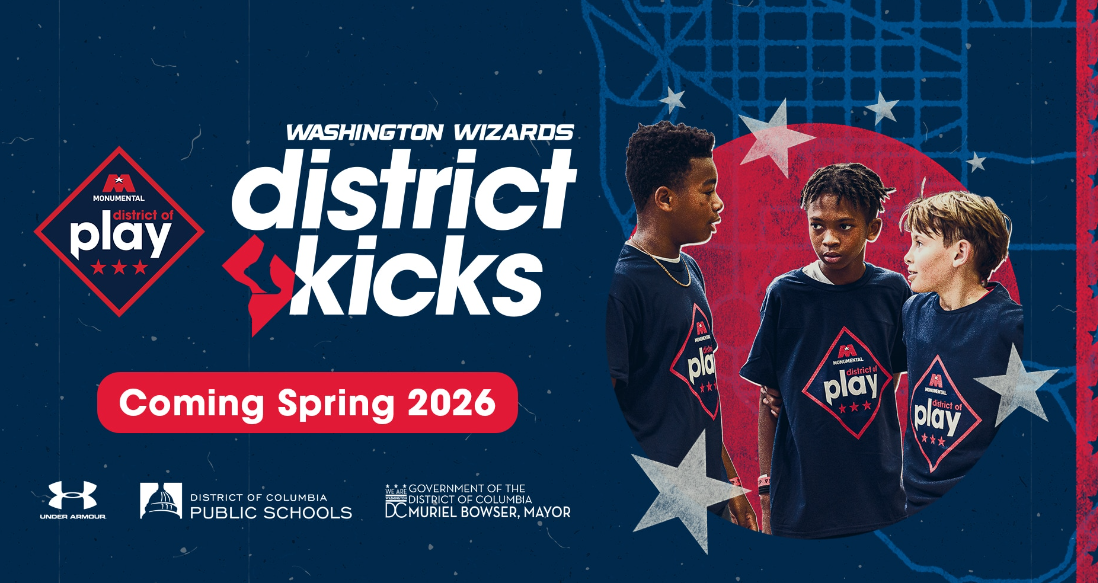
Monumental Sports & Entertainment announced District Kicks on December 21, the second major initiative under its District of Play platform. The Washington Wizards are leading the effort in partnership with Under Armour and DC Public Schools.
District of Play launched in 2024 as part of the Capital One Arena reimagination. The platform focuses on expanding youth sports access and wellness across Washington, DC through infrastructure investment and programming.
In its first year, the initiative distributed nearly 30,000 basketballs to every DCPS student in pre-K through fifth grade through the District Dribble program. District of Play reached more than 200,000 residents and earned recognition from Fight for Children, along with a nomination for a 2025 ESPY Sports Humanitarian Award.
District Kicks shifts focus from basketball equipment to athletic footwear, targeting older students who participate in organized sports programs.
Multi-Phase Distribution Across DC Public Schools
The initiative will unfold throughout 2026 with separate tracks for high school athletes and sixth grade students.
Approximately 5,200 high school student-athletes across roughly 22 DCPS schools will receive sport-specific Under Armour footwear. Shoes will be delivered directly to school campuses and distributed according to athletic seasons. Spring sports athletes receive shoes in March 2026, followed by fall sports in August and winter sports in November.
Each seasonal distribution will include a pep rally at a featured high school to create visibility for student athletes.
More than 1,200 sixth graders enrolled in DCPS 6th Grade Academies across 11 campuses will receive Under Armour athletic sneakers in multiple styles and colorways. MSE will distribute the footwear during a March 3, 2026 event at CareFirst Arena. The celebration will include interactive sports experiences and career-based learning opportunities, with MSE covering transportation and logistics for all participating schools.
“When I got my first basketball as a kid in Brooklyn, that single piece of equipment unlocked everything that followed: confidence, belonging, and the belief that sports could shape my future,” said Ted Leonsis, founder, chairman, managing partner and CEO of Monumental Sports & Entertainment. “District Kicks is built on that same idea: when you give young people the right tools, you give them the ability to dream bigger.”
Connecting to Under Armour’s Project Rampart
District Kicks operates within Under Armour’s Project Rampart framework, which aims to improve student-athlete experiences and academic outcomes through sports access.
Project Rampart launched in Baltimore in 2017 and has since expanded to Oakland and Washington, DC. The initiative provides student-athletes with upgraded facilities, apparel, leadership development, and specialized coach training.
DCPS Chancellor Dr. Lewis D. Ferebee noted the alignment with the district’s 6th Grade Academy model. “In our 6th Grade Academies, students are given the tools to excel inside and outside of the classroom,” Ferebee said. “DCPS is grateful to partner with Monumental Sports and Under Armour to provide resources to young people so they can thrive in programming that deepens their connection to school.”
Strategic Implications for Youth Sports Access
District Kicks represents a scaling approach to equipment access programs in large urban school districts. By targeting specific student populations (high school athletes and transitioning middle schoolers) rather than universal distribution, the initiative directs resources toward students most likely to engage in organized sports programming.
The multi-year commitment from MSE and Under Armour creates predictability for DCPS athletic departments planning seasonal equipment needs. Sport-specific footwear addresses a recurring cost barrier for families supporting student-athletes across multiple sports seasons.
The sixth grade focus aligns with research showing middle school transition years as critical for sustained sports participation. Providing footwear during this window may support retention in school-based athletics programs.
MSE’s integration of the initiative with the Capital One Arena project and District of Play platform suggests continued expansion of corporate-funded youth sports infrastructure in Washington, DC through 2026 and beyond.
via: Wizards
YSBR provides this content on an “as is” basis without any warranties, express or implied. We do not assume responsibility for the accuracy, completeness, legality, reliability, or use of the information, including any images, videos, or licenses associated with this article. For any concerns, including copyright issues or complaints, please contact YSBR directly.
About Youth Sports Business Report
Youth Sports Business Report is the largest and most trusted source for youth sports industry news, insights, and analysis covering the $54 billion youth sports market. Trusted by over 50,000 followers including industry executives, investors, youth sports parents and sports business professionals, we are the premier destination for comprehensive youth sports business intelligence.
Our core mission: Make Youth Sports Better. As the leading authority in youth sports business reporting, we deliver unparalleled coverage of sports business trends, youth athletics, and emerging opportunities across the youth sports ecosystem.
Our expert editorial team provides authoritative, in-depth reporting on key youth sports industry verticals including:
- Sports sponsorship and institutional capital (Private Equity, Venture Capital)
- Youth Sports events and tournament management
- NIL (Name, Image, Likeness) developments and compliance
- Youth sports coaching and sports recruitment strategies
- Sports technology and data analytics innovation
- Youth sports facilities development and management
- Sports content creation and digital media monetization
Whether you’re a sports industry executive, institutional investor, youth sports parent, coach, or sports business enthusiast, Youth Sports Business Report is your most reliable source for the actionable sports business insights you need to stay ahead of youth athletics trends and make informed decisions in the rapidly evolving youth sports landscape.
Join our growing community of 50,000+ industry leaders who depend on our trusted youth sports business analysis to drive success in the youth sports industry.
Stay connected with the pulse of the youth sports business – where industry expertise meets actionable intelligence.
Sign up for the biggest newsletter in Youth Sports – Youth Sports HQ – The best youth sports newsletter in the industry
Follow us on LinkedIn
Follow Youth Sports Business Report Founder Cameron Korab on LinkedIn
Are you a brand looking to tap into the world’s most passionate fanbase… youth sports?
Introducing Play Up Partners, a leading youth sports marketing agency connecting brands with the power of youth sports. We specialize in youth sports sponsorships, partnerships, and activations that drive measurable results.
About Play Up Partners
Play Up Partners is a leading youth sports marketing agency connecting brands with the power of youth sports. We specialize in youth sports sponsorships, partnerships, and activations that drive measurable results.
Why Sponsor Youth Sports?
Youth sports represents one of the most engaged and passionate audiences in sports marketing. With over 70 million young athletes and their families participating annually, the youth sports industry offers brands unparalleled access to motivated communities with strong purchasing power and loyalty.
What Does Play Up Partners Do?
We’ve done the heavy lifting to untangle the complex youth sports landscape so our brand partners can engage with clarity, confidence, and impact. Our vetted network of accredited youth sports organizations (from local leagues to national tournaments and operators) allows us to create flexible, scalable programs that evolve with the market.
Our Approach
Every partnership we build is rooted in authenticity and value creation. We don’t just broker deals. We craft youth sports marketing strategies that:
- Deliver measurable ROI for brand partners
- Create meaningful experiences for athletes and families
- Elevate the youth sports ecosystem
Our Vision
We’re positioning youth sports as the most desirable and effective platform in sports marketing. Our mission is simple: MAKE YOUTH SPORTS BETTER for athletes, families, organizations, and brand partners.
Common Questions About Youth Sports Marketing
Where can I sponsor youth sports? How do I activate in youth sports? What is the ROI of youth sports marketing? How much does youth sports sponsorship cost?
We have answers. Reach out to info@playuppartners.com to learn how Play Up Partners can help your brand navigate the youth sports landscape.
Youth sports organizations: Interested in partnership opportunities? Reach out to learn about our accreditation process.

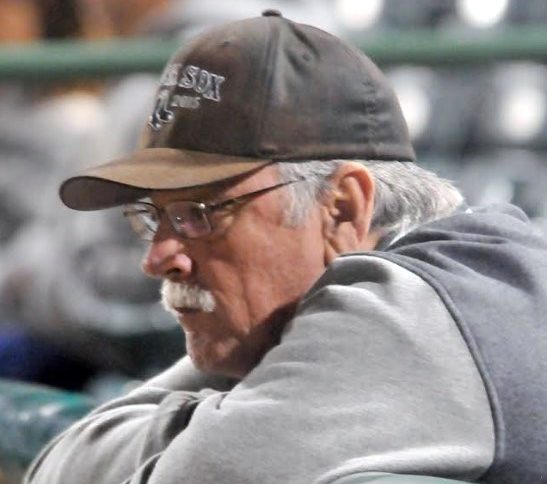
William J. Castner, Sr., a legendary community leader in Toms River, where he helped lead a nationally recognized youth baseball powerhouse that produced several major and league players, died on December 19 after an illness. He was 73.
Castner spent nearly three decades coaching baseball and served on the board of trustees of the onetime international championship Toms River East Little League. He played an integral role in the founding of a fall baseball program and the Toms River Black Sox that extended baseball into the summer.
The senior league field at the Toms River East Little League Complex was named “Castner Field” in 2009 to honor Castner and his wife of over fifty years, Diane, a longtime volunteer. Ten future major league players played on Castner Field.
He served on the governing board of the Atlantic Baseball Conference Collegiate League, the Youth Sports Safety Advisory Board, and the Play for James Foundation board.
“The only thing Bill would ask for Christmas each year were Wawa gift cards for gas money so he and Diane could drive tens of thousands of miles each year watching games all throughout the Garden State in their lawn chairs – often followed by a family meal at a Jersey diner or restaurant,” his family said in a statement.
In addition to coaching for over forty years, Castner was an executive for a global aluminum manufacturing and distribution company.
He is survived by his wife, three children, including Rutgers University Executive Vice President and General Counsel William J. Castner, Jr., and seven grandchildren.
A memorial visitation will be held on Saturday, December 27, from noon to 4 PM at the Quinn Hopping Funeral Home in Toms River. A celebration of life service will be held from 3:15 to 4 PM. Donations can be made to the Play for James Foundation.

FORT WAYNE, Ind. (WPTA) – A free Christmas tree recycling program is returning to Allen County on Friday.
The Allen County Department of Environmental Management program works together with local organizations for drop-off locations throughout the county. Those locations include:
- Fort Wayne City Utilities Biosolids Handling Facility
- 6202 Lake Avenue, Fort Wayne
- Open Monday-Friday, 7 a.m. to 3 p.m. (Closed Jan. 1)
- North Highway Department Building
- 2234 Carroll Road, Fort Wayne
- Open daily from dawn to dusk
- Metea County Park
- 8401 Union Chapel Road, Fort Wayne
- Open 9 a.m. to 6 p.m. daily
- South Lot (near Fort Wayne International Airport)
- 10100 Smith Road, Fort Wayne
- Open daily from dawn to dusk
- New Haven Utility Shop
- 2201 Summit Street, New Haven
- Open daily from dawn to dusk
- Monroeville Water Works Department
- 200 Utility Drive, Monroeville
- Open daily from dawn to dusk
The program runs from Dec. 26 through Jan. 16.
Before dropping off a tree, residents must remove all ornaments, tinsel and plastic bags. Wreaths, garlands and artificial trees are not accepted.
Trees will not be collected as part of regular trash pickup.
To be the first to get the latest breaking news alerts, download the 21Alive News App here.
You can also catch the latest news from 21Alive anytime on Roku, Amazon Fire TV, and Apple TV. Just search “21Alive” in the app store and download the app to your device.
Copyright 2025 WPTA. All rights reserved.

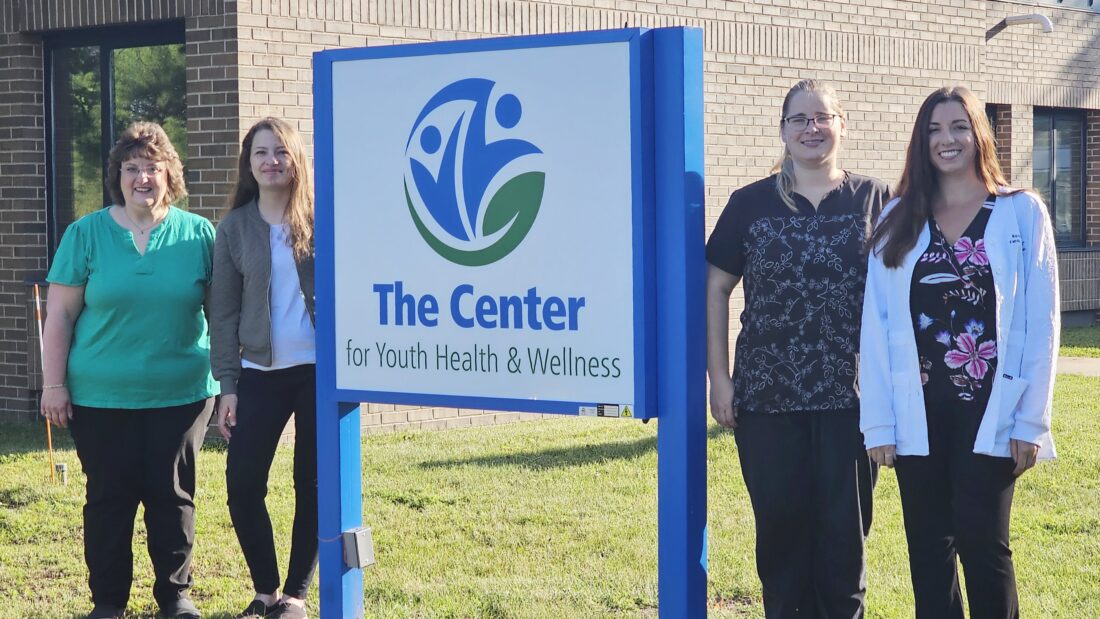
Photo courtesy Bay College
The Center for Youth Health & Wellness staff outside the new Center on the Escanaba campus in 2024.
ESCANABA – The Center for Youth Health and Wellness opened its doors on the Bay College Escanaba Campus in Fall 2024. The Center has quickly become a vital resource for students and local youth ages 10-21, providing accessible, high-quality medical and mental health services in a welcoming, youth-focused environment.
The Center has demonstrated strong community engagement and meaningful impact. Since opening in 2024, The Center has served 1,045 unduplicated clients. These individuals visited The Center for a wide range of health and wellness needs, including medical visits, mental health visits, and annual wellness exams.
“We are thrilled by the positive response and the number of young people who are choosing to access care right here on campus through The Center,” said Cindy Gallagher, Bay College Vice President of Workforce Innovation and Strategic Partnerships. “This partnership with Public Health Delta & Menominee Counties ensures that students and community youth have the support they need to thrive academically, personally, and socially.”
Since the start of the new fiscal year on October 1, 2025, The Center’s momentum has remained strong. In the first quarter alone, The Center has provided 99 medical visits and 147 mental health visits.
Since its opening, The Center has become a critical provider for the required high school sports physicals that allow youth to participate in high school sports. Kayla Coltson, Family Nurse Practitioner at The Center, shared that they have provided 755 sports physicals to area youth since August 2024.
These numbers reflect the continued and growing demand for accessible youth-focused health services in the region. The Center’s integrated approach–combining medical care, mental health support, prevention services, and wellness education–helps empower young people to make informed decisions and build healthier futures.
“It’s clear that this collaboration is filling a critical gap in our community,” said Michael Snyder, Health Officer at Public Health Delta & Menominee Counties. “We are committed to providing quality services, reducing barriers, and meeting the evolving needs of youth across Delta and Menominee counties.”
The Center for Youth Health and Wellness remains open to individuals ages 10-21, offering walk-in and scheduled appointments. Services include primary medical care, behavioral health counseling, vaccines, wellness visits, and health education–all provided in a confidential, inclusive, and supportive setting.
The Center employs four staff, including a receptionist, a licensed mental health counselor, a registered nurse, and a nurse practitioner. The Center also has an active Advisory Board consisting of representatives from local K-12 partners, Delta-Schoolcraft ISD, Public Health, Bay College, and local parents.
Funding for The Center is provided through a grant awarded to Public Health Delta & Menominee Counties from the Michigan Department of Health and Human Services, along with reimbursement from billing public and private insurance plans. No client between the ages of 10-21 will be denied care due to an inability to pay.
Bay College and Public Health Delta & Menominee Counties look forward to building on this strong foundation for years to come as we continue to serve the youth of our community.
For more information, visit the Center’s page at baycollege.edu, contact The Center for Youth Health and Wellness at 906-786-1672 or visit The Center’s Facebook page.

Law360 is on it, so you are, too.
A Law360 subscription puts you at the center of fast-moving legal issues, trends and developments so you can act with speed and confidence. Over 200 articles are published daily across more than 60 topics, industries, practice areas and jurisdictions.
A Law360 subscription includes features such as
- Daily newsletters
- Expert analysis
- Mobile app
- Advanced search
- Judge information
- Real-time alerts
- 450K+ searchable archived articles
And more!
Experience Law360 today with a free 7-day trial.

Letter: Sports complex at Pendleton would mean higher taxes
Published 4:58 pm Monday, December 22, 2025
Pendleton city officials announced that replacement of condemned stairway on Southwest 13th Street was a top priority, submitting a grant request for funding through the Safe Pathways To Schools Program sponsored by the Oregon Department of Transportation as adequate city funding was unavailable. The request was denied perhaps because the plan was not compliant with the federal American with Disabilities Act, according to the program administrator.
In 2011 the city purchased 40 acres adjacent to Barnhart Road, affectionately known as the “road to nowhere” for $500,000. The current city’s mayor and the economic development director have approved a proposal giving that property to Round-up City Development Corp., an agency masquerading as economic power house for the city, to construct a youth athletic complex. This sounds like a great idea until you consider the city, the school district, Babe Ruth and Little League associations have already established a good foundation of facilities that could be improved for considerably less. For the complex to be completed, a bond would be needed and approved by the voters, meaning property tax hike.
A common excuse from city officials when asked about improving streets is there is no funding. I wonder why.
Rick Rohde
Pendleton
Submit Letter to the Editor

Rec Sports7 minutes ago
Wizards and Under Armour to Provide Athletic Shoes to 6,500 DC Students Through 2026

Rec Sports15 minutes ago
Bill Castner, Sr., fabled Toms River baseball leader, dies at 73

Rec Sports23 minutes ago
Free Christmas tree recycling begins in Allen County Friday

NIL43 minutes ago
University of Alabama football player uses NIL money to spread Christmas cheer

Sports1 hour ago
Tomashek named GLIAC Offensive Player of the Week

NIL2 hours ago
$1.4 million QB predicted to follow departing coach to college football powerhouse
Sports2 hours ago
SCAC Announces 2025 Fall All-Sportsmanship Teams

Sports2 hours ago
RICHARDSON NAMED TO ACADEMIC ALL-LEAGUE TEAM

Sports2 hours ago
Una Vajagic becomes first Badger Volleyball starter to transfer after national semifinal run | Sports

Sports2 hours ago
Tigers Picked Fourth in EIVA Preseason Poll

NIL3 hours ago
Only one college football coaching hire earned an A+ grade

Sports3 hours ago
Barth Named to Summit League Volleyball All-Academic Team

Sports3 hours ago
Men’s Volleyball Ranked Third in EIVA Preseason Coaches Poll

Sports3 hours ago
Flathead Bravettes Volleyball Coach to Step Down after Six Years

NIL3 hours ago
USC-Notre Dame Rivalry The Latest Casualty Of Modern College Football

Rec Sports4 weeks ago
First Tee Winter Registration is open

Rec Sports4 weeks ago
Fargo girl, 13, dies after collapsing during school basketball game – Grand Forks Herald

Motorsports4 weeks ago
CPG Brands Like Allegra Are Betting on F1 for the First Time

Motorsports4 weeks ago
F1 Las Vegas: Verstappen win, Norris and Piastri DQ tighten 2025 title fight

Sports4 weeks ago
Sycamores unveil 2026 track and field schedule

Sports4 weeks ago
Utah State Announces 2025-26 Indoor Track & Field Schedule

Sports4 weeks ago
Two Pro Volleyball Leagues Serve Up Plans for Minnesota Teams

Motorsports2 weeks ago
SoundGear Named Entitlement Sponsor of Spears CARS Tour Southwest Opener

Motorsports3 weeks ago
Jo Shimoda Undergoes Back Surgery

Motorsports4 weeks ago
Redemption Means First Pro Stock World Championship for Dallas Glenn

NIL3 weeks ago
Bowl Projections: ESPN predicts 12-team College Football Playoff bracket, full bowl slate after Week 14

Sports4 weeks ago
Texas volleyball vs Kentucky game score: Live SEC tournament updates

Rec Sports3 weeks ago
Black Bear Revises Recording Policies After Rulebook Language Surfaces via Lever

Rec Sports3 weeks ago
Robert “Bobby” Lewis Hardin, 56

Rec Sports3 weeks ago
How this startup (and a KC sports icon) turned young players into card-carrying legends overnight





-
 Motorsports2 weeks ago
SoundGear Named Entitlement Sponsor of Spears CARS Tour Southwest Opener
-
 Rec Sports3 weeks ago
Black Bear Revises Recording Policies After Rulebook Language Surfaces via Lever
-
 Motorsports2 weeks ago
Donny Schatz finds new home for 2026, inks full-time deal with CJB Motorsports – InForum
-

 Rec Sports2 weeks ago
How Donald Trump became FIFA’s ‘soccer president’ long before World Cup draw
-
 Rec Sports2 weeks ago
David Blitzer, Harris Blitzer Sports & Entertainment
-
 Motorsports2 weeks ago
JR Motorsports Confirms Death Of NASCAR Veteran Michael Annett At Age 39
-
Sports2 weeks ago
Elliot and Thuotte Highlight Men’s Indoor Track and Field Season Opener
-
 Motorsports2 weeks ago
Rick Ware Racing switching to Chevrolet for 2026
-
Sports2 weeks ago
West Fargo volleyball coach Kelsey Titus resigns after four seasons – InForum
-
 Sports2 weeks ago
Temple Begins Indoor Track & Field Season at UPenn This Weekend