For months, Brooke Wilfley raised concerns that the president of her local youth hockey governing board was using his position for profit.
The Denver-area hockey mom discovered that the president, Randy Kanai, was secretly routing the Colorado Amateur Hockey Association’s money through his private company.
She reported his conflicts of interest and mismanagement to everyone she could: board members, club directors, coaches and four USA Hockey leaders who oversee the nonprofit. Little was done.
Then in January 2023, Wilfley received a letter from the Colorado Amateur Hockey Association’s attorney. The board, it said, was launching an investigation.
Into her.
Seeking evidence of “libelous and slanderous statements,” the letter demanded Wilfley hand over two years of her emails, texts, calendars, phone logs and any other records of her conversations about the Colorado Amateur Hockey Association’s finances. It gave her 21 days to turn in her cellphones, computers and iPads for a forensic review.
“This is an important legal duty,” the letter said, “and failure to follow these instructions may subject you to discipline.”
Whistleblower retaliation occurs in every industry. But in few sectors is the threat more personal than in youth sports, where parents who speak up about corruption and financial exploitation risk repercussions not just for themselves, but for their children.
Those fears are acute in youth hockey, where across the country, powerful rink operators, club directors and local governing body officials control the pathways by which kids advance to the sport’s highest stages. Many parents who suspect wrongdoing stay quiet out of fear of jeopardizing their kids’ opportunities. What some view as lax oversight from USA Hockey enables bad actors to flourish.
For Wilfley, the ramifications of the Colorado Amateur Hockey Association’s threats extended beyond her family. As the head of a Denver hockey academy and Tier I club – the top level of youth competition – dozens of parents entrusted her with their kids’ futures. Formal discipline against her club or a libel and slander lawsuit could affect those kids’ ability to play.
In the face of the Colorado Amateur Hockey Association’s threats, Wilfley didn’t back down. But it cost her: reputational damage, more than $100,000 in legal bills and three years she can’t get back.
“This is what happens when you speak up,” Wilfley told USA TODAY. “You get bullied. You get threatened. They’ll hurt your kids.
“I would never wish this on anybody.”
Conflicts of interest
Wilfley had never been a hockey fan. She became immersed in the sport when her five kids fell in love with it.
A law school grad who specialized in child advocacy, she saw how high costs and limited opportunities caused kids to quit the sport or leave the state for better options. She looked for ways to keep kids playing close to home.
She started a program that partnered with high schools to offer low-cost hockey lessons.
When the COVID-19 pandemic shut down in-person learning in many schools, she opened Aces Sports Academy, an accredited school where third to eighth graders spend the mornings on ice and the rest of their days in class.
In early 2022, she partnered with Okanagan Hockey Group, a Canadian youth hockey program, to start a recreational team in Colorado.
The Colorado Amateur Hockey Association, the regional USA Hockey governing body that regulates the sport in her state, sanctioned her programs. Kanai, its president since 2012, supported them – until they became Tier I.
Around the same time that Wilfley started her rec team, the Colorado Amateur Hockey Association announced its intent to strip the Colorado Springs Tigers, another local youth hockey club, of its Tier I status unless it fielded two more teams. So in April 2022, Brian Copeland, the Tigers’ president, approached Wilfley about merging their clubs.
Wilfley jumped at the opportunity. Before ever playing a game, her club ascended to the most coveted echelon of youth hockey. That didn’t sit well with Kanai and some other board members.
“They never went through the process to formally apply. They just made it happen,” Kanai said. “We didn’t like that she had found the back door.”
Kanai responded with a series of requirements that Wilfley felt unfairly targeted her club. He announced audits of a “sampling” of clubs, including hers. He made her restructure parts of her businesses. He said the association would honor her club’s Tier I designation only if her players wear Tigers jerseys and play games in Colorado Springs – an hour drive from Denver.
Wilfley spent thousands of dollars on new uniforms and legal expenses, only for Kanai to announce the board’s intent to eliminate one of the state’s four Tier I licenses. Wilfley felt her club was on the chopping block.
Suspecting a personal or financial motive for his actions, Wilfley scoured the nonprofit’s tax returns, bylaws and individual board members’ business filings, searching for conflicts of interest.
She didn’t find the motive she was looking for. What she found was even more troubling.
She discovered a dozen for-profit companies and trade names registered to Kanai that matched the names of Colorado Amateur Hockey Association programs. One called “Team Colorado” shared the same name as the association’s girls’ hockey teams. Others, like “CO Hockey” and “Rocky Mountain Sport Testing,” she recognized from the association’s website and payments she had made for her son’s hockey camps.
Wilfley also found that the association had not filed tax returns or held annual board elections in three years.
Concerned that Kanai was profiting off his volunteer position, Wilfley in September 2022 reported her findings to USA Hockey general counsel Casey Jorgensen and other top officials, emails show. But months passed, and little action was taken.
That December, with a board vote to potentially eliminate her Tier I status looming, Wilfley hired an attorney to formally request the Colorado Amateur Hockey Association’s meeting minutes and internal accounting records – as is her right under state law – including all its transactions with Kanai’s companies. She also demanded proper board elections be held.
That’s when Wilfley received the letter from the Colorado Amateur Hockey Association’s general counsel, Peter Schaffer. Its title: “Notice of Spoliation and Investigation.”
Hockey mom fights retaliation
Wilfley knew the demand for her private data was likely unlawful. But waiting for the legal system to play out was a luxury she didn’t have.
With the state championships weeks away, even interim disciplinary action against her club could result in her players’ disqualification. Defending herself from a libel or slander lawsuit – even a frivolous one – could cripple her businesses’ and family’s finances.
Days before the 21-day deadline to turn over her electronic devices for a “forensic accounting,” Wilfley had not yet responded. Schaffer ratcheted up the pressure. By refusing to comply, he wrote in a Feb. 9, 2023, email, her programs were now “in violation” of their USA Hockey member agreements.
“We will have no alternative,” his email said, “but to commence disciplinary procedures.”
Wilfley called a meeting to brief parents on the situation.
“I had to stand in front of those families and say, ‘I’m so sorry. Your kids have been amazing this season, but I don’t know if they’re going to be allowed to compete in the state championships,’” Wilfley said.
Meanwhile, she fought back.
She hired an outside accounting firm to scrutinize the Colorado Amateur Hockey Association’s finances, based on the limited records Schaffer provided in response to her requests. The firm’s report – which she sent to USA Hockey – found six-figure discrepancies and previously undisclosed transactions with Kanai’s companies.
The day of the deadline, her attorney sent a lengthy response to Schaffer, the association’s board members and Jorgensen, USA Hockey’s legal counsel. It accused Kanai and Schaffer of whistleblower retaliation and violating the association’s bylaws. Wilfley reiterated her concerns about Kanai’s conflicts of interests and failures to hold annual elections or file tax returns since 2019.
Finally, five months after she first reported her concerns to USA Hockey, the national governing body intervened.
“USA Hockey is very concerned with the ongoing governance and operational issues within the Colorado Amateur Hockey Association,” Jorgensen wrote in a Feb. 14, 2023, letter to Kanai.
USA Hockey would launch its own investigation into the association’s finances and compliance with whistleblower and conflict-of-interest policies, Jorgensen’s letter said. It ordered Kanai and Schaffer to “immediately cease” any disciplinary action against Wilfley’s program, adding that they had no legal authority to demand her records.
Two months later, USA Hockey hired its own outside accounting firm to forensically audit the Colorado Amateur Hockey Association’s finances, based in part on Wilfley’s outside firm’s report. USA Hockey President Mike Trimboli appointed three USA Hockey representatives to oversee its annual board election, which Kanai had postponed with less than a day’s notice.
The association’s members voted Kanai out of office at the rescheduled meeting in May 2023 after more than a decade as president. His successor, Brian Smith – whose son plays for Wilfley’s club – and the board moved to fire Schaffer days later.
USA Hockey in July 2023 suspended Kanai from all hockey activities for refusing to comply with its audit. The Colorado Amateur Hockey Association sued him that October, accusing him of stealing at least $180,000 of the nonprofit’s money by routing it through one of his private companies – the one Wilfley discovered.
‘Crazy hockey mom’
Kanai and Schaffer were gone from Colorado youth hockey. But their attacks on Wilfley continued.
They both subpoenaed Wilfley as part of defamation lawsuits they filed against the Colorado Amateur Hockey Association and two of its new board members: Smith and Bill Brierly, its executive vice president. Schaffer filed a motion to hold Wilfley in contempt of court for refusing to comply.
Judges ultimately quashed the subpoenas. But Wilfley spent tens of thousands of dollars fighting them, she said – money she hasn’t gotten back, even after Schaffer dropped his case, and Kanai lost his.
The Colorado Amateur Hockey Association’s lawsuit against Kanai went to a civil trial in April 2025 in Jefferson County District Court. In his testimony, Kanai didn’t deny profiting off his position as president. He argued he was allowed to do so.
He portrayed himself as the victim of a “smear campaign” by Wilfley. In his testimony and subsequent interviews with USA TODAY, he painted her as a parent so hellbent on getting a Tier I team for her kids that she orchestrated a plot to take him down.
“They weren’t happy with our decision on Tier I, so ‘Hey, let’s figure out what we can do to get these guys voted out,’” Kanai said. “It was all to influence the board vote, and they got what they wanted.”
He acknowledged in court having “no direct evidence” of that. Of the 10 people called to testify, she wasn’t one of them. His other witnesses, however, spent much of their time on the stand supporting his version of events.
“She wanted Tier I now, and that’s when the attacks came,” said Jason Schofield, Kanai’s business partner and a fellow board member who also admitted profiting $180,000 from Kanai’s company, in an interview with USA TODAY after the trial.
Testified Schaffer: “Never before the Brooke Wilfley situation were there any issues about the Colorado Amateur Hockey Association and finances.”
Judge Chantel Contiguglia didn’t buy it. Her October 2025 ruling found Kanai liable for civil theft, unjust enrichment, conversion and breach of fiduciary duty. She ordered him to repay the nonprofit $579,000 – triple the amount he stole, plus interest – and cover its court costs and attorney’s fees.
The ruling – which Kanai appealed in November – vindicated Wilfley. Yet many in the Colorado hockey community still accept Kanai’s version of events. The recent success of her teams – now among the top-ranked in the country – and the election of Smith, one of her player’s fathers, as Kanai’s successor as president only fueled those rumors.
“’Crazy hockey mom’ is a really easy narrative,” Wilfley said. “It’s been three years of that. It just does not stop.”
Better oversight needed
Wilfley is grateful to USA Hockey for intervening and to the Colorado Amateur Hockey Association’s new leadership for pursuing the lawsuit against Kanai. But better oversight by both organizations’ boards, she believes, could have saved her many sleepless nights.
“The hardest thing for me is the toll it has taken on my family and the time,” Wilfley said. “I would go home and stay up at night worrying about all these other kids, just feeling like the rug was constantly being pulled out from under me.”
Conflicts of interest and financial exploitation are rampant in youth hockey, said Brierly, the Colorado Amateur Hockey Association’s executive vice president whom Schaffer sued for defamation – a lawsuit Schaffer later dropped. Examining business affiliations of people who serve on the sport’s regional governing bodies should fall on USA Hockey, Brierly said – not individual parents.
Brierly said USA Hockey should enact better standards and controls to identify mismanagement and abuses of power in the sport long before they become issues.
“It’s expensive enough to play hockey,” Brierly said. “It’s more expensive when you’re also paying opportunistic individuals who are trying to make a dollar. That’s something USA Hockey should protect people against, but they obviously don’t care about protecting parents from financial abuse.”
USA Hockey did not respond to requests for comment for this story.
After the trial, Schaffer told USA TODAY that he truly believed he had the legal authority to demand access to Wilfley’s private records and electronic devices. Sending her a notice of spoliation and investigation, he said, “is the least level of aggression you can do.”
“If they’re not guilty, they would have sent it to us,” Schaffer said. “But they fought us. As much as they fought, it just made me know that they were guilty because they wouldn’t give it to us.”
Kanai, for his part, acknowledged after the trial that Wilfley’s concerns about his financial entanglements with the association were “legitimate.” Still, he said he and other board members, including his business partner, Schofield, felt they had to take action to protect their reputations as rumors swirled.
“We were pretty sure there were slanderous and defamation comments in texts and emails going around, so we were trying to put a stop to it and get evidence that that was truly going on,” Kanai told USA TODAY.
“Did we go too far? It’s debatable.”
He maintained that every decision he made as president was guided by what’s best for the kids.
Kenny Jacoby is an investigative reporter for USA TODAY who covers issues in sports, higher education and law enforcement. Contact him by email at kjacoby@usatoday.com. Follow him on X @kennyjacoby or Bluesky @kennyjacoby.bsky.social.
Plans to transform a long-dormant landfill into a sprawling sports complex are on hold as questions regarding the extent of soil contamination at the site remain unanswered.
Pinellas County Commissioners approved a $250,000 budget amendment Tuesday to complete subsurface investigation and engineering work at the former Toytown landfill. The state decommissioned the 175-acre dump, at 10540 16th Street N., in 1990.
County officials believe the anomalous, wide swath of vacant land near I-275 and Roosevelt Boulevard is ideally suited to host increasingly lucrative youth sports tournaments. In March, a local company submitted conceptual plans that included 20 synthetic turf baseball and softball diamonds, 17 multipurpose fields, 24 pickleball and 12 sand volleyball courts.
Brian Lowack, CEO of Visit St. Pete-Clearwater (VSPC), explained the conundrum to commissioners at a Dec. 11 workshop. “We have a ton of data from throughout the years of what’s under that landfill, but there were existing gaps that needed to be addressed in order to put pen to paper and provide a concrete proposal,” he said.
“What we’ve seen is, because we have this data gap, and folks don’t know what’s under there, they haven’t been willing to take on that risk,” Lowack said. “We haven’t been able to get the private sector to come in at a reasonable amount, limiting that public side investment.”
The former landfill at 10540 16th St. N. in St. Petersburg is adjacent to the Gateway business district. Image: Google.
Clearwater-based Sports Facilities Companies (SFC) was the sole respondent to the county’s request for proposals in December 2024. Lowack said Pinellas would boast the most fields in the Southeast if the estimated $150 million to $200 million plan comes to fruition.
“And given that, with the proximity to the beach, we have the potential to have the best youth sports facility in the country,” he added.
County officials bought the former Toytown subdivision in 1956. St. Petersburg leased 160 acres for a landfill from 1961 until 1983.
Toytown subsequently became a designated brownfield site. Multiple redevelopment attempts failed to gain traction; those efforts were essentially paused in 2016 when plans to build an Atlanta Braves spring training complex unraveled.
Pinellas received a $15 million state grant for environmental remediation in 2023. SFC has experience completing similar projects nationwide and believes an athletic complex would generate a direct economic impact of $350 million within five years.
Lowack said the county has “maxed out” other athletic fields, and local governments around the region and country are increasing investments in youth sports facilities. SFC declined to begin formal negotiations with VSPC until it received additional site information.
“This has been talked about for a long time – it would be a tremendous project,” said County Administrator Barry Burton. “But we have to make sure we understand what we’re getting ourselves into. These firms want to shift the risk to our side.”
Officials planned to redevelop approximately 95 acres. The study will determine if there is potential to expand into other areas.
“We simply don’t know what’s under there, and what materials that consists of, and how deep that goes,” Lowack explained. “If you put just a bunch of fields, with no vertical construction, we can do that. However, it’s going to be difficult, and you likely wouldn’t receive much private sector investment.”
Commissioner Rene Flowers said a complex needs “accessory pieces,” including lodging and restaurants, to attract premier tournaments from other areas. SFC proposed an optional “eatertainment” fieldhouse with indoor putting, sports simulators and an “interactive dining experience.”
Pinellas can use the FDEP grant to pay for environmental remediation, but not subsurface investigations. Commissioners approved using $250,000 in tourist development taxes to fund the studies Tuesday evening without discussion.
Commissioner Kathleen Peters said Dec. 11 that Toytown could host an amphitheater and a sports complex. She also noted that the county could have competing projects.
“It’s my understanding that there’s going to be a significant amount of fields being brought into Clearwater in a public-private partnership that I saw the plans on a couple of weeks ago,” Peters said. “That’s incredible. And a potential minor league soccer stadium. That may produce sooner.”
Lowack said SFC is also working on the Clearwater project. “If you’re working with the same firm, then I’m not concerned,” Peters said.
VSPC, with the commission’s funding approval, will now hire SFC’s geotechnical subcontractor to complete the studies. Pinellas can begin grant-related work once the process concludes in March 2026.
Lowack expects to receive a final proposal from SFC by the end of June. The redevelopment’s design and engineering phase could begin in October.
Fort Belvoir Nationally Recognized for Excellence in Youth Sports
Exercise and physical activity play key roles in quality of life, health and mental fitness, according to the World Health Organization, and Fort Belvoir Families have been reaping the benefits of an innovative Fort Belvoir program that has recently been awarded by the National Alliance of Youth Sports (NAYS). Jerry Arrington, Fort Belvoir’s Youth Sports and Fitness Director, said he was thrilled to see their Pre-K Health, Fitness and Wellness program earn such praise, as it delivers action-packed activities, fun challenges and interactive lessons.
“To manage a sports program, you have to start developing the young kids to feed into the program as they get older,” Arrington said. “We have a Start SMART program for kids 3-to-5 years old, which covers baseball football basketball, tennis and soccer.”
The outreach program covers many areas that are helping young children build that all-important foundation that can help forge healthy habits and lead to embracing active lifestyles. Executing this initiative at three of the base’s Child Development Centers provides a valuable sports and fitness segment that introduces skills needed for soccer, basketball, football and other team sports in a stress-free setting.
Classes begin with a song and a warm-up, helping kids latch onto the importance of preparing their bodies and minds for activity. Relay races and cone drills are woven into the sessions, giving kids the chance to experience and learn about teamwork, sportsmanship and perseverance.
Sessions culminate with yoga, as kids get to twist and turn their young bodies into calming poses while learning the art of relaxing and re-setting.
“The program encompasses developing team bonds and camaraderie,” Arrington says. “Plus, they get the chance to learn, have fun, and be successful.”
The department’s partnership with the Child and Youth Nutritionists has enabled children to learn about the importance of healthy nutrition and hydration choices through movement-based lessons. Moms and Dads report that their kids are practicing stretches, dances and exercises at home while talking about teamwork and their favorite yoga poses.
Teachers have seen noticeable improvements in attention spans, behavior and peer interaction, according to George Dickson, Director of Family Morale, Welfare and Recreation (MWR), who said the sports and fitness programs help to prepare the mind and bodies of Fort Belvoir children.
“We offer Sports and Fitness programs for all four seasons to keep our children moving and learning skills that will stay with them for their entire life,” Dickson said. “We are all very proud of our CYS Sports and Fitness Team and for being recognized by the National Alliance for Youth Sports.”
Founded in 1981, NAYS is focused on educating volunteer coaches on their roles and responsibilities. To date, NAYS Coach Training & Membership has educated more than four million member coaches worldwide. This is the second major award for Arrington at Fort Belvoir, who modestly credits his team.
“It’s about the staff that work with me,” said Arrington. “I’ve got a great staff – they do a tremendous job.”
Dickson said he could not agree more with that sentiment, and what it means for Fort Belvoir Families, adding, “Fort Belvoir Child and Youth Services (CYS) Sports and Fitness Programs are the best in the US Army!”
Date Taken:
12.17.2025
Date Posted:
12.17.2025 10:45
Story ID:
554557
Location:
FORT BELVOIR, VIRGINIA, US
Web Views:
3
Downloads:
0
PUBLIC DOMAIN
This work, Fort Belvoir Nationally Recognized for Excellence in Youth Sports, by Paul Lara, identified by DVIDS, must comply with the restrictions shown on https://www.dvidshub.net/about/copyright.
Cameron Maldonado didn’t know what to expect when a friend invited her to a girls wrestling tournament in 2023.
She sat in the student section in awe, watching her friend Adeline Tuccini – then a junior at Allen Park – compete. Maldonado knew then: She wanted to join the team.
“It’s a space I’ve never seen women in,” Maldanado, 17, of Romulus, said. “There’s not a lot of places that girls can be the ones in control. They’re the ones making the choices. They’re the ones that are getting sweaty and violent.
Submit items for youth and non-varsity high school sports by noon Tuesday for publication Wednesday. Email stories and photos (in .jpg format) to [email protected].
Information: 208-664-8176, Ext. 1205
Courtesy photo The seventh grade Wolves AAU boys basketball teams made donations to Union Gospel Mission in a joint effort with Lake City High School’s effort to fulfill several wish lists for kids this holiday season. In the front row from left are Micah Brumbach, Cam Tosi, Rowan Hammons and Cody Burrill; and back row from left, Sawyer Smith, Cannon Randklev, Mac Roberts, Bricen Cornett, EJ Von Behren, Ashton Elwell, Keegan Rosenberger, Rourek Denton, Kellan Larson, Camden Glindeman, Griffin Higgins and Keaton Knoll.
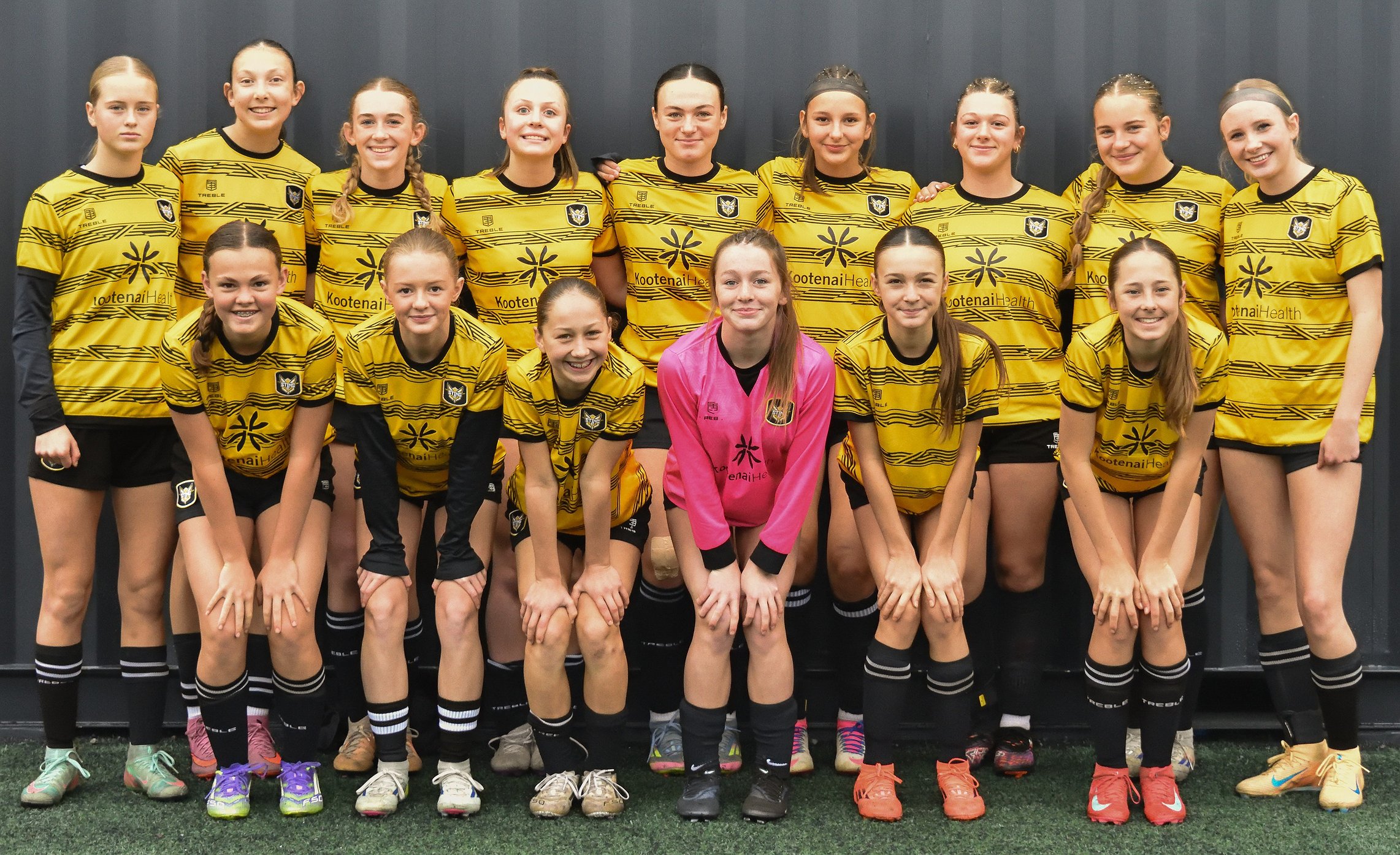
Courtesy photo The Sting SC 2011 girls GA Aspire soccer team won all three matches last weekend at the Alliance Showcase in Portland and Vancouver. The Sting opened the weekend with a 3–0 victory over the Saints Soccer Academy 11G Blue Premier. Presley Moreau led the attack with two goals, one coming off an assist from Katelyn Keaggy. Payton Brennan added the third goal. In match two, the Sting earned a 3–1 win against the Pacific FC Washington 11G Hurricanes. Payton Brennan found the back of the net off an assist from Nevi Sousley, while Brightyn Gatten scored two goals, including one from the penalty spot. The weekend concluded with another 3–1 victory over the Hillsboro Rush 11G Blue. Payton Brennan scored on an assist from Presley Moreau, Presley added a goal of her own, and center back Emily Hackett capped the scoring with a header off a corner kick. The Sting will be back in action next at the Pacific Northwest Cup in Seattle on Jan. 17–19. In the front row from left are Ava Langer, Olivia Hynes, Presley Moreau, Kenzie Dolan, Nevi Sousley and Aubrey Sargent; and back row from left, Brightyn Gatten, Katelyn Keaggy, Payton Brennan, Emily Hackett, Elle Sousley, Vivian Hartzell, Olivia Nusser, Constance Ovendale and Zoe Lemmon.
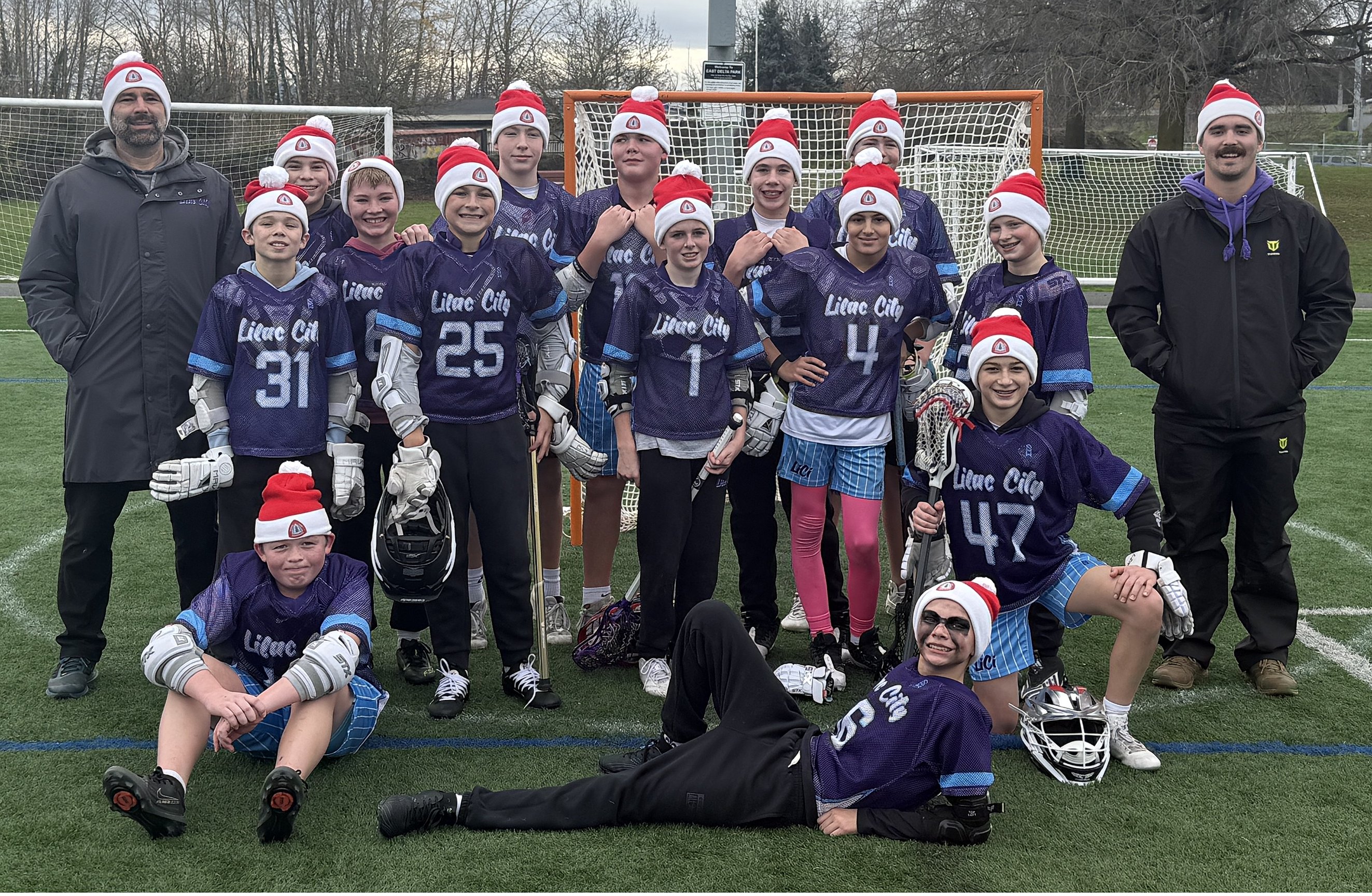
Courtesy photo The Lilac City boys 2031 lacrosse team, with most of its players from the Coeur d’Alene Falcons on the North Idaho Youth Lacrosse teams, took home the championship, winning five games this past weekend at the Sixes Showdown in Portland, Ore. In the front row from left are Wyatt Secord, Connor Smalley and Monty Montgomery; and back row from left, assistant coach Josh Soehner, Rohn Hageman, Crosby Soehner, Eddie Sandall, Keegan Rosenberger, Ethan Schulhauser, Jack Millard, Luke Perry, Jackson Hood, Johnny Mauro, Liam Knapp, Liam Clark and head coach Jackson Dean.
Courtesy photo The Lilac City boys 2033/34 lacrosse team, with most of its players from the Coeur d’Alene Falcons on the North Idaho Youth Lacrosse teams, took home the championship winning five games this past weekend at the Sixes Showdown in Portland, Ore. In the front row from left are JJ Campbell, Holden Hays and Kamran Rosenberger; and back row from left, Judge Buckner, assistant coach Micah Rickards, Riggens Hageman, Titus Young, Sascha Steinhoff, Jamison Lunsford, Brody Theriault, Maxx Dunham, Brayden Lange and head coach James Campbell.
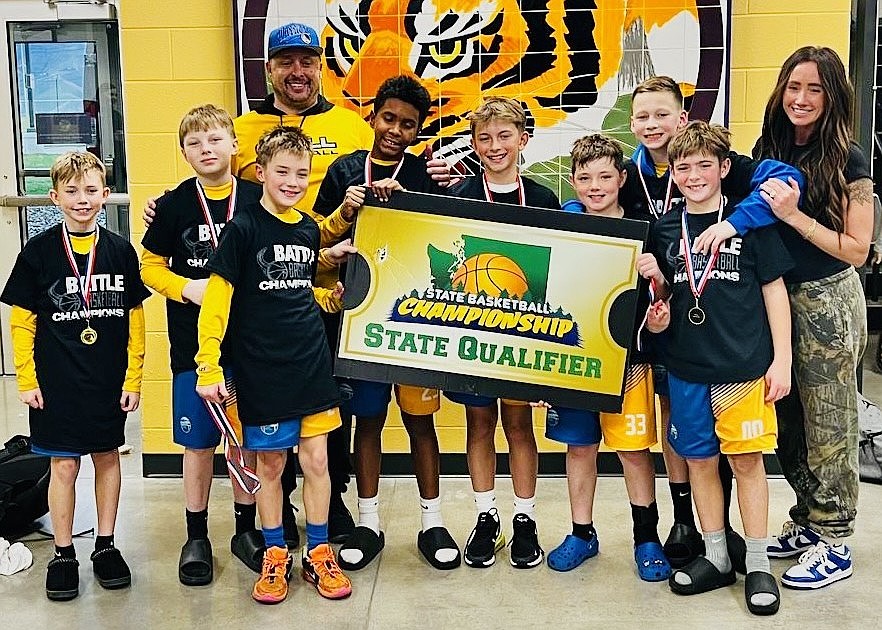
Walla Walla kids, playing weekend Amateur Athletic Union (AAU) club basketball in their hometown at its 2025 Tournament of Hoops, together came away as 7th grade boys team champion Dec. 14 after the Hawks won their title at Pioneer Middle School.
The Hawks consisted of club members from local middle schools including Garrison, DeSales Catholic, John Sager and Liberty Christian with both Casey Waddell and Donald Ponds as their coaches. They bounced around town over the weekend, wrapping up two-day competition at its title game after finishing pool play atop a four-team division with victory in all four of their matchups at Garrison.
A Tournament of Hoops title now has the Hawks bound for the Washington State Championships, March 20-22, in Spokane.
The big business of youth sports has reached the U.S. Congress. A House subcommittee says it has created a “crisis” for kids and their parents.
“The youth sports industry generates more than $40 billion in annual revenue,” Rep. Kevin Kiley (R-CA), the chair of the subcommittee on Early Childhood, Elementary, and Secondary Education, said to open a hearing on Tuesday, Dec. 16, entitled “Benched: The Crisis in American Youth Sports and Its cost to Our Future.”
“But this revenue comes at a steep cost to families,” Kiley said. “Parents are told that only year-round travel teams, private coaching and early specialization will keep their child competitive and maybe even earn them a scholarship. That false promise has created a spending surge that prices out the average family while pushing kids as young as eight into high-cost, high-pressure programs that simply aren’t necessary for long term development.”
Kiley said more than 60 million kids participate in youth sports in the U.S., and he doubled down on the 63% participation target set through the Healthy People 2030 program administered by the government.
We are somewhere around 55 percent of kids ages 6 to 17, a participation rate that lags behind the pre-pandemic level of 2019 (61%).
“Public funding absolutely is crucial to making sure that we have community-based, nonprofit-based and school-based programs,” said Katherine Van Dyck, a senior legal fellow for the American Economics Liberties Project and a witness at Tuesday’s hearing. “Because when we don’t have those, what we have left is these really high-cost monopolistic entities that aren’t interested in growing their programs to make them affordable and accessible to everybody.
“They’re interested in protecting their monopoly and driving cost up. That’s why we see a $40 billion industry that is growing according to investment firms, but it’s growing as participation is going down. What does that tell us? It tells us that they are jacking up prices and that they are solely focused on profit. …
“Our children deserve better than a childhood for sale to the highest bidder.”
While experts and Congressmembers pushed to the national forefront many of the issues that consume sports parents, they also offered potential changes to the system. Here are some highlights of the hearing:
Why is a Congressional subcommittee saying we have a youth sports ‘crisis’?
Several statistics used by Kiley, other members of the House subcommittee on Early Childhood, Elementary, and Secondary Education, and witnesses at the hearing have been mentioned in this space.
“What we are witnessing is more than a drop in sports participation,” Kiley said. “It is the loss of one of the most effective tools we have to combat rising isolation and mental health challenges in our children. When children lose regular in-person team activities, they lose daily opportunities to build confidence, belonging, and real world social connection.”
YOUTH SPORTS SURVIVAL GUIDE: Pre-order Coach Steve’s upcoming book for young athletes and their parents
How can kids and their parents better navigate youth sports?
My personal experience with travel and club teams at the high school level is that they don’t promise you the chance to play in college as much as give the opportunity to play in front of college coaches.
While we can look at sports as an outlet for getting a scholarship and helping us to get into a college or university, we need to understand the odds and can be more realistic about our kids’ chances.
“I think parents need to begin at the end,” says John O’Sullivan, chief executive officer of the Changing the Game Project, which helps use sports as a recreational but life developmental tool. “What do you want out of sport? They want a healthy, functioning, high-character human being. Sign up for sporting programs, and find coaches and find leagues that support that mission. The purpose is to develop a great human being, and then maybe if you have the luck and the genetics, you do well. And you get a scholarship. Maybe you play it the next level, but it’s really about human development first.”
According to 2024 NCAA data, supplemented by data from the National Federation of State High School Associations, about 6% of high school athletes play collegiately (a lower percentage play Division 1), while less than 1% of NCAA athletes are drafted into a professional sport.
A national parent survey conducted by the Aspen Institute’s Project Play showed that roughly two in 10 youth sports parents believe their child has the ability to eventually play Division I college sports, and one in 10 think their child could reach the pros or Olympics.
Perhaps filling the disconnect of perception requires us to reprioritize why we play sports.
“A kid standing over a putt, a kid about to take a penalty kick, a kid about to take a free throw that matters, those are life skills you can teach in real time,” Steve Boyle, the co-founder and executive director of 2-4-1 Sports, an organization that helps kids try out multiple sports, testified Tuesday. “I was a school counselor, and so I would always be told, ‘Hey, you gotta go in and do a lesson on anxiety, or anger management, or conflict resolution.’
“It was a heck of a lesson. You know how much impact it had? None. The next day, it was gone. We wouldn’t teach piano once and say, ‘Good luck, have at it. Now you’re good at it.’ You have to continue to teach these skills and use the opportunity of sports when those emotions are happening in real time, to say, ‘All right, this is how you can deal with this right here in a safe and fun place, so that when you’re about to road rage or lose it on somebody, you’ve developed those skills in such ways.’ Sports is the best opportunity to do that, and we miss out on so many kids if we don’t give them access to sports.”
Boyle and his wife, Kerry, started 2-4-1 Sports in 2006 after their 9-year-old daughter was told trying other sports wasn’t an option if she wanted to play for a local travel team. Still, many parents fear of missing out on such opportunities.
Kiley, the subcommittee’s chair, says he played basketball and soccer growing up. He didn’t make his high school freshman basketball team or varsity soccer team (though he played tennis) and spoke of an “inherent winnowing process in a lot of sports.”
He asked O’Sullivan, who has spent five decades as an athlete or coach to youth and collegiate athletes, how we maintain opportunities for young people of different skill levels?
“I think it’s, again, this education around what is the purpose of sport,” O’Sullivan replied. “Parents ask me all the time, ‘How does my kid make the elite team? And I think that’s the worst word in sports is ‘elite’ for little kids. We have to keep as many kids as possible, as long as possible, in the best environment possible. The countries that do it best in sport development, they keep those kids. They’re not making cuts at six or seven years old. They’re not forming competitive teams.”
STATE OF PLAY REPORT: Do immigration raids threaten the rise of youth sports?
What are some solutions to the youth sports ‘crisis?’
Van Dyck, an anti-monopoly and consumer advocate, said the 2008 financial crisis and the recession that followed proved devastating to parks and recreation budgets while COVID-19 delivered another crushing blow.
“Parks and Rec budgets were slashed, and that really did leave a void, where private equity firms came in and filled it with high cost, flashy, elite club teams,” she says. “And by filling that void, they were then able to continue to build their flywheel, where they gained control of the venues, and the governing bodies, and the apparel companies, and that flywheel also builds a moat that the community groups that my colleagues here are talking about can’t compete with. They can’t penetrate it because these private equity companies aren’t just capturing the teams and the leagues, they’re capturing the players.”
Robert “Bobby” Scott (D-VA), the ranking member of the House’s Committee on Education & Workforce – under which Kiley’s Childhood, Elementary, and Secondary Education is a subcommittee – then responded to her: “Well, it seems to me that we gotta get Parks and Rec and the public schools back involved so those opportunities are gonna be there.”
Fewer P.E. classes are being offered in U.S. schools due to budget cuts, according to Aspen Sports & Society Program’s State of Play 2025.
“My P.E. colleagues would say there’s more to physical education than just sport,” says Boyle, who played Division 1 basketball at Manhattan College. “I don’t think it has to be either/or. I think that schools can work in a way that teach fundamental sports skills so that kids have some confidence to perhaps do some sports outside of school time. I think there’s an opportunity here to create some consistency around how it’s being delivered and to recognize the value of sport.”
Tom Farrey, executive director of Aspen Sports & Society, testified Tuesday that we need to take a more deliberate look at the structure of school-based sports.
“One of the problems we have here is there’ll be 80 kids who try out for the boys’ basketball team,” he said. “And 15 will make it, and nine will get playing time, and we structurally push aside kids because of our traditional structure of school-based sports.
“But there are models out there where they’re creating multiple teams. You might have two freshman teams, or three J.V. teams. We need to move to an environment where the supply of experiences meets the demand for them. And that’s partly a function of schools rethinking their model.”
Farrey also suggested we can require all youth sports organizations to register with the U.S. Center for SafeSport and get their coaches trained in abuse prevention and pass background checks.
He also suggested redirecting federal sports betting taxes to close youth sports gaps, especially for low income youth, and educating states on ways to prioritize access to community sports.
What does the hearing mean for American sports families?
It appealed to several members of the House subcommittee, both about their own childhoods and the needs of constituents.
“In the district I represent, I have a lot of urban areas – Portland and Beaverton areas – but I also have a lot of very rural areas as well,” said Suzanne Bonamici (D-OR), the subcommittee’s ranking member. “So even with something like school bus drivers, if there’s a bus, it’s gonna take students somewhere. School bus driver employment is down 10%. What’s gonna happen for students who are hoping to engage in these extracurricular activities if they don’t have that vital transportation, especially in rural areas? Many kids are going to be left out.”
Kiley, the subcommittee chair from California, said he hoped the hearing would amplify the work within youth sports the witnesses are doing, and even institute change.
He identified a few areas “where we could see improvement.”
“One is just programmatic in terms of having more offerings for students to continue to be involved, regardless of skill level, having maybe more robust P.E. programs in schools,” he said. “The second is financial, removing the barriers to entry that have gotten just exorbitant in many communities across the country.
“The third, I think, is cultural, just trying to re-establish a culture that is supportive of play and competition, and giving kids these opportunities from an early age. I do have to say, a few witnesses mentioned the experience of COVID, where we took this opportunity away from many kids. In my state, we were the last to allow youth sports to continue again. I took part in what we called ‘let them play rallies’ with kids across our state. And that was a period where the interests of young people were not the highest priority when it came to policy, and this was one manifestation of it, and we really must never make that mistake again.
“That’s a broader issue, but on this specific issue of youth sports, I think we’ve had a lot of bipartisan agreement.”
Borelli, aka Coach Steve, has been an editor and writer with USA TODAY since 1999. He spent 10 years coaching his two sons’ baseball and basketball teams. He and his wife, Colleen, are now sports parents for two high schoolers. His Coach Steve column is posted weekly.For his past columns, click here.
Got a question for Coach Steve you want answered in a column? Email him at sborelli@usatoday.com