
Rec Sports
Youth Sports Facilities Are Now Anchoring Billion-Dollar Real Estate Developments

Key Takeaways
- The U.S. sports facilities market is valued at $36 billion today and is forecast to reach more than $260 billion by 2034, implying annual growth exceeding 20 percent
- The Dynasty in Ocoee, Florida, carries a capital stack approaching $1 billion across 155 acres with 17 fields, 1,100 hotel rooms, and up to 500,000 square feet of retail space
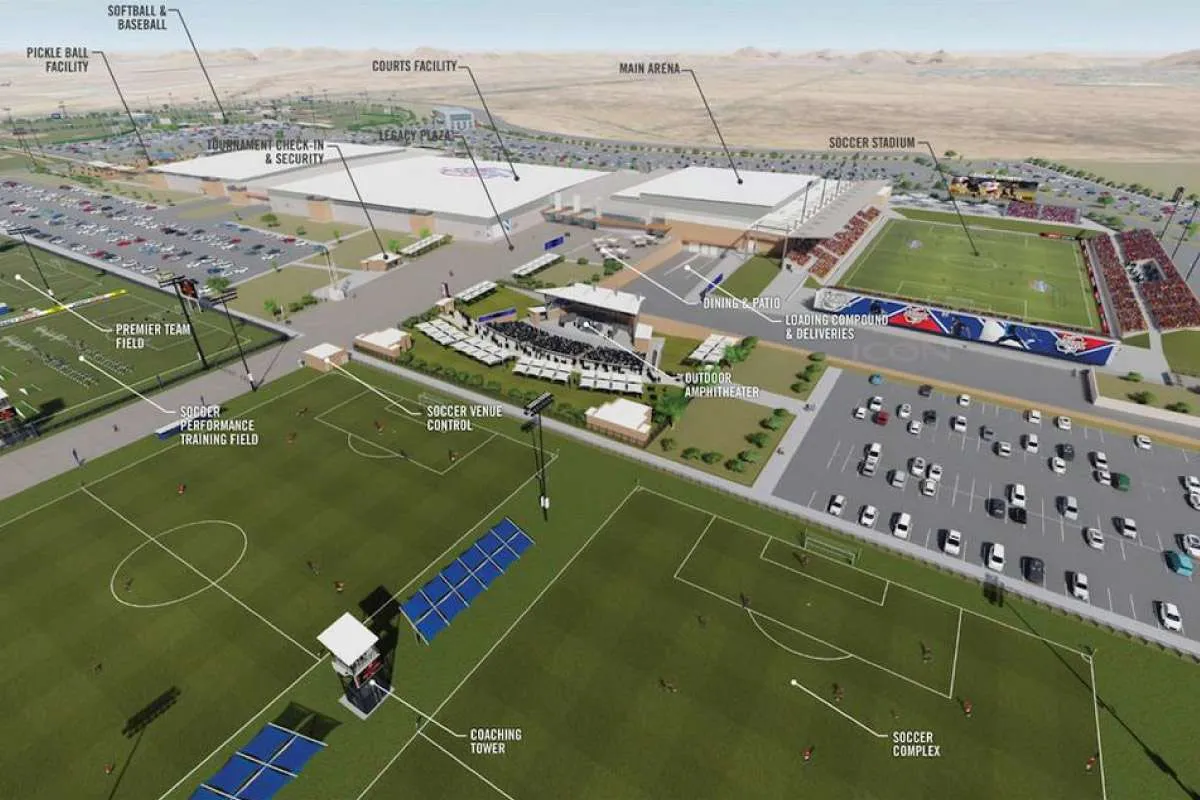
- Mesa’s Legacy Park project, anchored by Arizona Athletic Grounds, is entitled for 2,500 apartments, a 600-room hotel, 3.4 million square feet of office space, and 300,000 square feet of retail across 200 acres
- Spectator sports tourism generated $47.1 billion in direct spending in 2024 and a total economic impact of $114.4 billion, with more than 109 million non-local attendees
- Youth sports specialization has driven demand for year-round facilities, with the average number of sports per child dropping from two in 2019 to 1.6 in 2023
via: Travis Barrington – Propmodo
Youth sports facilities have moved beyond the edge-of-town field complex. Developers and cities are now treating tournament venues as anchors for mixed-use districts that include hotels, apartments, office campuses, and retail, creating what amounts to full neighborhoods organized around amateur athletics.
The economics behind the shift are substantial. Sports ETA research indicates youth and amateur sports generate more than $50 billion in direct spending annually. When combined with the broader spectator sports tourism market, which produced $47.1 billion in direct spending in 2024, the visitor volume and spending patterns now support real estate projects at scales typically reserved for downtown office towers or regional malls.
Florida Project Reaches $1 Billion Scale
Montierre Development is advancing The Dynasty in Ocoee, Florida, a privately funded complex on roughly 155 to 159 acres west of Orlando. The project includes 17 multi-sport fields, approximately 1,100 hotel rooms, multiple structured parking garages, and between 350,000 and 500,000 square feet of retail, dining, and entertainment space, plus a riverwalk along the site.
The capital stack approaches $1 billion. Construction is projected to support around 9,800 jobs, with roughly 5,000 permanent positions once operational. The estimated annual economic impact is $540 million.
Central Florida already hosts the ESPN Wide World of Sports Complex at Disney and the Boombah Sports Complex. The Dynasty represents an evolution from those earlier tournament-focused venues toward a full mixed-use district where sports are the organizing principle but not the only use.
Mesa Development Positions Sports Complex as Traffic Generator
In Mesa, Arizona, the Arizona Athletic Grounds (formerly Legacy Sports Park) operates as a regional tournament destination on the city’s southeast edge. The facility draws millions of visitors annually across dozens of fields, courts, and indoor venues.
Directly across the street, developer Vestar and landowner Pacific Proving LLC are planning Legacy Park, a 200-acre, multibillion-dollar mixed-use project. At full buildout, Legacy Park is entitled for 2,500 multifamily units, a 600-key resort hotel, about 3.4 million square feet of midrise office and corporate campus space, and 300,000 square feet of retail and restaurants. The plan includes more than 20 acres of programmed open space organized around a central lake.
The sports complex is not an amenity added to an existing development plan. It is the original traffic generator that provides the mixed-use project with a built-in customer base of traveling families, college programs, and regional tournaments.
Hamilton Shows Adaptive Reuse Model
Spooky Nook Sports at Champion Mill in Hamilton, Ohio, demonstrates another version of sports-anchored development through adaptive reuse. The city partnered with a developer to convert a historic paper mill along the Great Miami River into what is described as the largest indoor sports complex in North America. The project includes a 200-room hotel, convention space, restaurants, a microbrewery, and medical offices within the adaptive reuse framework.
Since opening, the complex has contributed to a broader downtown resurgence. Hamilton’s budget documents and local coverage describe new small businesses in the urban core, riverfront public spaces, and nearby multifamily projects such as Rossville Flats with street-level retail. The tens of thousands of visiting athletes and families each season have provided customer traffic that supports additional commercial activity in the surrounding area.
Specialization Patterns Support Concentrated Facilities
The development model is supported by shifts in youth sports participation. Research from the Aspen Institute and the Sports & Fitness Industry Association shows youth participation in organized sports has stabilized after pandemic lows, but kids are playing fewer sports and specializing earlier. The average number of sports per child dropped from about two in 2019 to around 1.6 in 2023.
That specialization has produced year-round club calendars, which favor destinations that can host multiple tournaments simultaneously across several sports. Facilities with reliable weather, quality infrastructure, and sufficient nearby hotel inventory can generate consistent shoulder-season demand that traditional seasonal field complexes cannot match.
Public-Private Structures Address Capital Requirements
The development economics remain complex despite compelling visitor numbers. A single tournament weekend might fill thousands of room nights and generate meaningful restaurant, retail, and fuel spending, but the underlying real estate requires significant upfront capital. Sports facilities carry high costs for land acquisition, design, and construction, along with long payback periods.
Most ambitious youth sports districts involve some combination of municipal land contribution, tourism improvement districts, tax-sharing agreements, and revenue participation structures. The Dynasty in Ocoee includes a development agreement where the city assembled a large portion of the site and negotiated road improvements, dedicated parking revenues, and a per-key hotel fee flowing back to the municipality.
In Hamilton, the Champion Mill project sits within a broader riverfront strategy that includes new trails, public art, and infill housing. The city views the complex as a long-term tax base and placemaking asset rather than a single facility transaction.
Strategic Implications for Developers and Municipalities
For developers and municipalities evaluating youth sports facilities, the opportunity extends beyond weekend tourism bumps. When a sports campus can reliably generate multi-day stays, repeat annual visitation, and demand during typically slow periods, it begins to support the fundamentals of a real neighborhood. That includes hotels, restaurants, service retail, and eventually housing for workers seeking proximity to employment centers.
The approach carries execution risk. Traffic impacts and neighborhood opposition can delay or reduce project scope. Overreliance on a single operator or sport leaves developments exposed to shifts in league calendars or club preferences. Secondary uses need consideration early in planning. Can a fieldhouse accommodate concerts? Can tournament housing convert to extended-stay formats in the offseason? Can parking structures support future EV charging or partial conversion to other uses?
The U.S. sports facilities market is forecast to scale from $36 billion today to more than $260 billion by 2034. The most significant projects in that growth may not be standalone mega-arenas but places where youth and amateur sports are integrated into full mixed-use environments. Cities and developers increasingly treat youth sports not as occasional programming but as durable, programmatic anchors comparable to how hospitals, universities, and professional arenas have historically organized mixed-use districts.
photo: Icon Architecture
YSBR provides this content on an “as is” basis without any warranties, express or implied. We do not assume responsibility for the accuracy, completeness, legality, reliability, or use of the information, including any images, videos, or licenses associated with this article. For any concerns, including copyright issues or complaints, please contact YSBR directly.
About Youth Sports Business Report
Youth Sports Business Report is the largest and most trusted source for youth sports industry news, insights, and analysis covering the $54 billion youth sports market. Trusted by over 50,000 followers including industry executives, investors, youth sports parents and sports business professionals, we are the premier destination for comprehensive youth sports business intelligence.
Our core mission: Make Youth Sports Better. As the leading authority in youth sports business reporting, we deliver unparalleled coverage of sports business trends, youth athletics, and emerging opportunities across the youth sports ecosystem.
Our expert editorial team provides authoritative, in-depth reporting on key youth sports industry verticals including:
- Sports sponsorship and institutional capital (Private Equity, Venture Capital)
- Youth Sports events and tournament management
- NIL (Name, Image, Likeness) developments and compliance
- Youth sports coaching and sports recruitment strategies
- Sports technology and data analytics innovation
- Youth sports facilities development and management
- Sports content creation and digital media monetization
Whether you’re a sports industry executive, institutional investor, youth sports parent, coach, or sports business enthusiast, Youth Sports Business Report is your most reliable source for the actionable sports business insights you need to stay ahead of youth athletics trends and make informed decisions in the rapidly evolving youth sports landscape.
Join our growing community of 50,000+ industry leaders who depend on our trusted youth sports business analysis to drive success in the youth sports industry.
Stay connected with the pulse of the youth sports business – where industry expertise meets actionable intelligence.
Sign up for the biggest newsletter in Youth Sports – Youth Sports HQ – The best youth sports newsletter in the industry
Follow us on LinkedIn
Follow Youth Sports Business Report Founder Cameron Korab on LinkedIn
Are you a brand looking to tap into the world’s most passionate fanbase… youth sports?
Introducing Play Up Partners, a leading youth sports marketing agency connecting brands with the power of youth sports. We specialize in youth sports sponsorships, partnerships, and activations that drive measurable results.
About Play Up Partners
Play Up Partners is a leading youth sports marketing agency connecting brands with the power of youth sports. We specialize in youth sports sponsorships, partnerships, and activations that drive measurable results.
Why Sponsor Youth Sports?
Youth sports represents one of the most engaged and passionate audiences in sports marketing. With over 70 million young athletes and their families participating annually, the youth sports industry offers brands unparalleled access to motivated communities with strong purchasing power and loyalty.
What Does Play Up Partners Do?
We’ve done the heavy lifting to untangle the complex youth sports landscape so our brand partners can engage with clarity, confidence, and impact. Our vetted network of accredited youth sports organizations (from local leagues to national tournaments and operators) allows us to create flexible, scalable programs that evolve with the market.
Our Approach
Every partnership we build is rooted in authenticity and value creation. We don’t just broker deals. We craft youth sports marketing strategies that:
- Deliver measurable ROI for brand partners
- Create meaningful experiences for athletes and families
- Elevate the youth sports ecosystem
Our Vision
We’re positioning youth sports as the most desirable and effective platform in sports marketing. Our mission is simple: MAKE YOUTH SPORTS BETTER for athletes, families, organizations, and brand partners.
Common Questions About Youth Sports Marketing
Where can I sponsor youth sports? How do I activate in youth sports? What is the ROI of youth sports marketing? How much does youth sports sponsorship cost?
We have answers. Reach out to info@playuppartners.com to learn how Play Up Partners can help your brand navigate the youth sports landscape.
Youth sports organizations: Interested in partnership opportunities? Reach out to learn about our accreditation process.



The current front-of-jersey sponsor, Tillamook, will transition to the sleeve patch and remain part of the team’s sponsor lineup.
PORTLAND, Ore. — Bank of America will become the new front-of-jersey sponsor for the Portland Timbers in a multi-year deal, the club announced Tuesday morning. The current front-of-jersey sponsor since 2024, Tillamook, will remain partnered with the team but will transition to the sleeve patch.
The updated jerseys will debut in 2026 and will mark the first time the Bank of America logo has been featured on a professional sports jersey, according to a joint news release from the club and the bank. Bank of America is also a sponsor for U.S. Soccer and FIFA World Cup 2026.
The sponsorship deal with the Timbers includes a new program called Soccer with Us aimed at making soccer more inclusive, mainly through youth-focused efforts including the development of “Community Futsal Courts,” a youth soccer camp program called “Camps for All” and an initiative called “Equipped to Play.”
The first initiative will build or resurface 10 futsal courts throughout Oregon, adding new goals, nets and equipment, according to the news release. The second will provide 50 free youth soccer camps at Providence Park and other locations to serve 5,000 youth athletes, including through 250 camp scholarships. The third will donate $200,000 worth of merchandise to schools and community groups.
“We’re proud to welcome Bank of America to the Timbers family, and together we are committed to making a meaningful impact in our community,” Portland Timbers CEO Heather Davis said in a statement. “Bank of America’s investment goes beyond the Timbers; it’s an investment in the city of Portland. This partnership will provide valuable resources and opportunities for youth in sports, local small businesses, public schools and more.”
Bank of America will also launch a series of initiatives aimed at bolstering local businesses, the club said. “First Match Access Pass” will provide 100 tickets per game to people who have never been to a match. “Small Business of the Game” will promote local businesses at games and give $5,000 grants, serving 50 businesses over the lifetime of the partnership.
“Game Changers of Tomorrow” will provide a VIP experience at a Timbers match and an educational grant to 20 students over the course of the partnership. An annual “Small Business Summit” at Providence Park will bring in more than 100 local businesses for workshops, panels and networking, and “Stand Together” will support the club’s annual initiative to serve nonprofit projects.
“The Timbers are a tremendous asset to Portland, and this partnership is an opportunity to strengthen ties in the community and create meaningful economic impact across the region,” Roger Hinshaw, Bank of America Oregon and Southwest Washington president, said in a statement. “Our collaboration goes well beyond the pitch, as we build programs that create greater access for youth to experience soccer and deliver lasting benefits throughout the community.”
Tillamook was already a Timbers sponsor for 10 years before becoming the front-of-jersey partner, and will continue to support community programs like Stand Together and PTFC camps, according to to the news release.
“Tillamook has been an incredible partner of the club, and we’re excited to continue our relationship for years to come,” Davis said in a statement. “Their move to the sleeve patch reflects their enduring support of the club and shared commitment to our community.”

CHESTERFIELD COUNTY, Va. — A new extensive report from Virginia’s watchdog agency resulted in lacking evidence that residents at Bon Air Juvenile Correction Center have been receiving adequate care, according to the Office of the State Inspector General (OSIG).
While the Department of Juvenile Justice (DJJ) has characterized the report’s findings as documentation based and having no impact on actual resident outcomes, one advocate described them as affirming of the complaints that advocacy groups have been raising for more than a year.
“The dedicated staff at Bon Air JCC have long-suffered misconceptions and unsubstantiated allegations from entities lacking in-depth knowledge of the workings of the Department or Bon Air. It is refreshing to see, that even after a large team of people dedicated months solely to reviewing the activities at Bon Air, many of the allegations lobbed against the facility and facility staff were unsubstantiated,” DJJ said in a written statement upon the release of the report.
“My first reaction was relief — relief that the voices of the families, the voices of the residents, and even staff members were finally being validated,” said Valerie Slater, who leads the nonprofit group RISE for Youth.

WTVR
Bon Air, located in Chesterfield County, serves as Virginia’s only youth prison. It houses about 180 young people aged 14-20 who have been convicted of mostly serious crimes. According to DJJ Director Amy Floriano, 76% of the population have committed crimes against another person.
Over the past year, some advocates, lawmakers, and even local emergency officials have raised public concerns about perceived safety issues within the facility. CBS 6 previously reported on 2024 evaluation of Bon Air by external consultants that revealed “critically low staffing levels” had led to unsatisfied employees, increased confinement among residents, limited rehabilitative programming, and unsafe conditions.
Local News
Report: ‘Critical’ staff shortage, lack of programming at Bon Air youth prison
Responding in part to what they characterized as “disturbing reports,” state lawmakers on the Commission on Youth in April requested an independent investigation of the conditions at Bon Air. In May, Governor Glenn Youngkin directed the inspector general’s office to complete a special review of the facility’s operations.
The scope of the audit was contained to reviewing “operations, adequacy of staffing, resident programming, and resident mental health services.” The OSIG team analyzed data from July 2024 through August 2025, and staff performed unannounced inspections from June 2025 through October 2025.
OSIG’s final report showed there was lacking evidence to prove staff at Bon Air were performing wellness checks on youth confined in their rooms as required, lacking documentation to show that residents were getting daily exercise, and limited mental health services being provided to youth.
Inspectors found therapeutic services were not provided in a timely or appropriate fashion, due to insufficient clinical staff, which may compromise rehabilitative outcomes.
Of resident records reviewed by OSIG:
- 100% did not receive all their sex offender group treatment sessions
- 82% did not receive all their individual therapy sessions
- 67% did not receive substance abuse therapy appropriately and on time
- 64% did not receive aggression management therapy appropriately and on time
“By not providing therapeutic services in a timely and appropriate manner, treatment integrity and resident rehabilitation outcomes are comprised, potentially delaying progress, increasing the risk of behavioral relapse, and reducing Bon Air’s ability to meet its clinical and rehabilitative mandates,” the report stated.
In response to this finding, DJJ referred to those risks as “speculated outcomes” and emphasized the identified gaps were based on documentation rather than actual resident outcomes. Additionally, the agency said documentation does not reflect that delivery of programs can be impacted by the fluid nature of individualized mental health treatment and that desginated officials can waive DJJ procedures when necessary.
However, Slater had a different takeaway from the finding.
“What it tells me is that they are not effectively providing services, and if you are not providing services, how can you then claim to be effectively rehabilitating young people?” Slater said.
Sen. Barbara Favola (D-Arlington), who chairs the Commission on Youth, said she too was “alarmed” by the statistics.
“That means the youth had been detained longer than what had been recommended in the guidelines for their particular offense, simply because Bon Air could not provide the mental health services, the educational services, the job training services, everything that’s needed to really give that youth an opportunity to succeed,” Favola said.
However, DJJ’s response said an analysis of 2023 length of stay guidelines showed the vast majority of residents enrolled in aggression management and substance abuse treatment completed their treatment prior to their late release date, “indicating no extension in commitment length was necessary as a result of treatment delivery.”
Other OSIG findings included vocational and post-secondary programming — such as HVAC and plumbing classes — being “often unavailable” due to insufficient staffing, a lack of documented emergency preparedness, a fragmented health records system that poses risks to resident safety, and “high rates” of students missing school and/or showing up late.
“Inconsistent attendance and tardiness diminish residents’ access to learning opportunities, hinder educational progress, and may lead to noncompliance with state academic standards. Incomplete or inaccurate attendance documentation limits Bon Air’s ability to correctly monitor engagement, identify systemic barriers, and ensure accountability in its educational program. Beyond compliance, poor attendance and engagement can have broader implications for rehabilitation outcomes,” the report said.
Inspectors could not verify whether past staffing assignments were sufficient to maintain operations due to a lack of documentation; however, OSIG said it did not observe Bon Air violating minimum staffing requirements during its on-site inspections. It noted that the facility utilized the “drafting” of employees to work extra hours in order to maintain adequate coverage.
High turnover and short tenure of staff, which have steadily gotten worse since 2021, undermined workforce stability and service delivery, according to the report. OSIG cited some contributing factors out of DJJ’s control such as low salaries due to limited funding and the unique challenges of working in a juvenile correctional environment.
The report praised DJJ for its recent hiring events, and Floriano wrote in a letter to Inspector General Michael Westfall that her agency has been working tirelessly to address staffing issues including “trying everything from signing bonuses, retention bonuses, focusing on marketing and advertising, and hiring an outside consulting company.”
Floriano’s letter stated she began noticing the results of recruitment efforts over the summer, but the agency declined to share its current vacancy rate with CBS 6. That figure was also not included in OSIG’s report. The legislature’s research arm said Bon Air’s vacancy rate was 51% in fiscal year 2024.
Favola acknowledged the resource constraints that DJJ faces and said lawmakers will be introducing a budget proposal to increase funding to hire more mental health professionals.
“I understand there were challenges. I understand that Bon Air had been underfunded for many years. I understand they’ve had challenges hiring staff. We need to help fix that,” Favola said.
In a press release responding to the inspector general report, DJJ said, “We are proud to relay that all of the OSIG findings are related to documentation and resource deficiencies and do not reflect or support a lapse in supervision or service delivery to the detriment of any youth in our care.”
Floriano said in her letter, “While their review noted a number of areas for procedural improvement, OSIGs investigation confirmed that the allegations against Bon Air JCC were unfounded.”
DJJ did not specify to CBS 6 which allegations it believes were unfounded by OSIG’s audit, but Floriano’s letter referred to no evidence of “instances of harm, mistreatment or danger” being uncovered.
Slater said she was disappointed that “the department failed to acknowledge that things are not right at Bon Air.”
“I could almost go back to the several comments given at the DJJ board meetings. I could go back to the many letters and other reports from parents, and I could check off one by one each of the issues raised by residents, staff and by family members — I could check each off in these findings,” Slater said. “Are we not reading the same report? Are you just unwilling to acknowledge what is even written before you by the Inspector General? At what point are you willing to take true accountability?”
Favola said DJJ’s response was unsurprising and “not good enough.”
Moving forward, Favola said she hopes the incoming Spanberger administration, which will ultimately be responsible for continuing to implement OSIG’s recommendations, will take the findings seriously.
Additionally, she said Commission on Youth members will pursue legislation that would elevate community diversion programs in an effort to keep youth out of Bon Air, convene a work group to study reducing isolation for residents at the facility, potentially establish independent ombudsman oversight, and require court approval in order to extend a resident’s sentence.
CBS 6 requested an interview with a DJJ official for this story, but a spokesperson referred back to the agency’s written statements.
CBS 6 is committed to sharing community voices on this important topic. Email your thoughts to the CBS 6 Newsroom.
📱More Stories from Tyler Layne on WTVR.com
📲: CONNECT WITH US
Blue Sky | Facebook | Instagram | X | Threads | TikTok | YouTube


Eight players from a Philadelphia youth football team allegedly stole over $2,000 worth of merchandise from a Dick’s Sporting Goods while in Florida for a national championship tournament, as the local sheriff tore into the “ultimate loser” coach who cried to get the kids’ charges dropped.
The juvenile suspects, part of the United Thoroughbreds under-14 team, were hours away from kickoff in the Prolifix Nationals tournament when they decided to take an Uber to the store in Davenport, Florida, on Dec. 6, the Polk County Sheriff’s Office said.
The delinquents were captured on security cameras entering the store just before 11 a.m., when they launched the daylight heist, according to footage shared by the sheriff’s office.
One of the kids, 15-year-old Marcus Hudgens, made a purchase at a checkout line to get a “Dicks” bag before meeting up with the other teens in the middle of the store.
Security footage allegedly captured the young thieves stuffing items into the bag as they made their way through the store.
Daimon Johnson, 15, Mark Bryan, 15, and Ibn Mahdee Abdul Haqq, 14, grabbed the bag and walked out of the store, bypassing all registers and into the parking lot, where they were stopped by waiting deputies.
Hudgens, Elijah Myers,14, Tymir Speller, 15, Tymir Smith, 14, and Jacob Scott, 15, were located inside the store and detained.
Abdul-Haqq allegedly stole merchandise inside a black backpack while Bryan was holding the store’s bag.
Speller was found with a stolen beanie down his pants.
The teens are accused of stealing 47 items totaling $2,296.07.
Among the stolen merchandise were a $135 Nike hoodie, a $125 Nike women’s running jacket, two $110 Under Armour hoodies and two $70 football gloves.
“These juveniles were not from Polk County, they came here from Philly for a football tournament, and instead of representing their team with pride, they chose to steal — they are Thoroughbred thieves,” Judd said. “Let this be clear: It doesn’t matter if you’re from here or visiting, if you break the law in Polk County, you will be arrested and held accountable.”
During the arrest, the team’s coach, Raekwon Bynes, was called to the store and began pleading with cops and store employees to release the players, Judd said.
“The coach who is responsible for them, you’d think he would be interested in holding them accountable and responsible, instead, he goes to the deputies and begs them not to take these young men into custody,” Judd said.
“Oh don’t arrest them, drop the charges, let them go,” the coach allegedly said, according to the sheriff.
“They were not taking bubble gum, one piece to chew. They stole over $2,000 worth of products. And when it was evident that they were going to be arrested, the coach says, ‘Don’t you guys have anything better to do than arrest these kids,’” Judd said.
“I don’t know how you do things in Philadelphia, Pennsylvania, but in Polk County, Florida, we lock you up for stealing, for being a thief,” he added.
The teens were arrested and charged with third-degree felony retail theft over $750 and third-degree felony conspiracy to commit retail theft.
They were transported to the Juvenile Assessment Center and missed playing in the championship game.
The Florida-based Cocoa Tigers U-14 routed the Thoroughbreds in the Prolifix Sportz AAU National Championship, winning 26-6.
“I don’t know if they were starters or not, but we are finishers, we arrested them,” Judd said.
“You chose to be arrested and that’s the way it is,” he added. “And for the coach, you’re way off base here, buddy. Way off base. You’re the ultimate loser.”
Rec Sports
Michigan parent files Title IX complaint with allegations over transgender athlete playing in volleyball game

A southeast Michigan parent has filed a Title IX complaint with the U.S. Department of Education over claims a transgender student athlete played against his daughter’s volleyball team.
The complaint alleges the opposing school didn’t submit the proper waiver for the child to play, that parents didn’t get notice ahead of the match, and that both teams shared a locker room while playing in Monroe.
Monroe High School student Briley Lechner plays on the volleyball team. She said her team was caught off guard by the player.
“Nobody would have expected that. That would’ve been the last thought because as I was looking at this person, admiring how amazing they were, admiring how high they could jump, I was kind of getting down on myself. Like, I wonder why I’m not capable of that,” Lechner said during a press conference to announce the complaint in Monroe Monday.
The Michigan High School Athletic Association (MHSAA) says it received one waiver for a transgender child to play sports this past fall but that it couldn’t give more information for privacy reasons.
MHSAA spokesperson Geoff Kimmerly said those waivers are granted on a case-by-case basis, using factors like medical records and whether the student has gone through hormone therapy or gender-affirming surgery.
“We look at every athlete individually,” Kimmerly said. “We’re talking about one individual student, so they’re all going to be different a little bit in some way and so they’re all going to be unique.”
Kimmerly said that’s been the practice for several years. Sometimes sports seasons don’t get any requests for transgender students to play.
The stated goal of the Title IX complaint is to stop all transgender kids from competing in girls’ sports.
Sean Lechner, Briley’s father, said he believed a student assigned male at birth would always have a competitive edge when competing against athletes assigned female at birth.
“It’s not fair, it’s not equal, and it’s not right. It takes every bit of dignity and privacy away from our girls,” Sean Lechner said.
Michigan civil rights law bans discrimination based on gender identity. But, in February, President Donald Trump issued a federal executive order banning trans athletes from girls’ sports.
Kimmerly said the MHSAA, a private non-profit that coordinates Michigan’s school sports, needs state lawmakers to give it more guidance about what to do with the conflicting policies.
“We know that they recognize these issues. We have reinforced over and over again that we have to follow the law. And when there are conflicts in the law, we rely on the Legislature and the courts to provide clarity,” Kimmerly said.
Several Republican state lawmakers and candidates for state and federal office attended Monday’s press conference.
In May, the Republican-led state House of Representatives passed bills to exempt school sports from that anti-gender identity discrimination law.
Package co-sponsor State Representative Rylee Linting (R-Grosse Ile Twp) said the new complaint was about keeping student athletes safe.
“To be clear, this is not about singling out a particular student, this is about calling out the individuals that are allowing this to happen,” Linting said.
The bills have stalled in the Democratic-led state Senate where they’re not likely to see any movement.
Meanwhile, LGBTQ rights advocates say transgender children should have equal chances to play youth sports. They argue zeroing in on one students’ case takes away from their teams’ accomplishments and makes them a target for adults to harass and bully them both online and in person.
The U.S. Supreme Court is scheduled to hear arguments over whether trans athletes should be allowed to play in girls’ and women’s sports next year.
Rec Sports
Where to Go in Corktown Detroit: Best Spots Near the Godfrey Hotel & Michigan Central Station

Michigan Central
2001 15th St, Detroit, MI 48216
First opened in 1913, it served more than 4,000 passengers per day, sending people all over the country with distinctive retail, cultural installations, and more. In the near future, The Station will also be a stop on Detroit’s Joe Louis Greenway, a recreational path that unites dozens of neighborhoods to create a more connected Detroit.
The Detroit St. Patrick’s Day Parade
In 1958, the United Irish Societies hosted the first St. Patrick’s Parade in Dearborn, MI. The Parade route follows Michigan Avenue through Corktown and is hosted on or near St. Patrick’s Day. The parade typically attracts 80,000-100,000 people, making it one of the largest St. Patrick’s parades in the country, and it features floats, marching bands, color guard units and more.
The Corner Ballpark
1680 Michigan Ave, Detroit, MI 48216
Built on the site of the historic Tiger Stadium, the Corner Ballpark is a multi-purpose sports stadium that has a beautiful Event Center perfect for weddings, galas, corporate events, and more. The Corner Ballpark, presented by Adient, exists to support the Detroit Police Athletic League — the city’s youth sports program. The field at the stadium is named the Willie Horton Field of Dreams after the former Major League Baseball player, best known for his powerful hitting and his 15-season career with the Detroit Tigers. The field hosts baseball, softball, T-ball, Coach pitch, football, soccer, cheer, and more throughout the year.
The Workers Row House
1430 Sixth St.
One of the oldest residences in Detroit, Worker Row House was built in 1849. These small, singular units measured 560 square feet and had an upstairs sleeping loft. According to reporting, it once served as a multi-family home for working-class immigrants. It survived nearly 200 years in Detroit as a functioning boarding home that ceased operations in the 1970s. The building features an exhibition center, lounge, and gallery,
The Father Clement Kern Statue
Clement Kern Gardens 1661 Bagley, Detroit, Michigan 48216
Located in a small park at the corner of Trumbull and Bagley Streets in Corktown, Clement Kern Gardens was dedicated to Father Clement Kern (b. 1907), who worked diligently for the poor. His church became a focal point for providing services for the poor in the days just before the expansion of state-funded welfare programs. Father Kern is credited with encouraging parishioners not to sell their homes amidst the White Flight to the suburbs, which may have been instrumental in preserving the neighborhood.

Dec. 12, 2025
Bernalillo County – Polls are now open for the 2025 City of Albuquerque Runoff Election. Voters may cast a ballot at any of the 50 voting locations across the city from 7 a.m. to 7 p.m. All eligible voters are encouraged to confirm their preferred voting location before heading out and to allow extra time in case of possible lines at busy sites.
“We want every voter to have a smooth experience today,” says Clerk Michelle S. Kavanaugh. “Take a moment this morning to confirm your voting location and make a plan. With fewer locations open for the runoff, planning ahead will help voters avoid surprises or frustration.”
Some Popular Locations Not Open Today
Many high school sites used during the November Regular Local Election are not open for the runoff. The only high school locations open today are:
- Manzano High School
- Sandia High School
- Rio Grande High School
A full list and map of all 50 open locations is available at BerncoClerk.gov.
Voters May Use Any Location
Voters may cast a ballot at any Election Day location in the city, regardless of where they live within Albuquerque. The Clerk’s Office encourages voters to:
- Review the list of 50 open locations at BerncoClerk.gov
- Identify an alternate location if their usual site is closed
- Allow additional time for possible lines at busy locations
Eligibility Reminder
Only voters who reside within the Albuquerque city limits are eligible to participate in the runoff. Voters in unincorporated areas of Bernalillo County will not receive a ballot for this municipal election. Voters can confirm their eligibility at NMVote.org.
Absentee Ballots Must Be Returned Today
Voters who still have an absentee ballot must return it by 7 p.m. tonight. Postmarks do not count.
Absentee ballots may be returned in two ways:
- Drop off the completed ballot at any Election Day voting location
- Use an official ballot drop box (locations listed at BerncoClerk.gov)
Please do not mail absentee ballots today as they will not arrive in time to be counted.
Official Results Website
Unofficial results will begin to post shortly after the polls close and the final in-person voter has cast a ballot.
The unofficial results will be posted at: https://results.bernco.gov/.
Results will update throughout the evening as ballots are processed and reported.
For all official election information, including voting locations and absentee ballot guidance, visit BerncoClerk.gov, call (505) 243-VOTE (8683), or email clerk@bernco.gov.
# # #
About Bernalillo County
Bernalillo County is 1,160 square miles and is New Mexico’s most populous county with more than 676,000 residents. Bernalillo County government provides a wide range of public services to residents who live in Albuquerque, Los Ranchos and Tijeras with approximately 106,000 residents living in unincorporated areas of the county. Bernalillo County employs approximately 2,800 people and has an annual operating budget, capital investments and other funds of more than $1 billion. Elected officials include five county commissioners, assessor, clerk, probate judge, sheriff and treasurer

Colorado Volleyball’s Burilovic Named to AVCA All-West Region First Team

Bank of America to become new front-of-jersey sponsor for Portland Timbers

Velocity-backed Parella Motorsports Holdings and SpeedTour picks up Racing America

23XI, Front Row should be awarded more than $360 million, economist testifies

Report reveals lacking evidence of adequate care at Bon Air youth prison

Big 12 Prepares for NCAA Volleyball Sweet 16

Philadelphia football players steal 2000 worth from Florida Dicks Sporting Goods

Players to watch at NCAA volleyball tournament’s Sweet 16

NIL’s marketing success proves the value of athletes as creators

Diego Pavia Vows to Give Up His NIL Money if This CFP Scenario Happens
NCAA women’s volleyball players with famous NBA, NFL dads

2026 Nebraska volleyball reseating concerns some longtime fans

Bailey, Rodriguez collect Pony Express Award

Michigan parent files Title IX complaint with allegations over transgender athlete playing in volleyball game

Where to Go in Corktown Detroit: Best Spots Near the Godfrey Hotel & Michigan Central Station

First Tee Winter Registration is open

Fargo girl, 13, dies after collapsing during school basketball game – Grand Forks Herald

CPG Brands Like Allegra Are Betting on F1 for the First Time

Volleyball Recaps – November 18

F1 Las Vegas: Verstappen win, Norris and Piastri DQ tighten 2025 title fight

Two Pro Volleyball Leagues Serve Up Plans for Minnesota Teams

Sycamores unveil 2026 track and field schedule

Utah State Announces 2025-26 Indoor Track & Field Schedule

Redemption Means First Pro Stock World Championship for Dallas Glenn

Bowl Projections: ESPN predicts 12-team College Football Playoff bracket, full bowl slate after Week 14

Texas volleyball vs Kentucky game score: Live SEC tournament updates

How this startup (and a KC sports icon) turned young players into card-carrying legends overnight

Jo Shimoda Undergoes Back Surgery

Indiana’s rapid ascent and its impact across college football

Robert “Bobby” Lewis Hardin, 56

 Why a rising mid-major power with an NCAA Tournament team opted out of revenue-sharing — and advertised it
 NBA Legend Michael Jordan to Join NBC Sports as Special Contributor
 Falcons mailbag
 Portal Update – Basketball and Gymnastics Take Hits
 has always dreamed in Mercurial. Now his initials are on the boots.
The new Kyl…
has always dreamed in Mercurial. Now his initials are on the boots.
The new Kyl…
-
 Rec Sports2 weeks ago
First Tee Winter Registration is open
-
 Rec Sports2 weeks ago
Fargo girl, 13, dies after collapsing during school basketball game – Grand Forks Herald
-
 Motorsports2 weeks ago
CPG Brands Like Allegra Are Betting on F1 for the First Time
-
 Motorsports2 weeks ago
F1 Las Vegas: Verstappen win, Norris and Piastri DQ tighten 2025 title fight
-
 Sports2 weeks ago
Two Pro Volleyball Leagues Serve Up Plans for Minnesota Teams
-
 Sports2 weeks ago
Utah State Announces 2025-26 Indoor Track & Field Schedule
-
 Sports2 weeks ago
Sycamores unveil 2026 track and field schedule
-
 Motorsports2 weeks ago
Redemption Means First Pro Stock World Championship for Dallas Glenn
-
 NIL1 week ago
Bowl Projections: ESPN predicts 12-team College Football Playoff bracket, full bowl slate after Week 14
-
 Sports2 weeks ago
Texas volleyball vs Kentucky game score: Live SEC tournament updates