Youth sports participation recovered to 55.4% in 2023, the highest rate since before COVID, with 65% of kids trying sports at least once in 2024.
Average family spending jumped 46% since 2019 to $1,016 annually, twice the rate of overall U.S. inflation during the same period.
The participation gap between low-income and high-income households widened from 13.6 percentage points in 2012 to 20.2 points in 2024.
Flag football grew 14% in regular youth participation from 2019 to 2024, the only team sport tracked to show growth during that period.
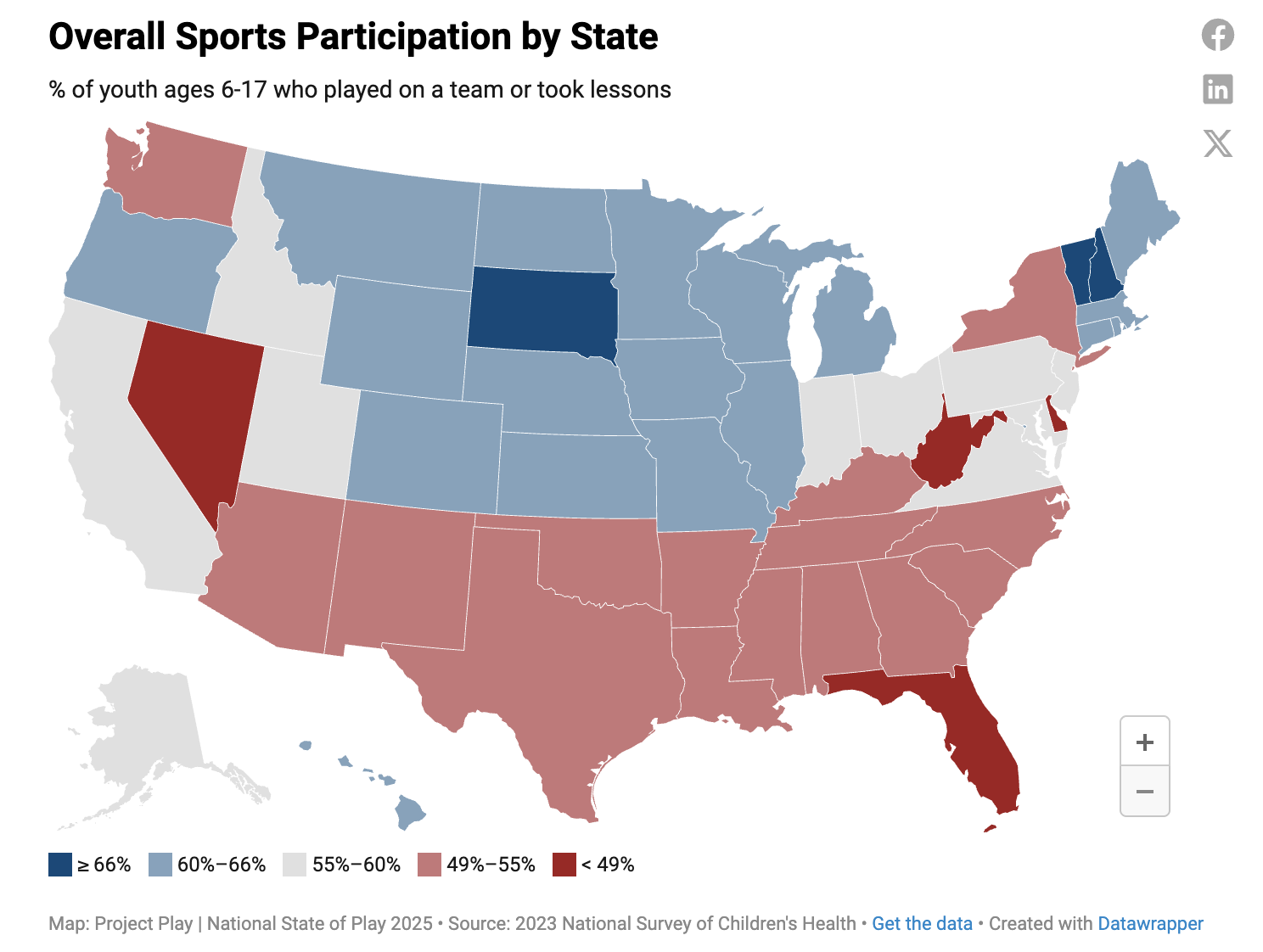
Fourteen states reached the federal government’s 63% participation target, with Vermont leading at 72% and Nevada trailing at 43%.
The Aspen Institute’s State of Play 2025 report delivers a clear message: youth sports bounced back from the pandemic, but the rebound masks growing fractures in access, affordability, and equity across the $54 billion industry.
Released annually by the Sports & Society Program’s Project Play initiative, the report draws from federal data, industry surveys, and parent research to analyze how well children are being served by the adults building youth sports programs. The 2025 findings reveal an ecosystem experiencing record participation alongside record costs, with implications that will shape the market through 2030 and beyond.
Post-Pandemic Rebound Defies Historical Precedent
According to the National Survey of Children’s Health, 55.4% of youth ages 6-17 played organized sports in 2023, up from 53.8% in 2022. Industry data from the Sports & Fitness Industry Association shows even stronger momentum in 2024, with 65% of kids trying sports at least once during the year.
The recovery matters because it didn’t have to happen. After the 2009 recession, participation rates fell and never returned to pre-recession levels. Municipal budgets got cut, local recreation programs suffered, and private sport providers flourished while leaving many kids behind.
This time, casual participation surged. Sixty-five percent of youth ages 6-17 tried sports at least once in 2024, up from 59% in 2021 and the highest rate recorded by SFIA since at least 2012. The shift reflects how pro leagues and operators adapted post-COVID to offer more informal, lower-commitment options. The NFL’s investment in flag football through RCX Sports exemplifies this trend.
“The rebound in participation since the pandemic is a credit to all who have innovated to improve access to quality sport programs,” said Tom Farrey, executive director of the Sports & Society Program. “But we’re going to need leadership to ensure that as more money flows into the space, the needs of children, all children, are prioritized.”
The Cost Crisis Intensifies
The average U.S. sports family spent $1,016 on their child’s primary sport in 2024, a 46% increase since 2019. That’s twice the rate of price inflation in the broader economy during the same period.
Higher team registration fees, travel costs for non-local competition, and spending on camps and private instruction all contributed to the increase. Baseball emerged as the most expensive of the three most popular sports, costing more on average than soccer or basketball.
The timing adds complexity. The report’s data came before President Trump’s tariffs and the federal government shutdown, both of which could further impact family budgets. In 2024, $6.27 billion worth of sporting goods imported into the U.S. came from China, accounting for 61% of these imports.
After the 2017 tariffs, physical inactivity rates for households earning less than $25,000 jumped from 45% to 47% in one year, according to SFIA. The organization’s CEO, Todd Smith, told ESPN that the increase was directly related to tariffs. “We, as an industry, sports and fitness offer a free remedy to try and minimize healthcare costs,” Smith said, “so why would we create more barriers to accessibility and entry into activities?”
Children are noticing the burden too. Project Play’s community surveys show more kids citing “too expensive” as what they dislike most about sports. One student told The New York Times his family paid $500 to $700 per month for his team. “A lot of time I would feel pressure to make sure I do well because it costs so much money and if I played badly my parents would be disappointed.”
Participation Gap Widens Along Income Lines
In 2012, 35.5% of kids ages 6-17 from homes earning under $25,000 regularly played sports compared to 49.1% from homes earning $100,000 or more, a difference of 13.6 percentage points. By 2024, that gap had widened to 20.2 percentage points.
Federal data tells a similar story. Children from the lowest-income homes played sports in 2023 at half the rate of those from the highest-income group.
The Aspen Institute’s parent survey found that children from the wealthiest households play their primary sport more frequently than their peers across community settings, schools, travel teams, and independent training. Kids from homes earning $100,000 or more are two times more likely to play travel sports than those from homes making under $50,000.
The one exception is free play, where the pattern reverses. Children from the lowest-income homes and those in urban environments engage in unstructured play more than the wealthiest children and those living in the suburbs.
Flag Football Outpaces All Team Sports
From 2019 to 2024, flag football was the only team sport tracked by SFIA that experienced growth in regular participation among kids ages 6-17. Flag grew 14% while baseball dropped 19%, tackle football fell 7%, soccer declined 3%, and basketball slipped 2%.
Among kids ages 6-12, flag surpassed tackle as the most commonly played form of football in 2017. The gap continues to widen, with 4% playing flag in 2024 versus 2.7% playing tackle. Among teenagers 13-17, tackle (6.4%) still significantly outpaces flag (2.8%).
NFL FLAG now serves more than 620,000 youth ages 4-17 across 50 states. Twenty-eight states either sanction girls’ high school flag football or are running pilot programs. In October, the NFL announced plans to launch professional women’s and men’s flag leagues ahead of the sport’s debut at the 2028 Los Angeles Olympics.
The sport’s rise is affecting soccer participation. In 2012, soccer exceeded flag by 6.4 percentage points among kids ages 6-12. By 2024, soccer’s advantage had shrunk to 3.5 percentage points, a shift that has some soccer leaders concerned about losing would-be players to flag.
Latino Youth Drive Fastest Demographic Growth
For years, Latino youth played sports at lower rates than their peers. That changed recently based on SFIA data. In 2024, 65% of Latino youth ages 6-17 tried sports at least once, a higher rate than Black and White youth.
Participation among Latina girls rose from 39.5% in 2019 to 48.4% in 2024, outpacing the growth of their non-Latina peers, according to McKinsey Institute research. The increase is attributed to greater representation of Latinas in college and pro sports, along with targeted programs from organizations like ELLA Sports Foundation, Girls on the Run, Sports 4 Life, and the Women’s Sports Foundation.
“When young girls feel represented, they are empowered to dream and to succeed in life,” said Patty Godoy, co-founder of ELLA Sports Foundation. “This representation is inspiring and motivating for young Latinas to play sports and stay in sports.”
Challenges remain. Latino parents cite scheduling conflicts more than non-Latinos as a barrier. Research by McKinsey and U.S. Soccer Federation found that Latino and Black children are three times more likely than White children to stop playing soccer because they feel unwelcome.
The report also documents impacts from immigration enforcement. A Stanford University study found that recent raids in California’s Central Valley coincided with a 22% increase in daily student absences. Media accounts from 2025 describe decreased attendance across summer sports programs in parts of Los Angeles after raids, and the Oregon Youth Soccer Association reported that as many as 16 teams withdrew from Portland competition after people reported ICE activity in community parks.
Coaching Training Reaches One Million
The Million Coaches Challenge reached a milestone in 2025 when its cohort of partners trained one million youth coaches across the U.S. in evidence-based youth development practices. Research shows that 93% of coaches trained by the program feel more confident in their ability to support youth, and their athletes report more joy, stronger relationships, and higher likelihood to continue playing.
The U.S. Tennis Association introduced a comprehensive coaching platform in 2025 that offers four membership tiers ranging from free to $249 annually. Benefits include equipment discounts from 20% to 50%, liability insurance, telehealth access, career counseling, and flexible education modules that coaches can complete in 20-minute sessions.
“Research shows that people aren’t attracted to coaching as a career anymore, and we need to change that,” said Craig Morris, USTA Coaching CEO. “We need to work with facility owners and operators to put value on coaches who are educated and have a growth mindset.”
Strategic Implications for Operators
The report identifies several trends that will define the youth sports landscape through 2026 and beyond. NIL deals are trickling down to middle school athletes, with one eighth-grader in Washington D.C. signing sponsorship deals and hiring an agent. AI-powered analytics platforms are reaching younger age groups, with some organizations offering video analysis and performance tracking for 8- and 9-year-olds at costs around $300 annually.
Fourteen states reached the federal government’s 63% participation target in 2023. Achieving that goal nationwide by 2030 could save the U.S. $80 billion in direct medical costs and productivity losses while delivering over 1.8 million more quality years of life to Americans, according to a study published in the American Journal of Preventive Medicine.
Illinois created the nation’s first statewide youth sports commission in 2025, focused on quality, access, and equity. California is studying whether to establish a Department of Youth Sports. The Children’s Bill of Rights in Sports gained endorsements from the U.S. Conference of Mayors, National League of Cities, and National Recreation and Park Association.
The data shows an industry at a crossroads. Participation is up, but so are costs and inequities. How operators, municipalities, brands, and policymakers respond to these tensions will determine whether youth sports becomes more accessible or more exclusive in the years ahead.
YSBR provides this content on an “as is” basis without any warranties, express or implied. We do not assume responsibility for the accuracy, completeness, legality, reliability, or use of the information, including any images, videos, or licenses associated with this article. For any concerns, including copyright issues or complaints, please contact YSBR directly.
About Youth Sports Business Report
Youth Sports Business Report is the largest and most trusted source for youth sports industry news, insights, and analysis covering the $54 billion youth sports market. Trusted by over 50,000 followers including industry executives, investors, youth sports parents and sports business professionals, we are the premier destination for comprehensive youth sports business intelligence.
Our core mission: Make Youth Sports Better. As the leading authority in youth sports business reporting, we deliver unparalleled coverage of sports business trends, youth athletics, and emerging opportunities across the youth sports ecosystem.
Our expert editorial team provides authoritative, in-depth reporting on key youth sports industry verticals including:
Sports sponsorship and institutional capital (Private Equity, Venture Capital)
Youth Sports events and tournament management
NIL (Name, Image, Likeness) developments and compliance
Youth sports coaching and sports recruitment strategies
Sports technology and data analytics innovation
Youth sports facilities development and management
Sports content creation and digital media monetization
Whether you’re a sports industry executive, institutional investor, youth sports parent, coach, or sports business enthusiast, Youth Sports Business Report is your most reliable source for the actionable sports business insights you need to stay ahead of youth athletics trends and make informed decisions in the rapidly evolving youth sports landscape.
Join our growing community of 50,000+ industry leaders who depend on our trusted youth sports business analysis to drive success in the youth sports industry.
Stay connected with the pulse of the youth sports business – where industry expertise meets actionable intelligence.
Sign up for the biggest newsletter in Youth Sports – Youth Sports HQ – The best youth sports newsletter in the industry
Follow us on LinkedIn
Follow Youth Sports Business Report Founder Cameron Korab on LinkedIn
Are you a brand looking to tap into the world’s most passionate fanbase… youth sports?
Introducing Play Up Partners, a leading youth sports marketing agency connecting brands with the power of youth sports. We specialize in youth sports sponsorships, partnerships, and activations that drive measurable results.
About Play Up Partners
Play Up Partners is a leading youth sports marketing agency connecting brands with the power of youth sports. We specialize in youth sports sponsorships, partnerships, and activations that drive measurable results.
Why Sponsor Youth Sports?
Youth sports represents one of the most engaged and passionate audiences in sports marketing. With over 70 million young athletes and their families participating annually, the youth sports industry offers brands unparalleled access to motivated communities with strong purchasing power and loyalty.
What Does Play Up Partners Do?
We’ve done the heavy lifting to untangle the complex youth sports landscape so our brand partners can engage with clarity, confidence, and impact. Our vetted network of accredited youth sports organizations (from local leagues to national tournaments and operators) allows us to create flexible, scalable programs that evolve with the market.
Our Approach
Every partnership we build is rooted in authenticity and value creation. We don’t just broker deals. We craft youth sports marketing strategies that:
Deliver measurable ROI for brand partners
Create meaningful experiences for athletes and families
Elevate the youth sports ecosystem
Our Vision
We’re positioning youth sports as the most desirable and effective platform in sports marketing. Our mission is simple: MAKE YOUTH SPORTS BETTER for athletes, families, organizations, and brand partners.
Common Questions About Youth Sports Marketing
Where can I sponsor youth sports?How do I activate in youth sports?What is the ROI of youth sports marketing?How much does youth sports sponsorship cost?
We have answers. Reach out to info@playuppartners.com to learn how Play Up Partners can help your brand navigate the youth sports landscape.
Youth sports organizations: Interested in partnership opportunities? Reach out to learn about our accreditation process.
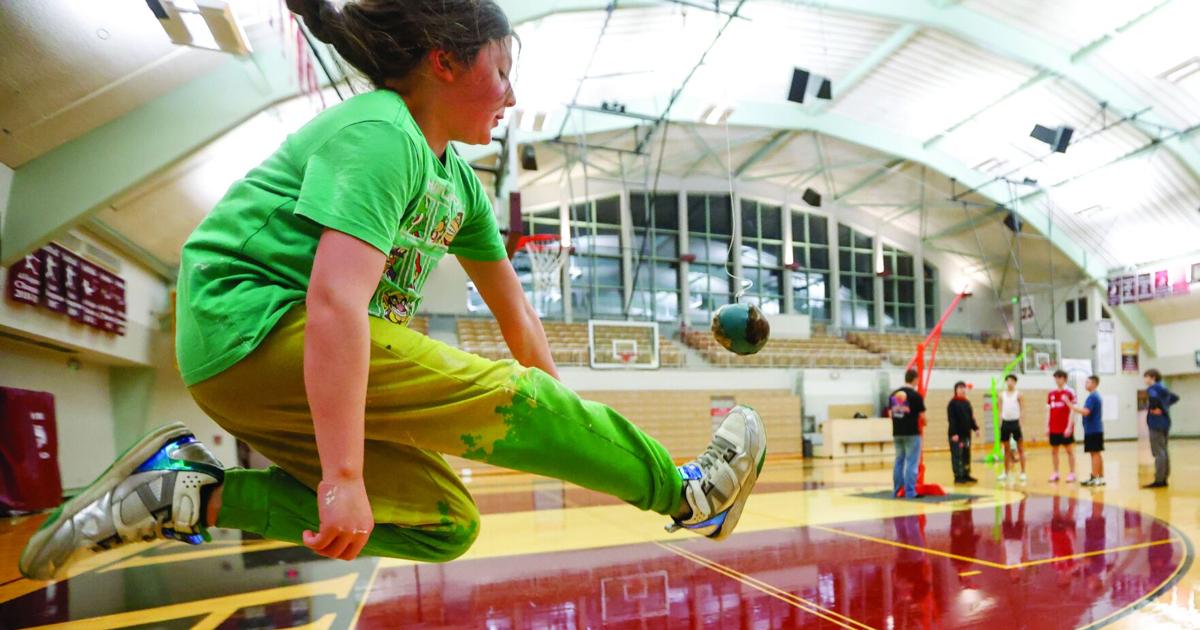
Ketchikan athletes had the gym to themselves on Friday as they warmed up for the Native Youth Olympics kick-off scheduled for 11 a.m. to 5:30 p.m. Saturday at the Clarke Cochrane Gymnasium at Kayhi.
Henry Agony practices the One Foot High Kick during the Native Youth Olympics open gym at the Clarke Cochrane Gymnasium on Friday, Jan. 8, 2026. Staff photo by Christopher Mullen
Teams from outside of Ketchikan were unable to make it for the open gym on Friday with ferries not sailing and flights not landing in town. Ketchikan coach Starla Agoney said she is hopeful that teams from Juneau, Metlakatla and Prince of Wales Island will be able to arrive for Saturday’s competition, but if not, the Ketchikan athletes will still compete in the games, “they just might go a little faster.”
Nina Varnell practices the Alaskan High Kick during the Native Youth Olympics open gym at the Clarke Cochrane Gymnasium on Friday, Jan. 8, 2026. Staff photo by Christopher Mullen
The public is welcome to attend throughout the day on Saturday and any interested athlete can still register at 10:30 a.m. No experience is necessary to participate in the kick-off.
Shawn Crabtree practices the One Foot High Kick during the Native Youth Olympics open gym at the Clarke Cochrane Gymnasium on Friday, Jan. 8, 2026. Staff photo by Christopher Mullen
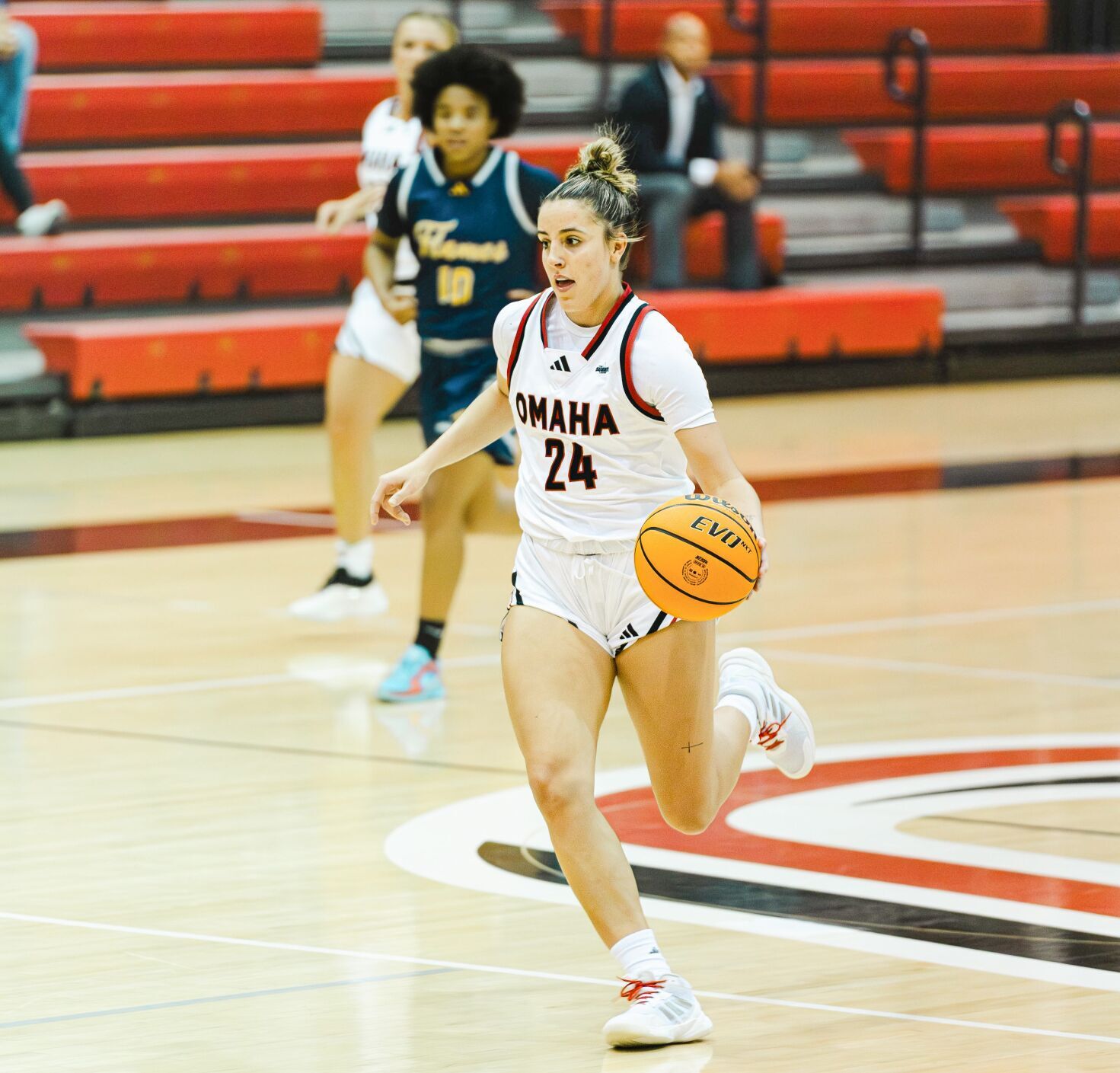
The Omaha women’s basketball team remains winless in conference play and suffered its third-largest loss of the season at the hands of North Dakota State.
The Mavericks (2-17, 0-4 Summit League) were blown out by the Bison (15-2, 4-0 Summit League) by a score of 94-39. The game marks the fifth time this season that Omaha has lost by 50 or more points.
NDSU controlled the game from the start. They opened the contest by scoring 15 straight points before Omaha’s Leekaya Burke Perryman ended the run with a layup.
The Bison put together another 9-0 run as the quarter wound down. Regan Juenemann beat the buzzer with a layup, but NDSU led by a whopping 20 points after the first.
The second quarter was followed similarly. The Bison matched their first-quarter total of 24 points and led 48-11 entering the locker room.
The third quarter proved to be the dagger in the backs of the Mavericks. Omaha almost doubled its first half score with ten points in the quarter, but 27 Bison points put the game out of reach. NDSU led 75-21 entering the fourth.
With North Dakota State’s subs in the game for majority of the final ten minutes, the Mavericks were resilient, only being outscored by one point in the final quarter.
Juenemann led the team with 15 points, being the only Maverick to finish in double figures. The freshman shot 6-for-10 from the field in 30 minutes off the bench.
Avril Smith continued crashing the boards, grabbing 15 rebounds in the contest and eclipsing 200 total boards on the season.
Recent addition Reilly Palmer logged her first statistics of the season, recording one rebound and one assist. Lainey Maehl also made her collegiate debut for her first appearance as a Maverick.
Molly Lenz topped the Bison with 24 points on the day, a career high for the junior. In total, four NDSU players scored in double figures.
The Bison shot 42.9 percent from the field and 44 percent from 3-point range compared to the Mavericks’ 27.1 percent and 18.8 percent marks in both categories.
Omaha returns home to host St. Thomas (8-9, 1-2 Summit League) at Baxter Arena on Thursday, Jan. 15 at 6:30 p.m.
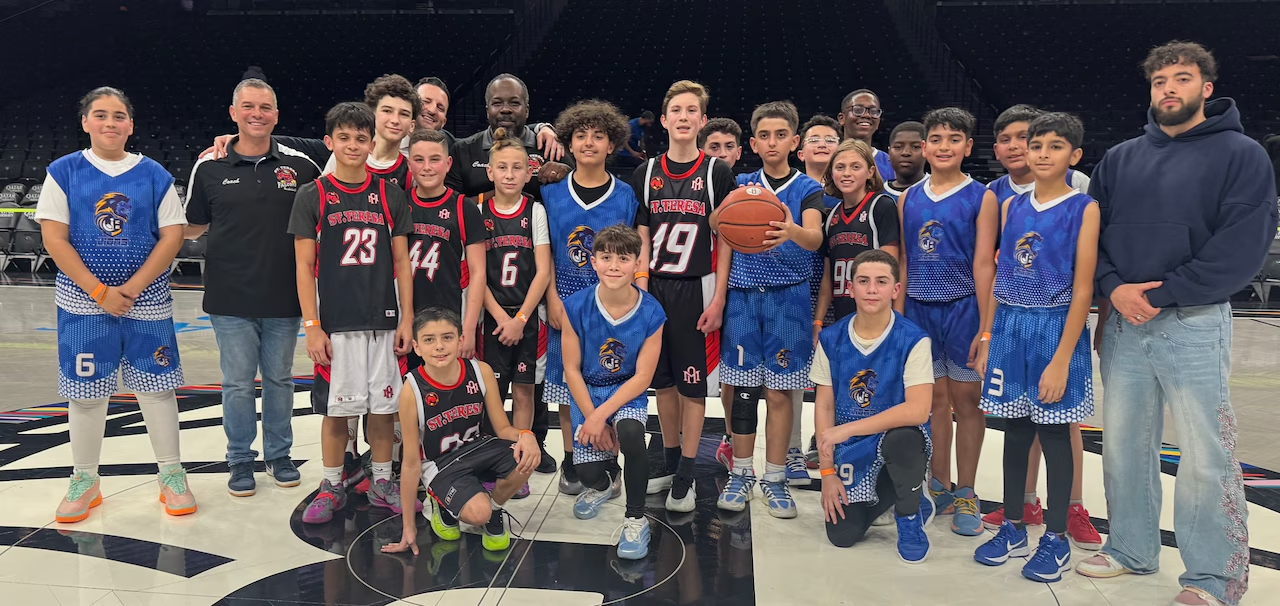
BROOKLYN, N.Y. — Players from two Staten Island youth basketball teams got the experience of a lifetime Friday night when they played at Barclays Center, home of the Brooklyn Nets.
The highly contested 7th-grade B matchup between the Islamic Center of Staten Island (ICIS) and St. Teresa took place following the Nets’ 121-105 loss to the Los Angeles Clippers.
Unlike the pro game in which the Nets trailed 63-47 at the half, the youth tilt was intense with the game being tied at 15 after regulation.
The ICIS squad then won it in overtime, 20-18.
“It was an amazing experience for all the kids and their families!” said St. Teresa parent Josephine Viglione, of the two teams who are both members of the Catholic Youth Organization basketball program.
STEUBENVILLE — It is often said that big things come in small packages.
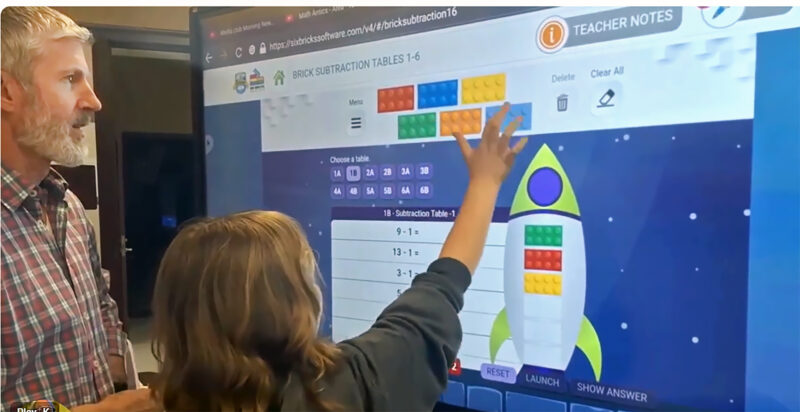
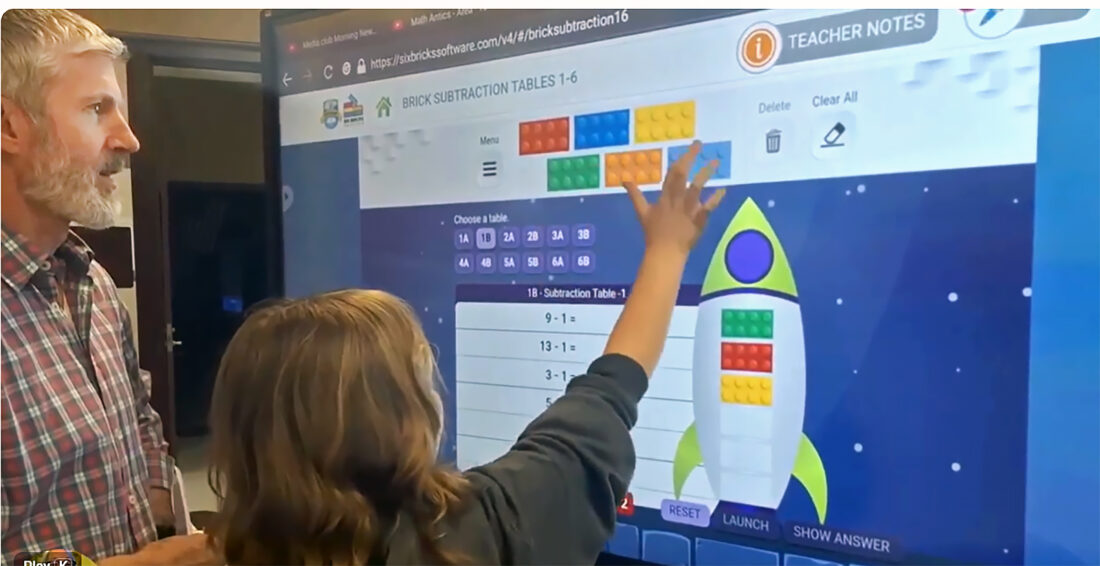
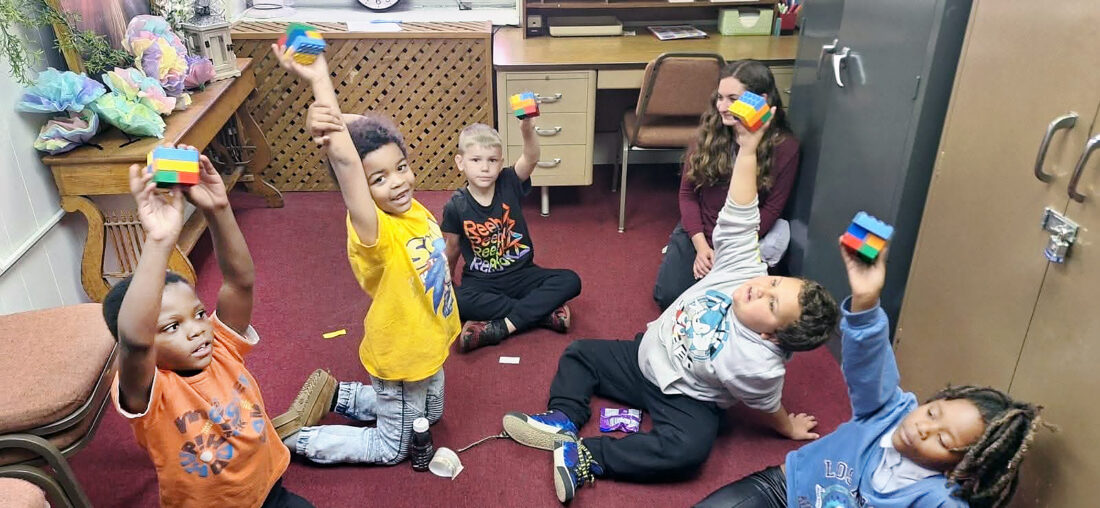
And in the case of the Sycamore Youth Center, big changes for the children of the Ohio Valley are arriving in the form of six colorful bricks.
The center has reached a historic milestone, officially becoming the first certified educator training site in the United States for Six Bricks.
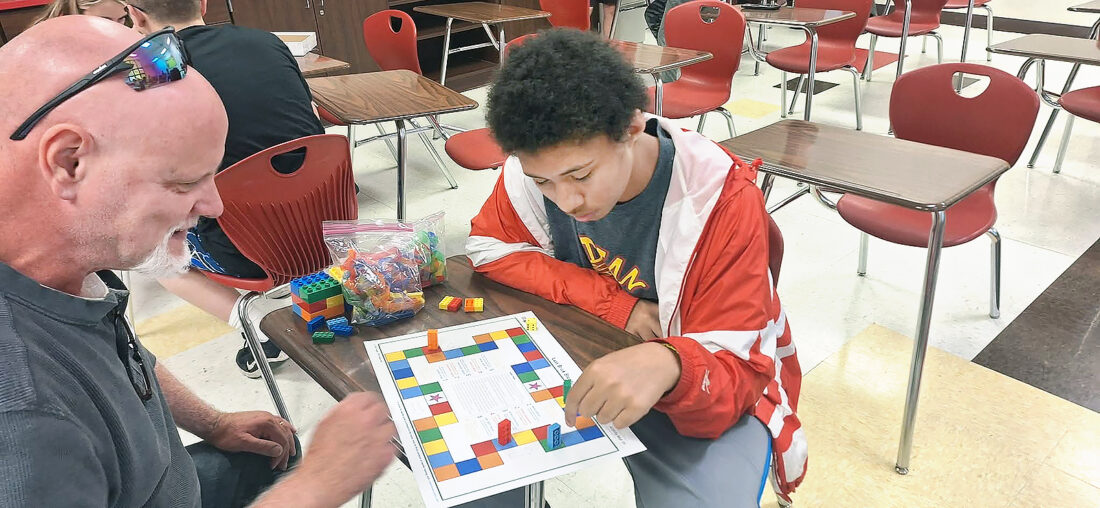
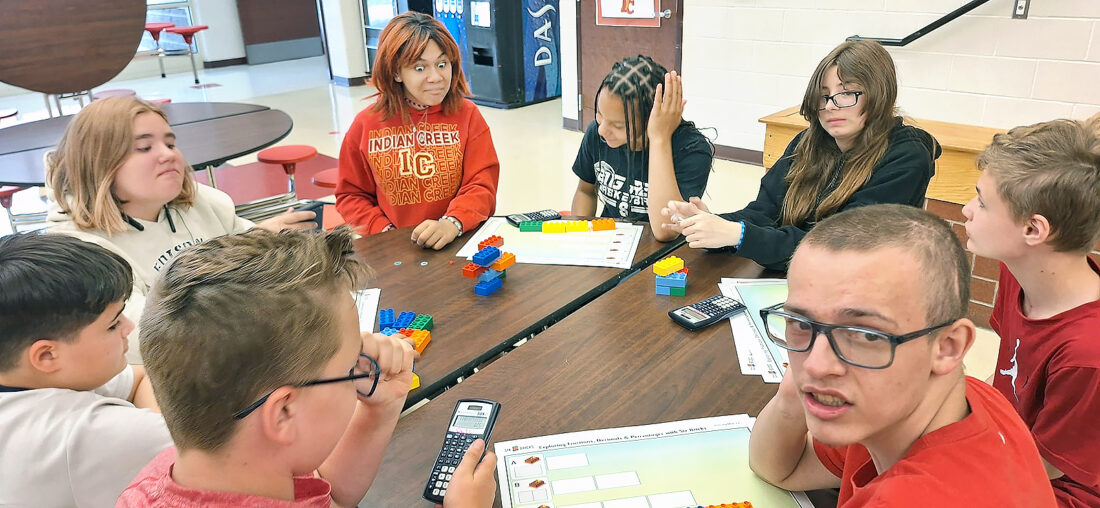
Six Bricks is an innovative, research-based program that uses six brightly-colored LEGO DUPLO bricks as a simple, hands-on tool to help children develop essential life and learning skills.
While the program has long been a staple for educators overseas, Steubenville is now the home base for its growth in America, reflecting a deep commitment to the community. Bobbyjon Bauman, executive director of the Sycamore Youth Center, explained how the center has always been focused on bringing meaningful, practical tools to those who work with children and families.
Bauman shared that becoming the first certified educator training site in the nation reflects a commitment to evidence-based practices that help children thrive socially, emotionally and academically.
The upcoming training sessions, scheduled for the afternoons of 3 p.m. to 5:30 p.m. Thursday and Friday at the Sycamore center, are being coordinated by Michelle Clum through a collaborative effort among the nonprofit organizations the Ohio Valley Youth Network and Six Bricks USA.
Workshop certificates will be issued to those who complete the five-hour training program.
This training is organized for faculty, staff, parents and community members.
Until recently, anyone in the United States wanting to be certified in this method had to seek training from facilitators outside the country.
However, following a successful pilot program and a full year of research conducted in the United States, the results spoke for themselves, showing that 95 percent of students improved in what experts call “SNaPCLaP” skills.
These skills represent a child’s total development, including social-emotional growth, numeracy or math skills, perceptual development, creativity, literacy and physical movement. In addition to the gains seen in students, teachers involved in the research reported the lessons were remarkably easy to store, prepare and adapt to the individual abilities of each child.
The lessons fit comfortably within a standard class period, while keeping children excited and engaged in their work.
Theresa Paterra, one of the first six certified facilitators in the country, will serve as the facilitator for the Steubenville training.
Paterra emphasized the program is not just for the classroom, noting Six Bricks opens the door to hands-on learning for people of all ages and abilities.
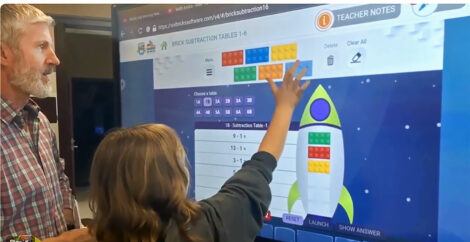
SYCAMORE BEGINS PILOT PROGRAM IN U.S. — The pilot program for Six Bricks involved members of the Sycamore Stars program and at the Sycamore Youth Center, including adult training. Sycamore has become the first certified educator training site in the country. Students taking part in the pilot program learned through the bricks matters such as fractions and decimals.
— Contributed
Educators, therapists, healthcare workers and youth leaders can all use these strategies with learners, who can range in age from 1 to 101.
Through the partnership with the Ohio Valley Youth Network, 12 participants are expected to complete their certified training during these January sessions, with plans for more advanced Level 4 training already in the works for a future date.
For those who are curious about how six simple bricks can change a learner’s perspective, free “taster” sessions are available.
Whether you are a parent, a teacher, or a community leader, the Sycamore Youth Center invites you to see what all the excitement is about.
For information or to register, contact Clum at (626) 905-0712 or send an e-mail to hello@sixbricksusa.org.
SYCAMORE BEGINS PILOT PROGRAM IN U.S. — The pilot program for Six Bricks involved members of the Sycamore Stars program and at the Sycamore Youth Center, including adult training. Sycamore has become the first certified educator training site in the country. Students taking part in the pilot program learned through the bricks matters such as fractions and decimals.
— Contributed
Nate Schimelfenig scored 17 points and Seamus Wallace helped spark a third-quarter surge to lift West Scranton over No. 9 Scranton, 54-41, on Friday night in a Lackawanna Division I boys basketball game.
Wallace finished with 13 points, and he, Schimelfenig and Brian Fried combined for 16 points while making four 3-pointers in a 21-point third quarter for the Invaders.
Cayden Farr contributed 10 points for West Scranton (5-7, 2-2).
Tony Battaglia scored 12 points and Justin Mayers had 10 for Scranton (4-7, 1-3).
Abington Heights 55, North Pocono 36: Jordan Shaffer scored 13 points to lead the sixth-ranked Comets to a Division I win.
Ben Reese contributed 10 points and Andrew Kettel had nine for Abington Heights (7-5, 4-0).
Noah DeSantis scored nine points and Cole West had eight for North Pocono (3-9, 0-4).
Delaware Valley 64, Wallenpaupack 59: James Dabney and Trey Newton helped the seventh-ranked Warriors recover from a slow start to post a win in Division I.
Dabney led four players in double figures with 18 points, and Newton added 16 to lead Delaware Valley (9-3, 2-2). Sam Wood and Colin McGarvey each scored 12 points in the win.
Nick VanBuskirk scored nine of his 20 points in the first quarter when Wallenpaupack built a 17-8 lead. JP Yeo added 18 points, which all came on 3-pointers, for the Buckhorns (3-6, 0-3).
Old Forge 50, Western Wayne 33: Cameron Parker scored 20 points to lead the fifth-ranked Blue Devils to a Division II win.
Ryan DeMarco added 15 points, and Cameron Krushnowski had 10 for Old Forge (9-2, 4-0).
Omar Vargas scored 11 points to lead Western Wayne (2-8, 0-3).
Riverside 77, Honesdale 47: Nico Antoniacci scored 26 points and Brayden Rose added 19 as No. 1 Riverside bounced back from its first loss of the season to beat the Hornets in a Division II game.
Michael Schimelfenig contributed 12 points for the Vikings (10-1, 3-1).
Gavin Briggs scored 17 of his 25 points in the second half, and Owen Pender had 11 points for Honesdale (6-6, 2-2).
Dunmore 76, Mid Valley 52: Carter Sload scored 20 points and Nate Aviles scored 17 points, including 10 in the third quarter when the Bucks scored 30 in a Division II win.
Jimmy Clark svored 16 and Brayden Canavan added 13 points for the balanced Dunmore (11-1, 4-0) attack.
Jeremy Cali scored 19 points and Landon Pratt added 12 for Mid Valley (5-7, 1-3).
Holy Cross 59, Lakeland 43: CJ Thompson scored 21 points to lead three Crusaders in double figures in a Division II win.
Colin Farrell contributed 17 points while hitting five 3-pointers, and Colin Rittenbusch scored 15 points for Holy Cross (6-6, 2-2).
Chase Rosenkrans scored 12 points and David Naniewicz added nine for Lakeland (5-7, 0-4).
Susquehanna 50, Lackawanna Trail 46: Griffin Fisk scored 21 points to lead the Sabers to a win in a battle of teams tied for first place in Division III.
Fisk helped Susquehanna hold off a rally by the Lions with 11 points in the second half. Mason Keyes contributed 13 points and Hudson Stengel had eight for the Sabers (9-2, 4-0).
Lucas Filipek scored 11 points, Jimmy Phillips had eight of his 10 points in the third quarter and Hayden Bluhm also scored 10 points for Lackawanna Trail (8-3, 3-1).
Elk Lake 66, Mountain View 36: Chase Pond scored 17 points to lead the Warriors to a win that keeps them tied for first place in Division III with Susquehanna.
John Heitsman added 16 points and Connor Stephens finished with 14 for the balanced attack by Elk Lake (11-1, 4-0).
Hudson Bain led Mountain View (3-8, 1-3) with 14 points.
Blue Ridge 59, Montrose 56: Paxton Pingarelli scored 26 points, including 18 in the first half, to lead the Raiders to the Division III win.
Landon Bishop drilled five 3-pointers for 15 points for Blue Ridge (4-6, 2-2).
Evan McComb scored 13 points and Sawyer Brown added 12 for Montrose (4-8, 2-2).
Carbondale Area 40, Forest City 30: Cole Becchetti scored 12 points to lead the Chargers to a win in Division III.
Cameron Williams added 10 points and Francisco Roman had seven for Carbondale Area (2-10, 1-3).
TJ Collins led Forest City (0-12, 0-4) with 16 points.
Girls basketball
Cora Castellani had 28 points, seven rebounds, six steals, four assists and one block to lead No. 1 Valley View to a 59-35 victory over Wallenpaupack in a Lackawanna League Division I girls basketball game Saturday.
Ava Gazoo added 11 points, and Ali Mauro chipped in six points for the Cougars (11-1, 4-0).
Abby Cykosky and Ashley Vanderputten each had seven points for the Lady Buckhorns (6-6, 1-3).
Boys wrestling
Mason Mitchell (215 pounds) and Apollo Kazmierski (285) had back-to-back pins to rally Valley View past Montrose, 42-36, in a nonleague boys wrestling match Friday at Montrose.
Cooper Rawlings (139) and Tywone Giles (172) also had pins for the Cougars.
Sawyer Brander (107), Delos Stone (133), Carl Nolt (145), Wyatt Steele (152) and Jeffrey Kany (189) had pins for the Meteors.